A French Word to Live By
Translate Se tirer d’affaire to English
/sə ti.ʁe da.fɛʁ/
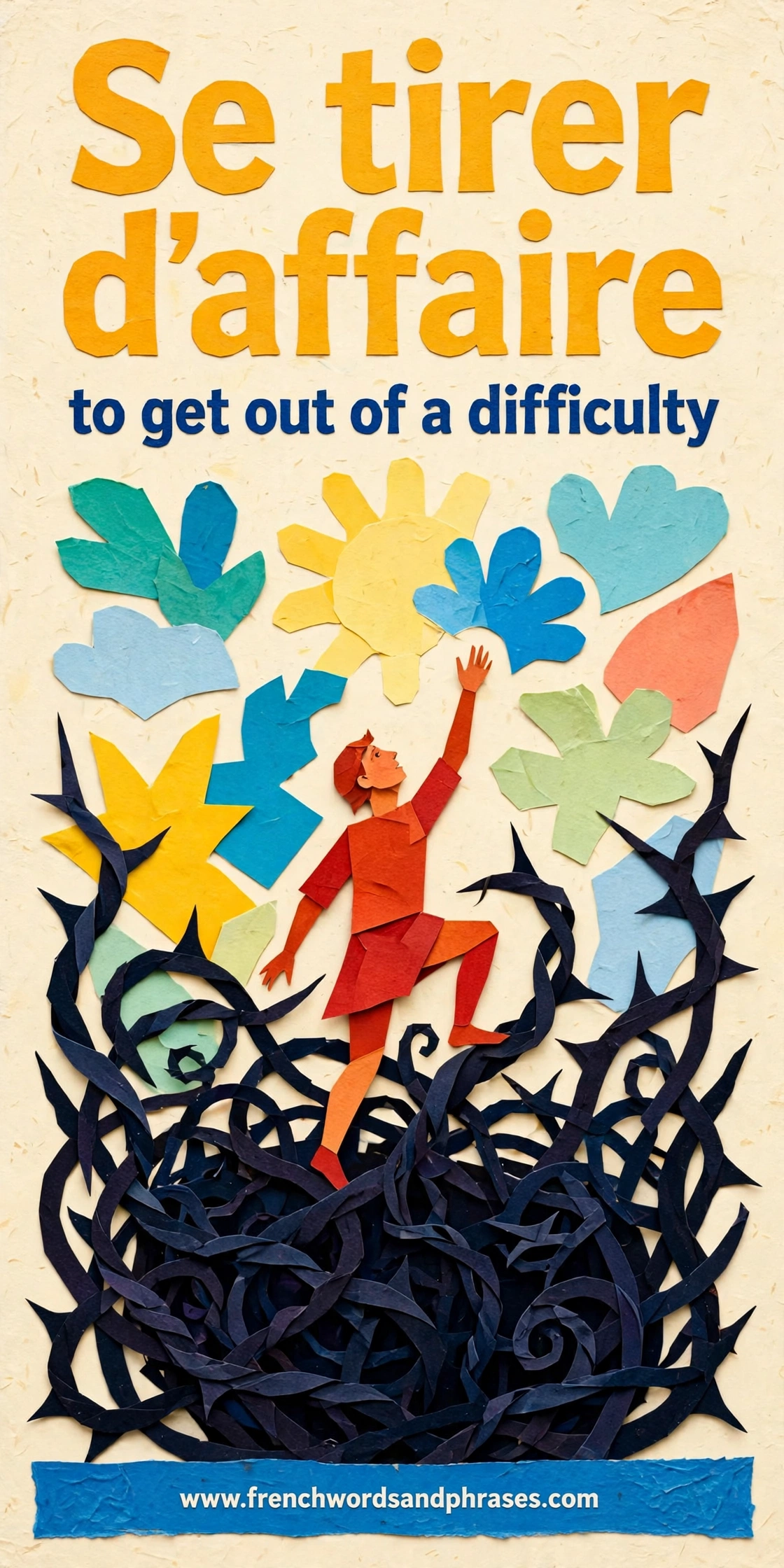
Se tirer d’affaire means to get out of a difficulty — to get yourself out of trouble.
The delivery van has broken down an hour before the wedding, the cake is in the back, and the road is blocked by a fallen tree. The baker makes three phone calls, borrows a tractor, and arrives with two minutes to spare. Her assistant shakes his head in admiration: « Elle sait toujours se tirer d’affaire. »
Let’s explore how se tirer d’affaire works in French, beginning with the whole phrase on one card.
Understanding the French Phrase Se tirer d’affaire
Se tirer d’affaire is a French idiomatic expression built from se tirer (to pull oneself out, to extricate oneself) and d’affaire (out of the matter, the fix). It praises a very French quality: the art of landing on your feet when things go wrong.
It means to get out of a difficulty — to extricate yourself from trouble, a tight spot, an awkward situation. The book’s example adds the skill inside it: il sait se tirer d’affaire, he knows how to get out of trouble. The phrase is rarely about one lucky escape; it describes a person who can always find the way out.
Type: Idiomatic expression — resourcefulness (reflexive verb + d’affaire)
Answers the need: Saying someone got out of trouble, or always manages to
Register: Neutral — safe everywhere, in speech and writing
Strength: Admiring — it praises skill and presence of mind, not luck
One important usage detail: the phrase very often travels with savoir — savoir se tirer d’affaire, to know how to get out of a fix — because it names a talent, not just an event. The affaire here is singular: one difficulty, one tight spot. For a single escape you can also hear il s’en est tiré, he got away with it, he came through.
Experience the Word
Se tirer d’affaire is the compliment French pays to the unflappable — the friend you call at midnight because something has gone wrong and she will know what to do.
Imagine the schoolteacher whose class trip loses its bus, its budget and its sunshine in a single morning. By lunch the children are eating in a village hall, a farmer is driving them home, and everyone is laughing. Nothing about the day went to plan, and everything about it worked.
The phrase carries no panic. To se tirer d’affaire is to treat trouble as a puzzle, not a verdict.
How to Use Se tirer d’affaire in French: Complete Guide
Let’s explore how se tirer d’affaire works in French, beginning with the whole phrase on one card.
Se tirer d’affaire at a Glance
The Whole Phrase on One Card
Real meaning, literal picture, English twin and register — se tirer d’affaire in five lines.
| Point | Se tirer d’affaire |
|---|---|
| What it really means | to get out of a difficulty — to extricate yourself from a tight spot |
| Word for word | to pull oneself out of the matter |
| English equivalent | to get out of trouble / to land on your feet |
| Register | neutral — safe everywhere |
| Use it for | escapes from awkward situations, and the people who always manage them |
Example
Il sait se tirer d’affaire dans toutes les situations.
He knows how to get out of a difficulty in any situation.
Word by Word: Building the Escape
Four small pieces — take them one by one and the way out appears.
| Word | Literal meaning | Its job in the phrase |
|---|---|---|
| se | oneself | you do the rescuing yourself — no one pulls you out |
| tirer | to pull | the effort of extraction: you pull, and the trouble lets go |
| d’ | out of, from | the little door of the phrase — the direction is out |
| affaire | matter, business | here, the fix itself: the difficulty you are inside |
Example
Elle s’est tirée d’affaire avec un simple coup de fil.
She got out of the difficulty with a single phone call.
Quick Quiz 1
What does tirer contribute to se tirer d’affaire?
Reveal the answer
The pulling — you pull yourself out of the fix, the way you would pull a cork or haul a boat ashore. The effort is yours.
Sans argent et sans voiture, il s’est quand même tiré d’affaire.
With no money and no car, he still managed to get out of trouble.
When You Say It: The Tight-Spot Moments
Se tirer d’affaire fires at moments like these — something has gone wrong, and someone is finding the exit.
| Situation | Example |
|---|---|
| Praising a resourceful person | elle sait se tirer d’affaire — she knows how to get out of a fix |
| A breakdown on the road | il s’est tiré d’affaire en empruntant un vélo — he got out of it by borrowing a bicycle |
| An awkward question | se tirer d’affaire par une plaisanterie — to get out of it with a joke |
| Money trouble | ils se sont tirés d’affaire de justesse — they got out of trouble by the skin of their teeth |
| Confidence in someone | ne t’inquiète pas, il se tirera d’affaire — don’t worry, he’ll manage |
Example
Perdu sans carte ni batterie, elle s’est tirée d’affaire en suivant la rivière.
Lost with no map and no battery, she got out of trouble by following the river.
Make It Yours: The Escape for Every Person
Se tirer is a reflexive of tirer, conjugated with être in the past — and it loves the company of savoir.
| Form | French | In English |
|---|---|---|
| The talent | savoir se tirer d’affaire | to know how to get out of a difficulty |
| I got out of it | je me suis tiré d’affaire | I got out of trouble |
| She got out of it | elle s’est tirée d’affaire | she got out of the difficulty |
| We managed | nous nous en sommes tirés | we came through, we got out of it |
| He will manage | il se tirera d’affaire | he will get out of trouble |
| Question | tu sais te tirer d’affaire ? | do you know how to get out of a fix? |
Example
Ne vous inquiétez pas pour lui : il sait se tirer d’affaire.
Don’t worry about him: he knows how to get out of a difficulty.
Quick Quiz 2
Which verb most often keeps se tirer d’affaire company — savoir or vouloir?
Reveal the answer
Savoir — savoir se tirer d’affaire names the talent itself: knowing how to get out of a fix.
C’est un débrouillard, il sait se tirer d’affaire.
He’s resourceful, he knows how to get out of trouble.
Everyday Expressions: Building on the Escape
Se tirer d’affaire slots into these everyday frames — each one ready to use as it stands.
| Frame | In English |
|---|---|
| savoir se tirer d’affaire | to know how to get out of a difficulty |
| se tirer d’affaire de justesse | to get out of trouble by the skin of your teeth |
| bien se tirer d’affaire | to come out of it well, to manage nicely |
| s’en tirer | to get through it, to come out all right |
| s’en tirer à bon compte | to get off lightly |
Example
Après l’accident, il s’en est tiré à bon compte.
After the accident, he got off lightly.
Close Cousins: The Other Ways Out
French has a whole shelf of escape phrases — se tirer d’affaire is the skilful one; its cousins stress the muddle, the dodge or the sheer relief.
| Expression | The difference |
|---|---|
| se tirer d’affaire | to get out of a difficulty — skilfully, by your own efforts |
| se débrouiller | to manage, to cope — the everyday word for resourcefulness in any situation |
| s’en sortir | to come through, to get out of a bad patch — with relief in the voice |
| sortir d’un mauvais pas | to get out of a tight corner — the picture of the narrow place |
| se tirer d’un mauvais pas | a blend of the two — to pull yourself out of a tight spot |
Example
Elle se débrouille toujours, elle s’en sortira cette fois encore.
She always manages, she’ll come through this time too.
Quick Quiz 3
Your friend copes brilliantly with everyday chaos, no crisis in sight. Se tirer d’affaire or se débrouiller?
Reveal the answer
Se débrouiller — it is the general talent of managing. Se tirer d’affaire needs an actual difficulty to escape from.
Elle se débrouille très bien toute seule à Paris.
She manages very well on her own in Paris.
Se tirer d’affaire and Its Neighbours
The tight-spot shelf around the phrase — trouble, ingenuity and the way out.
| French | In English |
|---|---|
| un mauvais pas | a tight spot, a difficult patch |
| un débrouillard | a resourceful person |
| une solution | a way out, a solution |
| de justesse | narrowly, by the skin of your teeth |
| un imprévu | an unexpected hitch |
| s’en sortir | to come through it |
Example
C’est un débrouillard : aucun imprévu ne le bloque longtemps.
He’s resourceful: no hitch keeps him stuck for long.
Watch Out: The Traps Around Se tirer d’affaire
The traps: a slang twin that means leaving, a shooting verb in disguise, and an affaire that is trouble, not trade.
| Trap | The truth |
|---|---|
| se tirer, the slang twin | in very informal speech, se tirer alone can mean to clear off, to leave — je me tire, I’m off; the d’affaire is what makes it an escape from trouble |
| tirer is not only pulling | tirer also means to shoot and to print; in this phrase it is purely the pull of extraction |
| affaire means the fix | here affaire is the difficulty itself, not business or commerce — you are pulling yourself out of the problem |
| the agreement | elle s’est tirée d’affaire — the participle agrees with the subject, because the object of the pulling is yourself |
Example
Elle s’est tirée d’affaire, puis elle s’est tirée avant la pluie.
She got out of the difficulty, then she cleared off before the rain.
Quick Quiz 4
True or false: in elle s’est tirée d’affaire, the participle tirée agrees with the subject.
Reveal the answer
True — she pulls herself out, so tirée takes the feminine ending. Compare il s’est tiré d’affaire.
Elles se sont tirées d’affaire toutes seules.
They got out of trouble all by themselves.
Se tirer d’affaire in Everyday French: Real-Life Examples
Now that you know the word, let’s see how se tirer d’affaire appears in everyday French.
Example 1 — The broken-down van
Le camion est tombé en panne, mais elle s’est tirée d’affaire.
The van broke down, but she got out of the difficulty.
Example 2 — The compliment
C’est un homme qui sait se tirer d’affaire.
He is a man who knows how to get out of trouble.
Example 3 — By a whisker
Ils se sont tirés d’affaire de justesse.
They got out of trouble by the skin of their teeth.
Example 4 — The awkward dinner
Elle s’est tirée d’affaire avec une plaisanterie.
She got out of the awkward moment with a joke.
Example 5 — Reassurance
Ne t’inquiète pas, je me tirerai d’affaire.
Don’t worry, I’ll get out of trouble.
Example 6 — No money, no problem
Sans un sou, il s’est tiré d’affaire en travaillant au port.
Without a penny, he got out of his fix by working at the harbour.
Beyond Translation: The Meaning of Se tirer d’affaire
English gets out of trouble as if trouble were a place you could simply leave. French pulls itself out — se tirer — and the effort stays in the phrase: nobody opens the door for you.
To se tirer d’affaire is to be your own rescue party.
That is why it so often follows savoir. It is not describing an escape; it is describing a character — the person who, when the plan collapses, is already building the next one.
How to Remember the French Phrase Se tirer d’affaire
Remember it this way: Se tirer d’affaire is the self-rescue — you are stuck in the fix, and you pull, and the fix lets go.
- You picture the pull — tirer is to pull, and here you pull yourself out of the difficulty.
- You pair it with savoir — savoir se tirer d’affaire is the talent the phrase most loves to praise.
- You agree the participle — elle s’est tirée d’affaire, because the person pulled out is herself.
The key idea is se tirer d’affaire means to get out of a difficulty — to pull yourself out of the fix.
Test Your Knowledge of Se tirer d’affaire
Let’s see how much you’ve learned. Try answering these questions before revealing the answers.
Question 1
What does se tirer d’affaire mean?
Reveal the answer
To get out of a difficulty — to extricate yourself from trouble or a tight spot.
Question 2
What does savoir add in savoir se tirer d’affaire?
Reveal the answer
It turns the escape into a talent — knowing how to get out of a fix, whenever one appears.
Question 3
How do you say ‘she got out of the difficulty’?
Reveal the answer
Elle s’est tirée d’affaire — the participle agrees, because she pulls herself out.
Question 4
What is the difference between se tirer d’affaire and s’en tirer à bon compte?
Reveal the answer
S’en tirer à bon compte is to get off lightly — the outcome was better than feared. Se tirer d’affaire is the escape itself.
Question 5
Complete the sentence:
Il sait toujours se ______ d’affaire. (He always knows how to get out of trouble.)
Reveal the answer
tirer
Il sait toujours se tirer d’affaire.
He always knows how to get out of trouble.
Your Final Challenge
Can You Use It?
How would you say this in French?
“Don’t worry, she always gets out of trouble.”
Reveal the answer
Ne t’inquiète pas, elle sait toujours se tirer d’affaire.
Don’t worry, she always gets out of trouble.
A little French. A little curiosity. A richer everyday life.
LEARN FRENCH ONE WORD AT A TIME