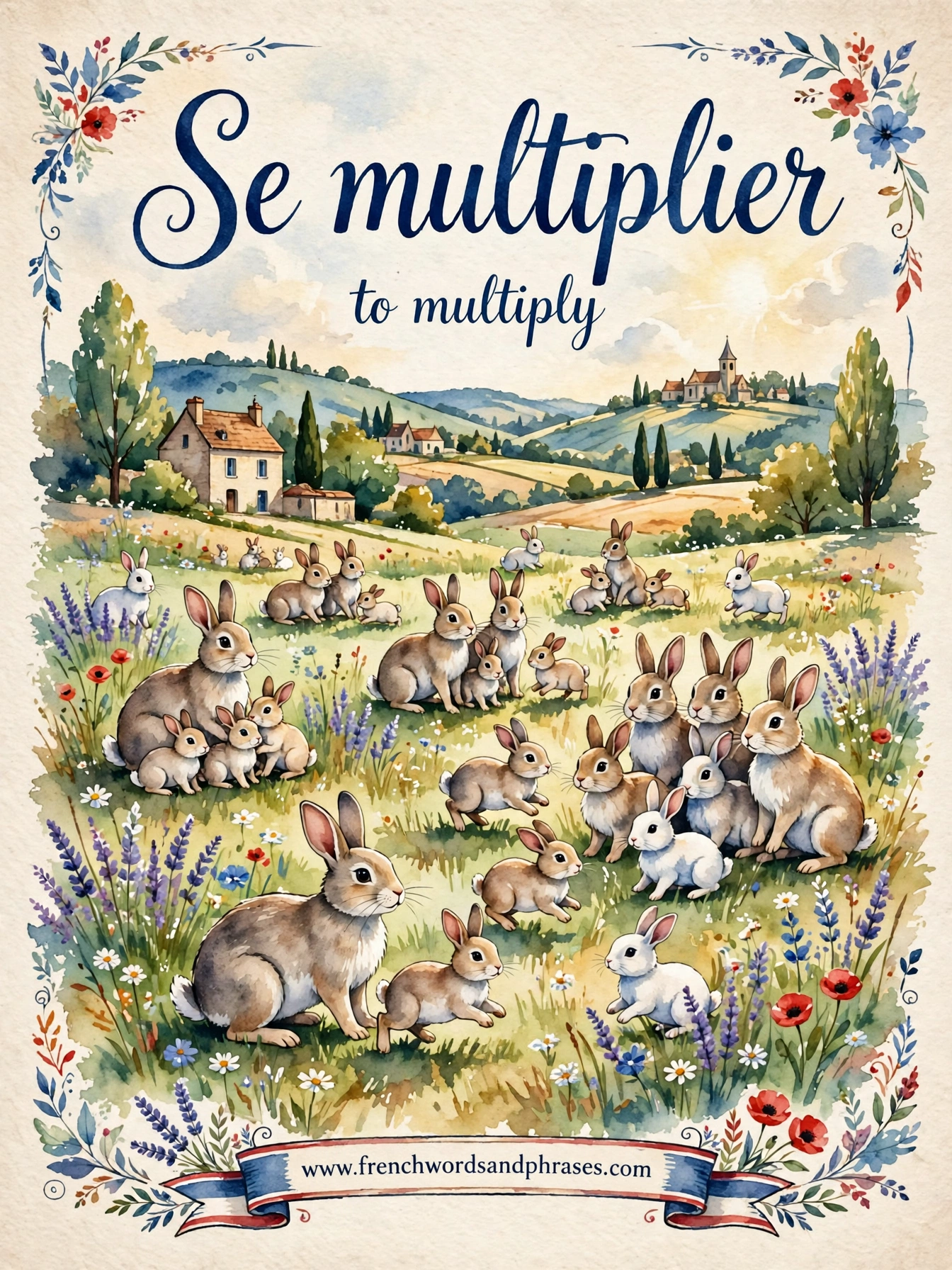
A French Word to Live By
How to Conjugate Se multiplier in French
/sə.myl.ti.pli.je/
Se multiplier means to multiply.
One cell becomes two, two become four, and soon there are thousands. That rapid growth is se multiplier.
In this guide, you’ll learn how to conjugate se multiplier in all the major French tenses and moods. Explore complete conjugation tables, French examples, English translations, and practice quizzes.
Understanding the French Verb Se multiplier
Se multiplier is a reflexive French verb belonging to the first group of verbs, those ending in -er.
It means to multiply. It is used for living things, numbers, and even problems that grow in number — les cas se multiplient. Like all reflexive verbs, it takes the auxiliary être in compound tenses.
Verb classification: First group (-er), reflexive
Auxiliary verb: Être
Past participle: multiplié
Present participle: se multipliant
English equivalents: To multiply.
One important spelling detail: the reflexive pronoun changes with the subject — je me multiplie, tu te multiplies, il se multiplie, nous nous multiplions — and the i after the pl stays the same in every form.
Experience the Word
Se multiplier is more than growing. It is growing by copying itself, again and again.
Imagine a single bacterium in a warm dish. In a few hours it has become a whole colony, each new cell dividing in turn.
You have not just watched something grow. You have watched it multiply.
How to Conjugate Se multiplier: Complete French Conjugation Guide
Let’s explore every major conjugation of se multiplier, beginning with the indicative mood.
How to Conjugate Se multiplier in the Indicative Mood
The indicative mood is used to express facts, observations, actions, and events.
How to Conjugate Se multiplier in the Present Tense (Présent)
Used for actions happening now, habitual actions, and general truths.
| Subject | Conjugation |
|---|---|
| je | me multiplie |
| tu | te multiplies |
| il / elle | se multiplie |
| nous | nous multiplions |
| vous | vous multipliez |
| ils / elles | se multiplient |
Example
Il se multiplie très vite.
He multiplies very fast.
Quick Quiz 1
Complete the sentence:
Il ______ très vite.
Reveal the answer
se multiplie
Il se multiplie très vite.
He multiplies very fast.
How to Conjugate Se multiplier in the Passé Composé
Used for completed actions in the past. Se multiplier takes the auxiliary verb être.
| Subject | Conjugation |
|---|---|
| je | me suis multiplié / me suis multipliée |
| tu | t’es multiplié / t’es multipliée |
| il / elle | s’est multiplié / s’est multipliée |
| nous | nous sommes multipliés / nous sommes multipliées |
| vous | vous êtes multipliés / vous êtes multipliées / vous êtes multiplié / vous êtes multipliée |
| ils / elles | se sont multipliés / se sont multipliées |
Example
Hier, il s’est multiplié très vite.
Yesterday, he multiplied very fast.
How to Conjugate Se multiplier in the Imparfait (Imperfect Tense)
Used for habitual past actions, descriptions, and ongoing situations in the past.
| Subject | Conjugation |
|---|---|
| je | me multipliais |
| tu | te multipliais |
| il / elle | se multipliait |
| nous | nous multipliions |
| vous | vous multipliiez |
| ils / elles | se multipliaient |
Example
Autrefois, il se multipliait très vite.
In the past, he used to multiply very fast.
Quick Quiz 2
Choose the correct form:
Yesterday, he multiplied very fast.
Hier, il ______ très vite.
Reveal the answer
s’est multiplié
Hier, il s’est multiplié très vite.
How to Conjugate Se multiplier in the Plus-que-parfait
Used to describe an action that had already been completed before another past event.
| Subject | Conjugation |
|---|---|
| je | m’étais multiplié / m’étais multipliée |
| tu | t’étais multiplié / t’étais multipliée |
| il / elle | s’était multiplié / s’était multipliée |
| nous | nous étions multipliés / nous étions multipliées |
| vous | vous étiez multipliés / vous étiez multipliées / vous étiez multiplié / vous étiez multipliée |
| ils / elles | s’étaient multipliés / s’étaient multipliées |
Example
Avant midi, il s’était multiplié déjà très vite.
Before noon, he had already multiplied very fast.
How to Conjugate Se multiplier in the Passé Simple
Primarily used in formal writing, literature, and historical narratives. It is rarely used in everyday conversation.
| Subject | Conjugation |
|---|---|
| je | me multipliai |
| tu | te multiplias |
| il / elle | se multiplia |
| nous | nous multipliâmes |
| vous | vous multipliâtes |
| ils / elles | se multiplièrent |
Example
Un jour, il se multiplia très vite.
One day, he multiplied very fast.
How to Conjugate Se multiplier in the Passé Antérieur
A literary tense used to express an action completed immediately before another past action, generally in the passé simple.
| Subject | Conjugation |
|---|---|
| je | me fus multiplié / me fus multipliée |
| tu | te fus multiplié / te fus multipliée |
| il / elle | se fut multiplié / se fut multipliée |
| nous | nous fûmes multipliés / nous fûmes multipliées |
| vous | vous fûtes multipliés / vous fûtes multipliées / vous fûtes multiplié / vous fûtes multipliée |
| ils / elles | se furent multipliés / se furent multipliées |
Example
Dès qu’il se fut multiplié très vite, il est sorti.
As soon as he had multiplied very fast, he went out.
How to Conjugate Se multiplier in the Future Tense (Futur Simple)
Used to describe actions that will take place in the future.
| Subject | Conjugation |
|---|---|
| je | me multiplierai |
| tu | te multiplieras |
| il / elle | se multipliera |
| nous | nous multiplierons |
| vous | vous multiplierez |
| ils / elles | se multiplieront |
Example
Demain, il se multipliera très vite.
Tomorrow, he will multiply very fast.
How to Conjugate Se multiplier in the Futur Antérieur (Future Perfect)
Used for an action that will have been completed before a particular point in the future.
| Subject | Conjugation |
|---|---|
| je | me serai multiplié / me serai multipliée |
| tu | te seras multiplié / te seras multipliée |
| il / elle | se sera multiplié / se sera multipliée |
| nous | nous serons multipliés / nous serons multipliées |
| vous | vous serez multipliés / vous serez multipliées / vous serez multiplié / vous serez multipliée |
| ils / elles | se seront multipliés / se seront multipliées |
Example
À midi, il se sera multiplié déjà très vite.
By noon, he will have multiplied very fast.
How to Conjugate Se multiplier in the Near Future (Futur Proche)
Used to describe something that is going to happen soon. Formed with aller + infinitive.
| Subject | Conjugation |
|---|---|
| je | vais me multiplier |
| tu | vas te multiplier |
| il / elle | va se multiplier |
| nous | allons nous multiplier |
| vous | allez vous multiplier |
| ils / elles | vont se multiplier |
Example
Il va se multiplier très vite.
He is going to multiply very fast.
How to Conjugate Se multiplier in the Conditional Mood
The conditional mood expresses what would happen under certain circumstances. It is also frequently used to make polite requests or express wishes.
How to Conjugate Se multiplier in the Present Conditional
| Subject | Conjugation |
|---|---|
| je | me multiplierais |
| tu | te multiplierais |
| il / elle | se multiplierait |
| nous | nous multiplierions |
| vous | vous multiplieriez |
| ils / elles | se multiplieraient |
Example
Il se multiplierait très vite s’il pouvait.
He would multiply very fast if he could.
How to Conjugate Se multiplier in the Past Conditional
| Subject | Conjugation |
|---|---|
| je | me serais multiplié / me serais multipliée |
| tu | te serais multiplié / te serais multipliée |
| il / elle | se serait multiplié / se serait multipliée |
| nous | nous serions multipliés / nous serions multipliées |
| vous | vous seriez multipliés / vous seriez multipliées / vous seriez multiplié / vous seriez multipliée |
| ils / elles | se seraient multipliés / se seraient multipliées |
Example
Il se serait multiplié très vite s’il avait pu.
He would have multiplied very fast if he had been able to.
Se multiplier in the Literary Past Conditional Form
This less common literary form uses the imperfect subjunctive of être.
| Subject | Conjugation |
|---|---|
| je | me fusse multiplié / me fusse multipliée |
| tu | te fusses multiplié / te fusses multipliée |
| il / elle | se fût multiplié / se fût multipliée |
| nous | nous fussions multipliés / nous fussions multipliées |
| vous | vous fussiez multipliés / vous fussiez multipliées / vous fussiez multiplié / vous fussiez multipliée |
| ils / elles | se fussent multipliés / se fussent multipliées |
Example
Il se fût multiplié très vite s’il avait pu.
He would have multiplied very fast if he had been able to.
How to Conjugate Se multiplier in the Subjunctive Mood
The subjunctive is used to express wishes, emotions, doubts, necessity, and uncertainty. It frequently follows expressions such as il faut que (it is necessary that) or bien que (although).
How to Conjugate Se multiplier in the Present Subjunctive
| Subject | Conjugation |
|---|---|
| que je | me multiplie |
| que tu | te multiplies |
| qu’il / qu’elle | se multiplie |
| que nous | nous multipliions |
| que vous | vous multipliiez |
| qu’ils / qu’elles | se multiplient |
Example
Il faut qu’il se multiplie très vite.
He needs to multiply very fast.
Quick Quiz 3
Complete the sentence using the subjunctive:
Il faut qu’il ______ très vite.
Reveal the answer
se multiplie
Il faut qu’il se multiplie très vite.
He needs to multiply very fast.
How to Conjugate Se multiplier in the Imperfect Subjunctive
A literary tense, rarely encountered in modern spoken French.
| Subject | Conjugation |
|---|---|
| que je | me multipliasse |
| que tu | te multipliasses |
| qu’il / qu’elle | se multipliât |
| que nous | nous multipliassions |
| que vous | vous multipliassiez |
| qu’ils / qu’elles | se multipliassent |
Example
Il fallait qu’il se multipliât très vite.
He needed to multiply very fast.
How to Conjugate Se multiplier in the Pluperfect Subjunctive
A literary construction used to express an action completed before another past action.
| Subject | Conjugation |
|---|---|
| que je | me fusse multiplié / me fusse multipliée |
| que tu | te fusses multiplié / te fusses multipliée |
| qu’il / qu’elle | se fût multiplié / se fût multipliée |
| que nous | nous fussions multipliés / nous fussions multipliées |
| que vous | vous fussiez multipliés / vous fussiez multipliées / vous fussiez multiplié / vous fussiez multipliée |
| qu’ils / qu’elles | se fussent multipliés / se fussent multipliées |
Example
Il regrettait qu’il se fût multiplié très vite.
He regretted that he had multiplied very fast.
How to Conjugate Se multiplier in the Past Subjunctive
| Subject | Conjugation |
|---|---|
| que je | me sois multiplié / me sois multipliée |
| que tu | te sois multiplié / te sois multipliée |
| qu’il / qu’elle | se soit multiplié / se soit multipliée |
| que nous | nous soyons multipliés / nous soyons multipliées |
| que vous | vous soyez multipliés / vous soyez multipliées / vous soyez multiplié / vous soyez multipliée |
| qu’ils / qu’elles | se soient multipliés / se soient multipliées |
Example
Je suis content qu’il se soit multiplié très vite.
I am glad that he has multiplied very fast.
How to Conjugate Se multiplier in the Imperative
The imperative is used to give commands, instructions, invitations, or suggestions. Subject pronouns are omitted.
How to Conjugate Se multiplier in the Present Imperative
| Person | Conjugation |
|---|---|
| (tu) | multiplie-toi |
| (nous) | multiplions-nous |
| (vous) | multipliez-vous |
Example
Multiplie-toi très vite !
Multiply very fast!
Quick Quiz 4
How would you say Multiply very fast! (tu form)?
Reveal the answer
Multiplie-toi très vite !
French Participles of Se multiplier
Participles are verb forms that can be used in compound tenses and other grammatical constructions.
Present Participle of Se multiplier
se multipliant
En se multipliant très vite, il continue sa journée.
While multiplying very fast, he carries on with his day.
Past Participle of Se multiplier
multiplié
Il s’est multiplié très vite hier.
He multiplied very fast yesterday.
Se multiplier in Everyday French: Real-Life Examples
Now that you know the conjugations, let’s see how se multiplier appears in everyday French.
Example 1 — Present
Il se multiplie très vite.
He multiplies very fast.
Example 2 — Passé composé
Hier, il s’est multiplié très vite.
Yesterday, he multiplied very fast.
Example 3 — Imparfait
Autrefois, il se multipliait très vite.
In the past, he used to multiply very fast.
Example 4 — Future
Demain, il se multipliera très vite.
Tomorrow, he will multiply very fast.
Example 5 — Conditional
Il se multiplierait très vite s’il pouvait.
He would multiply very fast if he could.
Example 6 — Subjunctive
Il faut qu’il se multiplie très vite.
He needs to multiply very fast.
Beyond Translation: The Meaning of Se multiplier
English has one word, multiply, for the meaning of se multiplier. But the French verb is reflexive — a thing multiplies itself, again and again.
Growing by dividing.
To se multiplier is to increase in number quickly, by reproduction or by repetition. It evokes cells, numbers, and news that spreads.
How to Remember the French Verb Se multiplier
Remember it this way: Se multiplier is about multiplying again and again.
- A single cell divides again and again — il se multiplie.
- Cases of flu rise through the winter — ils se multiplient.
- In a warm dish, the bacteria have spread fast — ils se sont multipliés.
The key idea is multiplying again and again.
Test Your Knowledge of Se multiplier
Let’s see how much you’ve learned. Try answering these questions before revealing the answers.
Question 1
What auxiliary verb is used with se multiplier in compound tenses?
Reveal the answer
Être
Question 2
How do you say I will multiply in French?
Reveal the answer
Je me multiplierai.
Question 3
Translate: He multiplied very fast.
Reveal the answer
Hier, il s’est multiplié très vite.
Question 4
What is the present participle of se multiplier?
Reveal the answer
Se multipliant.
Question 5
Complete the sentence:
Si je pouvais, je ______ très vite.
Reveal the answer
me multiplierais
Si je pouvais, je me multiplierais très vite.
If I could, I would multiply very fast.
Your Final Challenge
Can You Use It?
How would you say this in French?
“Tomorrow, I want to multiply very fast.”
Reveal the answer
Demain, je veux me multiplier très vite.
Tomorrow, I want to multiply very fast.
A little French. A little curiosity. A richer everyday life.
LEARN FRENCH ONE WORD AT A TIME