A French Word to Live By
How to Conjugate Se engouffrer in French
/sə ɑ̃.ɡu.fʁe/
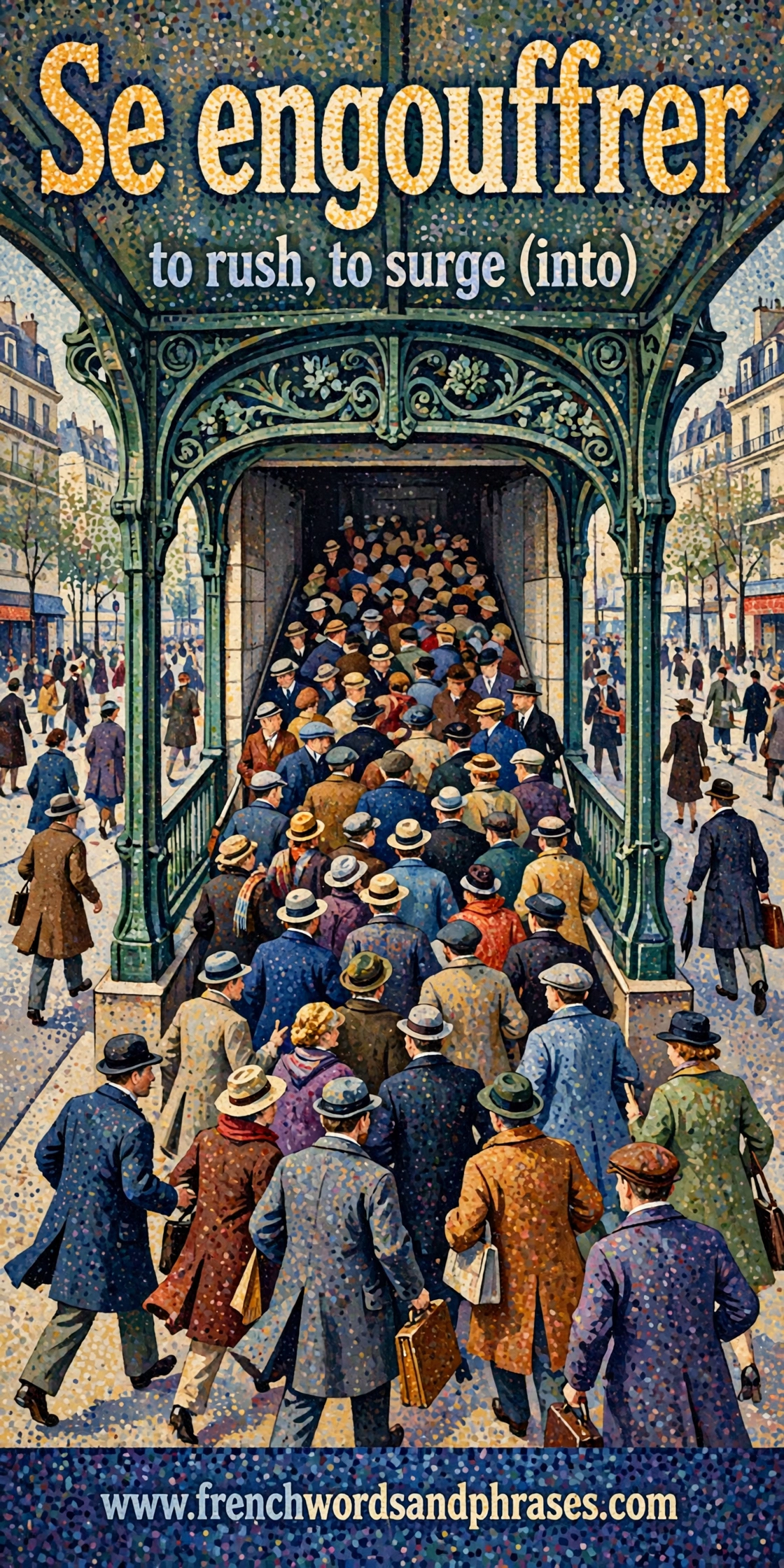
Se engouffrer means to rush, to surge (into) — to plunge headlong through a narrow opening into a street, a carriage or a breach, carried by one’s own momentum.
Wind funnelling down a narrow street, a crowd pouring through the station doors, a river forcing its way into a gorge — se engouffrer is the verb of rushing in: whatever surges through an opening and floods what lies beyond it is s’engouffrant.
In this guide, you’ll learn how to conjugate se engouffrer in all the major French tenses and moods. Explore complete conjugation tables, French examples, English translations, and practice quizzes.
Understanding the French Verb Se engouffrer
Se engouffrer is a regular French verb belonging to the first group of verbs, those ending in-er.
It means to rush, to surge (into). It is commonly used for crowds pouring into stations, stadiums and shops, for wind and water funnelling through gaps, and figuratively for anyone who dives headlong into a conversation, a project or an opportunity without pausing at the door.
Verb classification: First group (-er), reflexive
Auxiliary verb: Être
Past participle: engouffré
Present participle: engouffrant
English equivalents: To rush in, to surge into, to pour into; s’engouffrer dans une rue — to surge down a street; s’engouffrer dans le métro — to pile into the metro; le vent s’engouffre dans la cheminée — the wind rushes down the chimney; s’engouffrer dans la brèche — to charge into the breach.
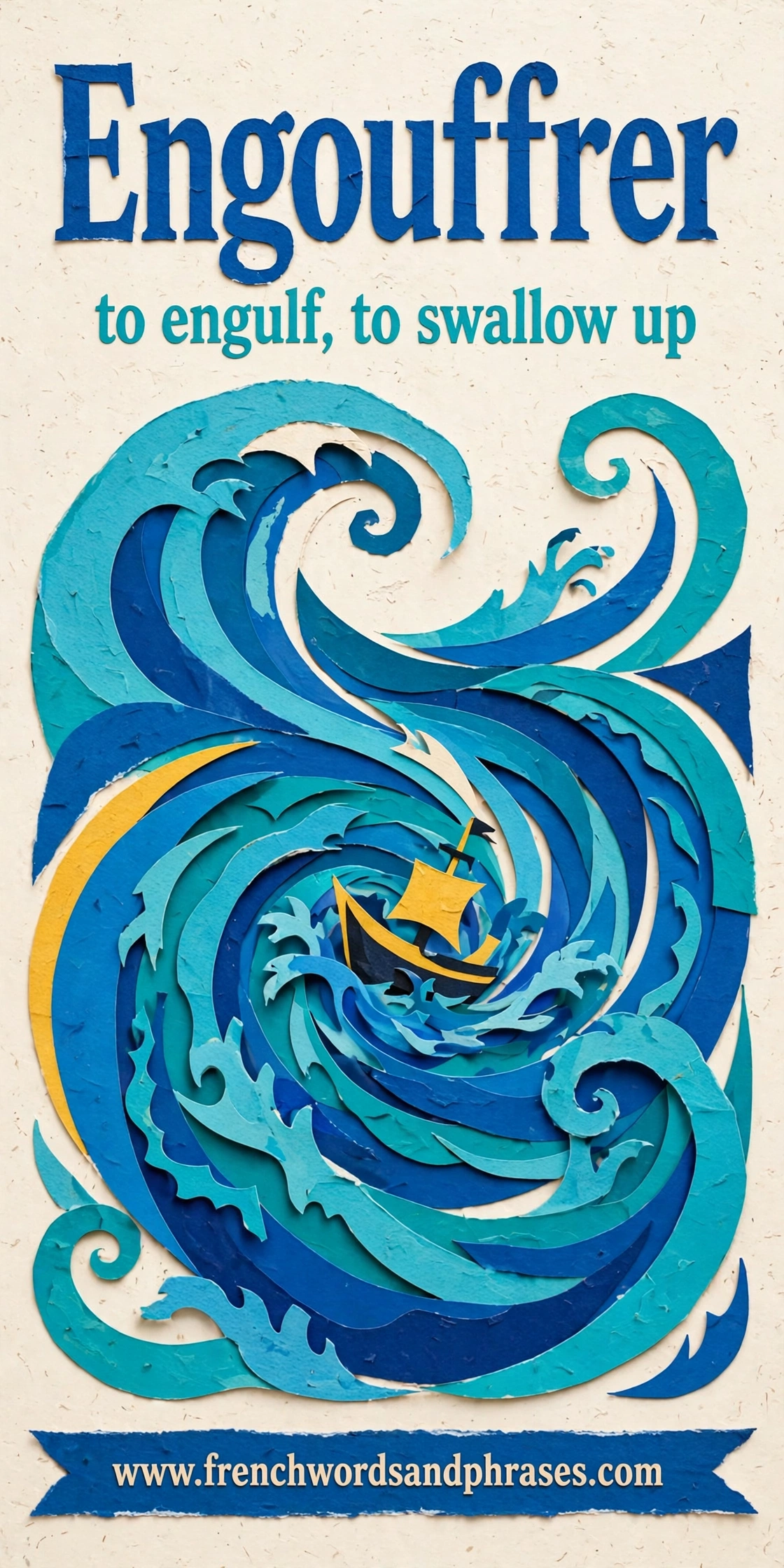
One important detail: se engouffrer is reflexive in its rushing sense, so it takes être in every compound tense and the past participle agrees with the subject: elle s’est engouffrée dans la gare, ils se sont engouffrés dans le train. Its inseparable partner is the preposition dans — one surges dans a street, a carriage, a tunnel. The plain engouffrer exists too, but it means to engulf or swallow up: la mer a engouffré le navire. The tu imperative tucks the pronoun behind the verb: engouffre-toi !
Experience the Word
Se engouffrer is the verb of the flood through the doorway — no queueing, no hesitation, just the surge of bodies, wind or water through a narrow opening.
Imagine the station doors opening at eight in the morning. A hundred travellers move as one wave — la foule s’engouffre dans le hall, through the barriers, down the stairs, into the train — and ten seconds later the platform is empty and the carriage is full.
Nobody walked in one by one. The crowd surged — engouffrée, all at once, through the opening.
How to Conjugate Se engouffrer: Complete French Conjugation Guide
Let’s explore every major conjugation of se engouffrer, beginning with the indicative mood.
How to Conjugate Se engouffrer in the Indicative Mood
The indicative mood is used to express facts, observations, actions, and events.
How to Conjugate Se engouffrer in the Present Tense (Présent)
Used for actions happening now, habitual actions, and general truths.
| Subject | Conjugation |
|---|---|
| je | m’engouffre |
| tu | t’engouffres |
| il / elle | s’engouffre |
| nous | nous engouffrons |
| vous | vous engouffrez |
| ils / elles | s’engouffrent |
Example
La foule s’engouffre dans la gare dès l’ouverture des portes.
The crowd surges into the station as soon as the doors open.
Quick Quiz 1
Complete the sentence:
Nous nous ______ dans le métro.
Reveal the answer
engouffrons
Nous nous engouffrons dans le métro.
We surge into the metro.
How to Conjugate Se engouffrer in the Passé Composé
Used for completed actions in the past. Se engouffrer takes the auxiliary verb être.
| Subject | Conjugation |
|---|---|
| je | me suis engouffré / me suis engouffrée |
| tu | t’es engouffré / t’es engouffrée |
| il / elle | s’est engouffré / s’est engouffrée |
| nous | nous sommes engouffrés / nous sommes engouffrées |
| vous | vous êtes engouffrés / vous êtes engouffrées / vous êtes engouffré / vous êtes engouffrée |
| ils / elles | se sont engouffrés / se sont engouffrées |
Example
Le vent s’est engouffré dans la rue étroite.
The wind rushed into the narrow street.
How to Conjugate Se engouffrer in the Imparfait (Imperfect Tense)
Used for habitual past actions, descriptions, and ongoing situations in the past.
| Subject | Conjugation |
|---|---|
| je | m’engouffrais |
| tu | t’engouffrais |
| il / elle | s’engouffrait |
| nous | nous engouffrions |
| vous | vous engouffriez |
| ils / elles | s’engouffraient |
Example
Les voyageurs s’engouffraient dans le train à chaque arrêt.
The travellers used to pile into the train at every stop.
Quick Quiz 2
Choose the correct form:
The crowd poured into the station.
La foule ______ dans la gare. (s’est engouffrée / a engouffré)
Reveal the answer
s’est engouffrée
La foule s’est engouffrée dans la gare.
Se engouffrer is reflexive, takes être, and the participle agrees: engouffrée.
How to Conjugate Se engouffrer in the Plus-que-parfait
Used to describe an action that had already been completed before another past event.
| Subject | Conjugation |
|---|---|
| je | m’étais engouffré / m’étais engouffrée |
| tu | t’étais engouffré / t’étais engouffrée |
| il / elle | s’était engouffré / s’était engouffrée |
| nous | nous étions engouffrés / nous étions engouffrées |
| vous | vous étiez engouffrés / vous étiez engouffrées / vous étiez engouffré / vous étiez engouffrée |
| ils / elles | s’étaient engouffrés / s’étaient engouffrées |
Example
La foule s’était engouffrée dans le stade avant la pluie.
The crowd had poured into the stadium before the rain.
How to Conjugate Se engouffrer in the Passé Simple
Primarily used in formal writing, literature, and historical narratives. It is rarely used in everyday conversation.
| Subject | Conjugation |
|---|---|
| je | m’engouffrai |
| tu | t’engouffras |
| il / elle | s’engouffra |
| nous | nous engouffrâmes |
| vous | vous engouffrâtes |
| ils / elles | s’engouffrèrent |
Example
L’armée s’engouffra dans la brèche au lever du jour.
The army charged into the breach at daybreak.
How to Conjugate Se engouffrer in the Passé Antérieur
A literary tense used to express an action completed immediately before another past action, generally in the passé simple.
| Subject | Conjugation |
|---|---|
| je | me fus engouffré / me fus engouffrée |
| tu | te fus engouffré / te fus engouffrée |
| il / elle | se fut engouffré / se fut engouffrée |
| nous | nous fûmes engouffrés / nous fûmes engouffrées |
| vous | vous fûtes engouffrés / vous fûtes engouffrées / vous fûtes engouffré / vous fûtes engouffrée |
| ils / elles | se furent engouffrés / se furent engouffrées |
Example
Dès que l’eau se fut engouffrée dans la cale, le navire pencha.
As soon as the water had rushed into the hold, the ship listed.
How to Conjugate Se engouffrer in the Future Tense (Futur Simple)
Used to describe actions that will take place in the future.
| Subject | Conjugation |
|---|---|
| je | m’engouffrerai |
| tu | t’engouffreras |
| il / elle | s’engouffrera |
| nous | nous engouffrerons |
| vous | vous engouffrerez |
| ils / elles | s’engouffreront |
Example
À neuf heures, les clients s’engouffreront dans le magasin.
At nine o’clock, the customers will surge into the shop.
How to Conjugate Se engouffrer in the Futur Antérieur (Future Perfect)
Used for an action that will have been completed before a particular point in the future.
| Subject | Conjugation |
|---|---|
| je | me serai engouffré / me serai engouffrée |
| tu | te seras engouffré / te seras engouffrée |
| il / elle | se sera engouffré / se sera engouffrée |
| nous | nous serons engouffrés / nous serons engouffrées |
| vous | vous serez engouffrés / vous serez engouffrées / vous serez engouffré / vous serez engouffrée |
| ils / elles | se seront engouffrés / se seront engouffrées |
Example
À midi, des milliers de spectateurs se seront engouffrés dans le stade.
By noon, thousands of spectators will have poured into the stadium.
How to Conjugate Se engouffrer in the Near Future (Futur Proche)
Used to describe something that is going to happen soon. Formed with aller + infinitive.
| Subject | Conjugation |
|---|---|
| je | vais m’engouffrer |
| tu | vas t’engouffrer |
| il / elle | va s’engouffrer |
| nous | allons nous engouffrer |
| vous | allez vous engouffrer |
| ils / elles | vont s’engouffrer |
Example
Regarde la foule, elle va s’engouffrer dans le métro.
Look at the crowd, it is going to surge into the metro.
How to Conjugate Se engouffrer in the Conditional Mood
The conditional mood expresses what would happen under certain circumstances. It is also frequently used to make polite requests or express wishes.
How to Conjugate Se engouffrer in the Present Conditional
| Subject | Conjugation |
|---|---|
| je | m’engouffrerais |
| tu | t’engouffrerais |
| il / elle | s’engouffrerait |
| nous | nous engouffrerions |
| vous | vous engouffreriez |
| ils / elles | s’engouffreraient |
Example
Sans les barrières, l’eau s’engouffrerait dans le tunnel.
Without the barriers, the water would rush into the tunnel.
How to Conjugate Se engouffrer in the Past Conditional
| Subject | Conjugation |
|---|---|
| je | me serais engouffré / me serais engouffrée |
| tu | te serais engouffré / te serais engouffrée |
| il / elle | se serait engouffré / se serait engouffrée |
| nous | nous serions engouffrés / nous serions engouffrées |
| vous | vous seriez engouffrés / vous seriez engouffrées / vous seriez engouffré / vous seriez engouffrée |
| ils / elles | se seraient engouffrés / se seraient engouffrées |
Example
La foule se serait engouffrée dans la salle sans les agents.
The crowd would have poured into the hall without the stewards.
Se engouffrer in the Literary Past Conditional Form
This less common literary form uses the imperfect subjunctive of être.
| Subject | Conjugation |
|---|---|
| je | me fusse engouffré / me fusse engouffrée |
| tu | te fusses engouffré / te fusses engouffrée |
| il / elle | se fût engouffré / se fût engouffrée |
| nous | nous fussions engouffrés / nous fussions engouffrées |
| vous | vous fussiez engouffrés / vous fussiez engouffrées / vous fussiez engouffré / vous fussiez engouffrée |
| ils / elles | se fussent engouffrés / se fussent engouffrées |
Example
Le vent se fût engouffré dans la vallée sans la forêt.
The wind would have rushed into the valley without the forest.
How to Conjugate Se engouffrer in the Subjunctive Mood
The subjunctive is used to express wishes, emotions, doubts, necessity, and uncertainty. It frequently follows expressions such as il faut que (it is necessary that) or bien que (although).
How to Conjugate Se engouffrer in the Present Subjunctive
| Subject | Conjugation |
|---|---|
| que je | m’engouffre |
| que tu | t’engouffres |
| qu’il / qu’elle | s’engouffre |
| que nous | nous engouffrions |
| que vous | vous engouffriez |
| qu’ils / qu’elles | s’engouffrent |
Example
Je crains que l’eau ne s’engouffre dans la cave.
I fear the water may rush into the cellar.
Quick Quiz 3
Complete the sentence using the subjunctive:
Il faut que tu t’______ dans le premier train.
Reveal the answer
engouffres
Il faut que tu t’engouffres dans le premier train.
You must pile into the first train.
How to Conjugate Se engouffrer in the Imperfect Subjunctive
A literary tense, rarely encountered in modern spoken French.
| Subject | Conjugation |
|---|---|
| que je | m’engouffrasse |
| que tu | t’engouffrasses |
| qu’il / qu’elle | s’engouffrât |
| que nous | nous engouffrassions |
| que vous | vous engouffrassiez |
| qu’ils / qu’elles | s’engouffrassent |
Example
On craignait que la foule ne s’engouffrât dans les rues étroites.
People feared the crowd might surge into the narrow streets.
How to Conjugate Se engouffrer in the Pluperfect Subjunctive
A literary construction used to express an action completed before another past action.
| Subject | Conjugation |
|---|---|
| que je | me fusse engouffré / me fusse engouffrée |
| que tu | te fusses engouffré / te fusses engouffrée |
| qu’il / qu’elle | se fût engouffré / se fût engouffrée |
| que nous | nous fussions engouffrés / nous fussions engouffrées |
| que vous | vous fussiez engouffrés / vous fussiez engouffrées / vous fussiez engouffré / vous fussiez engouffrée |
| qu’ils / qu’elles | se fussent engouffrés / se fussent engouffrées |
Example
On racontait que le torrent se fût engouffré dans le village.
People said the torrent had rushed into the village.
How to Conjugate Se engouffrer in the Past Subjunctive
| Subject | Conjugation |
|---|---|
| que je | me sois engouffré / me sois engouffrée |
| que tu | te sois engouffré / te sois engouffrée |
| qu’il / qu’elle | se soit engouffré / se soit engouffrée |
| que nous | nous soyons engouffrés / nous soyons engouffrées |
| que vous | vous soyez engouffrés / vous soyez engouffrées / vous soyez engouffré / vous soyez engouffrée |
| qu’ils / qu’elles | se soient engouffrés / se soient engouffrées |
Example
Je suis étonné que tant de monde se soit engouffré dans ce petit train.
I am amazed so many people piled into this little train.
How to Conjugate Se engouffrer in the Imperative
The imperative is used to give commands, instructions, invitations, or suggestions. Subject pronouns are omitted.
How to Conjugate Se engouffrer in the Present Imperative
| Person | Conjugation |
|---|---|
| (tu) | engouffre-toi |
| (nous) | engouffrons-nous |
| (vous) | engouffrez-vous |
Example
Engouffrez-vous dans le bus, il part !
Pile into the bus, it is leaving!
Quick Quiz 4
How would you say Jump into the car (tu form)?
Reveal the answer
Engouffre-toi dans la voiture !
French Participles of Se engouffrer
Participles are verb forms that can be used in compound tenses and other grammatical constructions.
Present Participle of Se engouffrer
engouffrant
En s’engouffrant dans la brèche, les soldats ont forcé le passage.
By charging into the breach, the soldiers forced the passage.
Past Participle of Se engouffrer
engouffré
Engouffrée dans le passage étroit, la foule avançait lentement.
Wedged into the narrow passage, the crowd moved forward slowly.
Se engouffrer in Everyday French: Real-Life Examples
Now that you know the conjugations, let’s see how se engouffrer appears in everyday French.
Example 1 — Present
Le vent s’engouffre dans la cheminée.
The wind rushes down the chimney.
Example 2 — Passé composé
La foule s’est engouffrée dans le métro.
The crowd surged into the metro.
Example 3 — Imparfait
Les élèves s’engouffraient dans la cour.
The pupils used to pour into the playground.
Example 4 — Future
Les voyageurs s’engouffreront dans le train.
The travellers will pile into the train.
Example 5 — Conditional
L’eau s’engouffrerait dans le tunnel sans les barrières.
The water would rush into the tunnel without the barriers.
Example 6 — Imperative
Engouffre-toi dans la voiture, vite !
Jump into the car, quick!
Beyond Translation: The Meaning of Se engouffrer
At the heart of the verb sits un gouffre — a chasm, a yawning abyss. To s’engouffrer is literally to throw yourself into the gouffre, which is why the word always carries a sense of a narrow mouth and a flood behind it.
English engulf is a distant cousin.
Both come from the old word for a gulf or whirlpool — the French verb kept the doorway, the English one kept the swallowing.
How to Remember the French Verb Se engouffrer
Remember it this way: Se engouffrer is about the crowd pouring through the station doors.
- Always reflexive for the rushing sense: je m’engouffre, elle s’est engouffrée — être, and the participle agrees.
- Dans leads the way in: s’engouffrer dans une rue, dans le métro, dans la brèche.
- Regular -er underneath: je m’engouffre, nous nous engouffrons, past participle engouffré.
The key idea is the crowd pouring through the station doors.
Test Your Knowledge of Se engouffrer
Let’s see how much you’ve learned. Try answering these questions before revealing the answers.
Question 1
Which auxiliary does se engouffrer use, and why?
Reveal the answer
Être — it is a reflexive verb: la foule s’est engouffrée dans la gare.
Question 2
How do you say The crowd surges into the metro in French?
Reveal the answer
La foule s’engouffre dans le métro.
Question 3
Translate: The wind rushed into the narrow street.
Reveal the answer
Le vent s’est engouffré dans la rue étroite.
Question 4
What is the past participle of se engouffrer?
Reveal the answer
Engouffré — agreeing: engouffrée, engouffrés, engouffrées.
Question 5
Complete the sentence:
Je crains que l’eau ne ______ dans la cave.
Reveal the answer
s’engouffre
Je crains que l’eau ne s’engouffre dans la cave.
I fear the water may rush into the cellar.
Your Final Challenge
Can You Use It?
How would you say this in French?
The wind surges into the valley, and the whole village shuts its shutters.
Reveal the answer
Le vent s’engouffre dans la vallée, et tout le village ferme ses volets.
The wind surges into the valley, and the whole village shuts its shutters.
A little French. A little curiosity. A richer everyday life.
LEARN FRENCH ONE WORD AT A TIME