A French Word to Live By
Translate Se casser le nez to English
/sə ka.se lə ne/
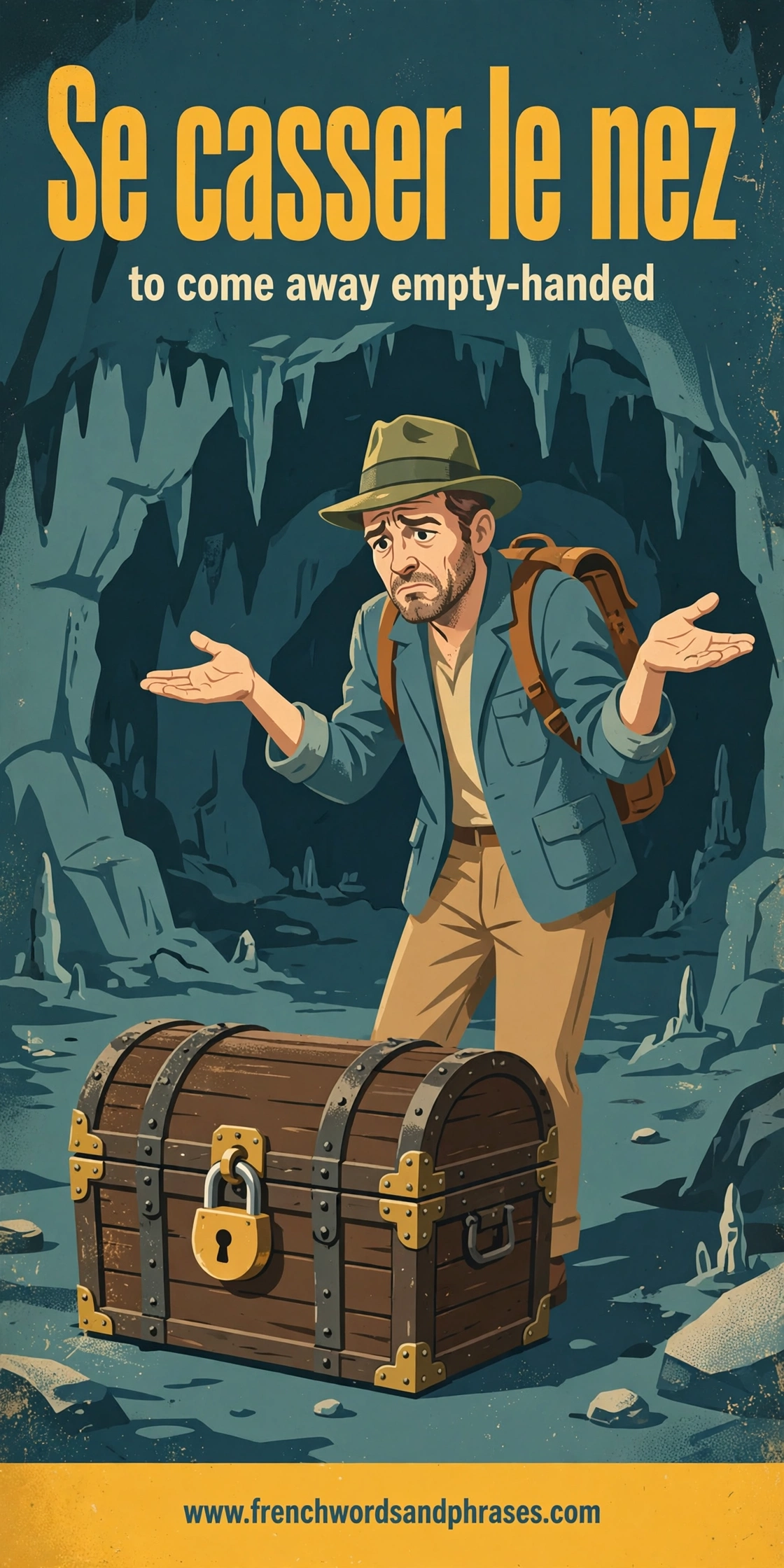
Se casser le nez means to come away empty-handed — to turn up somewhere and find nobody there, or fail in the attempt.
You have crossed the whole city in the rain to reach the little office before it closes, papers in hand, hope intact. The door is locked, the lights are off, and a small sign announces a holiday you had never heard of. In French, your nose has met that door: « Je me suis cassé le nez » — you have broken your nose, which is to say you have come all this way for nothing.
Let’s explore how se casser le nez works in French, beginning with the whole phrase on one card.
Understanding the French Phrase Se casser le nez
Se casser le nez is a reflexive idiomatic expression built from se casser (to break one’s) and le nez (the nose). The picture is pure slapstick physics: you arrive at speed, full of purpose, and walk straight into a closed door — nose first. From that collision comes the meaning: to find nobody there, to be turned away, to fail in the errand entirely.
It means to come away empty-handed — to go somewhere expecting to find a person, a shop, an answer, and to find nothing: a locked door, an empty house, a closed counter. It also shades into failing at an attempt in general. The disappointment is always practical: the journey was made, and the journey was wasted.
Type: Reflexive idiomatic expression — failure (se casser + body-part picture)
Answers the need: Reporting a wasted trip, a locked door, a person not found
Register: Familiar — everyday storytelling, with a shrug built in
Strength: Complete for the errand — nothing obtained, nobody found
One important usage detail: the phrase often carries its setting with it — se casser le nez à la mairie, chez le médecin, or in its long form se casser le nez à une porte close (to find the door shut, literally to break your nose on a closed door). The context, not the anatomy, tells your listener no hospital was involved.
Experience the Word
Se casser le nez is the sound of a plan meeting a locked door — purpose, arrival, and nothing on the other side.
Imagine a travelling salesman of the old school, sample case in hand, who has walked four kilometres to a farm that buys from him every spring. The shutters are closed, the dog is unimpressed, and a neighbour leans over the fence: sold up, gone to the city. The salesman laughs, because the phrase exists precisely so that this moment can be laughed at.
The nose is the scout of the body — it arrives first everywhere. To break it on a door is to have your hopes arrive first, and be stopped.
How to Use Se casser le nez in French: Complete Guide
Let’s explore how se casser le nez works in French, beginning with the whole phrase on one card.
Se casser le nez at a Glance
The Whole Phrase on One Card
Real meaning, literal picture, English twin and register — se casser le nez in five lines.
| Point | Se casser le nez |
|---|---|
| What it really means | to come away empty-handed — to find nobody there, to fail in the errand |
| The literal picture | to break your nose walking into a closed door |
| Word for word | se casser = to break one’s; le nez = the nose |
| The English twin | to draw a blank; to come away empty-handed; to find no one in |
| Register | familiar — the storyteller’s phrase for a wasted trip |
Example
Je suis allé à la mairie, je me suis cassé le nez.
I went to the town hall and drew a blank — nobody was there.
Word by Word: Building the Collision
Three pieces: a break, a nose, and a door you supply yourself.
| Word | Literal meaning | Its job in the phrase |
|---|---|---|
| se | oneself | the reflexive pronoun — the nose is your own |
| casser | to break | the verb of the collision — also used for real breakages |
| le nez | the nose | the body part that arrives first and pays for it |
| (à / chez) | at, to someone’s place | names the locked door: à la poste, chez le notaire |
| (une porte close) | a closed door | the long form makes the picture explicit |
Example
Il s’est cassé le nez chez son avocat.
He went to his lawyer’s and found nobody there.
Quick Quiz 1
Why a nose, in se casser le nez?
Reveal the answer
Because the nose arrives first — you walk into the closed door nose-first, and the wasted trip gets its injury.
Elle s’est cassé le nez à la bibliothèque, c’était fermé.
She went to the library and found it closed — a wasted trip.
When You Say It: The Wasted-Trip Moments
The phrase appears in the doorway of closed places, telling the story afterwards.
| Situation | Example |
|---|---|
| A closed office | Je me suis cassé le nez à la préfecture. |
| An absent friend | On est allés chez lui, on s’est cassé le nez. |
| A shut shop | Elle s’est cassé le nez à la boulangerie, jour de fermeture. |
| A failed request | Il a demandé une augmentation et s’est cassé le nez. |
| Reporting the day | Partout où je vais, je me casse le nez aujourd’hui. |
Example
Nous nous sommes cassé le nez au musée, fermé le lundi.
We went to the museum and found it shut — closed on Mondays.
Make It Yours: The Failure in Every Shape
Reflexive, past-tense friendly, and happiest with a place attached.
| Form | French | In English |
|---|---|---|
| Present | je me casse le nez | I draw a blank / find nobody there |
| Past | elle s’est cassé le nez | she came away empty-handed |
| With a place | se casser le nez à la poste | to find nobody at the post office |
| Long form | se casser le nez à une porte close | to find the door shut |
| Plural | ils se sont cassé le nez | they came away empty-handed |
| Future warning | tu vas te casser le nez, c’est fermé le dimanche | you’ll waste your trip — it’s closed on Sundays |
Example
Il s’est cassé le nez chez le dentiste, parti en vacances.
He went to the dentist’s and found him away on holiday.
Quick Quiz 2
Complete the sentence:
Je suis allé au bureau de poste, mais je me suis ______ le nez.
Reveal the answer
cassé
Je suis allé au bureau de poste, mais je me suis cassé le nez.
I went to the post office, but I came away empty-handed.
Everyday Expressions: Building on the Nose
Frames that carry the phrase through daily storytelling.
| Frame | In English |
|---|---|
| se casser le nez à… | to find nobody at… / to draw a blank at… |
| se casser le nez chez quelqu’un | to go to someone’s place and find them out |
| se casser le nez à une porte close | to find the door shut |
| partout, je me casse le nez | everywhere I go, I draw a blank |
| encore un nez cassé | another wasted trip (joking summary) |
Example
Je me suis cassé le nez à la pharmacie de garde.
I went to the duty pharmacy and found nobody there.
Close Cousins: The Other Failures of French
French fails in several styles — here are the neighbours.
| Expression | The difference |
|---|---|
| se casser le nez | the wasted trip — you went, you found nobody, you came back |
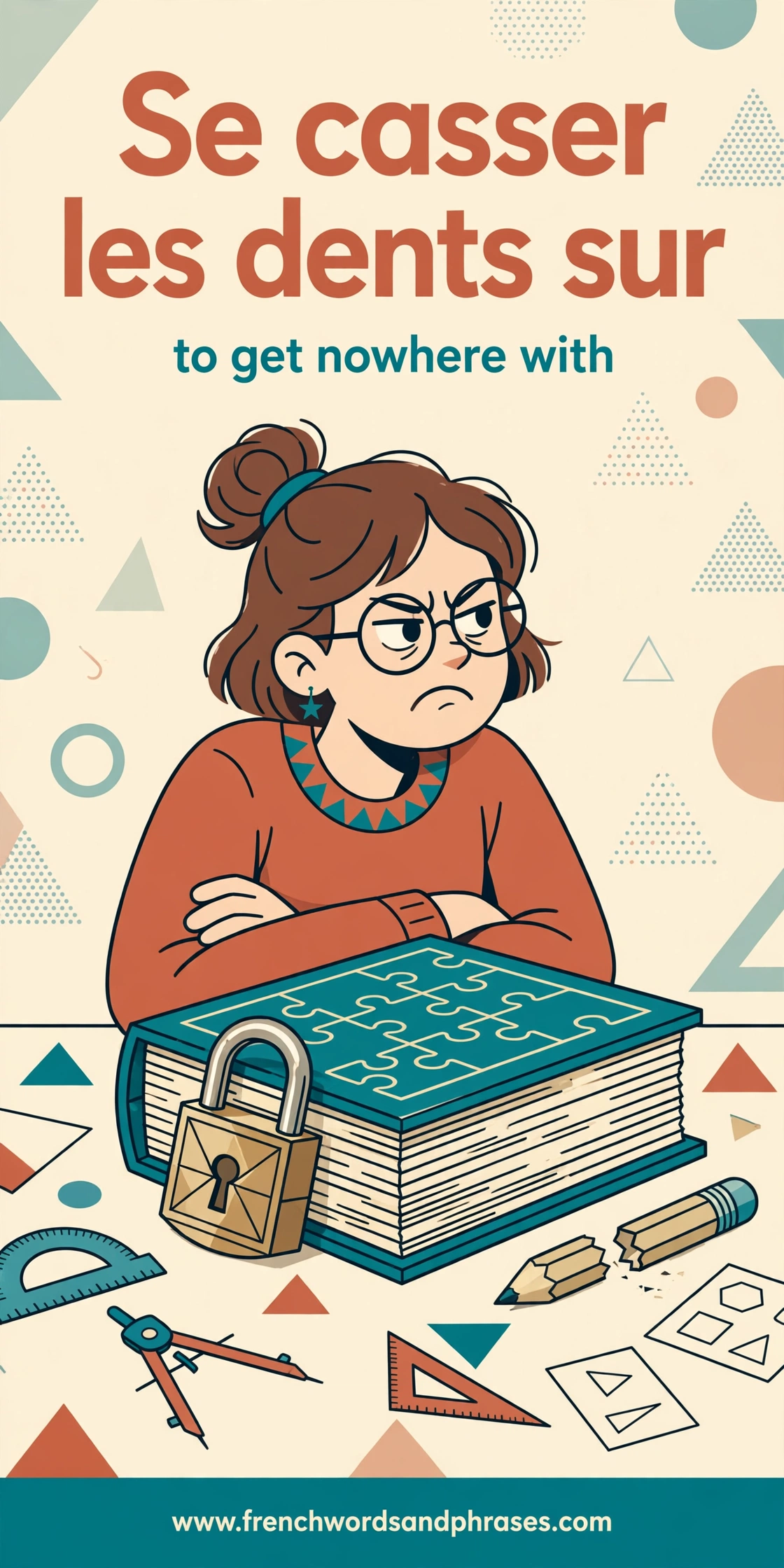
| se casser les dents sur | the too-hard problem — you tried, and the thing would not bite |
| tomber sur un os | to hit a snag — an unexpected obstacle in the plan |
| faire chou blanc | to draw a complete blank — nothing gained at all |
| rater son coup | to miss your shot — the attempt itself failed |
Example
Il a fait chou blanc à la pêche aujourd’hui.
He drew a complete blank fishing today.
Quick Quiz 3
You cross town to visit a friend who turns out to be away. Se casser le nez or se casser les dents?
Reveal the answer
Se casser le nez — the teeth are for problems too hard to bite; the nose is for doors that stay shut.
Je me suis cassé le nez chez Paul, il était en vacances.
I went to Paul’s and found him away on holiday.
Se casser le nez and Its Neighbours
The phrase at work in full sentences.
| French | In English |
|---|---|
| Je me suis cassé le nez à la mairie ce matin. | I drew a blank at the town hall this morning. |
| Elle s’est cassé le nez chez son coiffeur. | She went to her hairdresser’s and found it closed. |
| Ils se sont cassé le nez, l’exposition était terminée. | They came away empty-handed — the exhibition was over. |
| Tu vas te casser le nez, il ne reçoit que sur rendez-vous. | You’ll waste your trip — he only sees people by appointment. |
| On s’est cassé le nez trois fois cette semaine. | We drew a blank three times this week. |
| Il s’est cassé le nez à une porte close, au sens propre presque. | He found the door shut — almost literally. |
Example
Nous nous sommes cassé le nez au guichet, fermé à midi.
We found the counter closed at noon — a wasted trip.
Watch Out: The Traps Around Se casser le nez
Four misunderstandings to leave behind.
| Trap | The truth |
|---|---|
| Sending the person to a doctor | the broken nose is a picture; the real injury is the wasted journey |
| Forgetting the reflexive agreement story | with se casser, the participle agrees: elle s’est cassé le nez (nez is the object — no extra e on cassé) |
| Using it for hard problems | a problem that resists you is se casser les dents sur — teeth, not nose |
| Dropping the place | the phrase loves its setting: à la mairie, chez le médecin — name the door |
Example
Elle s’est cassé le nez à la librairie, fermée pour travaux.
She found the bookshop closed for renovations.
Quick Quiz 4
True or false: se casser le nez always means a medical emergency.
Reveal the answer
False — in the idiom it means a wasted trip and an empty-handed return. Context decides; a hospital story would make the literal meaning clear.
Je me suis cassé le nez à la poste, rien de cassé sauf mes projets.
I drew a blank at the post office — nothing broken but my plans.
Se casser le nez in Everyday French: Real-Life Examples
Now that you know the word, let’s see how se casser le nez appears in everyday French.
Example 1 — The town hall
Je me suis cassé le nez à la mairie, fermée pour inventaire.
I drew a blank at the town hall — closed for stocktaking.
Example 2 — A friend’s house
On s’est cassé le nez chez les voisins, ils étaient partis.
We went to the neighbours’ and found them away.
Example 3 — The pharmacy
Elle s’est cassé le nez à la pharmacie, fermée le dimanche.
She found the pharmacy closed — it shuts on Sundays.
Example 4 — A request refused
Il a demandé un délai et s’est cassé le nez.
He asked for more time and got nowhere.
Example 5 — A warning
N’y va pas aujourd’hui, tu vas te casser le nez.
Don’t go today — you’ll waste your trip.
Example 6 — The summary
Toute la matinée à me casser le nez de porte en porte.
The whole morning drawing blanks from door to door.
Beyond Translation: The Meaning of Se casser le nez
English draws a blank — a gambler’s phrase, an empty ticket. French walks into a door. The difference is the body: French failure is physical, a small collision between your hopes and a piece of wood that was never going to open.
To se casser le nez is to let your nose pay for your optimism.
And the shrug inside the phrase is its gift: a broken nose, in this story, heals by the time you get home.
How to Remember the French Phrase Se casser le nez
Remember it this way: Se casser le nez is the closed door at the end of a long walk — you arrive full of purpose, nose first, and the door has not heard of your purpose.
- You picture the door — the nez arrives first and meets it; the trip is wasted, not the face.
- You attach the place — à la mairie, chez le médecin: the phrase wants its locked door named.
- You keep the family straight — nez for wasted trips, dents for problems too hard to bite.
The key idea is se casser le nez means to come away empty-handed — your nose against a closed door.
Test Your Knowledge of Se casser le nez
Let’s see how much you’ve learned. Try answering these questions before revealing the answers.
Question 1
What does se casser le nez mean?
Reveal the answer
To come away empty-handed — to go somewhere and find nobody there, or fail in the errand.
Question 2
What is the literal, word-for-word meaning?
Reveal the answer
To break your nose — the picture of walking straight into a closed door.
Question 3
How do you say ‘I went to the town hall and found nobody there’?
Reveal the answer
Je me suis cassé le nez à la mairie — the place rides along after à.
Question 4
What is the difference between se casser le nez and se casser les dents sur?
Reveal the answer
Door versus problem — the nose is for wasted trips and absent people; the teeth are for tasks too hard to crack.
Question 5
Complete the sentence:
Elle s’est cassé le ______ chez son notaire. (She went to her notary’s and found nobody there.)
Reveal the answer
nez
Elle s’est cassé le nez chez son notaire.
She went to her notary’s and found nobody there.
Your Final Challenge
Can You Use It?
How would you say this in French?
“We went to the shop on Sunday and came away empty-handed: it was closed.”
Reveal the answer
Nous nous sommes cassé le nez au magasin dimanche : c’était fermé.
We went to the shop on Sunday and came away empty-handed: it was closed.
A little French. A little curiosity. A richer everyday life.
LEARN FRENCH ONE WORD AT A TIME