
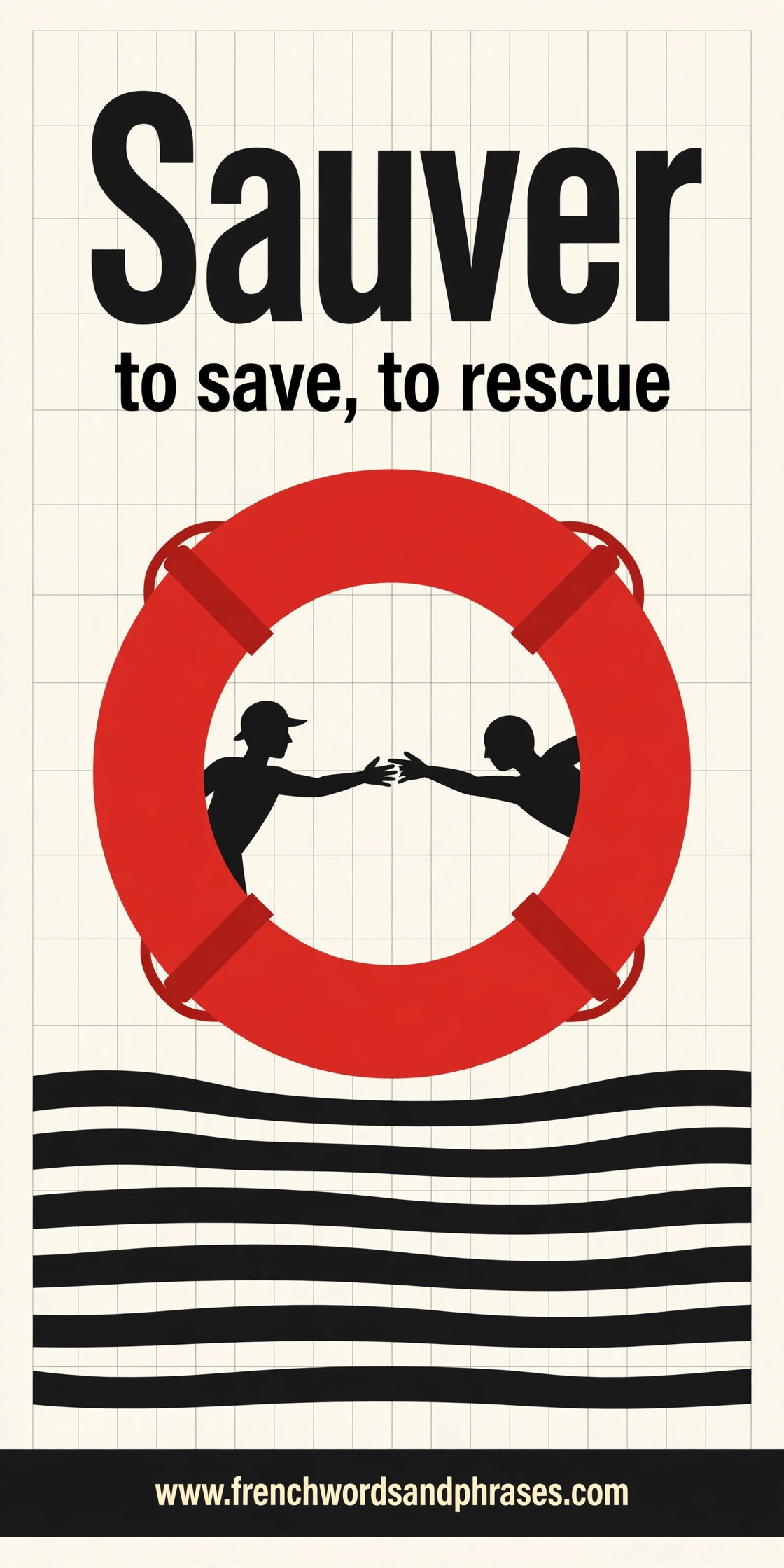
A French Word to Live By
How to Conjugate Sauver in French
/so.ve/
Sauver means to save, to rescue — to pull someone or something out of danger: a swimmer from the water, a house from the fire, a file from a dying computer, a match from defeat.
A lifeguard sprinting into the surf, a firefighter at a window, a hand hitting “save” a second before the screen goes black — sauver is the verb of the last moment: whatever it touches was about to be lost, and is not.
In this guide, you’ll learn how to conjugate sauver in all the major French tenses and moods. Explore complete conjugation tables, French examples, English translations, and practice quizzes.
Understanding the French Verb Sauver
Sauver is a regular French verb belonging to the first group of verbs, those ending in-er.
It means to save, to rescue. Sauver covers the whole scale of rescue: sauver un noyé (a drowning man), sauver une entreprise de la faillite (a company from bankruptcy), sauver les meubles (to salvage what can be salvaged — literally the furniture), sauver un fichier (a computer file, where enregistrer is the menu word but sauver is what everyone says). The saved person is un rescapé or un survivant; the rescuer is un sauveteur.
Verb classification: First group (-er)
Auxiliary verb: Avoir
Past participle: sauvé
Present participle: sauvant
English equivalents: To save, to rescue; sauver un enfant — to save a child; sauver la vie de quelqu’un — to save someone’s life; sauver un document — to save a document; sauver la situation — to save the day; se sauver — to escape, to run away (and, familiarly, to be off: je me sauve !).
One important detail: sauver is a perfectly regular -er verb — je sauve, nous sauvons, ils sauvent, past participle sauvé. The trap is not the spelling but the reflexive: se sauver does not mean to save oneself, it means to escape, to flee — and in familiar speech, simply to leave in a hurry: je me sauve, je suis en retard !
Experience the Word
Sauver is the verb of the grabbed hand — the moment where loss was one second away and did not happen.
Imagine the beach at Biarritz in August, the red flag of the lifeguards, a child carried too far by the current. The sauveteur is already in the water, arm out, voice calm: « N’aie pas peur, je te sauve. » Two minutes later the child is coughing on the sand, wrapped in a towel, and the whole beach has witnessed the oldest story there is.
The danger has not changed. But the child has been saved — sauvé — and that changes everything.
How to Conjugate Sauver: Complete French Conjugation Guide
Let’s explore every major conjugation of sauver, beginning with the indicative mood.
How to Conjugate Sauver in the Indicative Mood
The indicative mood is used to express facts, observations, actions, and events.
How to Conjugate Sauver in the Present Tense (Présent)
Used for actions happening now, habitual actions, and general truths.
| Subject | Conjugation |
|---|---|
| je | sauve |
| tu | sauves |
| il / elle | sauve |
| nous | sauvons |
| vous | sauvez |
| ils / elles | sauvent |
Example
Le chien sauve l’enfant qui se noie.
The dog saves the drowning child.
Quick Quiz 1
Complete the sentence:
Nous ______ le jardin avec cette pluie.
Reveal the answer
sauvons
Nous sauvons le jardin avec cette pluie.
We are saving the garden with this rain.
How to Conjugate Sauver in the Passé Composé
Used for completed actions in the past. Sauver takes the auxiliary verb avoir.
| Subject | Conjugation |
|---|---|
| j’ | ai sauvé |
| tu | as sauvé |
| il / elle | a sauvé |
| nous | avons sauvé |
| vous | avez sauvé |
| ils / elles | ont sauvé |
Example
Les pompiers ont sauvé toute la famille.
The firefighters saved the whole family.
How to Conjugate Sauver in the Imparfait (Imperfect Tense)
Used for habitual past actions, descriptions, and ongoing situations in the past.
| Subject | Conjugation |
|---|---|
| je | sauvais |
| tu | sauvais |
| il / elle | sauvait |
| nous | sauvions |
| vous | sauviez |
| ils / elles | sauvaient |
Example
Autrefois, ce phare sauvait les marins perdus.
In the old days, this lighthouse used to save lost sailors.
Quick Quiz 2
Choose the correct form:
She saved the child.
Elle ______ l’enfant. (a sauvé / est sauvée)
Reveal the answer
a sauvé
Elle a sauvé l’enfant.
Sauver takes avoir.
How to Conjugate Sauver in the Plus-que-parfait
Used to describe an action that had already been completed before another past event.
| Subject | Conjugation |
|---|---|
| j’ | avais sauvé |
| tu | avais sauvé |
| il / elle | avait sauvé |
| nous | avions sauvé |
| vous | aviez sauvé |
| ils / elles | avaient sauvé |
Example
Elle avait sauvé son document juste avant la panne.
She had saved her document just before the crash.
How to Conjugate Sauver in the Passé Simple
Primarily used in formal writing, literature, and historical narratives. It is rarely used in everyday conversation.
| Subject | Conjugation |
|---|---|
| je | sauvai |
| tu | sauvas |
| il / elle | sauva |
| nous | sauvâmes |
| vous | sauvâtes |
| ils / elles | sauvèrent |
Example
Le héros sauva la ville entière.
The hero saved the entire city.
How to Conjugate Sauver in the Passé Antérieur
A literary tense used to express an action completed immediately before another past action, generally in the passé simple.
| Subject | Conjugation |
|---|---|
| j’ | eus sauvé |
| tu | eus sauvé |
| il / elle | eut sauvé |
| nous | eûmes sauvé |
| vous | eûtes sauvé |
| ils / elles | eurent sauvé |
Example
Quand il eut sauvé l’enfant, la foule applaudit.
When he had saved the child, the crowd applauded.
How to Conjugate Sauver in the Future Tense (Futur Simple)
Used to describe actions that will take place in the future.
| Subject | Conjugation |
|---|---|
| je | sauverai |
| tu | sauveras |
| il / elle | sauvera |
| nous | sauverons |
| vous | sauverez |
| ils / elles | sauveront |
Example
Ce traitement sauvera des milliers de vies.
This treatment will save thousands of lives.
How to Conjugate Sauver in the Futur Antérieur (Future Perfect)
Used for an action that will have been completed before a particular point in the future.
| Subject | Conjugation |
|---|---|
| j’ | aurai sauvé |
| tu | auras sauvé |
| il / elle | aura sauvé |
| nous | aurons sauvé |
| vous | aurez sauvé |
| ils / elles | auront sauvé |
Example
À la fin de l’année, ce programme aura sauvé cent emplois.
By the end of the year, this programme will have saved a hundred jobs.
How to Conjugate Sauver in the Near Future (Futur Proche)
Used to describe something that is going to happen soon. Formed with aller + infinitive.
| Subject | Conjugation |
|---|---|
| je | vais sauver |
| tu | vas sauver |
| il / elle | va sauver |
| nous | allons sauver |
| vous | allez sauver |
| ils / elles | vont sauver |
Example
Vite, tu vas sauver la situation !
Quick, you are going to save the day!
How to Conjugate Sauver in the Conditional Mood
The conditional mood expresses what would happen under certain circumstances. It is also frequently used to make polite requests or express wishes.
How to Conjugate Sauver in the Present Conditional
| Subject | Conjugation |
|---|---|
| je | sauverais |
| tu | sauverais |
| il / elle | sauverait |
| nous | sauverions |
| vous | sauveriez |
| ils / elles | sauveraient |
Example
Un parapluie sauverait notre promenade.
An umbrella would save our walk.
How to Conjugate Sauver in the Past Conditional
| Subject | Conjugation |
|---|---|
| j’ | aurais sauvé |
| tu | aurais sauvé |
| il / elle | aurait sauvé |
| nous | aurions sauvé |
| vous | auriez sauvé |
| ils / elles | auraient sauvé |
Example
Sans toi, je n’aurais pas sauvé le fichier.
Without you, I would not have saved the file.
Sauver in the Literary Past Conditional Form
This less common literary form uses the imperfect subjunctive of avoir.
| Subject | Conjugation |
|---|---|
| j’ | eusse sauvé |
| tu | eusses sauvé |
| il / elle | eût sauvé |
| nous | eussions sauvé |
| vous | eussiez sauvé |
| ils / elles | eussent sauvé |
Example
Le capitaine eût sauvé le navire, si la tempête l’avait permis.
The captain would have saved the ship, had the storm allowed it.
How to Conjugate Sauver in the Subjunctive Mood
The subjunctive is used to express wishes, emotions, doubts, necessity, and uncertainty. It frequently follows expressions such as il faut que (it is necessary that) or bien que (although).
How to Conjugate Sauver in the Present Subjunctive
| Subject | Conjugation |
|---|---|
| que je | sauve |
| que tu | sauves |
| qu’il / qu’elle | sauve |
| que nous | sauvions |
| que vous | sauviez |
| qu’ils / qu’elles | sauvent |
Example
Il faut que tu sauves ton travail toutes les dix minutes.
You must save your work every ten minutes.
Quick Quiz 3
Complete the sentence using the subjunctive:
Je suis heureux que les pompiers ______ la maison.
Reveal the answer
aient sauvé
Je suis heureux que les pompiers aient sauvé la maison.
I am glad the firefighters saved the house.
How to Conjugate Sauver in the Imperfect Subjunctive
A literary tense, rarely encountered in modern spoken French.
| Subject | Conjugation |
|---|---|
| que je | sauvasse |
| que tu | sauvasses |
| qu’il / qu’elle | sauvât |
| que nous | sauvassions |
| que vous | sauvassiez |
| qu’ils / qu’elles | sauvassent |
Example
Je craignais qu’il ne sauvât pas le malade à temps.
I feared he would not save the patient in time.
How to Conjugate Sauver in the Pluperfect Subjunctive
A literary construction used to express an action completed before another past action.
| Subject | Conjugation |
|---|---|
| que j’ | eusse sauvé |
| que tu | eusses sauvé |
| qu’il / qu’elle | eût sauvé |
| que nous | eussions sauvé |
| que vous | eussiez sauvé |
| qu’ils / qu’elles | eussent sauvé |
Example
On racontait qu’elle eût sauvé trois enfants de l’incendie.
People said she had saved three children from the fire.
How to Conjugate Sauver in the Past Subjunctive
| Subject | Conjugation |
|---|---|
| que j’ | aie sauvé |
| que tu | aies sauvé |
| qu’il / qu’elle | ait sauvé |
| que nous | ayons sauvé |
| que vous | ayez sauvé |
| qu’ils / qu’elles | aient sauvé |
Example
Je suis heureux que les pompiers aient sauvé la maison.
I am glad the firefighters saved the house.
How to Conjugate Sauver in the Imperative
The imperative is used to give commands, instructions, invitations, or suggestions. Subject pronouns are omitted.
How to Conjugate Sauver in the Present Imperative
| Person | Conjugation |
|---|---|
| (tu) | sauve |
| (nous) | sauvons |
| (vous) | sauvez |
Example
Sauve-toi, le toit va tomber !
Save yourself, the roof is going to fall!
Quick Quiz 4
How would you say Save your document (tu form)?
Reveal the answer
Sauve ton document !
French Participles of Sauver
Participles are verb forms that can be used in compound tenses and other grammatical constructions.
Present Participle of Sauver
sauvant
En sauvant le chat, il est tombé de l’échelle.
While saving the cat, he fell off the ladder.
Past Participle of Sauver
sauvé
Sauvée par les voisins, la vieille dame sourit enfin.
Saved by the neighbours, the old lady finally smiled.
Sauver in Everyday French: Real-Life Examples
Now that you know the conjugations, let’s see how sauver appears in everyday French.
Example 1 — Present
Le gardien sauve le ballon sur la ligne.
The goalkeeper saves the ball on the line.
Example 2 — Passé composé
Les pompiers ont sauvé la famille.
The firefighters saved the family.
Example 3 — Imparfait
Le phare sauvait les marins perdus.
The lighthouse used to save lost sailors.
Example 4 — Future
Ce médicament sauvera des vies.
This medicine will save lives.
Example 5 — Conditional
Un peu de pluie sauverait le jardin.
A little rain would save the garden.
Example 6 — Imperative
Sauve ton document avant de partir !
Save your document before leaving!
Beyond Translation: The Meaning of Sauver
Sauver comes from the Latin salvare, from salvus, safe and whole — the same root as salut, salvation and the soldier’s salute. French uses one verb where English splits hairs between save, rescue and salvage, because the heart of the word is not the method but the result: what was perishing is now safe. Even the computer obeys the old word: sauver un fichier. And the reflexive performs the language’s neatest trick — se sauver turns the rescue around: the saved person becomes his own rescuer and runs.
To sauver is to snatch back from loss.
Learn it with its people: le sauveteur who saves, le rescapé who is saved, and the cry that starts it all — au secours !
How to Remember the French Verb Sauver
Remember it this way: Sauver is about the lifeguard’s calm je te sauve — snatched back from loss.
- Perfectly regular -er: je sauve, nous sauvons, past participle sauvé.
- One verb for save and rescue alike: sauver un enfant, sauver un document, sauver la situation.
- The reflexive trap: se sauver means to escape, to run off — je me sauve, I must be off!
The key idea is the lifeguard’s calm je te sauve — snatched back from loss.
Test Your Knowledge of Sauver
Let’s see how much you’ve learned. Try answering these questions before revealing the answers.
Question 1
What does se sauver mean?
Reveal the answer
To escape, to run away — and familiarly, to be off in a hurry: je me sauve !
Question 2
How do you say The firefighters saved the whole family in French?
Reveal the answer
Les pompiers ont sauvé toute la famille.
Question 3
Translate: She had saved her document just before the crash.
Reveal the answer
Elle avait sauvé son document juste avant la panne.
Question 4
What is the past participle of sauver?
Reveal the answer
Sauvé.
Question 5
Complete the sentence:
Il faut que tu ______ ton travail régulièrement.
Reveal the answer
sauves
Il faut que tu sauves ton travail régulièrement.
You must save your work regularly.
Your Final Challenge
Can You Use It?
How would you say this in French?
The firefighters saved the family and its dog.
Reveal the answer
Les pompiers ont sauvé la famille et son chien.
The firefighters saved the family and its dog.
A little French. A little curiosity. A richer everyday life.
LEARN FRENCH ONE WORD AT A TIME




