A French Word to Live By
Translate Rivage to English
/ʁi.vaʒ/
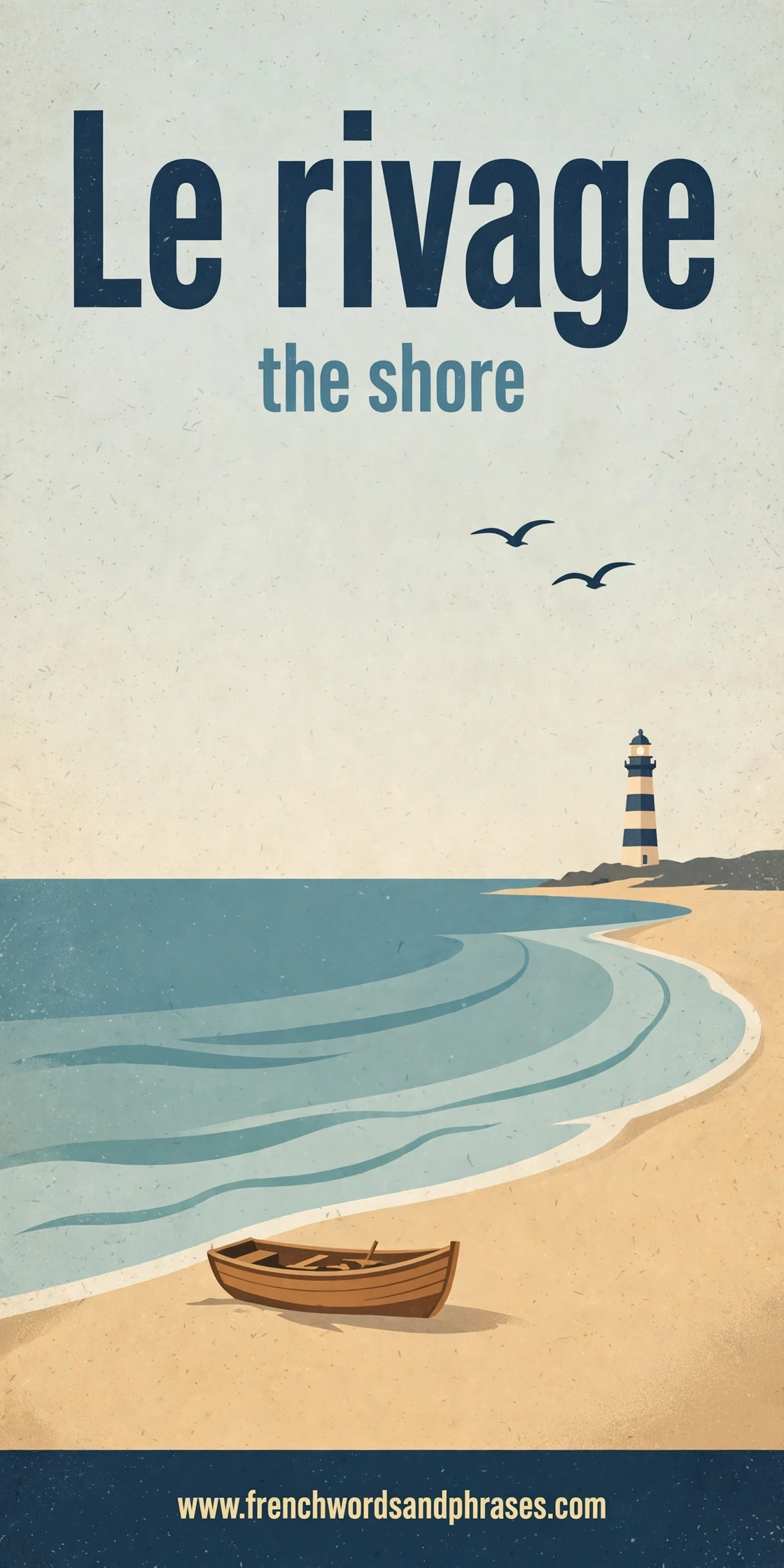
Le rivage means the shore.
The path drops through the pines, the light changes, and suddenly the land gives up: le rivage, the shore — the narrow, shining border where the earth ends and the water begins, and where every walker slows down without knowing why.
In this guide, you’ll learn what rivage means in English, how to use it with its articles, how to form its plural, and how it appears in everyday French. Explore French examples, English translations, and practice quizzes.
Understanding the French Noun Rivage
Rivage is a masculine French noun, learned with its article: le rivage, un rivage. It is built on rive, a bank or shore, from the Latin ripa. Where la rive is the bank of a river or one side of a lake, le rivage is the seashore, the water’s edge — the word of beaches, cliffs and tide lines.
It means the shore — the land along the edge of the sea or a lake: le rivage de la mer, the seashore, se promener sur le rivage, to walk along the shore, les vagues se brisent sur le rivage, the waves break on the shore. It is a slightly literary word: everyday French often says le bord de la mer or la plage for a beach, but rivage keeps the poetry of the waterline — shells, foam, wet sand and the mark of the last tide.
Gender: Masculine — le rivage
Definite article: le — le rivage (the shore)
Indefinite article: un — un rivage (a shore)
Plural: les rivages — regular, with a simple -s
Spelling note: built on rive, a bank — from Latin ripa, the steep bank of a river
Close neighbours: la rive — the bank (of a river); la côte — the coast; la plage — the beach
English equivalents: The shore, the seashore, the water’s edge.
You walk sur le rivage or le long du rivage, along the shore, and the sea throws things sur le rivage — driftwood, shells, the occasional lost buoy. For the bank of a river, French prefers la rive: Paris is divided into la rive gauche and la rive droite, the Left Bank and the Right Bank. A rivage belongs to the sea and the great lakes.
Experience the Word
Rivage is the line the world draws between two elements — and redraws twice a day with the tide.
Imagine dawn on an empty coast: the tide has left the rivage polished and shining, ribbed with little pools, and the first footprints of the morning are yours.
You have not just named a beach. You have named the meeting place of land and water — le rivage, the shore.
How to Use Rivage in French: Complete Guide
Let’s explore how rivage works in French, beginning with its articles — le rivage, un rivage, le long du rivage.
Rivage with the Definite Article (Le, Les)
Used for a specific shore — the one below the village, the one in the painting.
| Form | French |
|---|---|
| Masculine singular | le rivage |
| Plural | les rivages |
Example
Le rivage est couvert de coquillages après la tempête.
The shore is covered with shells after the storm.
Rivage with the Indefinite Article (Un, Des)
Used for a shore in general — any stretch of water’s edge.
| Form | French |
|---|---|
| Masculine singular | un rivage |
| Plural | des rivages |
Example
Nous cherchons un rivage tranquille pour pique-niquer.
We are looking for a quiet shore for a picnic.
Rivage with Prepositions (Sur, Le long de…)
The shore is walked on and along — these are its natural prepositions.
| Expression | French |
|---|---|
| on the shore | sur le rivage |
| along the shore | le long du rivage |
| towards the shore | vers le rivage |
| from the shore | depuis le rivage |
| at the water’s edge | au bord du rivage |
Example
Les enfants courent le long du rivage.
The children run along the shore.
Quick Quiz 1
Complete the sentence:
______ rivage de ce lac est sauvage et rocheux. (the)
Reveal the answer
Le
Le rivage de ce lac est sauvage et rocheux.
The shore of this lake is wild and rocky — rivage is masculine, so le.
The Plural of Rivage
Rivage takes a regular plural in -s — coasts and islands have many shores.
| Number | French |
|---|---|
| Singular | le rivage |
| Plural | les rivages |
Example
Les rivages de la Bretagne sont célèbres pour leurs falaises.
The shores of Brittany are famous for their cliffs.
Rivage with Possessive Adjectives (Mon, Ton, Son…)
Possessives agree with the noun: rivage is masculine, so mon, ton, son in the singular.
| Owner | French |
|---|---|
| my | mon rivage |
| your (tu) | ton rivage |
| his / her | son rivage |
| our | notre rivage |
| your (vous) | votre rivage |
| their | leur rivage |
Example
Chaque été, je retrouve mon rivage préféré en Normandie.
Every summer, I return to my favourite shore in Normandy.
Quick Quiz 2
Complete the sentence:
Les vagues se brisent sur ______ rivage. (the)
Reveal the answer
le
Les vagues se brisent sur le rivage.
The waves break on the shore — le, because rivage is masculine.
Rivage with Demonstrative Adjectives (Ce, Ces)
Used to point: ce rivage, this shore — the one in front of you.
| Form | French |
|---|---|
| Masculine singular | ce rivage |
| Plural | ces rivages |
Example
Ce rivage désert est parfait pour se baigner.
This deserted shore is perfect for swimming.
Rivage with Adjectives
Adjectives agree with rivage — masculine singular: un rivage rocheux, un rivage désert.
| Adjective | With Rivage |
|---|---|
| rocheux (rocky) | un rivage rocheux |
| désert (deserted) | un rivage désert |
| sauvage (wild) | un rivage sauvage |
| sablonneux (sandy) | un rivage sablonneux |
| lointain (distant) | un rivage lointain |
Example
Le bateau approche d’un rivage lointain.
The boat is approaching a distant shore.
Quick Quiz 3
Complete the sentence:
Nous marchons sur un rivage ______. (rocky)
Reveal the answer
rocheux
Nous marchons sur un rivage rocheux.
We are walking on a rocky shore — rocheux, masculine, to agree with rivage.
Everyday Expressions with Rivage
Tides, walks and shipwrecks — the rivage phrases of daily life.
| Expression | In English |
|---|---|
| le rivage de la mer | the seashore |
| se promener sur le rivage | to walk along the shore |
| échouer sur le rivage | to wash up / run aground on the shore |
| le long du rivage | along the shore |
| un rivage désert | a deserted shore |
Example
Un vieux bateau a échoué sur le rivage.
An old boat ran aground on the shore.
Words from the Same Family as Rivage
Banks and coasts — the words that travel with rivage.
| French | In English |
|---|---|
| la rive | the bank (of a river) |
| la côte | the coast |
| la plage | the beach |
| la falaise | the cliff |
| la marée | the tide |
Example
La marée basse découvre tout le rivage.
Low tide uncovers the whole shore.
Quick Quiz 4
What is the difference between le rivage and la rive?
Reveal the answer
Le rivage is the seashore — the edge of the sea or a lake; la rive is the bank of a river (la rive gauche, the Left Bank).
On se promène sur le rivage.
We walk along the shore.
Rivage in Everyday French: Real-Life Examples
Now that you know the word, let’s see how rivage appears in everyday French.
Example 1 — A walk
Le matin, nous marchons le long du rivage.
In the morning, we walk along the shore.
Example 2 — Shells
Les enfants ramassent des coquillages sur le rivage.
The children collect shells on the shore.
Example 3 — The tide
À marée basse, le rivage semble immense.
At low tide, the shore seems immense.
Example 4 — A boat
Le phare guide les bateaux vers le rivage.
The lighthouse guides the boats towards the shore.
Example 5 — Swimming
Ce rivage désert est idéal pour se baigner.
This deserted shore is ideal for swimming.
Example 6 — The storm
Après la tempête, le rivage est plein de bois flotté.
After the storm, the shore is full of driftwood.
Beyond Translation: The Meaning of Rivage
Rivage is the literary twin of the everyday beach: where la plage promises towels and ice cream, le rivage promises horizon. Poets and painters chose it — the shore as the edge of the known world, the line where sailors’ families waited and where castaways first touched land. Its mother word, la rive, stayed with the rivers and gave Paris its two famous halves, rive gauche and rive droite.
To say rivage is to stand exactly where the land gives up and the water begins.
It evokes wet sand, foam, shells and the slow breathing of the tide.
How to Remember the French Noun Rivage
Remember it this way: Rivage is the shore — masculine: le rivage, the water’s edge of the sea or a lake; the river’s bank is la rive.
- Always masculine — le rivage, un rivage, mon rivage.
- The walking phrase — se promener le long du rivage, to walk along the shore.
- Not the riverbank — that is la rive; the rivage belongs to the sea.
The key idea is le rivage — the shore, masculine; la rive is the riverbank.
Test Your Knowledge of Rivage
Let’s see how much you’ve learned. Try answering these questions before revealing the answers.
Question 1
Is rivage masculine or feminine?
Reveal the answer
Masculine — le rivage, un rivage.
Question 2
How do you say to walk along the shore?
Reveal the answer
Se promener le long du rivage.
Question 3
Translate: The waves break on the shore.
Reveal the answer
Les vagues se brisent sur le rivage.
Question 4
Which word names the bank of a river?
Reveal the answer
La rive — as in la rive gauche, the Left Bank of Paris.
Question 5
Complete the sentence:
______ rivages de Bretagne sont rocheux. (the)
Reveal the answer
Les
Les rivages de Bretagne sont rocheux.
The shores of Brittany are rocky.
Your Final Challenge
Can You Use It?
How would you say this in French?
“In the morning, we walk along the shore.”
Reveal the answer
Le matin, nous marchons le long du rivage.
In the morning, we walk along the shore.
A little French. A little curiosity. A richer everyday life.
LEARN FRENCH ONE WORD AT A TIME