A French Word to Live By
Translate Rien à cirer to English
/ʁjɛ̃ na si.ʁe/
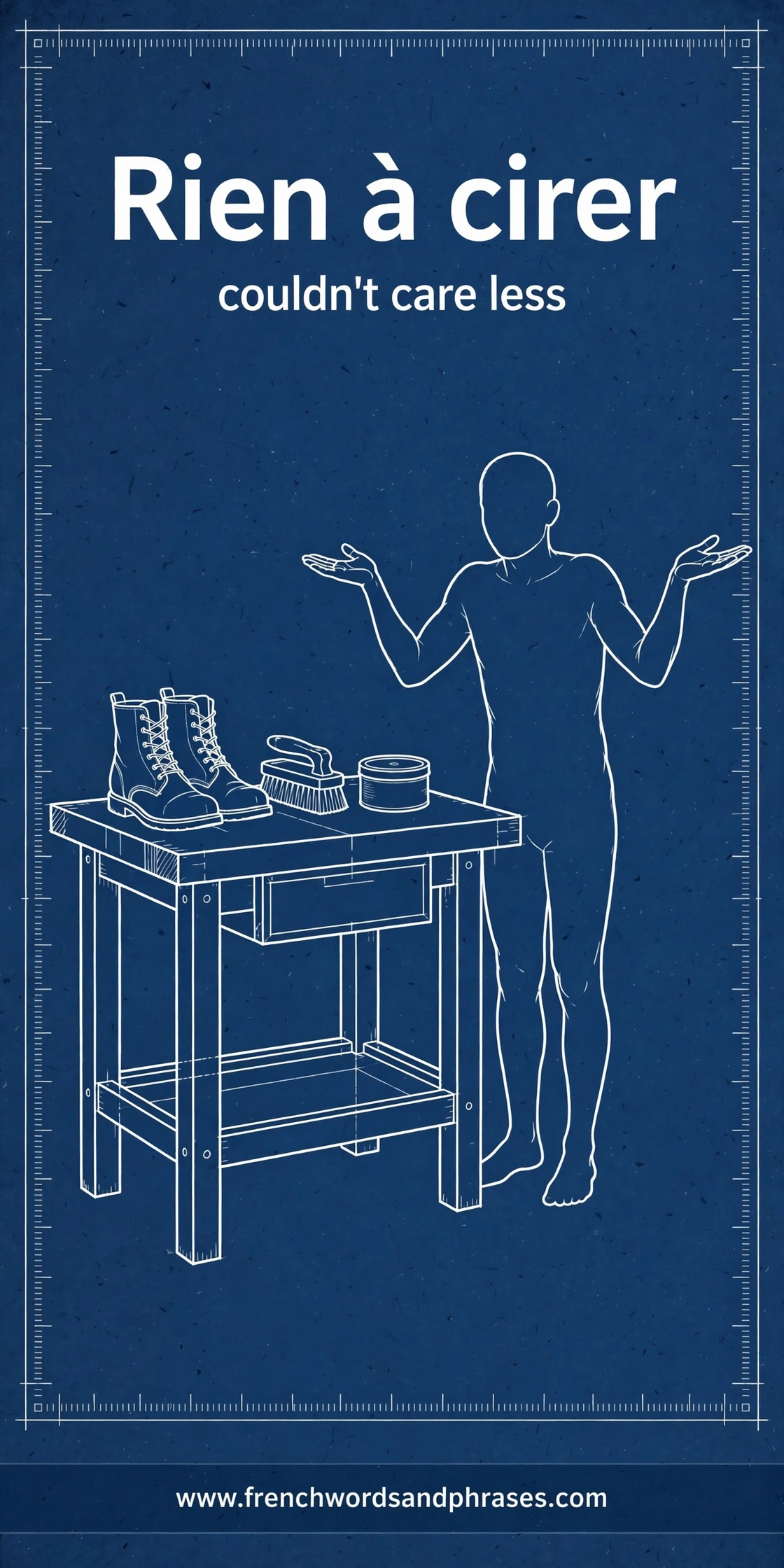
Rien à cirer means couldn’t care less — I really don’t care at all.
The office gossip reaches your desk at full speed: what the manager said, what the new girl answered, who is furious with whom. You look up from your screen, consider the whole storm for exactly one second, and deliver the flattest sentence in French: « J’en ai rien à cirer. »
Let’s explore how rien à cirer works in French, beginning with the whole phrase on one card.
Understanding the French Phrase Rien à cirer
Rien à cirer is a French idiomatic expression built from rien (nothing) and cirer (to wax, to polish — shoes, floors, furniture). Its full working form is je n’en ai rien à cirer: of all that, I have nothing to polish — the matter is not worth even a coat of wax.
It means couldn’t care less — I really don’t care at all. It dismisses gossip, opinions, scandals and other people’s drama completely. The register is familiar: stronger and blunter than ça m’est égal, a step below the outright je m’en fous — indifference with its sleeves rolled up.
Type: Idiomatic expression — indifference (negative phrase with rien)
Answers the need: Dismissing something completely — you could not care less
Register: Familiar — friends and informal speech; too blunt for formal settings
Strength: Maximum indifference, short of outright swearing
One important usage detail: the phrase almost always travels with its owner and its little en — je n’en ai rien à cirer, il en a rien à cirer — and in speech the ne drops away: « J’en ai rien à cirer. » Add the thing dismissed with de: rien à cirer de son avis, nothing to wax about his opinion.
Experience the Word
Rien à cirer is indifference that has inspected the matter, priced the polish, and declined to spend it.
Imagine the village scandal arriving at the café for the tenth retelling: names, glances, theories. The old man at the counter does not even turn around. Some news deserves a debate; this one does not deserve a shoeshine. His sentence closes the subject like a door.
French indifference has many temperatures, and this is the cold one with humour in it. It does not argue with the thing — it refuses to maintain it.
How to Use Rien à cirer in French: Complete Guide
Let’s explore how rien à cirer works in French, beginning with the whole phrase on one card.
Rien à cirer at a Glance
The Whole Phrase on One Card
Real meaning, literal picture, English twin and register — rien à cirer in five lines.
| Point | Rien à cirer |
|---|---|
| What it really means | couldn’t care less — I really don’t care at all |
| Word for word | nothing to wax (about it) |
| English equivalent | couldn’t care less / I couldn’t give a… (kept polite) |
| Register | familiar — friends and informal speech only |
| Use it for | gossip, scandals, other people’s opinions, office drama |
Example
Son avis ? Je n’en ai rien à cirer.
His opinion? I couldn’t care less.
Word by Word: Building the Dismissal
Three small pieces, plus the little en that carries the whole scandal away.
| Word | Literal meaning | Its job in the phrase |
|---|---|---|
| rien | nothing | the heart of the phrase — the amount of care available is zero |
| à | to | points the nothing at a job that will never be done |
| cirer | to wax, to polish | shoes, floors, furniture — the effort the matter is not worth |
| en | of it, about it | in the full form je n’en ai rien à cirer, en carries the dismissed thing |
Example
De ces rumeurs, je n’en ai rien à cirer.
These rumours? I couldn’t care less about them.
Quick Quiz 1
What does cirer mean outside the idiom?
Reveal the answer
To wax or polish — shoes, a wooden floor, furniture. The idiom refuses the matter even that small effort.
Il cire ses chaussures tous les dimanches.
He polishes his shoes every Sunday.
When You Say It: The Dismissal Moments
Rien à cirer fires at moments like these — wherever a storm in a teacup asks for your attention and is refused.
| Situation | Example |
|---|---|
| Gossip about you | ce qu’ils racontent ? j’en ai rien à cirer — what they’re saying? I couldn’t care less |
| A celebrity scandal | leur divorce, je n’en ai rien à cirer — their divorce, I couldn’t care less |
| An ex’s opinion | ce que pense mon ex : rien à cirer — what my ex thinks: couldn’t care less |
| Office politics | les réunions pour juger les autres, rien à cirer — meetings to judge other people, not interested at all |
| A rule nobody respects | interdit avant dix-huit heures ? j’en ai rien à cirer — banned before six pm? I couldn’t care less |
Example
Les rumeurs du bureau, franchement, je n’en ai rien à cirer.
The office rumours, honestly, I couldn’t care less.
Make It Yours: The Dismissal for Every Owner
The phrase conjugates its owner through avoir — and loses its ne the moment it is spoken aloud.
| Form | French | In English |
|---|---|---|
| Full written form | je n’en ai rien à cirer | I couldn’t care less |
| Spoken form | j’en ai rien à cirer | I couldn’t care less (ne dropped) |
| He doesn’t care | il en a rien à cirer | he couldn’t care less |
| With the thing named | rien à cirer de son avis | couldn’t care less about his opinion |
| We don’t care | on en a rien à cirer | we couldn’t care less |
| Question | tu en as rien à cirer, toi ? | you really don’t care at all? |
Example
Elle en a rien à cirer, et elle le montre.
She couldn’t care less, and she shows it.
Quick Quiz 2
Which little word disappears from the phrase in everyday speech?
Reveal the answer
Ne — je n’en ai rien à cirer becomes j’en ai rien à cirer. The rien survives; it is the heart of the dismissal.
J’en ai rien à cirer, je te dis.
I couldn’t care less, I’m telling you.
Everyday Expressions: Building on the Dismissal
Rien à cirer slots into these everyday frames — each one ready to use as it stands.
| Frame | In English |
|---|---|
| je n’en ai rien à cirer | I couldn’t care less |
| j’en ai rien à cirer | I couldn’t care less — the spoken form |
| rien à cirer de + noun | couldn’t care less about… |
| en avoir rien à cirer | to couldn’t-care-less — the infinitive frame |
| rien à cirer, vraiment rien | couldn’t care less, really less |
Example
Rien à cirer de ce classement, vraiment rien.
Couldn’t care less about that ranking, really less.
Close Cousins: The Other Temperatures of Indifference
French has a whole ladder of not caring — rien à cirer stands near the cold end; its cousins range from polite to ironic.
| Expression | The difference |
|---|---|
| rien à cirer | couldn’t care less — familiar, blunt, the polish refused |
| je m’en fiche | I don’t care — the familiar twin, a shade ruder still |
| ça m’est égal | I don’t mind — the polite, mild version for any company |
| ça me fait une belle jambe | a lot of good that does me — the ironic cousin, said of useless news |
| je m’en moque | I couldn’t care — lighter, and it can be said with a smile |
Example
Au bureau je dis « ça m’est égal » ; entre amis, « rien à cirer ».
At the office I say ‘I don’t mind’; among friends, ‘couldn’t care less’.
Quick Quiz 3
Which cousin is the polite one, safe at the office — rien à cirer or ça m’est égal?
Reveal the answer
Ça m’est égal — level scales, no offence. Rien à cirer is for friends, and it closes doors.
Ça m’est égal, chef, vraiment.
I don’t mind, boss, really.
Rien à cirer and Its Neighbours
The indifference shelf around the phrase — polish, shrugs and beautiful legs.
| French | In English |
|---|---|
| le cirage | shoe polish, wax |
| cirer les pompes à quelqu’un | to suck up to someone — literally to polish his shoes |
| s’en ficher | to not care — the familiar verb family |
| je m’en balance | I don’t care — slang twin, from swinging |
| une belle jambe | a fine leg — inside the ironic cousin ça me fait une belle jambe |
| l’indifférence | indifference |
Example
Il ne cire les pompes à personne : il n’en a rien à cirer.
He sucks up to nobody: he couldn’t care less.
Watch Out: The Traps Around Rien à cirer
The traps: a negative that must keep its rien, a register that closes doors, and polished shoes that flatter instead of dismissing.
| Trap | The truth |
|---|---|
| rien is the heart | without rien the phrase collapses — j’en ai à cirer is not French for anything; the nothing IS the idiom |
| the register trap | perfect with friends, risky with a boss or a stranger — the phrase ends conversations, it does not soften them |
| the polished-shoes trap | cirer les pompes à quelqu’un means to flatter and suck up — the same polish, the opposite errand |
| not scier | cirer is to wax; scier is to saw — one letter, another workshop entirely |
Example
Il ne cire les pompes à personne, et des ragots il n’a rien à cirer.
He sucks up to nobody, and as for gossip, he couldn’t care less.
Quick Quiz 4
True or false: cirer les pompes à quelqu’un means you don’t care about him.
Reveal the answer
False — it means the opposite errand: polishing his shoes, sucking up to him. Rien à cirer refuses the polish; les pompes offer it.
Il cire les pompes au directeur depuis janvier.
He has been sucking up to the director since January.
Rien à cirer in Everyday French: Real-Life Examples
Now that you know the word, let’s see how rien à cirer appears in everyday French.
Example 1 — The gossip
Ce qu’ils racontent sur moi ? J’en ai rien à cirer.
What they’re saying about me? I couldn’t care less.
Example 2 — The scandal
Leur histoire de divorce, je n’en ai rien à cirer.
Their divorce story — I couldn’t care less.
Example 3 — The opinion
Rien à cirer de son avis, vraiment rien.
Couldn’t care less about his opinion, really nothing.
Example 4 — At the café
Il en a rien à cirer, il n’a même pas levé les yeux.
He couldn’t care less, he didn’t even look up.
Example 5 — The ranking
On en a rien à cirer, de ce classement.
We couldn’t care less about that ranking.
Example 6 — The question
Tu en as vraiment rien à cirer, toi ? — Vraiment rien.
You really don’t care at all? — Really nothing.
Beyond Translation: The Meaning of Rien à cirer
English ‘couldn’t care less’ measures care and finds the tank empty. French refuses a job instead: somewhere there is a floor, a shoe, a piece of furniture connected to this matter — and it will not be polished.
Rien à cirer turns indifference into an unpaid bill of effort: the thing is not worth the wax.
The same polish serves the opposite master across the corridor: cirer les pompes à quelqu’un is flattery itself. French shoe-shine, it seems, is either refused or fawning — never neutral.
How to Remember the French Phrase Rien à cirer
Remember it this way: Rien à cirer is the scandal refused at the door of the workshop — not worth the wax, not worth the work.
- You keep the rien — the nothing is the heart; without it, there is no idiom.
- You hear the spoken form — j’en ai rien à cirer, with the ne dropped and the en carrying the scandal away.
- You mind the two polishes — rien à cirer dismisses; cirer les pompes flatters.
The key idea is rien à cirer means couldn’t care less — the matter is not worth the wax.
Test Your Knowledge of Rien à cirer
Let’s see how much you’ve learned. Try answering these questions before revealing the answers.
Question 1
What does rien à cirer mean?
Reveal the answer
Couldn’t care less — I really don’t care at all.
Question 2
What does cirer mean outside the idiom?
Reveal the answer
To wax or polish — shoes, floors, furniture. The matter is refused even that effort.
Question 3
What is the polite cousin, safe at the office?
Reveal the answer
Ça m’est égal — I don’t mind. Rien à cirer is familiar and door-closing.
Question 4
What does cirer les pompes à quelqu’un mean?
Reveal the answer
To suck up to someone — literally to polish his shoes. The opposite errand to dismissing him.
Question 5
Complete the sentence:
Son avis ? Je n’en ai ______ à cirer. (His opinion? I couldn’t care less.)
Reveal the answer
rien
Son avis ? Je n’en ai rien à cirer.
His opinion? I couldn’t care less.
Your Final Challenge
Can You Use It?
How would you say this in French?
“Honestly, I couldn’t care less about his opinion.”
Reveal the answer
Franchement, je n’ai rien à cirer de son avis.
Honestly, I couldn’t care less about his opinion.
A little French. A little curiosity. A richer everyday life.
LEARN FRENCH ONE WORD AT A TIME