A French Word to Live By
Translate Réveil to English
/ʁe.vɛj/
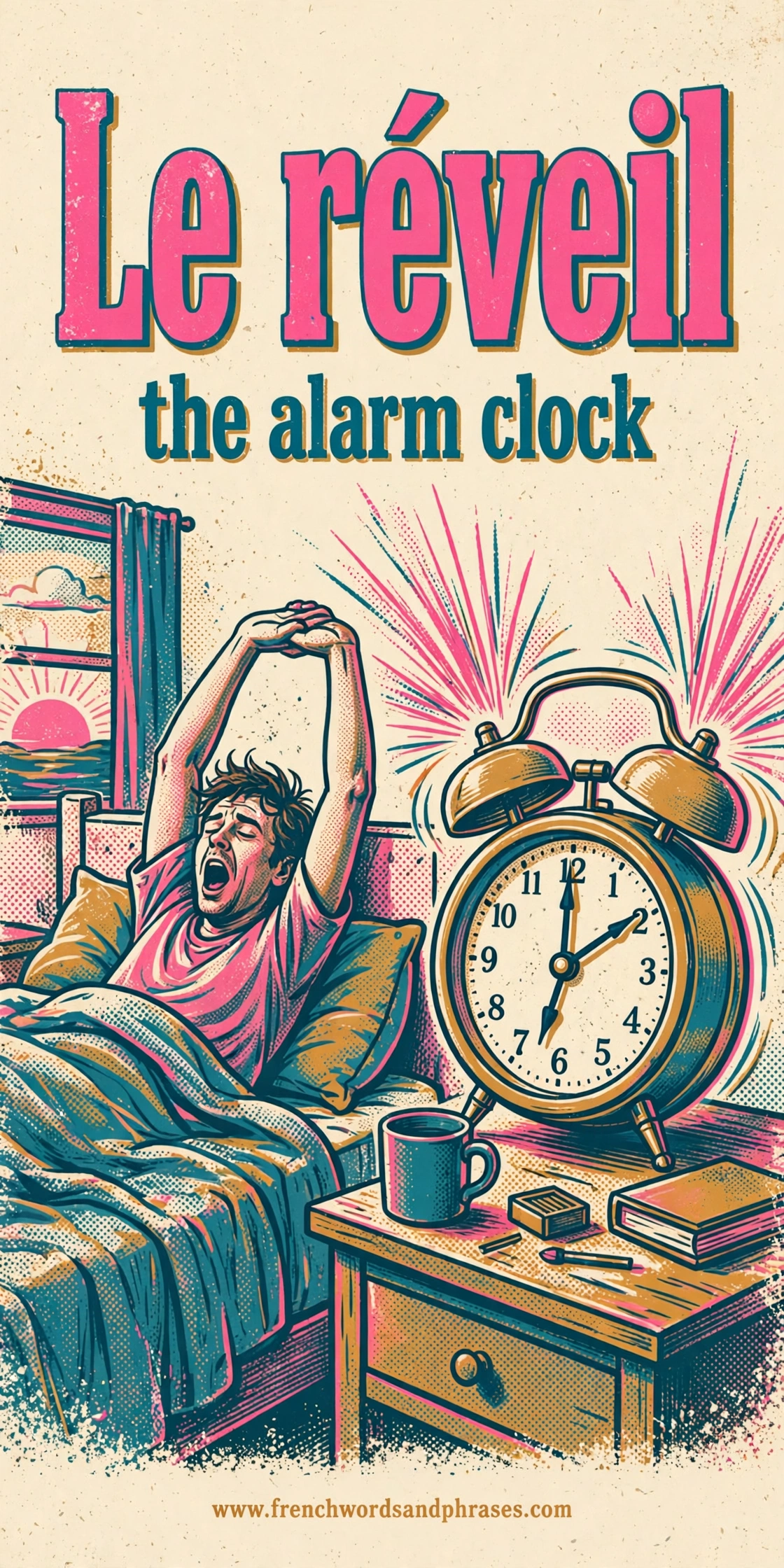
Le réveil means the alarm clock.
It sits on the bedside table with its glowing numbers, patient all night, then shatters the dark without mercy: le réveil, the alarm clock — the smallest tyrant in the house, and the one nobody dares dismiss.
In this guide, you’ll learn what réveil means in English, how to use it with its articles, how to form its plural, and how it appears in everyday French. Explore French examples, English translations, and practice quizzes.
Understanding the French Noun Réveil
Réveil is a masculine French noun, learned with its article: le réveil, un réveil. It is the noun of the verb réveiller, to wake — and it keeps both senses: the object that wakes you, and the waking itself, le réveil est difficile, waking up is hard. In full, the clock is un réveil-matin, a morning-waker.
It means an alarm clock: mettre le réveil à six heures, to set the alarm for six o’clock, le réveil sonne, the alarm goes off. The second life is the awakening: un réveil en douceur, a gentle awakening, le réveil de la nature, nature’s awakening in spring, and the traveller’s enemy, le réveil à l’aube before an early train. On a phone, the alarm keeps the same name: mettre un réveil sur son téléphone.
Gender: Masculine — le réveil
Definite article: le — le réveil (the alarm clock)
Indefinite article: un — un réveil (an alarm clock)
Plural: les réveils — regular, with a simple -s
Spelling note: from réveiller, to wake; in full, un réveil-matin
Double life: the alarm clock, and the act of waking up: le réveil est dur
English equivalents: The alarm clock, the awakening.
The daily verbs are mettre le réveil, to set the alarm, and le réveil sonne, the alarm rings — never oublier: n’oublie pas de mettre le réveil ! For the snooze generation, French phones offer répéter le réveil, and a rude awakening after good news is un réveil difficile or, figuratively, un retour à la réalité.
Experience the Word
Réveil is the border guard between the country of dreams and the country of duties — it stamps your passport at 6 a.m. sharp.
Imagine the farmhouse kitchen in winter darkness: the réveil rings upstairs, boots thump, the stove is lit, and the whole day is pulled out of the night by one small bell.
You have not just named a clock. You have named the moment the day begins — le réveil, the awakening.
How to Use Réveil in French: Complete Guide
Let’s explore how réveil works in French, beginning with its articles — le réveil, un réveil, mettre le réveil.
Réveil with the Definite Article (Le, Les)
Used for a specific alarm clock — the one that rings too early, every day.
| Form | French |
|---|---|
| Masculine singular | le réveil |
| Plural | les réveils |
Example
Le réveil sonne à six heures précises.
The alarm clock goes off at six o’clock sharp.
Réveil with the Indefinite Article (Un, Des)
Used for an alarm clock in general — or for an awakening, gentle or brutal.
| Form | French |
|---|---|
| Masculine singular | un réveil |
| Plural | des réveils |
Example
Il m’a offert un réveil qui simule le lever du soleil.
He gave me an alarm clock that simulates sunrise.
Réveil with Quantities and Kinds (Électronique, Mécanique…)
Alarm clocks are described by their mechanism and their mercy — the vocabulary of mornings.
| Quantity | French |
|---|---|
| an electronic alarm clock | un réveil électronique |
| an old wind-up alarm clock | un vieux réveil mécanique |
| a gentle awakening | un réveil en douceur |
| an early start | un réveil à l’aube |
| a rude awakening | un réveil difficile |
Example
Un réveil en douceur vaut mieux qu’une sonnerie brutale.
A gentle awakening is better than a brutal ring.
Quick Quiz 1
Complete the sentence:
______ réveil n’a pas sonné ce matin ! (the)
Reveal the answer
Le
Le réveil n’a pas sonné ce matin !
The alarm clock didn’t go off this morning! — réveil is masculine, so le.
The Plural of Réveil
Réveil takes a regular plural in -s — one per bedside table, in hotels across the country.
| Number | French |
|---|---|
| Singular | le réveil |
| Plural | les réveils |
Example
Les réveils des chambres d’hôtel sont déjà réglés.
The alarm clocks in the hotel rooms are already set.
Réveil with Possessive Adjectives (Mon, Ton, Son…)
Possessives agree with the noun: réveil is masculine, so mon, ton, son in the singular.
| Owner | French |
|---|---|
| my | mon réveil |
| your (tu) | ton réveil |
| his / her | son réveil |
| our | notre réveil |
| your (vous) | votre réveil |
| their | leur réveil |
Example
Mon réveil est réglé sur six heures et demie.
My alarm clock is set for half past six.
Quick Quiz 2
Complete the sentence:
Mets ______ réveil à cinq heures, le train part tôt. (your)
Reveal the answer
ton
Mets ton réveil à cinq heures, le train part tôt.
Set your alarm for five o’clock, the train leaves early — ton, because réveil is masculine.
Réveil with Demonstrative Adjectives (Ce, Ces)
Used to point: ce réveil, this alarm clock — the enemy, identified.
| Form | French |
|---|---|
| Masculine singular | ce réveil |
| Plural | ces réveils |
Example
Ce réveil sonne trop fort, je vais le changer.
This alarm clock rings too loudly, I’m going to change it.
Réveil with Adjectives
Adjectives agree with réveil — masculine singular: un réveil bruyant, un vieux réveil.
| Adjective | With Réveil |
|---|---|
| bruyant (noisy) | un réveil bruyant |
| électronique (electronic) | un réveil électronique |
| vieux (old) | un vieux réveil |
| pratique (handy) | un réveil pratique |
| matinal (early, for waking) | un réveil matinal |
Example
Un vieux réveil mécanique fait un bruit d’enfer.
An old wind-up alarm clock makes a terrible noise.
Quick Quiz 3
Complete the sentence:
Le lundi, le réveil est toujours ______. (hard)
Reveal the answer
difficile
Le lundi, le réveil est toujours difficile.
On Mondays, waking up is always hard — here réveil means the awakening itself.
Everyday Expressions with Réveil
Bells, snoozing and early trains — the réveil phrases of daily life.
| Expression | In English |
|---|---|
| mettre le réveil | to set the alarm |
| le réveil sonne | the alarm goes off |
| un réveil en douceur | a gentle awakening |
| le réveil de la nature | nature’s awakening (spring) |
| se réveiller | to wake up (the verb) |
Example
N’oublie pas de mettre le réveil pour demain.
Don’t forget to set the alarm for tomorrow.
Words from the Same Family as Réveil
Waking and sleeping — the words that travel with réveil.
| French | In English |
|---|---|
| réveiller | to wake (someone) up |
| se lever | to get up |
| le sommeil | sleep |
| la table de chevet | the bedside table it sits on |
| éveillé | awake, wide awake |
Example
Après le réveil, elle reste éveillée un moment dans le noir.
After waking, she stays awake a moment in the dark.
Quick Quiz 4
What does mettre le réveil mean?
Reveal the answer
To set the alarm — the nightly ritual before an early start.
Mets le réveil à sept heures.
Set the alarm for seven o’clock.
Réveil in Everyday French: Real-Life Examples
Now that you know the word, let’s see how réveil appears in everyday French.
Example 1 — Nightly ritual
Mets le réveil à six heures, s’il te plaît.
Set the alarm for six o’clock, please.
Example 2 — Disaster
Le réveil n’a pas sonné, je suis en retard !
The alarm didn’t go off, I’m late!
Example 3 — Gentle start
Un réveil en douceur, avec la radio, c’est mieux.
A gentle awakening, with the radio, is better.
Example 4 — Spring
Le réveil de la nature commence dès février.
Nature’s awakening begins in February.
Example 5 — Early train
Réveil à l’aube demain, le train part à sept heures.
An early start tomorrow, the train leaves at seven.
Example 6 — Snooze
Il répète son réveil trois fois avant de se lever.
He snoozes his alarm three times before getting up.
Beyond Translation: The Meaning of Réveil
Réveil is a word that refuses to stay an object: the clock on the table and the opening of the eyes share one name, as if French knew the machine and the moment were the same thing. History borrowed it too — le Réveil became the title of newspapers and movements, the awakening of a people; and every spring, le réveil de la nature does the work of a whole poem in four words.
To say réveil is to hear the day knock.
It evokes dark kitchens, first light, and the small bravery of getting up.
How to Remember the French Noun Réveil
Remember it this way: Réveil is the alarm clock — masculine: le réveil. And the waking itself takes the same word: le réveil est dur.
- Always masculine — le réveil, un réveil, mon réveil.
- The nightly phrase — mettre le réveil à six heures, to set the alarm for six.
- Two lives — the clock, and the awakening: un réveil en douceur.
The key idea is le réveil — the alarm clock, masculine; mettre le réveil = to set the alarm.
Test Your Knowledge of Réveil
Let’s see how much you’ve learned. Try answering these questions before revealing the answers.
Question 1
Is réveil masculine or feminine?
Reveal the answer
Masculine — le réveil, un réveil.
Question 2
How do you say to set the alarm for six o’clock?
Reveal the answer
Mettre le réveil à six heures.
Question 3
Translate: The alarm clock goes off at six o’clock sharp.
Reveal the answer
Le réveil sonne à six heures précises.
Question 4
Besides the clock, what else does réveil mean?
Reveal the answer
The awakening itself — le réveil de la nature, nature’s awakening; le réveil est difficile, waking up is hard.
Question 5
Complete the sentence:
______ réveils des chambres d’hôtel sont déjà réglés. (the)
Reveal the answer
Les
Les réveils des chambres d’hôtel sont déjà réglés.
The alarm clocks in the hotel rooms are already set.
Your Final Challenge
Can You Use It?
How would you say this in French?
“Don’t forget to set the alarm for tomorrow.”
Reveal the answer
N’oublie pas de mettre le réveil pour demain.
Don’t forget to set the alarm for tomorrow.
A little French. A little curiosity. A richer everyday life.
LEARN FRENCH ONE WORD AT A TIME