A French Word to Live By
How to Conjugate Restreindre in French
/ʁəs.tʁɛ̃dʁ/
Restreindre means to restrict — to draw a tighter line around something: access, spending, freedom, speed — and to hold it there.
A librarian limiting a rare book to one reader at a time, a doctor ordering a patient to cut down on salt, a town hall lowering the speed limit past the school — restreindre is the verb of the narrowed gate: less room, fewer people, tighter rules.
In this guide, you’ll learn how to conjugate restreindre in all the major French tenses and moods. Explore complete conjugation tables, French examples, English translations, and practice quizzes.
Understanding the French Verb Restreindre
Restreindre is an irregular French verb ending in -eindre, conjugated exactly like craindre.
It means to restrict. It is the verb of budgets, security and diets: towns restreignent la circulation, doctors restreignent le sel, and families restreignent leurs dépenses when money is short. It always suggests a deliberate tightening by someone in authority — even when that authority is only oneself.
Verb classification: Irregular (-eindre)
Auxiliary verb: Avoir
Past participle: restreint
Present participle: restreignant
English equivalents: To restrict, to limit, to cut back; restreindre l’accès — to restrict access; restreindre les dépenses — to cut back spending; restreindre la liberté de quelqu’un — to restrict someone’s freedom; un accès restreint — restricted access; une mesure restrictive — a restrictive measure.
One important detail: restreindre belongs to the -eindre family (craindre, éteindre, peindre), whose stem changes its shape: restreign- before a vowel — nous restreignons, je restreignais, en restreignant — and restrein- before a consonant or at the end: je restreins, tu restreins, il restreint. The future keeps the full infinitive stem: je restreindrai. And the past participle is restreint — which lives a second life as an adjective: un cercle restreint, a small, select circle.
Experience the Word
Restreindre is the verb of the line drawn tighter — the gate narrowed, the budget trimmed, the list shortened.
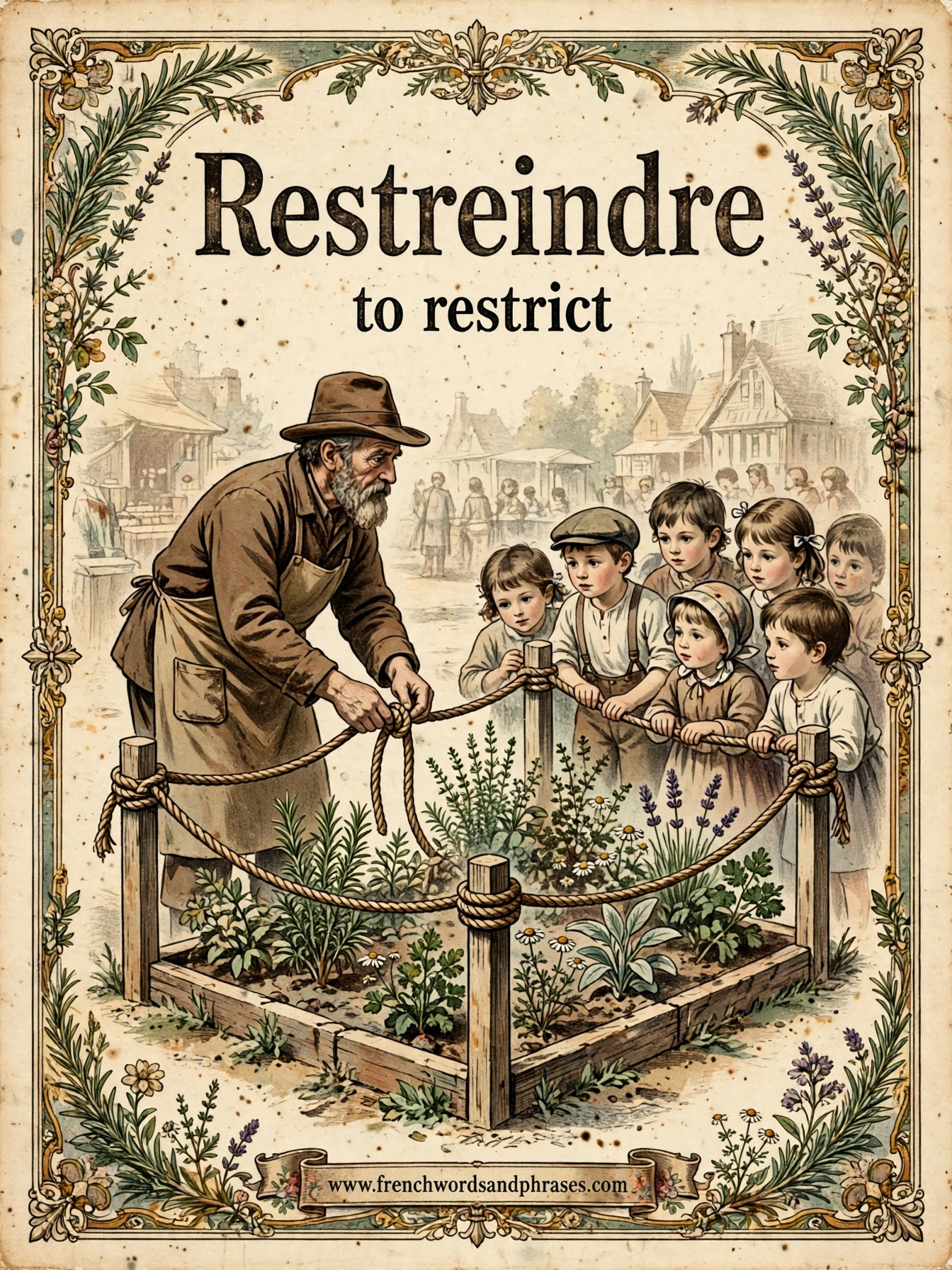
Imagine the little library of a mountain village. Its oldest book, a hand-drawn atlas, was falling apart from love: too many hands. The librarian makes her decision — elle restreint l’accès: one reader at a time, gloves on, an hour a day. The book will survive precisely because fewer people can touch it.
Less access, more future. She has restricted it — restreint — in order to save it.
How to Conjugate Restreindre: Complete French Conjugation Guide
Let’s explore every major conjugation of restreindre, beginning with the indicative mood.
How to Conjugate Restreindre in the Indicative Mood
The indicative mood is used to express facts, observations, actions, and events.
How to Conjugate Restreindre in the Present Tense (Présent)
Used for actions happening now, habitual actions, and general truths.
| Subject | Conjugation |
|---|---|
| je | restreins |
| tu | restreins |
| il / elle | restreint |
| nous | restreignons |
| vous | restreignez |
| ils / elles | restreignent |
Example
La ville restreint la circulation dans le centre.
The town is restricting traffic in the centre.
Quick Quiz 1
Complete the sentence:
Nous ______ les dépenses depuis janvier.
Reveal the answer
restreignons
Nous restreignons les dépenses depuis janvier.
We have been cutting back spending since January.
How to Conjugate Restreindre in the Passé Composé
Used for completed actions in the past. Restreindre takes the auxiliary verb avoir.
| Subject | Conjugation |
|---|---|
| j’ | ai restreint |
| tu | as restreint |
| il / elle | a restreint |
| nous | avons restreint |
| vous | avez restreint |
| ils / elles | ont restreint |
Example
Ils ont restreint l’accès au bâtiment.
They restricted access to the building.
How to Conjugate Restreindre in the Imparfait (Imperfect Tense)
Used for habitual past actions, descriptions, and ongoing situations in the past.
| Subject | Conjugation |
|---|---|
| je | restreignais |
| tu | restreignais |
| il / elle | restreignait |
| nous | restreignions |
| vous | restreigniez |
| ils / elles | restreignaient |
Example
Autrefois, ce règlement restreignait les visites au dimanche.
In the old days, this rule used to restrict visits to Sundays.
Quick Quiz 2
Choose the correct form:
They restricted access.
Ils ______ l’accès. (ont restreint / sont restreints)
Reveal the answer
ont restreint
Ils ont restreint l’accès.
Restreindre takes avoir.
How to Conjugate Restreindre in the Plus-que-parfait
Used to describe an action that had already been completed before another past event.
| Subject | Conjugation |
|---|---|
| j’ | avais restreint |
| tu | avais restreint |
| il / elle | avait restreint |
| nous | avions restreint |
| vous | aviez restreint |
| ils / elles | avaient restreint |
Example
Elle avait restreint ses dépenses pendant un an.
She had cut back her spending for a year.
How to Conjugate Restreindre in the Passé Simple
Primarily used in formal writing, literature, and historical narratives. It is rarely used in everyday conversation.
| Subject | Conjugation |
|---|---|
| je | restreignis |
| tu | restreignis |
| il / elle | restreignit |
| nous | restreignîmes |
| vous | restreignîtes |
| ils / elles | restreignirent |
Example
Le roi restreignit les pouvoirs des seigneurs.
The king restricted the powers of the lords.
How to Conjugate Restreindre in the Passé Antérieur
A literary tense used to express an action completed immediately before another past action, generally in the passé simple.
| Subject | Conjugation |
|---|---|
| j’ | eus restreint |
| tu | eus restreint |
| il / elle | eut restreint |
| nous | eûmes restreint |
| vous | eûtes restreint |
| ils / elles | eurent restreint |
Example
Dès qu’il eut restreint le budget, les travaux ralentirent.
As soon as he had cut the budget, the work slowed down.
How to Conjugate Restreindre in the Future Tense (Futur Simple)
Used to describe actions that will take place in the future.
| Subject | Conjugation |
|---|---|
| je | restreindrai |
| tu | restreindras |
| il / elle | restreindra |
| nous | restreindrons |
| vous | restreindrez |
| ils / elles | restreindront |
Example
Le médecin restreindra le sel dans son régime.
The doctor will restrict the salt in his diet.
How to Conjugate Restreindre in the Futur Antérieur (Future Perfect)
Used for an action that will have been completed before a particular point in the future.
| Subject | Conjugation |
|---|---|
| j’ | aurai restreint |
| tu | auras restreint |
| il / elle | aura restreint |
| nous | aurons restreint |
| vous | aurez restreint |
| ils / elles | auront restreint |
Example
À la fin du mois, nous aurons restreint toutes les dépenses inutiles.
By the end of the month, we will have cut back all unnecessary spending.
How to Conjugate Restreindre in the Near Future (Futur Proche)
Used to describe something that is going to happen soon. Formed with aller + infinitive.
| Subject | Conjugation |
|---|---|
| je | vais restreindre |
| tu | vas restreindre |
| il / elle | va restreindre |
| nous | allons restreindre |
| vous | allez restreindre |
| ils / elles | vont restreindre |
Example
Tu vas restreindre tes sorties ce mois-ci ?
Are you going to cut back your evenings out this month?
How to Conjugate Restreindre in the Conditional Mood
The conditional mood expresses what would happen under certain circumstances. It is also frequently used to make polite requests or express wishes.
How to Conjugate Restreindre in the Present Conditional
| Subject | Conjugation |
|---|---|
| je | restreindrais |
| tu | restreindrais |
| il / elle | restreindrait |
| nous | restreindrions |
| vous | restreindriez |
| ils / elles | restreindraient |
Example
Un mot de passe restreindrait mieux l’accès aux dossiers.
A password would restrict access to the files better.
How to Conjugate Restreindre in the Past Conditional
| Subject | Conjugation |
|---|---|
| j’ | aurais restreint |
| tu | aurais restreint |
| il / elle | aurait restreint |
| nous | aurions restreint |
| vous | auriez restreint |
| ils / elles | auraient restreint |
Example
Ils auraient restreint la vitesse sans les protestations.
They would have restricted the speed without the protests.
Restreindre in the Literary Past Conditional Form
This less common literary form uses the imperfect subjunctive of avoir.
| Subject | Conjugation |
|---|---|
| j’ | eusse restreint |
| tu | eusses restreint |
| il / elle | eût restreint |
| nous | eussions restreint |
| vous | eussiez restreint |
| ils / elles | eussent restreint |
Example
Le préfet eût restreint les rassemblements sans l’avis du juge.
The prefect would have restricted gatherings without the judge’s ruling.
How to Conjugate Restreindre in the Subjunctive Mood
The subjunctive is used to express wishes, emotions, doubts, necessity, and uncertainty. It frequently follows expressions such as il faut que (it is necessary that) or bien que (although).
How to Conjugate Restreindre in the Present Subjunctive
| Subject | Conjugation |
|---|---|
| que je | restreigne |
| que tu | restreignes |
| qu’il / qu’elle | restreigne |
| que nous | restreignions |
| que vous | restreigniez |
| qu’ils / qu’elles | restreignent |
Example
Il faut que tu restreignes ton budget ce mois-ci.
You must cut back your budget this month.
Quick Quiz 3
Complete the sentence using the subjunctive:
Il faut que vous ______ la vitesse près de l’école.
Reveal the answer
restreigniez
Il faut que vous restreigniez la vitesse près de l’école.
You must restrict the speed near the school.
How to Conjugate Restreindre in the Imperfect Subjunctive
A literary tense, rarely encountered in modern spoken French.
| Subject | Conjugation |
|---|---|
| que je | restreignisse |
| que tu | restreignisses |
| qu’il / qu’elle | restreignît |
| que nous | restreignissions |
| que vous | restreignissiez |
| qu’ils / qu’elles | restreignissent |
Example
Je craignais que la loi restreignît les libertés.
I feared the law might restrict freedoms.
How to Conjugate Restreindre in the Pluperfect Subjunctive
A literary construction used to express an action completed before another past action.
| Subject | Conjugation |
|---|---|
| que j’ | eusse restreint |
| que tu | eusses restreint |
| qu’il / qu’elle | eût restreint |
| que nous | eussions restreint |
| que vous | eussiez restreint |
| qu’ils / qu’elles | eussent restreint |
Example
On racontait que le directeur eût restreint les horaires sans prévenir.
People said the manager had restricted the hours without warning.
How to Conjugate Restreindre in the Past Subjunctive
| Subject | Conjugation |
|---|---|
| que j’ | aie restreint |
| que tu | aies restreint |
| qu’il / qu’elle | ait restreint |
| que nous | ayons restreint |
| que vous | ayez restreint |
| qu’ils / qu’elles | aient restreint |
Example
Je suis content qu’elle ait restreint ses dépenses.
I am glad she cut back her spending.
How to Conjugate Restreindre in the Imperative
The imperative is used to give commands, instructions, invitations, or suggestions. Subject pronouns are omitted.
How to Conjugate Restreindre in the Present Imperative
| Person | Conjugation |
|---|---|
| (tu) | restreins |
| (nous) | restreignons |
| (vous) | restreignez |
Example
Restreignez l’accès à ce dossier, s’il vous plaît !
Restrict access to this file, please!
Quick Quiz 4
How would you say Cut back your spending (tu form)?
Reveal the answer
Restreins tes dépenses !
French Participles of Restreindre
Participles are verb forms that can be used in compound tenses and other grammatical constructions.
Present Participle of Restreindre
restreignant
En restreignant les dépenses, la famille a enfin économisé.
By cutting back spending, the family finally saved money.
Past Participle of Restreindre
restreint
Restreint à quelques membres, le comité décide plus vite.
Restricted to a few members, the committee decides faster.
Restreindre in Everyday French: Real-Life Examples
Now that you know the conjugations, let’s see how restreindre appears in everyday French.
Example 1 — Present
La ville restreint la circulation dans le centre.
The town is restricting traffic in the centre.
Example 2 — Passé composé
Ils ont restreint l’accès au bâtiment.
They restricted access to the building.
Example 3 — Imparfait
Ce règlement restreignait les visites au dimanche.
This rule used to restrict visits to Sundays.
Example 4 — Future
Le médecin restreindra le sel dans son régime.
The doctor will restrict the salt in his diet.
Example 5 — Conditional
Un mot de passe restreindrait mieux l’accès.
A password would restrict access better.
Example 6 — Imperative
Restreins tes dépenses ce mois-ci !
Cut back your spending this month!
Beyond Translation: The Meaning of Restreindre
Restreindre comes from Latin restringere, to bind back tight — the same root as English restrict, restrain and even strait, as in a straitjacket.
The image is a rope pulled tighter.
French keeps the physical picture close: what is restreint is bound, narrowed, held — and the adjective survives everywhere from un public restreint, a select few, to en comité restreint, behind closed doors with only the essential people present.
How to Remember the French Verb Restreindre
Remember it this way: Restreindre is about the gate drawn narrower — the rope pulled one notch tighter.
- The -eindre stem dance: restreins / restreint before consonants, restreignons / restreignais before vowels.
- Past participle restreint doubles as an everyday adjective: un accès restreint, un cercle restreint.
- Future on the full stem: je restreindrai; present participle restreignant.
The key idea is the gate drawn narrower — the rope pulled one notch tighter.
Test Your Knowledge of Restreindre
Let’s see how much you’ve learned. Try answering these questions before revealing the answers.
Question 1
What are the two shapes of the restreindre stem?
Reveal the answer
Restrein- before a consonant (je restreins, il restreint) and restreign- before a vowel (nous restreignons, en restreignant).
Question 2
How do you say They restricted access to the building in French?
Reveal the answer
Ils ont restreint l’accès au bâtiment.
Question 3
Translate: The town is restricting traffic in the centre.
Reveal the answer
La ville restreint la circulation dans le centre.
Question 4
What is the past participle of restreindre?
Reveal the answer
Restreint — also an adjective: un accès restreint, restricted access.
Question 5
Complete the sentence:
Il faut que tu ______ ton budget ce mois-ci.
Reveal the answer
restreignes
Il faut que tu restreignes ton budget ce mois-ci.
You must cut back your budget this month.
Your Final Challenge
Can You Use It?
How would you say this in French?
To restrict access today is sometimes to save what we love for tomorrow.
Reveal the answer
Restreindre l’accès aujourd’hui, c’est parfois sauver ce qu’on aime pour demain.
To restrict access today is sometimes to save what we love for tomorrow.
A little French. A little curiosity. A richer everyday life.
LEARN FRENCH ONE WORD AT A TIME