
A French Word to Live By
How to Conjugate Résoudre in French
/ʁe.zudʁ/
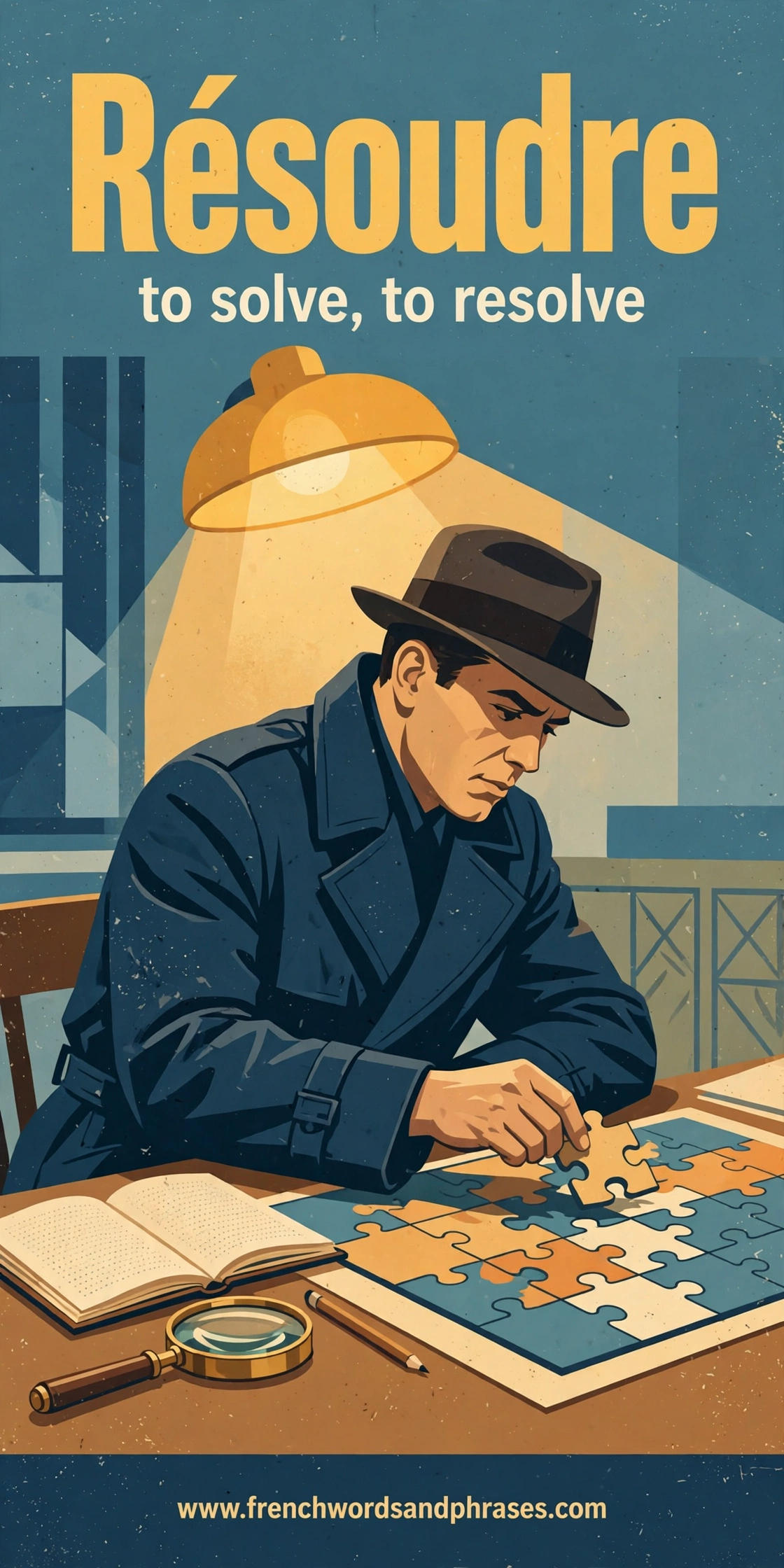
Résoudre means to solve, to resolve — to untie a problem until it comes apart in your hands: a puzzle solved, an equation resolved, a difficulty dissolved; and se résoudre à is to bring yourself, at last, to do the hard thing.
A detective over a cold case file, a schoolboy over an equation, a committee over a quarrel that has lasted ten years — résoudre is the verb of the knot undone: whatever it touches stops being a problem and becomes an answer.
In this guide, you’ll learn how to conjugate résoudre in all the major French tenses and moods. Explore complete conjugation tables, French examples, English translations, and practice quizzes.
Understanding the French Verb Résoudre
Résoudre is an irregular French verb ending in -dre, conjugated like absoudre — the stem résolv- before vowels (nous résolvons), résou- before consonants (je résous), and the past participle is résolu.
It means to solve, to resolve. Two lives: the life of problems — résoudre un problème, une énigme, une équation, un conflit — where the verb means to solve and settle; and the inner life, where se résoudre à faire quelque chose is to make up your mind to do it, usually something difficult or sad. The noun une résolution covers both the solution’s cousin, the decision, and the New Year’s promise.
Verb classification: Irregular (-dre, like absoudre)
Auxiliary verb: Avoir
Past participle: résolu
Present participle: résolvant
English equivalents: To solve, to resolve, to settle; résoudre un problème — to solve a problem; résoudre une équation — to solve an equation; résoudre un conflit — to resolve a conflict; se résoudre à partir — to resolve to leave, to bring oneself to leave; une résolution — a resolution, a decision.
One important detail: résoudre follows absoudre exactly — present je résous, tu résous, il résout, but nous résolvons, vous résolvez, ils résolvent, the v returning wherever the ending begins with a vowel sound. The past participle is résolu (résolue, résolus, résolues), and the passé simple runs je résolus, il résolut. The reflexive twin matters as much as the verb: se résoudre à — elle s’est résolue à partir, she brought herself to leave — takes être and agrees.
Experience the Word
Résoudre is the verb of the knot coming undone — the moment the problem that filled the room shrinks back into an answer on one line.
Imagine the schoolboy at the kitchen table, three evenings defeated by the same equation — and then, between two sips of soup, the step he was missing simply appears. Il a résolu le problème, and his shout brings the whole family to the door.
The knot was never cut, only untied. Now it lies open — résolu — and the evening belongs to him again.
How to Conjugate Résoudre: Complete French Conjugation Guide
Let’s explore every major conjugation of résoudre, beginning with the indicative mood.
How to Conjugate Résoudre in the Indicative Mood
The indicative mood is used to express facts, observations, actions, and events.
How to Conjugate Résoudre in the Present Tense (Présent)
Used for actions happening now, habitual actions, and general truths.
| Subject | Conjugation |
|---|---|
| je | résous |
| tu | résous |
| il / elle | résout |
| nous | résolvons |
| vous | résolvez |
| ils / elles | résolvent |
Example
Elle résout les mots croisés en dix minutes.
She solves the crossword in ten minutes.
Quick Quiz 1
Complete the sentence:
Nous ______ les problèmes un par un.
Reveal the answer
résolvons
Nous résolvons les problèmes un par un.
We solve the problems one by one.
How to Conjugate Résoudre in the Passé Composé
Used for completed actions in the past. Résoudre takes the auxiliary verb avoir.
| Subject | Conjugation |
|---|---|
| j’ | ai résolu |
| tu | as résolu |
| il / elle | a résolu |
| nous | avons résolu |
| vous | avez résolu |
| ils / elles | ont résolu |
Example
Ils ont résolu le conflit par une longue discussion.
They resolved the conflict with a long discussion.
How to Conjugate Résoudre in the Imparfait (Imperfect Tense)
Used for habitual past actions, descriptions, and ongoing situations in the past.
| Subject | Conjugation |
|---|---|
| je | résolvais |
| tu | résolvais |
| il / elle | résolvait |
| nous | résolvions |
| vous | résolviez |
| ils / elles | résolvaient |
Example
Chaque soir, il résolvait un problème de mathématiques.
Every evening, he used to solve a maths problem.
Quick Quiz 2
Choose the correct form:
She solved the riddle.
Elle ______ l’énigme. (a résolu / est résolu)
Reveal the answer
a résolu
Elle a résolu l’énigme.
Résoudre takes avoir.
How to Conjugate Résoudre in the Plus-que-parfait
Used to describe an action that had already been completed before another past event.
| Subject | Conjugation |
|---|---|
| j’ | avais résolu |
| tu | avais résolu |
| il / elle | avait résolu |
| nous | avions résolu |
| vous | aviez résolu |
| ils / elles | avaient résolu |
Example
Elle avait résolu l’énigme avant tout le monde.
She had solved the riddle before everyone else.
How to Conjugate Résoudre in the Passé Simple
Primarily used in formal writing, literature, and historical narratives. It is rarely used in everyday conversation.
| Subject | Conjugation |
|---|---|
| je | résolus |
| tu | résolus |
| il / elle | résolut |
| nous | résolûmes |
| vous | résolûtes |
| ils / elles | résolurent |
Example
Le détective résolut l’affaire en trois jours.
The detective solved the case in three days.
How to Conjugate Résoudre in the Passé Antérieur
A literary tense used to express an action completed immediately before another past action, generally in the passé simple.
| Subject | Conjugation |
|---|---|
| j’ | eus résolu |
| tu | eus résolu |
| il / elle | eut résolu |
| nous | eûmes résolu |
| vous | eûtes résolu |
| ils / elles | eurent résolu |
Example
Quand il eut résolu l’équation, le professeur sourit.
When he had solved the equation, the teacher smiled.
How to Conjugate Résoudre in the Future Tense (Futur Simple)
Used to describe actions that will take place in the future.
| Subject | Conjugation |
|---|---|
| je | résoudrai |
| tu | résoudras |
| il / elle | résoudra |
| nous | résoudrons |
| vous | résoudrez |
| ils / elles | résoudront |
Example
Nous résoudrons ce problème ensemble demain.
We will solve this problem together tomorrow.
How to Conjugate Résoudre in the Futur Antérieur (Future Perfect)
Used for an action that will have been completed before a particular point in the future.
| Subject | Conjugation |
|---|---|
| j’ | aurai résolu |
| tu | auras résolu |
| il / elle | aura résolu |
| nous | aurons résolu |
| vous | aurez résolu |
| ils / elles | auront résolu |
Example
À la fin de la réunion, ils auront résolu la question des horaires.
By the end of the meeting, they will have settled the question of the timetable.
How to Conjugate Résoudre in the Near Future (Futur Proche)
Used to describe something that is going to happen soon. Formed with aller + infinitive.
| Subject | Conjugation |
|---|---|
| je | vais résoudre |
| tu | vas résoudre |
| il / elle | va résoudre |
| nous | allons résoudre |
| vous | allez résoudre |
| ils / elles | vont résoudre |
Example
Tu vas résoudre cette énigme en une minute, je le sais.
You are going to solve this riddle in a minute, I know it.
How to Conjugate Résoudre in the Conditional Mood
The conditional mood expresses what would happen under certain circumstances. It is also frequently used to make polite requests or express wishes.
How to Conjugate Résoudre in the Present Conditional
| Subject | Conjugation |
|---|---|
| je | résoudrais |
| tu | résoudrais |
| il / elle | résoudrait |
| nous | résoudrions |
| vous | résoudriez |
| ils / elles | résoudraient |
Example
Avec plus de données, on résoudrait le problème facilement.
With more data, we would solve the problem easily.
How to Conjugate Résoudre in the Past Conditional
| Subject | Conjugation |
|---|---|
| j’ | aurais résolu |
| tu | aurais résolu |
| il / elle | aurait résolu |
| nous | aurions résolu |
| vous | auriez résolu |
| ils / elles | auraient résolu |
Example
Elle aurait résolu l’affaire si elle avait eu le dossier complet.
She would have solved the case if she had had the complete file.
Résoudre in the Literary Past Conditional Form
This less common literary form uses the imperfect subjunctive of avoir.
| Subject | Conjugation |
|---|---|
| j’ | eusse résolu |
| tu | eusses résolu |
| il / elle | eût résolu |
| nous | eussions résolu |
| vous | eussiez résolu |
| ils / elles | eussent résolu |
Example
Le ministre souhaitait que l’on résolût la crise avant l’été.
The minister wished that the crisis would be resolved before the summer.
How to Conjugate Résoudre in the Subjunctive Mood
The subjunctive is used to express wishes, emotions, doubts, necessity, and uncertainty. It frequently follows expressions such as il faut que (it is necessary that) or bien que (although).
How to Conjugate Résoudre in the Present Subjunctive
| Subject | Conjugation |
|---|---|
| que je | résolve |
| que tu | résolves |
| qu’il / qu’elle | résolve |
| que nous | résolvions |
| que vous | résolviez |
| qu’ils / qu’elles | résolvent |
Example
Il faut que tu résolves ce problème avant vendredi.
You must solve this problem before Friday.
Quick Quiz 3
Complete the sentence using the subjunctive:
Il faut que vous ______ le conflit avant lundi.
Reveal the answer
résolviez
Il faut que vous résolviez le conflit avant lundi.
You must resolve the conflict before Monday.
How to Conjugate Résoudre in the Imperfect Subjunctive
A literary tense, rarely encountered in modern spoken French.
| Subject | Conjugation |
|---|---|
| que je | résolusse |
| que tu | résolusses |
| qu’il / qu’elle | résolût |
| que nous | résolussions |
| que vous | résolussiez |
| qu’ils / qu’elles | résolussent |
Example
Le professeur voulait que nous résolussions l’exercice sans aide.
The teacher wanted us to solve the exercise without help.
How to Conjugate Résoudre in the Pluperfect Subjunctive
A literary construction used to express an action completed before another past action.
| Subject | Conjugation |
|---|---|
| que j’ | eusse résolu |
| que tu | eusses résolu |
| qu’il / qu’elle | eût résolu |
| que nous | eussions résolu |
| que vous | eussiez résolu |
| qu’ils / qu’elles | eussent résolu |
Example
On doutait qu’il eût résolu l’énigme seul.
People doubted that he had solved the riddle on his own.
How to Conjugate Résoudre in the Past Subjunctive
| Subject | Conjugation |
|---|---|
| que j’ | aie résolu |
| que tu | aies résolu |
| qu’il / qu’elle | ait résolu |
| que nous | ayons résolu |
| que vous | ayez résolu |
| qu’ils / qu’elles | aient résolu |
Example
Je suis content que vous ayez résolu le conflit.
I am glad you resolved the conflict.
How to Conjugate Résoudre in the Imperative
The imperative is used to give commands, instructions, invitations, or suggestions. Subject pronouns are omitted.
How to Conjugate Résoudre in the Present Imperative
| Person | Conjugation |
|---|---|
| (tu) | résous |
| (nous) | résolvons |
| (vous) | résolvez |
Example
Résous ce problème à ta façon, calmement.
Solve this problem in your own way, calmly.
Quick Quiz 4
How would you say Solve this problem (tu form)?
Reveal the answer
Résous ce problème !
French Participles of Résoudre
Participles are verb forms that can be used in compound tenses and other grammatical constructions.
Present Participle of Résoudre
résolvant
En résolvant l’équation, elle a trouvé une erreur dans l’énoncé.
While solving the equation, she found a mistake in the question.
Past Participle of Résoudre
résolu
Résolu en une heure, le problème a fait rire toute la classe.
Solved in an hour, the problem made the whole class laugh.
Résoudre in Everyday French: Real-Life Examples
Now that you know the conjugations, let’s see how résoudre appears in everyday French.
Example 1 — Present
Elle résout les mots croisés en dix minutes.
She solves the crossword in ten minutes.
Example 2 — Passé composé
Ils ont résolu le conflit par une longue discussion.
They resolved the conflict with a long discussion.
Example 3 — Imparfait
Il résolvait un problème de mathématiques chaque soir.
He used to solve a maths problem every evening.
Example 4 — Future
Nous résoudrons ce problème ensemble.
We will solve this problem together.
Example 5 — Conditional
On résoudrait le problème avec plus de données.
We would solve the problem with more data.
Example 6 — Imperative
Résous ce problème calmement.
Solve this problem calmly.
Beyond Translation: The Meaning of Résoudre
English resolve and solve are this verb’s own children: Latin solvere, to loosen, to untie, stands behind all of them, and the re- of résoudre adds the sense of loosening completely, down to the last knot.
From the equation to the quarrel, it is the same untying.
French keeps the picture honest: a problem is a knot — problème, énigme, conflit — and résoudre is the patient hand that works it open, or, in se résoudre à, the will that finally unties itself.
How to Remember the French Verb Résoudre
Remember it this way: Résoudre is about the knot coming undone at the kitchen table — solve, resolve, untie.
- Conjugated like absoudre: je résous, il résout — but nous résolvons, ils résolvent, with the v.
- Past participle résolu (résolue, résolus, résolues); passé simple je résolus.
- The reflexive twin: se résoudre à faire quelque chose — to bring oneself to do it (être, with agreement).
The key idea is the knot coming undone at the kitchen table — solve, resolve, untie.
Test Your Knowledge of Résoudre
Let’s see how much you’ve learned. Try answering these questions before revealing the answers.
Question 1
Which verb does résoudre follow exactly?
Reveal the answer
Absoudre — je résous, il résout, nous résolvons, past participle résolu.
Question 2
How do you say We will solve this problem together in French?
Reveal the answer
Nous résoudrons ce problème ensemble.
Question 3
Translate: They resolved the conflict with a long discussion.
Reveal the answer
Ils ont résolu le conflit par une longue discussion.
Question 4
What is the past participle of résoudre?
Reveal the answer
Résolu — résolue, résolus, résolues.
Question 5
Complete the sentence:
Il faut que tu ______ ce problème avant vendredi.
Reveal the answer
résolves
Il faut que tu résolves ce problème avant vendredi.
You must solve this problem before Friday.
Your Final Challenge
Can You Use It?
How would you say this in French?
Every problem solved is a knot untied, and every knot untied makes the day lighter.
Reveal the answer
Chaque problème résolu est un nœud dénoué, et chaque nœud dénoué rend la journée plus légère.
Every problem solved is a knot untied, and every knot untied makes the day lighter.
A little French. A little curiosity. A richer everyday life.
LEARN FRENCH ONE WORD AT A TIME




