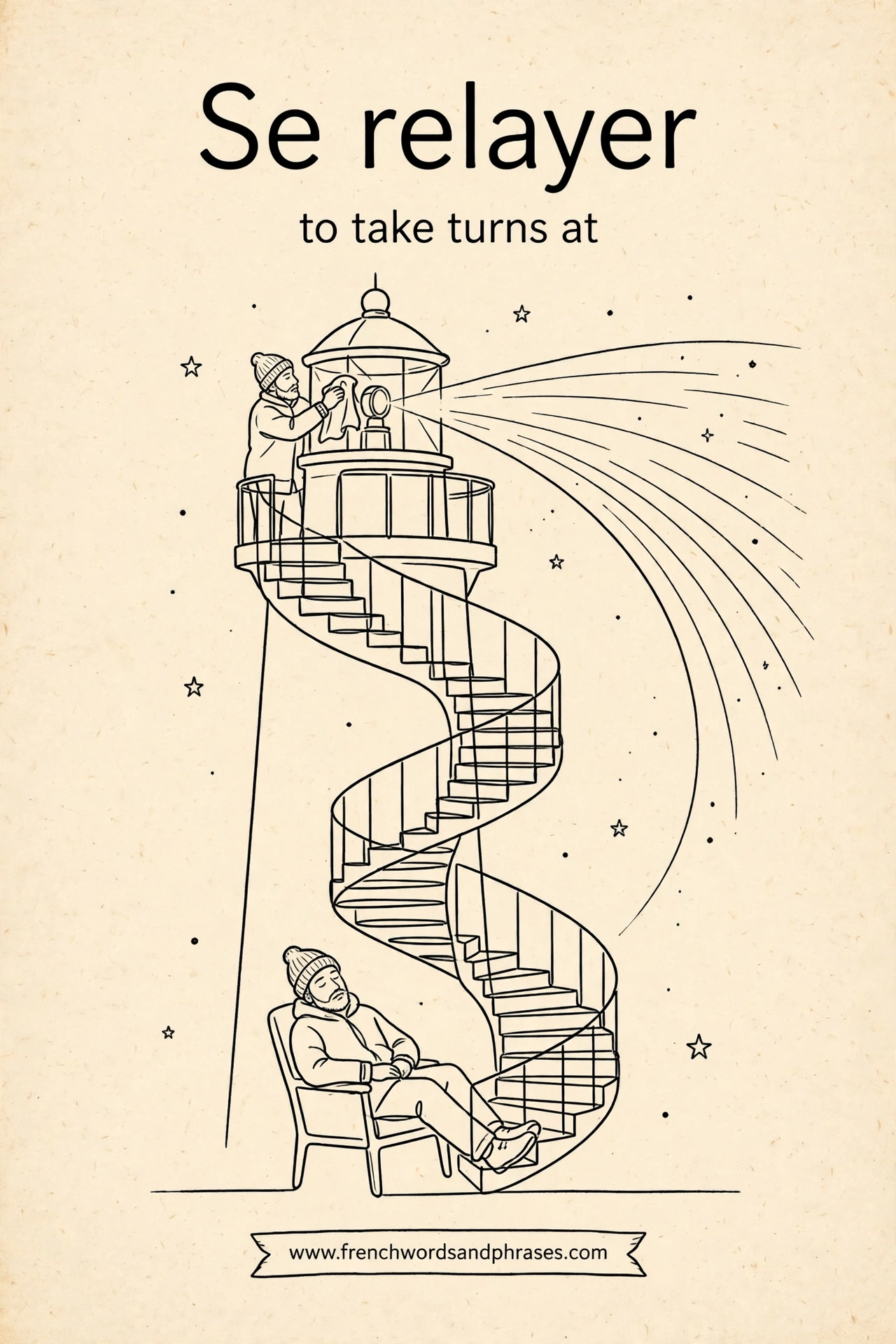
A French Word to Live By
How to Conjugate Relayer in French
/ʁə.lɛ.je/
Relayer means to relay, to relieve — to take over from someone at the exact point where their strength, or their leg of the journey, runs out.
A baton changing hands at full sprint, a fresh driver taking the wheel at midnight, a story passing from screen to screen — relayer is the verb of the hand-over: nothing stops, only the carrier changes.
In this guide, you’ll learn how to conjugate relayer in all the major French tenses and moods. Explore complete conjugation tables, French examples, English translations, and practice quizzes.
Understanding the French Verb Relayer
Relayer is a regular French verb belonging to the first group of verbs, those ending in-er.
It means to relay, to relieve. It moves between three worlds that share one picture: sport, where a runner takes the baton; work and travel, where a fresh colleague or driver takes over a shift or a wheel; and the media, where newspapers and social networks relay a piece of news from hand to hand until everyone has seen it.
Verb classification: First group (-er)
Auxiliary verb: Avoir
Past participle: relayé
Present participle: relayant
English equivalents: To relay, to take over from, to relieve; relayer un coureur — to take over from a runner; relayer qqn au volant — to relieve someone at the wheel; relayer une information — to relay, to pass on a piece of news; un relais — a relay, a staging post; se relayer — to take turns (see its own entry).
One important detail: relayer is a -oyer verb — the y turns into i wherever the next syllable is mute: je relaie, tu relaies, il relaie, ils relaient, and all through the future and conditional, je relaierai, je relaierais. The y survives wherever the ending is sounded: nous relayons, vous relayez, je relayais, and in the present participle, en relayant. The subjunctive splits along the same line: que je relaie, but que nous relayions. Past participle relayé.
Experience the Word
Relayer is the verb of continuity — the work never stops, it simply changes hands.
Imagine a night drive across France. At two in the morning, in a motorway service area, the father rubs his eyes and pulls over; the mother slides into the driving seat — elle le relaie — and the car rolls back into the dark without the journey ever really pausing.
The journey has not stopped for a second. It has been relayed — relayé — from one pair of hands to another.
How to Conjugate Relayer: Complete French Conjugation Guide
Let’s explore every major conjugation of relayer, beginning with the indicative mood.
How to Conjugate Relayer in the Indicative Mood
The indicative mood is used to express facts, observations, actions, and events.
How to Conjugate Relayer in the Present Tense (Présent)
Used for actions happening now, habitual actions, and general truths.
| Subject | Conjugation |
|---|---|
| je | relaie |
| tu | relaies |
| il / elle | relaie |
| nous | relayons |
| vous | relayez |
| ils / elles | relaient |
Example
Au kilomètre vingt, un coéquipier relaie le coureur fatigué.
At kilometre twenty, a teammate takes over from the tired runner.
Quick Quiz 1
Complete the sentence:
Nous ______ les équipes toutes les deux heures.
Reveal the answer
relayons
Nous relayons les équipes toutes les deux heures.
We relieve the teams every two hours.
How to Conjugate Relayer in the Passé Composé
Used for completed actions in the past. Relayer takes the auxiliary verb avoir.
| Subject | Conjugation |
|---|---|
| j’ | ai relayé |
| tu | as relayé |
| il / elle | a relayé |
| nous | avons relayé |
| vous | avez relayé |
| ils / elles | ont relayé |
Example
Les journaux ont relayé l’information dans tout le pays.
The newspapers relayed the news across the whole country.
How to Conjugate Relayer in the Imparfait (Imperfect Tense)
Used for habitual past actions, descriptions, and ongoing situations in the past.
| Subject | Conjugation |
|---|---|
| je | relayais |
| tu | relayais |
| il / elle | relayait |
| nous | relayions |
| vous | relayiez |
| ils / elles | relayaient |
Example
Pendant la nuit, deux gardiens relayaient l’équipe de jour à l’entrée de l’usine.
During the night, two guards relieved the day team at the factory entrance.
Quick Quiz 2
Choose the correct form:
The press relayed our appeal.
La presse ______ notre appel. (a relayé / est relayé)
Reveal the answer
a relayé
La presse a relayé notre appel.
Relayer takes avoir.
How to Conjugate Relayer in the Plus-que-parfait
Used to describe an action that had already been completed before another past event.
| Subject | Conjugation |
|---|---|
| j’ | avais relayé |
| tu | avais relayé |
| il / elle | avait relayé |
| nous | avions relayé |
| vous | aviez relayé |
| ils / elles | avaient relayé |
Example
Elle avait relayé son frère au comptoir avant de partir.
She had taken over from her brother at the counter before leaving.
How to Conjugate Relayer in the Passé Simple
Primarily used in formal writing, literature, and historical narratives. It is rarely used in everyday conversation.
| Subject | Conjugation |
|---|---|
| je | relayai |
| tu | relayas |
| il / elle | relaya |
| nous | relayâmes |
| vous | relayâtes |
| ils / elles | relayèrent |
Example
Le second coureur relaya son partenaire sans perdre une seconde.
The second runner took over from his partner without losing a second.
How to Conjugate Relayer in the Passé Antérieur
A literary tense used to express an action completed immediately before another past action, generally in the passé simple.
| Subject | Conjugation |
|---|---|
| j’ | eus relayé |
| tu | eus relayé |
| il / elle | eut relayé |
| nous | eûmes relayé |
| vous | eûtes relayé |
| ils / elles | eurent relayé |
Example
Quand l’équipe de nuit eut relayé celle de jour, l’usine continua de tourner.
When the night team had relieved the day team, the factory kept running.
How to Conjugate Relayer in the Future Tense (Futur Simple)
Used to describe actions that will take place in the future.
| Subject | Conjugation |
|---|---|
| je | relaierai |
| tu | relaieras |
| il / elle | relaiera |
| nous | relaierons |
| vous | relaierez |
| ils / elles | relaieront |
Example
Demain, je te relaierai au volant après Lyon.
Tomorrow, I will take over from you at the wheel after Lyon.
How to Conjugate Relayer in the Futur Antérieur (Future Perfect)
Used for an action that will have been completed before a particular point in the future.
| Subject | Conjugation |
|---|---|
| j’ | aurai relayé |
| tu | auras relayé |
| il / elle | aura relayé |
| nous | aurons relayé |
| vous | aurez relayé |
| ils / elles | auront relayé |
Example
À minuit, les bénévoles auront relayé trois équipes entières.
By midnight, the volunteers will have relieved three whole teams.
How to Conjugate Relayer in the Near Future (Futur Proche)
Used to describe something that is going to happen soon. Formed with aller + infinitive.
| Subject | Conjugation |
|---|---|
| je | vais relayer |
| tu | vas relayer |
| il / elle | va relayer |
| nous | allons relayer |
| vous | allez relayer |
| ils / elles | vont relayer |
Example
Attention, le prochain coureur va relayer le capitaine.
Careful, the next runner is going to take over from the captain.
How to Conjugate Relayer in the Conditional Mood
The conditional mood expresses what would happen under certain circumstances. It is also frequently used to make polite requests or express wishes.
How to Conjugate Relayer in the Present Conditional
| Subject | Conjugation |
|---|---|
| je | relaierais |
| tu | relaierais |
| il / elle | relaierait |
| nous | relaierions |
| vous | relaieriez |
| ils / elles | relaieraient |
Example
Avec plus de bénévoles, nous relaierions les équipes toutes les deux heures.
With more volunteers, we would relieve the teams every two hours.
How to Conjugate Relayer in the Past Conditional
| Subject | Conjugation |
|---|---|
| j’ | aurais relayé |
| tu | aurais relayé |
| il / elle | aurait relayé |
| nous | aurions relayé |
| vous | auriez relayé |
| ils / elles | auraient relayé |
Example
Il aurait relayé son collègue si la réunion avait fini plus tôt.
He would have taken over from his colleague if the meeting had ended earlier.
Relayer in the Literary Past Conditional Form
This less common literary form uses the imperfect subjunctive of avoir.
| Subject | Conjugation |
|---|---|
| j’ | eusse relayé |
| tu | eusses relayé |
| il / elle | eût relayé |
| nous | eussions relayé |
| vous | eussiez relayé |
| ils / elles | eussent relayé |
Example
Elle l’eût relayé au volant sans ce mal de tête.
She would have relieved him at the wheel without that headache.
How to Conjugate Relayer in the Subjunctive Mood
The subjunctive is used to express wishes, emotions, doubts, necessity, and uncertainty. It frequently follows expressions such as il faut que (it is necessary that) or bien que (although).
How to Conjugate Relayer in the Present Subjunctive
| Subject | Conjugation |
|---|---|
| que je | relaie |
| que tu | relaies |
| qu’il / qu’elle | relaie |
| que nous | relayions |
| que vous | relayiez |
| qu’ils / qu’elles | relaient |
Example
Il faut qu’un autre chauffeur relaie Karim avant minuit.
Another driver must take over from Karim before midnight.
Quick Quiz 3
Complete the sentence using the subjunctive:
Il faut que tu ______ ton collègue à minuit.
Reveal the answer
relaies
Il faut que tu relaies ton collègue à minuit.
You must take over from your colleague at midnight.
How to Conjugate Relayer in the Imperfect Subjunctive
A literary tense, rarely encountered in modern spoken French.
| Subject | Conjugation |
|---|---|
| que je | relayasse |
| que tu | relayasses |
| qu’il / qu’elle | relayât |
| que nous | relayassions |
| que vous | relayassiez |
| qu’ils / qu’elles | relayassent |
Example
Le patron souhaitait que je relayasse mon collègue dès le soir même.
The boss wanted me to take over from my colleague that very evening.
How to Conjugate Relayer in the Pluperfect Subjunctive
A literary construction used to express an action completed before another past action.
| Subject | Conjugation |
|---|---|
| que j’ | eusse relayé |
| que tu | eusses relayé |
| qu’il / qu’elle | eût relayé |
| que nous | eussions relayé |
| que vous | eussiez relayé |
| qu’ils / qu’elles | eussent relayé |
Example
On racontait que les coureurs eussent relayé le témoin sous la pluie battante.
People said the runners had passed the baton in the driving rain.
How to Conjugate Relayer in the Past Subjunctive
| Subject | Conjugation |
|---|---|
| que j’ | aie relayé |
| que tu | aies relayé |
| qu’il / qu’elle | ait relayé |
| que nous | ayons relayé |
| que vous | ayez relayé |
| qu’ils / qu’elles | aient relayé |
Example
Je suis content que la presse ait relayé notre appel.
I am glad the press relayed our appeal.
How to Conjugate Relayer in the Imperative
The imperative is used to give commands, instructions, invitations, or suggestions. Subject pronouns are omitted.
How to Conjugate Relayer in the Present Imperative
| Person | Conjugation |
|---|---|
| (tu) | relaie |
| (nous) | relayons |
| (vous) | relayez |
Example
Relaie-moi au comptoir à midi précises !
Take over from me at the counter at exactly noon!
Quick Quiz 4
How would you say Take over from me at the counter (tu form)?
Reveal the answer
Relaie-moi au comptoir !
French Participles of Relayer
Participles are verb forms that can be used in compound tenses and other grammatical constructions.
Present Participle of Relayer
relayant
En relayant l’alerte, les réseaux sociaux ont mobilisé tout le quartier.
By relaying the alert, social networks mobilised the whole neighbourhood.
Past Participle of Relayer
relayé
Relayée par des milliers d’internautes, la vidéo a fait le tour du monde.
Relayed by thousands of internet users, the video went around the world.
Relayer in Everyday French: Real-Life Examples
Now that you know the conjugations, let’s see how relayer appears in everyday French.
Example 1 — Present
Je relaie mon collègue à midi.
I take over from my colleague at noon.
Example 2 — Passé composé
Les journaux ont relayé l’information.
The newspapers relayed the news.
Example 3 — Imparfait
Les gardiens relayaient l’équipe de jour.
The guards relieved the day team.
Example 4 — Future
Je te relaierai au volant après Lyon.
I will take over from you at the wheel after Lyon.
Example 5 — Conditional
Nous relaierions les équipes plus souvent avec plus de monde.
We would relieve the teams more often with more people.
Example 6 — Imperative
Relayez les coureurs fatigués !
Relieve the tired runners!
Beyond Translation: The Meaning of Relayer
English relay is this very word, borrowed from French — and behind it stands the relais de poste, the staging post on the old coaching routes where tired horses were swapped for fresh ones and the coach rolled on.
Fresh horses, same journey.
The verb never forgot that picture: a runner, a driver, a nurse, a news story — each is a horse changed at the post, so that the road itself never has to stop.
How to Remember the French Verb Relayer
Remember it this way: Relayer is about fresh horses waiting at the staging post.
- -oyer spelling: je relaie with an i, but nous relayons with a y.
- One picture covers every sense: fresh horses at the staging post — the journey continues, the carrier changes.
- Past participle relayé: les journaux ont relayé l’information.
The key idea is fresh horses waiting at the staging post.
Test Your Knowledge of Relayer
Let’s see how much you’ve learned. Try answering these questions before revealing the answers.
Question 1
Why do we write je relaie but nous relayons?
Reveal the answer
The -oyer rule — y becomes i before a mute ending (je relaie, ils relaient), and stays y where the ending is sounded (nous relayons, en relayant).
Question 2
How do you say The newspapers relayed the news in French?
Reveal the answer
Les journaux ont relayé l’information.
Question 3
Translate: I will take over from you at the wheel after Lyon.
Reveal the answer
Je te relaierai au volant après Lyon.
Question 4
What is the past participle of relayer?
Reveal the answer
Relayé.
Question 5
Complete the sentence:
Il faut qu’un autre chauffeur ______ Karim avant minuit.
Reveal the answer
relaie
Il faut qu’un autre chauffeur relaie Karim avant minuit.
Another driver must take over from Karim before midnight.
Your Final Challenge
Can You Use It?
How would you say this in French?
The runner holds out the baton without slowing down, and his teammate relays the effort towards the finish line.
Reveal the answer
Le coureur tend le témoin sans ralentir, et son coéquipier relaie l’effort vers la ligne d’arrivée.
The runner holds out the baton without slowing down, and his teammate relays the effort towards the finish line.
A little French. A little curiosity. A richer everyday life.
LEARN FRENCH ONE WORD AT A TIME