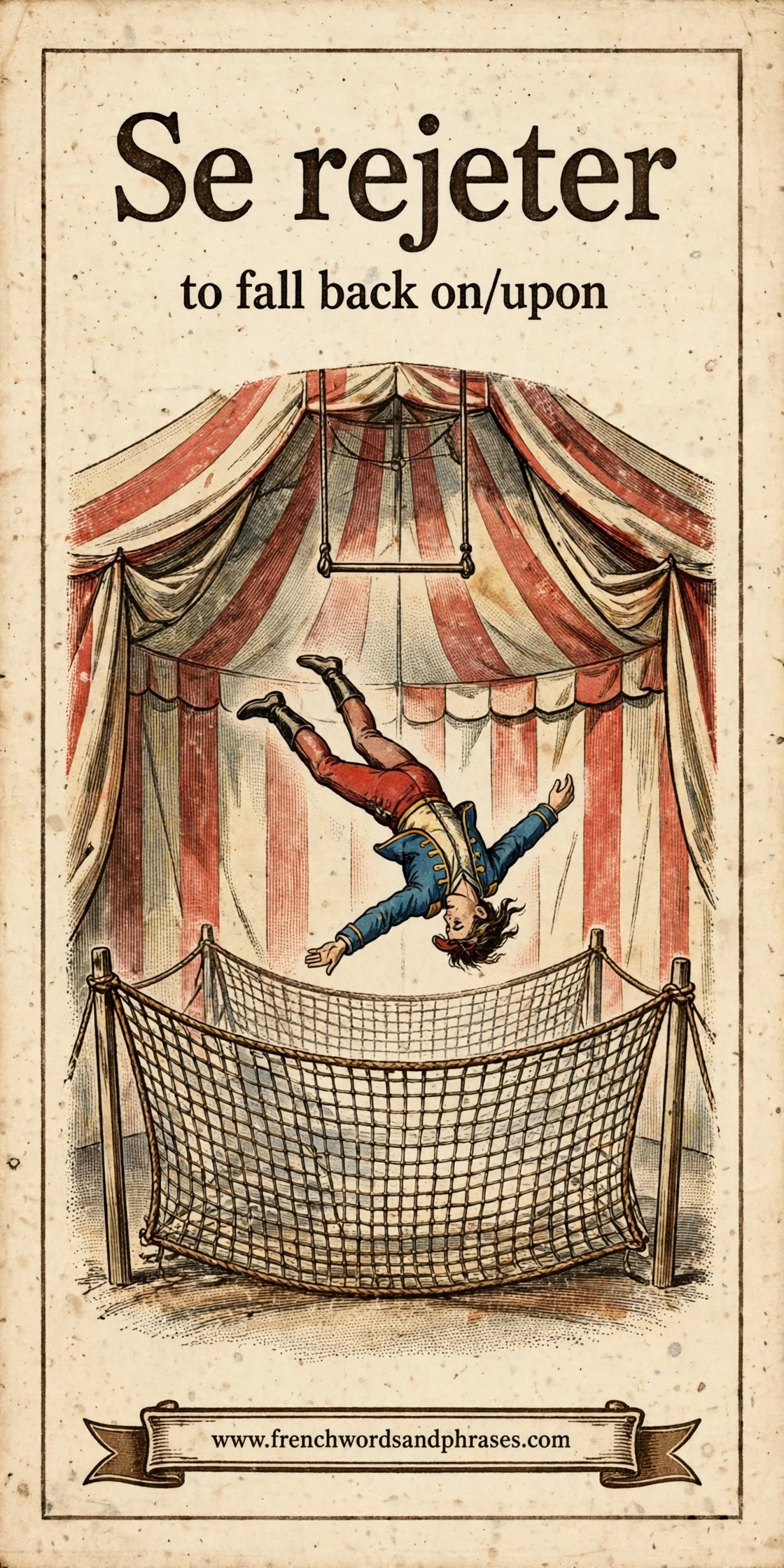
A French Word to Live By
How to Conjugate Rejeter in French
/ʁə.ʒə.te/
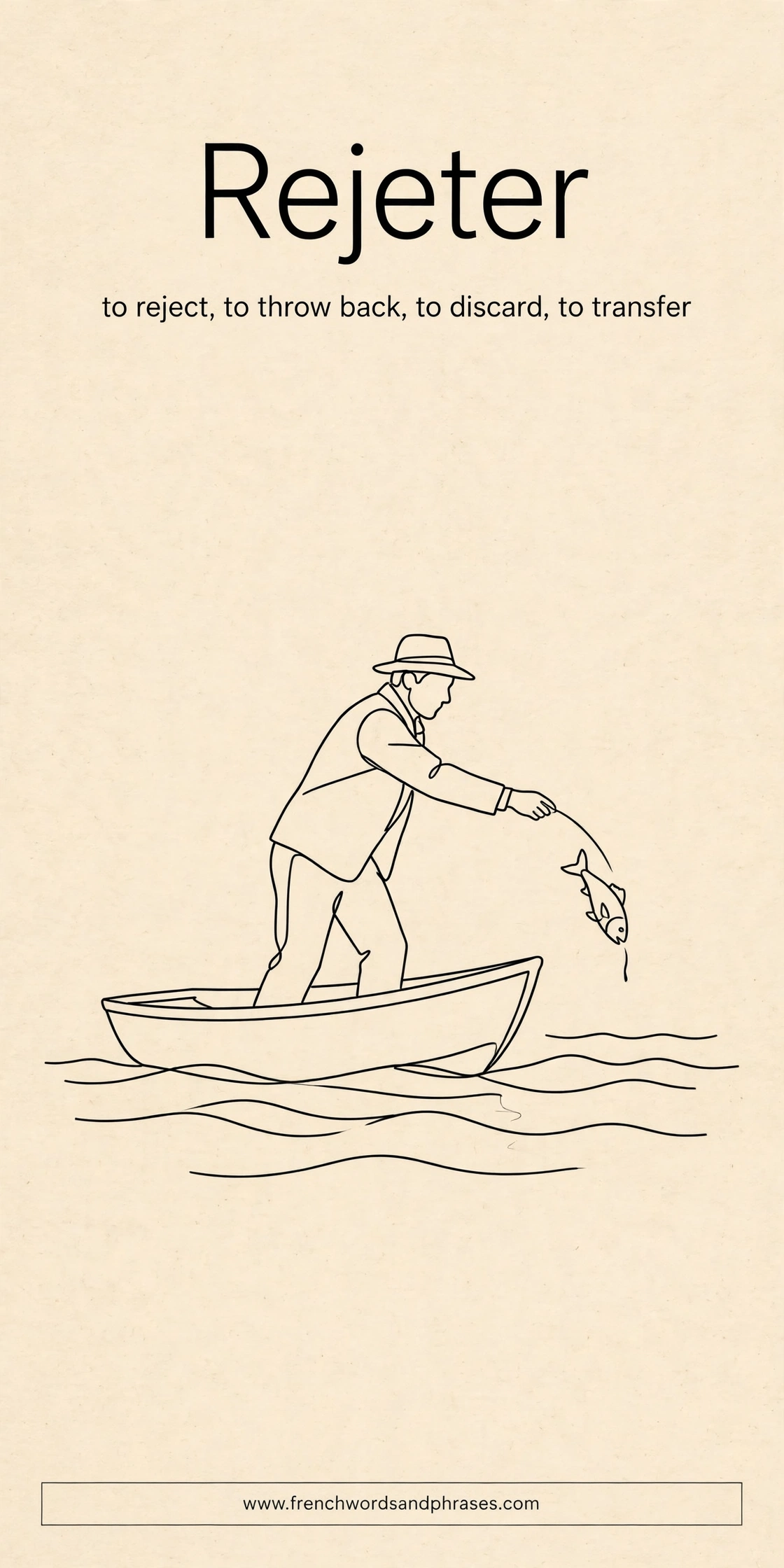
Rejeter means to reject, to throw back, to discard, to transfer — to push something away from you: back to the sea, out of the body, off the agenda, onto someone else.
The sea returning a wreck to the beach, a body refusing a transplanted heart, an assembly voting a proposal down — rejeter is the verb of refusal with momentum: whatever arrives is thrown back the way it came.
In this guide, you’ll learn how to conjugate rejeter in all the major French tenses and moods. Explore complete conjugation tables, French examples, English translations, and practice quizzes.
Understanding the French Verb Rejeter
Rejeter is a regular French verb belonging to the first group of verbs, those ending in-er.
It means to reject, to throw back, to discard, to transfer. It is the verb of every refusal that pushes back: medicine (le corps rejette la greffe), politics (rejeter une motion), the sea (rejeter une épave sur la plage) and the conscience (rejeter la faute sur un autre). English splits these between reject, throw back and shift; French throws them all with one verb.
Verb classification: First group (-er)
Auxiliary verb: Avoir
Past participle: rejeté
Present participle: rejetant
English equivalents: To reject, to throw back, to discard, to transfer; la mer rejette les épaves — the sea throws back the wreckage; rejeter une greffe — to reject a transplant; rejeter une proposition — to reject a proposal; rejeter la faute sur quelqu’un — to shift the blame onto someone; rejeter un appel — to dismiss an appeal.
One important detail: rejeter is a jeter-type verb — the single t of the infinitive doubles wherever the next syllable is mute: je rejette, tu rejettes, il rejette, ils rejettent, and all through the future and conditional: je rejetterai, je rejetterais. Where the ending is sounded, one t is enough: nous rejetons, vous rejetez, je rejetais, en rejetant. And the past participle never doubles: rejeté, with a single t — the throw is in the present, not in the result.
Experience the Word
Rejeter is refusal with a return address — nothing rejected simply vanishes; it goes back where it came from, or onto someone else.
Imagine the beach after a storm. All night the sea has worked the wreckage of a boat, and at dawn it rejette the timbers onto the sand, plank by plank, as if returning goods it never ordered. The village reads the shore like a letter: everything the sea refuses is delivered back by morning.
The sea keeps nothing it does not want. It has thrown it back — elle l’a rejeté sur le sable.
How to Conjugate Rejeter: Complete French Conjugation Guide
Let’s explore every major conjugation of rejeter, beginning with the indicative mood.
How to Conjugate Rejeter in the Indicative Mood
The indicative mood is used to express facts, observations, actions, and events.
How to Conjugate Rejeter in the Present Tense (Présent)
Used for actions happening now, habitual actions, and general truths.
| Subject | Conjugation |
|---|---|
| je | rejette |
| tu | rejettes |
| il / elle | rejette |
| nous | rejetons |
| vous | rejetez |
| ils / elles | rejettent |
Example
La mer rejette les épaves sur la plage.
The sea throws the wreckage back onto the beach.
Quick Quiz 1
Complete the sentence:
Nous ______ cette demande pour la deuxième fois.
Reveal the answer
rejetons
Nous rejetons cette demande pour la deuxième fois.
We are rejecting this request for the second time — one t, because the ending is sounded.
How to Conjugate Rejeter in the Passé Composé
Used for completed actions in the past. Rejeter takes the auxiliary verb avoir.
| Subject | Conjugation |
|---|---|
| j’ | ai rejeté |
| tu | as rejeté |
| il / elle | a rejeté |
| nous | avons rejeté |
| vous | avez rejeté |
| ils / elles | ont rejeté |
Example
L’assemblée a rejeté la proposition à une large majorité.
The assembly rejected the proposal by a large majority.
How to Conjugate Rejeter in the Imparfait (Imperfect Tense)
Used for habitual past actions, descriptions, and ongoing situations in the past.
| Subject | Conjugation |
|---|---|
| je | rejetais |
| tu | rejetais |
| il / elle | rejetait |
| nous | rejetions |
| vous | rejetiez |
| ils / elles | rejetaient |
Example
Son corps rejetait lentement le cœur greffé.
His body was slowly rejecting the transplanted heart.
Quick Quiz 2
Choose the correct form:
The committee rejected your project.
Le comité ______ ton projet. (a rejeté / est rejeté)
Reveal the answer
a rejeté
Le comité a rejeté ton projet.
Rejeter takes avoir, and the participle is rejeté with a single t.
How to Conjugate Rejeter in the Plus-que-parfait
Used to describe an action that had already been completed before another past event.
| Subject | Conjugation |
|---|---|
| j’ | avais rejeté |
| tu | avais rejeté |
| il / elle | avait rejeté |
| nous | avions rejeté |
| vous | aviez rejeté |
| ils / elles | avaient rejeté |
Example
Ils avaient rejeté toutes nos demandes avant la réunion.
They had rejected all our requests before the meeting.
How to Conjugate Rejeter in the Passé Simple
Primarily used in formal writing, literature, and historical narratives. It is rarely used in everyday conversation.
| Subject | Conjugation |
|---|---|
| je | rejetai |
| tu | rejetas |
| il / elle | rejeta |
| nous | rejetâmes |
| vous | rejetâtes |
| ils / elles | rejetèrent |
Example
Le tribunal rejeta l’appel sans débat.
The court dismissed the appeal without discussion.
How to Conjugate Rejeter in the Passé Antérieur
A literary tense used to express an action completed immediately before another past action, generally in the passé simple.
| Subject | Conjugation |
|---|---|
| j’ | eus rejeté |
| tu | eus rejeté |
| il / elle | eut rejeté |
| nous | eûmes rejeté |
| vous | eûtes rejeté |
| ils / elles | eurent rejeté |
Example
Quand la mer eut rejeté l’épave, les enfants accoururent.
When the sea had thrown back the wreck, the children ran up.
How to Conjugate Rejeter in the Future Tense (Futur Simple)
Used to describe actions that will take place in the future.
| Subject | Conjugation |
|---|---|
| je | rejetterai |
| tu | rejetteras |
| il / elle | rejettera |
| nous | rejetterons |
| vous | rejetterez |
| ils / elles | rejetteront |
Example
Le comité rejettera ce projet trop coûteux.
The committee will reject this overly expensive project.
How to Conjugate Rejeter in the Futur Antérieur (Future Perfect)
Used for an action that will have been completed before a particular point in the future.
| Subject | Conjugation |
|---|---|
| j’ | aurai rejeté |
| tu | auras rejeté |
| il / elle | aura rejeté |
| nous | aurons rejeté |
| vous | aurez rejeté |
| ils / elles | auront rejeté |
Example
À la fin du mois, ils auront rejeté trois versions du texte.
By the end of the month, they will have rejected three versions of the text.
How to Conjugate Rejeter in the Near Future (Futur Proche)
Used to describe something that is going to happen soon. Formed with aller + infinitive.
| Subject | Conjugation |
|---|---|
| je | vais rejeter |
| tu | vas rejeter |
| il / elle | va rejeter |
| nous | allons rejeter |
| vous | allez rejeter |
| ils / elles | vont rejeter |
Example
Tu vas rejeter cette offre ? Elle est excellente !
You are going to reject this offer? It is excellent!
How to Conjugate Rejeter in the Conditional Mood
The conditional mood expresses what would happen under certain circumstances. It is also frequently used to make polite requests or express wishes.
How to Conjugate Rejeter in the Present Conditional
| Subject | Conjugation |
|---|---|
| je | rejetterais |
| tu | rejetterais |
| il / elle | rejetterait |
| nous | rejetterions |
| vous | rejetteriez |
| ils / elles | rejetteraient |
Example
À ta place, je rejetterais cette demande sans hésiter.
In your place, I would reject this request without hesitating.
How to Conjugate Rejeter in the Past Conditional
| Subject | Conjugation |
|---|---|
| j’ | aurais rejeté |
| tu | aurais rejeté |
| il / elle | aurait rejeté |
| nous | aurions rejeté |
| vous | auriez rejeté |
| ils / elles | auraient rejeté |
Example
Nous aurions rejeté la faute sur le fournisseur.
We would have shifted the blame onto the supplier.
Rejeter in the Literary Past Conditional Form
This less common literary form uses the imperfect subjunctive of avoir.
| Subject | Conjugation |
|---|---|
| j’ | eusse rejeté |
| tu | eusses rejeté |
| il / elle | eût rejeté |
| nous | eussions rejeté |
| vous | eussiez rejeté |
| ils / elles | eussent rejeté |
Example
Il eût rejeté l’offre sans la pression de sa famille.
He would have rejected the offer without his family’s pressure.
How to Conjugate Rejeter in the Subjunctive Mood
The subjunctive is used to express wishes, emotions, doubts, necessity, and uncertainty. It frequently follows expressions such as il faut que (it is necessary that) or bien que (although).
How to Conjugate Rejeter in the Present Subjunctive
| Subject | Conjugation |
|---|---|
| que je | rejette |
| que tu | rejettes |
| qu’il / qu’elle | rejette |
| que nous | rejetions |
| que vous | rejetiez |
| qu’ils / qu’elles | rejettent |
Example
Il faut que le jury rejette cette preuve.
The jury must reject this evidence.
Quick Quiz 3
Complete the sentence using the subjunctive:
Il faut que vous ______ cette preuve.
Reveal the answer
rejetiez
Il faut que vous rejetiez cette preuve.
You must reject this evidence.
How to Conjugate Rejeter in the Imperfect Subjunctive
A literary tense, rarely encountered in modern spoken French.
| Subject | Conjugation |
|---|---|
| que je | rejetasse |
| que tu | rejetasses |
| qu’il / qu’elle | rejetât |
| que nous | rejetassions |
| que vous | rejetassiez |
| qu’ils / qu’elles | rejetassent |
Example
Je doutais qu’elle rejetât une si belle occasion.
I doubted she would reject such a fine opportunity.
How to Conjugate Rejeter in the Pluperfect Subjunctive
A literary construction used to express an action completed before another past action.
| Subject | Conjugation |
|---|---|
| que j’ | eusse rejeté |
| que tu | eusses rejeté |
| qu’il / qu’elle | eût rejeté |
| que nous | eussions rejeté |
| que vous | eussiez rejeté |
| qu’ils / qu’elles | eussent rejeté |
Example
On disait qu’il eût rejeté la faute sur son associé.
People said he had shifted the blame onto his partner.
How to Conjugate Rejeter in the Past Subjunctive
| Subject | Conjugation |
|---|---|
| que j’ | aie rejeté |
| que tu | aies rejeté |
| qu’il / qu’elle | ait rejeté |
| que nous | ayons rejeté |
| que vous | ayez rejeté |
| qu’ils / qu’elles | aient rejeté |
Example
Je regrette que le comité ait rejeté ton projet.
I am sorry the committee rejected your project.
How to Conjugate Rejeter in the Imperative
The imperative is used to give commands, instructions, invitations, or suggestions. Subject pronouns are omitted.
How to Conjugate Rejeter in the Present Imperative
| Person | Conjugation |
|---|---|
| (tu) | rejette |
| (nous) | rejetons |
| (vous) | rejetez |
Example
Rejette cette excuse, elle ne vaut rien !
Reject that excuse, it is worth nothing!
Quick Quiz 4
How would you say Reject that excuse (tu form)?
Reveal the answer
Rejette cette excuse !
French Participles of Rejeter
Participles are verb forms that can be used in compound tenses and other grammatical constructions.
Present Participle of Rejeter
rejetant
En rejetant la faute sur les autres, il a perdu ses amis.
By shifting the blame onto others, he lost his friends.
Past Participle of Rejeter
rejeté
Rejetée par la mer, l’épave gisait sur le sable.
Thrown back by the sea, the wreck lay on the sand.
Rejeter in Everyday French: Real-Life Examples
Now that you know the conjugations, let’s see how rejeter appears in everyday French.
Example 1 — Present
La mer rejette les épaves sur la plage.
The sea throws the wreckage back onto the beach.
Example 2 — Passé composé
L’assemblée a rejeté la proposition.
The assembly rejected the proposal.
Example 3 — Imparfait
Il rejetait toujours la faute sur les autres.
He always used to shift the blame onto others.
Example 4 — Future
Le comité rejettera ce projet.
The committee will reject this project.
Example 5 — Conditional
Je rejetterais cette demande sans hésiter.
I would reject this request without hesitating.
Example 6 — Imperative
Rejette cette excuse !
Reject that excuse!
Beyond Translation: The Meaning of Rejeter
English reject is the same throw — Latin reicere, to hurl back — but English has tidied the verb into offices and committees.
French rejeter still gets its feet wet.
The same word serves the sea casting up a wreck, the surgeon fearing a rejected graft, the deputy voting down a motion and the coward shifting blame — rejeter la faute sur quelqu’un — because in French all four are one gesture: throwing the thing away from yourself.
How to Remember the French Verb Rejeter
Remember it this way: Rejeter is about the sea throwing the wreck back onto the beach.
- Jeter-type doubling: je rejette with tt, but nous rejetons with one t — and the participle is always rejeté, single t.
- Four theatres, one gesture: the sea, the body, the assembly, the conscience.
- Its favourite transfer: rejeter la faute sur quelqu’un — to shift the blame onto someone.
The key idea is the sea throwing the wreck back onto the beach.
Test Your Knowledge of Rejeter
Let’s see how much you’ve learned. Try answering these questions before revealing the answers.
Question 1
Why does je rejette have two t’s but rejeté only one?
Reveal the answer
The jeter-type rule — t doubles before a mute syllable (je rejette, je rejetterai), but the past participle keeps a single t: rejeté.
Question 2
How do you say The sea throws the wreckage back onto the beach in French?
Reveal the answer
La mer rejette les épaves sur la plage.
Question 3
Translate: The assembly rejected the proposal.
Reveal the answer
L’assemblée a rejeté la proposition.
Question 4
What is the past participle of rejeter?
Reveal the answer
Rejeté — always with a single t.
Question 5
Complete the sentence:
Il faut que le jury ______ cette preuve.
Reveal the answer
rejette
Il faut que le jury rejette cette preuve.
The jury must reject this evidence.
Your Final Challenge
Can You Use It?
How would you say this in French?
The sea throws the wreck back onto the sand, as the conscience rejects the excuses it can no longer carry.
Reveal the answer
La mer rejette l’épave sur le sable, comme la conscience rejette les excuses qu’elle ne peut plus porter.
The sea throws the wreck back onto the sand, as the conscience rejects the excuses it can no longer carry.
A little French. A little curiosity. A richer everyday life.
LEARN FRENCH ONE WORD AT A TIME