A French Word to Live By
How to Conjugate Réincarcérer in French
/ʁe.ɛ̃.kaʁ.se.ʁe/
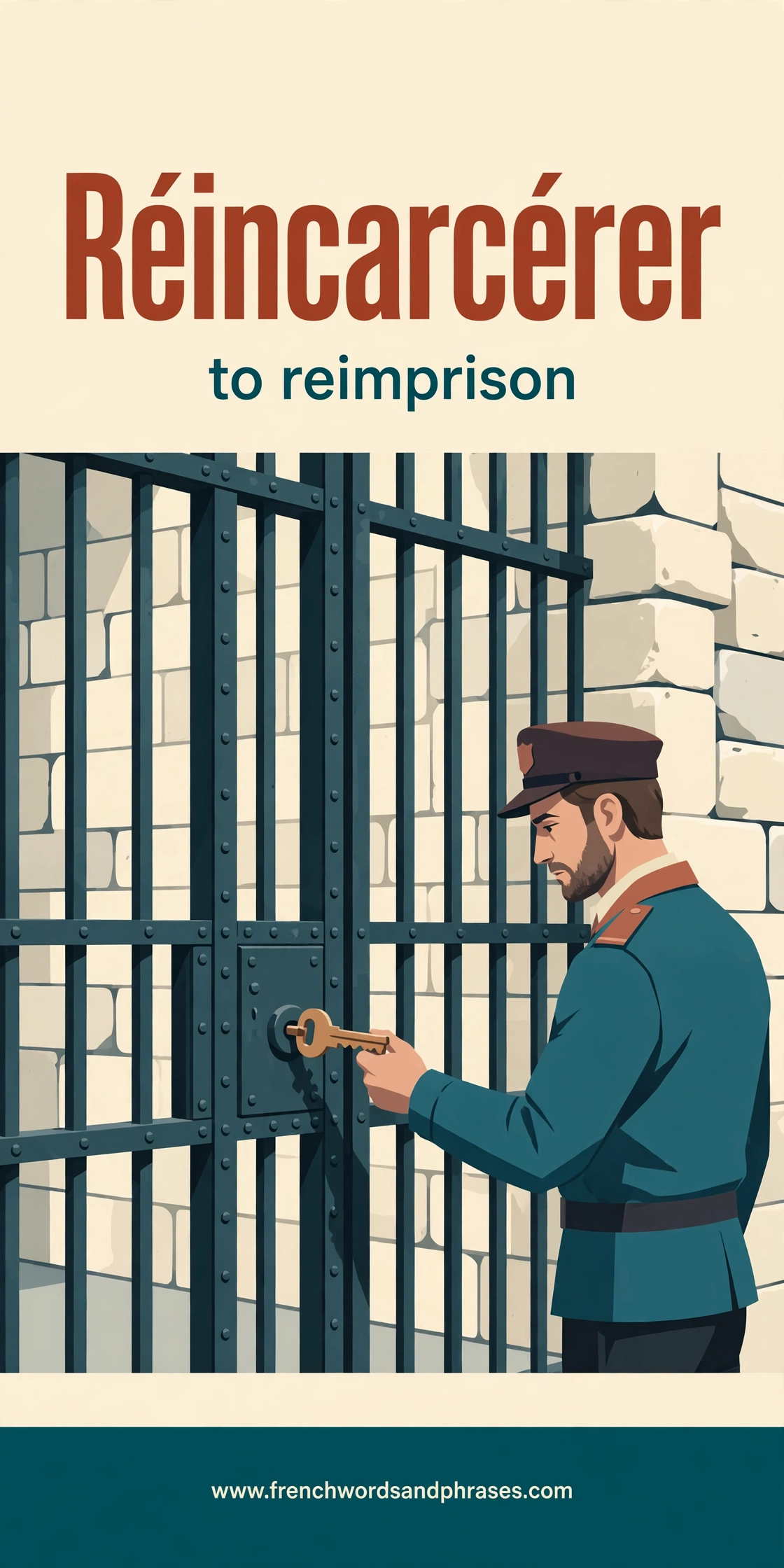
Réincarcérer means to reimprison — to send someone back to prison after a release, an escape or a broken condition.
A released prisoner caught breaking his parole, an escapee recaptured at the border, a judge signing the order at midnight — réincarcérer is the heavy verb of the return to prison: the cell door closes on the same man twice.
In this guide, you’ll learn how to conjugate réincarcérer in all the major French tenses and moods. Explore complete conjugation tables, French examples, English translations, and practice quizzes.
Understanding the French Verb Réincarcérer
Réincarcérer is a regular French verb belonging to the first group of verbs, those ending in-er.
It means to reimprison. It belongs to courtrooms, police reports and prison administration: judges réincarcèrent offenders who break parole, escape or offend again, and newspapers use it whenever a released prisoner goes back inside.
Verb classification: First group (-er)
Auxiliary verb: Avoir
Past participle: réincarcéré
Present participle: réincarcérant
English equivalents: To reimprison, to send back to prison; réincarcérer un détenu — to send a prisoner back inside; réincarcérer un récidiviste — to reimprison a repeat offender; réincarcérer un évadé — to reimprison an escapee; la réincarcération — reimprisonment.
One important detail: réincarcérer is a céder-type verb — the é of the last stem syllable opens to è wherever the next syllable is mute: je réincarcère, tu réincarcères, il réincarcère, ils réincarcèrent, and all through the future and conditional: je réincarcèrerai, je réincarcèrerais. The é survives wherever the ending is sounded: nous réincarcérons, vous réincarcérez, je réincarcérais, en réincarcérant, and in the infinitive and participle, réincarcérer, réincarcéré. Inside the long word sits Latin carcer, a prison — the same root as English incarcerate.
Experience the Word
Réincarcérer is the verb of the second imprisonment — freedom granted, freedom withdrawn, the same door closing again.
Imagine a man released on parole in spring, fitted with an electronic tag and a list of rules. By autumn he has missed every appointment and vanished from his address. The judge reads the file, signs one line, and the police car is already waiting: on l’a réincarcéré avant la nuit.
No new crime was needed. He has been reimprisoned — réincarcéré — for breaking the conditions of his freedom.
How to Conjugate Réincarcérer: Complete French Conjugation Guide
Let’s explore every major conjugation of réincarcérer, beginning with the indicative mood.
How to Conjugate Réincarcérer in the Indicative Mood
The indicative mood is used to express facts, observations, actions, and events.
How to Conjugate Réincarcérer in the Present Tense (Présent)
Used for actions happening now, habitual actions, and general truths.
| Subject | Conjugation |
|---|---|
| je | réincarcère |
| tu | réincarcères |
| il / elle | réincarcère |
| nous | réincarcérons |
| vous | réincarcérez |
| ils / elles | réincarcèrent |
Example
Le juge réincarcère le détenu qui a violé son contrôle judiciaire.
The judge is sending back to prison the inmate who broke his judicial supervision.
Quick Quiz 1
Complete the sentence:
Nous ______ le détenu dès ce soir.
Reveal the answer
réincarcérons
Nous réincarcérons le détenu dès ce soir.
We are sending the inmate back to prison tonight.
How to Conjugate Réincarcérer in the Passé Composé
Used for completed actions in the past. Réincarcérer takes the auxiliary verb avoir.
| Subject | Conjugation |
|---|---|
| j’ | ai réincarcéré |
| tu | as réincarcéré |
| il / elle | a réincarcéré |
| nous | avons réincarcéré |
| vous | avez réincarcéré |
| ils / elles | ont réincarcéré |
Example
La police a réincarcéré le fugitif dès son arrestation.
The police sent the fugitive back to prison as soon as he was arrested.
How to Conjugate Réincarcérer in the Imparfait (Imperfect Tense)
Used for habitual past actions, descriptions, and ongoing situations in the past.
| Subject | Conjugation |
|---|---|
| je | réincarcérais |
| tu | réincarcérais |
| il / elle | réincarcérait |
| nous | réincarcérions |
| vous | réincarcériez |
| ils / elles | réincarcéraient |
Example
Autrefois, on réincarcérait les vagabonds pour un rien.
In the old days, vagrants were sent back to prison for next to nothing.
Quick Quiz 2
Choose the correct form:
The police put the fugitive back in prison.
La police ______ le fugitif. (a réincarcéré / est réincarcéré)
Reveal the answer
a réincarcéré
La police a réincarcéré le fugitif.
Réincarcérer takes avoir.
How to Conjugate Réincarcérer in the Plus-que-parfait
Used to describe an action that had already been completed before another past event.
| Subject | Conjugation |
|---|---|
| j’ | avais réincarcéré |
| tu | avais réincarcéré |
| il / elle | avait réincarcéré |
| nous | avions réincarcéré |
| vous | aviez réincarcéré |
| ils / elles | avaient réincarcéré |
Example
Le tribunal avait réincarcéré l’accusé avant même le procès.
The court had sent the accused back to prison even before the trial.
How to Conjugate Réincarcérer in the Passé Simple
Primarily used in formal writing, literature, and historical narratives. It is rarely used in everyday conversation.
| Subject | Conjugation |
|---|---|
| je | réincarcérai |
| tu | réincarcéras |
| il / elle | réincarcéra |
| nous | réincarcérâmes |
| vous | réincarcérâtes |
| ils / elles | réincarcérèrent |
Example
Le juge réincarcéra le récidiviste dès le lendemain de sa libération.
The judge sent the repeat offender back to prison the very day after his release.
How to Conjugate Réincarcérer in the Passé Antérieur
A literary tense used to express an action completed immediately before another past action, generally in the passé simple.
| Subject | Conjugation |
|---|---|
| j’ | eus réincarcéré |
| tu | eus réincarcéré |
| il / elle | eut réincarcéré |
| nous | eûmes réincarcéré |
| vous | eûtes réincarcéré |
| ils / elles | eurent réincarcéré |
Example
Quand la police eut réincarcéré le chef du gang, le quartier respira.
When the police had put the gang leader back in prison, the neighbourhood breathed again.
How to Conjugate Réincarcérer in the Future Tense (Futur Simple)
Used to describe actions that will take place in the future.
| Subject | Conjugation |
|---|---|
| je | réincarcèrerai |
| tu | réincarcèreras |
| il / elle | réincarcèrera |
| nous | réincarcèrerons |
| vous | réincarcèrerez |
| ils / elles | réincarcèreront |
Example
S’il récidive, le juge le réincarcèrera aussitôt.
If he reoffends, the judge will send him back to prison at once.
How to Conjugate Réincarcérer in the Futur Antérieur (Future Perfect)
Used for an action that will have been completed before a particular point in the future.
| Subject | Conjugation |
|---|---|
| j’ | aurai réincarcéré |
| tu | auras réincarcéré |
| il / elle | aura réincarcéré |
| nous | aurons réincarcéré |
| vous | aurez réincarcéré |
| ils / elles | auront réincarcéré |
Example
À la fin du mois, on aura réincarcéré trois détenus évadés.
By the end of the month, three escaped prisoners will have been put back inside.
How to Conjugate Réincarcérer in the Near Future (Futur Proche)
Used to describe something that is going to happen soon. Formed with aller + infinitive.
| Subject | Conjugation |
|---|---|
| je | vais réincarcérer |
| tu | vas réincarcérer |
| il / elle | va réincarcérer |
| nous | allons réincarcérer |
| vous | allez réincarcérer |
| ils / elles | vont réincarcérer |
Example
Le parquet va réincarcérer le suspect dans l’attente du procès.
The prosecutor’s office is going to remand the suspect in custody pending trial.
How to Conjugate Réincarcérer in the Conditional Mood
The conditional mood expresses what would happen under certain circumstances. It is also frequently used to make polite requests or express wishes.
How to Conjugate Réincarcérer in the Present Conditional
| Subject | Conjugation |
|---|---|
| je | réincarcèrerais |
| tu | réincarcèrerais |
| il / elle | réincarcèrerait |
| nous | réincarcèrerions |
| vous | réincarcèreriez |
| ils / elles | réincarcèreraient |
Example
Sans cette nouvelle loi, on ne réincarcèrerait pas les petits délinquants.
Without this new law, petty offenders would not be sent back to prison.
How to Conjugate Réincarcérer in the Past Conditional
| Subject | Conjugation |
|---|---|
| j’ | aurais réincarcéré |
| tu | aurais réincarcéré |
| il / elle | aurait réincarcéré |
| nous | aurions réincarcéré |
| vous | auriez réincarcéré |
| ils / elles | auraient réincarcéré |
Example
Le juge aurait réincarcéré l’accusé si le risque de fuite avait été réel.
The judge would have sent the accused back to prison if the flight risk had been real.
Réincarcérer in the Literary Past Conditional Form
This less common literary form uses the imperfect subjunctive of avoir.
| Subject | Conjugation |
|---|---|
| j’ | eusse réincarcéré |
| tu | eusses réincarcéré |
| il / elle | eût réincarcéré |
| nous | eussions réincarcéré |
| vous | eussiez réincarcéré |
| ils / elles | eussent réincarcéré |
Example
Le tribunal eût réincarcéré le coupable sans les aveux de son complice.
The court would have sent the culprit back to prison but for his accomplice’s confession.
How to Conjugate Réincarcérer in the Subjunctive Mood
The subjunctive is used to express wishes, emotions, doubts, necessity, and uncertainty. It frequently follows expressions such as il faut que (it is necessary that) or bien que (although).
How to Conjugate Réincarcérer in the Present Subjunctive
| Subject | Conjugation |
|---|---|
| que je | réincarcère |
| que tu | réincarcères |
| qu’il / qu’elle | réincarcère |
| que nous | réincarcérions |
| que vous | réincarcériez |
| qu’ils / qu’elles | réincarcèrent |
Example
Il est probable que le juge réincarcère le détenu après cette évasion.
It is likely the judge will send the inmate back to prison after this escape.
Quick Quiz 3
Complete the sentence using the subjunctive:
Il est probable que le juge le ______ après son évasion.
Reveal the answer
réincarcère
Il est probable que le juge le réincarcère après son évasion.
It is likely the judge will send him back to prison after his escape.
How to Conjugate Réincarcérer in the Imperfect Subjunctive
A literary tense, rarely encountered in modern spoken French.
| Subject | Conjugation |
|---|---|
| que je | réincarcérasse |
| que tu | réincarcérasses |
| qu’il / qu’elle | réincarcérât |
| que nous | réincarcérassions |
| que vous | réincarcérassiez |
| qu’ils / qu’elles | réincarcérassent |
Example
Les avocats craignaient que le juge ne réincarcérât leur client.
The lawyers feared the judge might send their client back to prison.
How to Conjugate Réincarcérer in the Pluperfect Subjunctive
A literary construction used to express an action completed before another past action.
| Subject | Conjugation |
|---|---|
| que j’ | eusse réincarcéré |
| que tu | eusses réincarcéré |
| qu’il / qu’elle | eût réincarcéré |
| que nous | eussions réincarcéré |
| que vous | eussiez réincarcéré |
| qu’ils / qu’elles | eussent réincarcéré |
Example
On murmurait que le préfet eût réincarcéré les manifestants sans jugement.
It was whispered that the prefect had thrown the demonstrators back in prison without trial.
How to Conjugate Réincarcérer in the Past Subjunctive
| Subject | Conjugation |
|---|---|
| que j’ | aie réincarcéré |
| que tu | aies réincarcéré |
| qu’il / qu’elle | ait réincarcéré |
| que nous | ayons réincarcéré |
| que vous | ayez réincarcéré |
| qu’ils / qu’elles | aient réincarcéré |
Example
Je regrette que le tribunal ait réincarcéré cet homme sans preuves.
I regret that the court sent this man back to prison without evidence.
How to Conjugate Réincarcérer in the Imperative
The imperative is used to give commands, instructions, invitations, or suggestions. Subject pronouns are omitted.
How to Conjugate Réincarcérer in the Present Imperative
| Person | Conjugation |
|---|---|
| (tu) | réincarcère |
| (nous) | réincarcérons |
| (vous) | réincarcérez |
Example
Réincarcérez les deux fugitifs dès leur arrestation !
Send the two fugitives back to prison as soon as they are arrested!
Quick Quiz 4
How would you say Send him back to prison (tu form)?
Reveal the answer
Réincarcère-le !
French Participles of Réincarcérer
Participles are verb forms that can be used in compound tenses and other grammatical constructions.
Present Participle of Réincarcérer
réincarcérant
En réincarcérant le récidiviste, la justice applique la loi sur la récidive.
By sending the repeat offender back to prison, the justice system is applying the reoffending law.
Past Participle of Réincarcérer
réincarcéré
Réincarcéré après son évasion, le détenu a perdu tous ses privilèges.
Put back in prison after his escape, the inmate lost all his privileges.
Réincarcérer in Everyday French: Real-Life Examples
Now that you know the conjugations, let’s see how réincarcérer appears in everyday French.
Example 1 — Present
Le juge réincarcère le détenu.
The judge is sending the inmate back to prison.
Example 2 — Passé composé
La police a réincarcéré le fugitif.
The police put the fugitive back in prison.
Example 3 — Imparfait
On réincarcérait les vagabonds pour un rien.
Vagrants were sent back to prison for next to nothing.
Example 4 — Future
Le juge le réincarcèrera s’il récidive.
The judge will send him back if he reoffends.
Example 5 — Conditional
On ne le réincarcèrerait pas sans raison.
They would not send him back without a reason.
Example 6 — Imperative
Réincarcérez les fugitifs !
Put the fugitives back in prison!
Beyond Translation: The Meaning of Réincarcérer
The word is built like a set of Russian dolls: Latin carcer, prison, gives incarcérer, to put in prison, and the prefix ré- wraps it in a second journey — out, and back in again.
English incarcerate and French incarcérer are the same word.
French simply goes one step further and adds the return trip: la réincarcération is a whole policy debate in a single noun.
How to Remember the French Verb Réincarcérer
Remember it this way: Réincarcérer is about the cell door closing on the same man twice.
- Céder-type spelling: je réincarcère with è, but nous réincarcérons with é.
- Inside the word is carcer, prison — the same root as English incarcerate.
- It is the judge’s and the police report’s verb: réincarcérer un détenu, un évadé, un récidiviste.
The key idea is the cell door closing on the same man twice.
Test Your Knowledge of Réincarcérer
Let’s see how much you’ve learned. Try answering these questions before revealing the answers.
Question 1
Why does je réincarcère have a grave accent but nous réincarcérons an acute one?
Reveal the answer
The céder-type rule — é becomes è before a mute syllable (je réincarcère), and stays é where the ending is sounded (nous réincarcérons).
Question 2
How do you say The police put the fugitive back in prison in French?
Reveal the answer
La police a réincarcéré le fugitif.
Question 3
Translate: If he reoffends, the judge will send him back to prison.
Reveal the answer
S’il récidive, le juge le réincarcèrera.
Question 4
What is the past participle of réincarcérer?
Reveal the answer
Réincarcéré.
Question 5
Complete the sentence:
Il est probable que le juge ______ le détenu après cette évasion.
Reveal the answer
réincarcère
Il est probable que le juge réincarcère le détenu après cette évasion.
It is likely the judge will send the inmate back to prison after this escape.
Your Final Challenge
Can You Use It?
How would you say this in French?
A prison that reimprisons the same men every year admits it repairs no one.
Reveal the answer
Une prison qui réincarcère les mêmes hommes chaque année avoue qu’elle ne répare personne.
A prison that reimprisons the same men every year admits it repairs no one.
A little French. A little curiosity. A richer everyday life.
LEARN FRENCH ONE WORD AT A TIME