A French Word to Live By
How to Conjugate Regeler in French
/ʁə.ʒə.le/
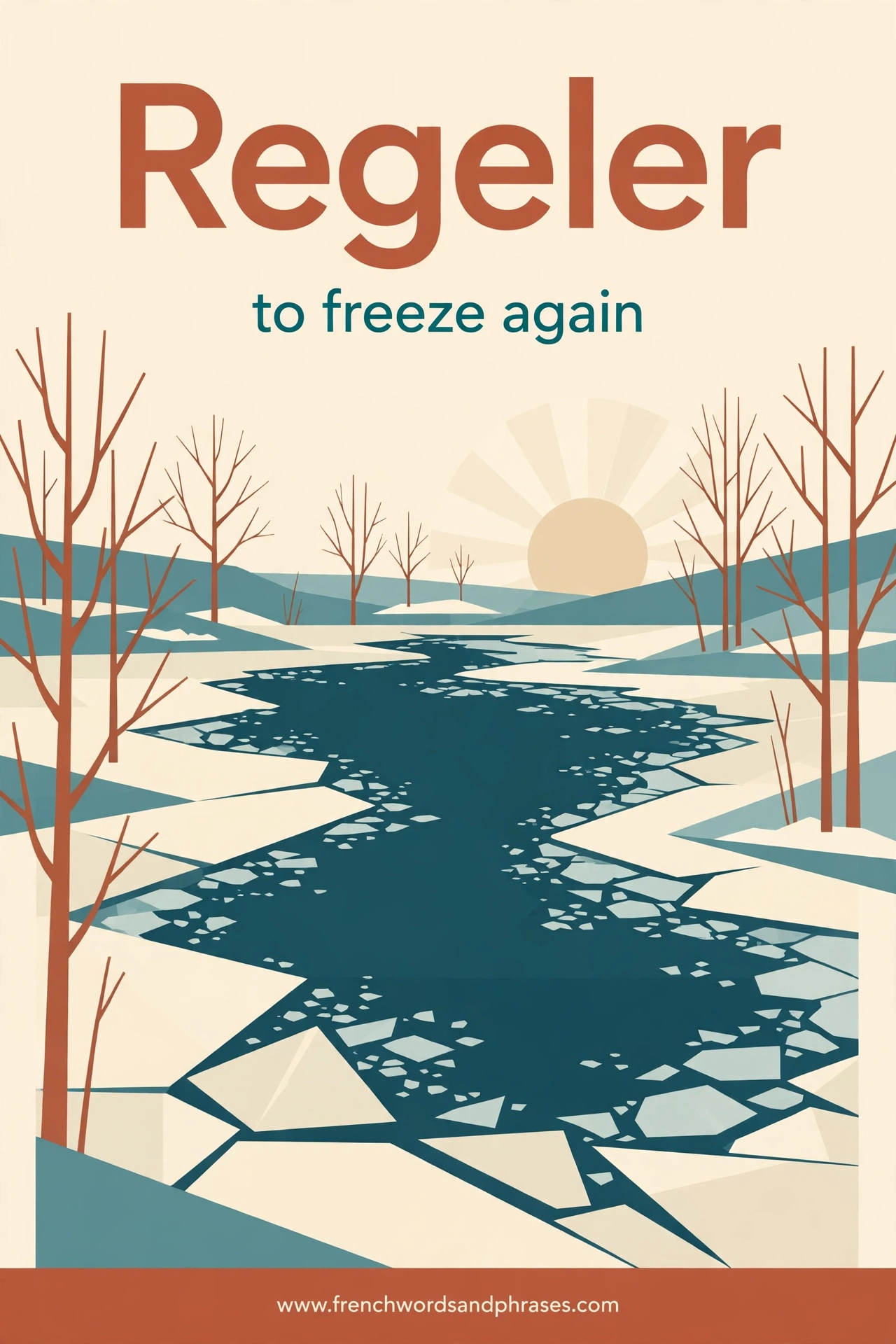
Regeler means to freeze again — the lake, the road and the pipes closing back into ice after a brief thaw.
The thaw lasted two days; the puddles shone, the path softened — and then the north wind returned in the night. Regeler is winter’s second grip: everything that melted, freezing hard again.
In this guide, you’ll learn how to conjugate regeler in all the major French tenses and moods. Explore complete conjugation tables, French examples, English translations, and practice quizzes.
Understanding the French Verb Regeler
Regeler is a regular French verb belonging to the first group of verbs, those ending in-er.
It means to freeze again. It is a weather verb above all: lakes, roads, pipes and puddles are its subjects, and il regèle its commonest form. Where geler freezes the first time, regeler is the treacherous second act — the black ice of the morning after the thaw.
Verb classification: First group (-er)
Auxiliary verb: Avoir
Past participle: regelé
Present participle: regelant
English equivalents: To freeze again, to freeze over again; le lac regèle — the lake is freezing again; il regèle — it is freezing again (weather); les routes regèlent — the roads are icing over again; un regel — a renewed frost.
One important detail: regeler belongs to the geler family, where the mute e of the stem opens to è whenever the ending is silent: je regèle, tu regèles, il regèle, ils regèlent, and through the future and conditional — il regèlera, il regèlerait. Where the ending is sounded, plain e returns: nous regelons, vous regelez, je regelais, en regelant, and in the participle regelé. It is most at home without a personal subject: il regèle — it is freezing again — is its signature sentence.
Experience the Word
Regeler is winter changing its mind — the thaw forgiven, the ice restored, harder than before.
Imagine a mountain village in February. Two days of sun have freed the fountain and turned the square to slush. In the night the temperature falls ten degrees; at dawn, tout a regelé: the fountain is a statue, the square a skating rink, and the mayor is on the radio warning about the roads.
Yesterday it melted. Today it has frozen again — tout a regelé.
How to Conjugate Regeler: Complete French Conjugation Guide
Let’s explore every major conjugation of regeler, beginning with the indicative mood.
How to Conjugate Regeler in the Indicative Mood
The indicative mood is used to express facts, observations, actions, and events.
How to Conjugate Regeler in the Present Tense (Présent)
Used for actions happening now, habitual actions, and general truths.
| Subject | Conjugation |
|---|---|
| je | regèle |
| tu | regèles |
| il / elle | regèle |
| nous | regelons |
| vous | regelez |
| ils / elles | regèlent |
Example
Le lac regèle déjà par endroits.
The lake is already freezing again in places.
Quick Quiz 1
Complete the sentence:
Nous ______ dès que le vent tourne au nord.
Reveal the answer
regelons
Nous regelons dès que le vent tourne au nord.
We freeze again as soon as the wind turns north.
How to Conjugate Regeler in the Passé Composé
Used for completed actions in the past. Regeler takes the auxiliary verb avoir.
| Subject | Conjugation |
|---|---|
| j’ | ai regelé |
| tu | as regelé |
| il / elle | a regelé |
| nous | avons regelé |
| vous | avez regelé |
| ils / elles | ont regelé |
Example
Les routes ont regelé pendant la nuit.
The roads froze over again during the night.
How to Conjugate Regeler in the Imparfait (Imperfect Tense)
Used for habitual past actions, descriptions, and ongoing situations in the past.
| Subject | Conjugation |
|---|---|
| je | regelais |
| tu | regelais |
| il / elle | regelait |
| nous | regelions |
| vous | regeliez |
| ils / elles | regelaient |
Example
Autrefois, la rivière regelait chaque hiver jusqu’en mars.
In the old days, the river would freeze again every winter until March.
Quick Quiz 2
Choose the correct form:
The lake froze again.
Le lac ______ . (a regelé / est regelé)
Reveal the answer
a regelé
Le lac a regelé.
Regeler takes avoir.
How to Conjugate Regeler in the Plus-que-parfait
Used to describe an action that had already been completed before another past event.
| Subject | Conjugation |
|---|---|
| j’ | avais regelé |
| tu | avais regelé |
| il / elle | avait regelé |
| nous | avions regelé |
| vous | aviez regelé |
| ils / elles | avaient regelé |
Example
La fontaine avait regelé avant l’aube.
The fountain had frozen again before dawn.
How to Conjugate Regeler in the Passé Simple
Primarily used in formal writing, literature, and historical narratives. It is rarely used in everyday conversation.
| Subject | Conjugation |
|---|---|
| je | regelai |
| tu | regelas |
| il / elle | regela |
| nous | regelâmes |
| vous | regelâtes |
| ils / elles | regelèrent |
Example
Après le redoux, le lac regela en une seule nuit.
After the thaw, the lake froze again in a single night.
How to Conjugate Regeler in the Passé Antérieur
A literary tense used to express an action completed immediately before another past action, generally in the passé simple.
| Subject | Conjugation |
|---|---|
| j’ | eus regelé |
| tu | eus regelé |
| il / elle | eut regelé |
| nous | eûmes regelé |
| vous | eûtes regelé |
| ils / elles | eurent regelé |
Example
Quand la mare eut regelé, les canards partirent.
When the pond had frozen again, the ducks left.
How to Conjugate Regeler in the Future Tense (Futur Simple)
Used to describe actions that will take place in the future.
| Subject | Conjugation |
|---|---|
| je | regèlerai |
| tu | regèleras |
| il / elle | regèlera |
| nous | regèlerons |
| vous | regèlerez |
| ils / elles | regèleront |
Example
Il regèlera cette nuit, couvrez les plantes.
It will freeze again tonight, cover the plants.
How to Conjugate Regeler in the Futur Antérieur (Future Perfect)
Used for an action that will have been completed before a particular point in the future.
| Subject | Conjugation |
|---|---|
| j’ | aurai regelé |
| tu | auras regelé |
| il / elle | aura regelé |
| nous | aurons regelé |
| vous | aurez regelé |
| ils / elles | auront regelé |
Example
Demain matin, les tuyaux auront regelé si le froid continue.
By tomorrow morning, the pipes will have frozen again if the cold continues.
How to Conjugate Regeler in the Near Future (Futur Proche)
Used to describe something that is going to happen soon. Formed with aller + infinitive.
| Subject | Conjugation |
|---|---|
| je | vais regeler |
| tu | vas regeler |
| il / elle | va regeler |
| nous | allons regeler |
| vous | allez regeler |
| ils / elles | vont regeler |
Example
Attention, ça va regeler ce soir sur les routes.
Careful, it is going to freeze again on the roads tonight.
How to Conjugate Regeler in the Conditional Mood
The conditional mood expresses what would happen under certain circumstances. It is also frequently used to make polite requests or express wishes.
How to Conjugate Regeler in the Present Conditional
| Subject | Conjugation |
|---|---|
| je | regèlerais |
| tu | regèlerais |
| il / elle | regèlerait |
| nous | regèlerions |
| vous | regèleriez |
| ils / elles | regèleraient |
Example
Sans ce vent du nord, rien ne regèlerait.
Without this north wind, nothing would freeze again.
How to Conjugate Regeler in the Past Conditional
| Subject | Conjugation |
|---|---|
| j’ | aurais regelé |
| tu | aurais regelé |
| il / elle | aurait regelé |
| nous | aurions regelé |
| vous | auriez regelé |
| ils / elles | auraient regelé |
Example
Le lac aurait regelé plus tôt sans le courant.
The lake would have frozen again sooner without the current.
Regeler in the Literary Past Conditional Form
This less common literary form uses the imperfect subjunctive of avoir.
| Subject | Conjugation |
|---|---|
| j’ | eusse regelé |
| tu | eusses regelé |
| il / elle | eût regelé |
| nous | eussions regelé |
| vous | eussiez regelé |
| ils / elles | eussent regelé |
Example
La rivière eût regelé jusqu’au pont sans le redoux.
The river would have frozen again as far as the bridge without the thaw.
How to Conjugate Regeler in the Subjunctive Mood
The subjunctive is used to express wishes, emotions, doubts, necessity, and uncertainty. It frequently follows expressions such as il faut que (it is necessary that) or bien que (although).
How to Conjugate Regeler in the Present Subjunctive
| Subject | Conjugation |
|---|---|
| que je | regèle |
| que tu | regeles |
| qu’il / qu’elle | regèle |
| que nous | regelions |
| que vous | regeliez |
| qu’ils / qu’elles | regèlent |
Example
Je crains que les routes regèlent cette nuit.
I fear the roads will freeze again tonight.
Quick Quiz 3
Complete the sentence using the subjunctive:
Je crains que les routes ______ cette nuit.
Reveal the answer
regèlent
Je crains que les routes regèlent cette nuit.
I fear the roads will freeze again tonight.
How to Conjugate Regeler in the Imperfect Subjunctive
A literary tense, rarely encountered in modern spoken French.
| Subject | Conjugation |
|---|---|
| que je | regelasse |
| que tu | regelasses |
| qu’il / qu’elle | regelât |
| que nous | regelassions |
| que vous | regelassiez |
| qu’ils / qu’elles | regelassent |
Example
On ne pensait pas que le lac regelât avant janvier.
Nobody thought the lake would freeze again before January.
How to Conjugate Regeler in the Pluperfect Subjunctive
A literary construction used to express an action completed before another past action.
| Subject | Conjugation |
|---|---|
| que j’ | eusse regelé |
| que tu | eusses regelé |
| qu’il / qu’elle | eût regelé |
| que nous | eussions regelé |
| que vous | eussiez regelé |
| qu’ils / qu’elles | eussent regelé |
Example
On s’étonna que la fontaine eût regelé si vite.
People were surprised the fountain had frozen again so fast.
How to Conjugate Regeler in the Past Subjunctive
| Subject | Conjugation |
|---|---|
| que j’ | aie regelé |
| que tu | aies regelé |
| qu’il / qu’elle | ait regelé |
| que nous | ayons regelé |
| que vous | ayez regelé |
| qu’ils / qu’elles | aient regelé |
Example
C’est dommage que les tuyaux aient regelé.
It is a shame the pipes have frozen again.
How to Conjugate Regeler in the Imperative
The imperative is used to give commands, instructions, invitations, or suggestions. Subject pronouns are omitted.
How to Conjugate Regeler in the Present Imperative
| Person | Conjugation |
|---|---|
| (tu) | regèle |
| (nous) | regelons |
| (vous) | regelez |
Example
Regèle bien cette nuit, petit lac, on patine demain !
Freeze hard tonight, little lake, we’re skating tomorrow!
Quick Quiz 4
How would you say Freeze hard tonight (tu form, to the little lake)?
Reveal the answer
Regèle bien cette nuit !
French Participles of Regeler
Participles are verb forms that can be used in compound tenses and other grammatical constructions.
Present Participle of Regeler
regelant
En regelant, l’eau a fait éclater la canalisation.
By freezing again, the water burst the pipe.
Past Participle of Regeler
regelé
Regelée pendant la nuit, la route brillait comme un miroir.
Frozen again during the night, the road shone like a mirror.
Regeler in Everyday French: Real-Life Examples
Now that you know the conjugations, let’s see how regeler appears in everyday French.
Example 1 — Present
Le lac regèle déjà par endroits.
The lake is already freezing again in places.
Example 2 — Passé composé
Les routes ont regelé pendant la nuit.
The roads froze over again during the night.
Example 3 — Imparfait
La rivière regelait chaque hiver.
The river would freeze again every winter.
Example 4 — Future
Il regèlera cette nuit.
It will freeze again tonight.
Example 5 — Conditional
Rien ne regèlerait sans ce vent du nord.
Nothing would freeze again without this north wind.
Example 6 — Imperative
Regèle bien, petit lac, on patine demain !
Freeze hard, little lake, we’re skating tomorrow!
Beyond Translation: The Meaning of Regeler
Geler descends from Latin gelare, from gelu, frost — the same root that gives English jelly and congeal: things that set in the cold. Regeler adds winter’s cruelty, the second setting: a thaw is only a pause, and what regelé roads teach every driver is that the most dangerous ice is the ice that came back.
How to Remember the French Verb Regeler
Remember it this way: Regeler is about the lake icing over the morning after the thaw.
- Geler family rule: è before a silent ending — je regèle, il regèlera — but plain e in nous regelons, je regelais.
- Its signature sentence has no real subject: il regèle — it is freezing again.
- Avoir everywhere: le lac a regelé, past participle regelé.
The key idea is the lake icing over the morning after the thaw.
Test Your Knowledge of Regeler
Let’s see how much you’ve learned. Try answering these questions before revealing the answers.
Question 1
Why does je regèle have è but nous regelons plain e?
Reveal the answer
The geler-family rule — the mute e opens to è before a silent ending (je regèle), and stays e where the ending is sounded (nous regelons).
Question 2
How do you say The roads froze over again during the night in French?
Reveal the answer
Les routes ont regelé pendant la nuit.
Question 3
Translate: It will freeze again tonight.
Reveal the answer
Il regèlera cette nuit.
Question 4
What is the past participle of regeler?
Reveal the answer
Regelé.
Question 5
Complete the sentence:
Je crains que les routes ______ cette nuit.
Reveal the answer
regèlent
Je crains que les routes regèlent cette nuit.
I fear the roads will freeze again tonight.
Your Final Challenge
Can You Use It?
How would you say this in French?
The thaw lasted two days, then the lake froze again, and the skaters came back.
Reveal the answer
Le redoux a duré deux jours, puis le lac a regelé, et les patineurs sont revenus.
The thaw lasted two days, then the lake froze again, and the skaters came back.
A little French. A little curiosity. A richer everyday life.
LEARN FRENCH ONE WORD AT A TIME