A French Word to Live By
How to Conjugate Réfugier in French
/ʁe.fy.ʒje/
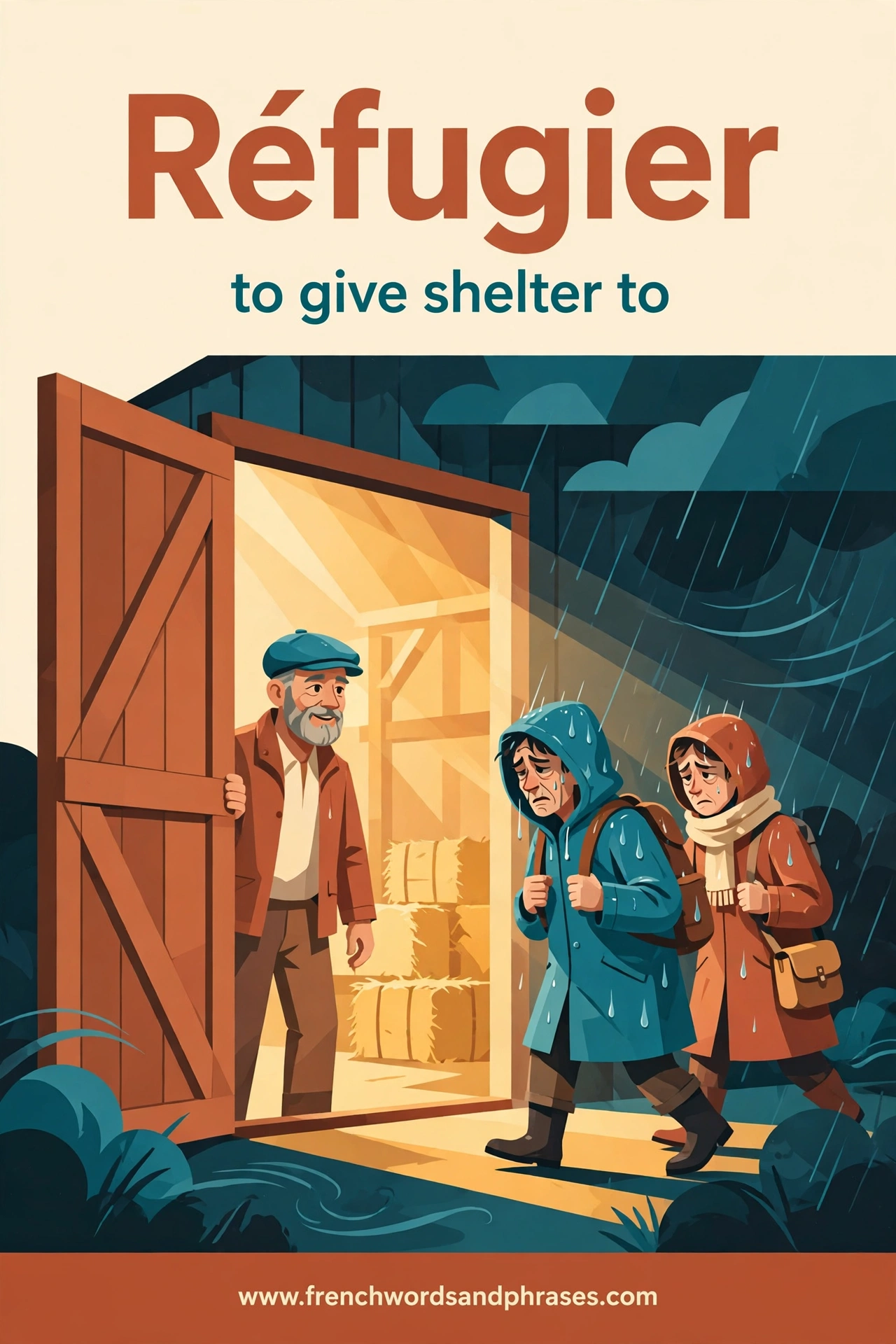
Réfugier means to give shelter to — to take people in and keep them safe when their homes are lost; the people who are sheltered, for their part, se réfugient.
A school gymnasium opened at midnight, rows of camp beds unrolled on the basketball court, a mayor signing the order that turns a sports hall into a home — réfugier is the verb of the shelter-giver: the town, the family, the abbey that takes the displaced in.
In this guide, you’ll learn how to conjugate réfugier in all the major French tenses and moods. Explore complete conjugation tables, French examples, English translations, and practice quizzes.
Understanding the French Verb Réfugier
Réfugier is a regular French verb belonging to the first group of verbs, those ending in-er.
It means to give shelter to. You will meet the transitive réfugier in news reports and official French — la commune a réfugié les habitants, the town housed the residents — where English would say «shelter» or «take in». In a private house the warmer verb is accueillir; réfugier belongs to emergencies, floods, fires and wars, and to the institutions that respond to them.
Verb classification: First group (-er)
Auxiliary verb: Avoir
Past participle: réfugié
Present participle: réfugiant
English equivalents: To shelter, to house, to give refuge to; réfugier des familles — to shelter families; réfugier les sinistrés dans un gymnase — to house disaster victims in a gymnasium; un réfugié — a refugee; se réfugier — to take refuge (the everyday reflexive form, with its own page).
One important detail: the everyday verb of this family is the reflexive se réfugier — to take refuge — which has its own page and is a hundred times commoner. The plain réfugier on this page is transitive and rarer: it means to give shelter to someone else, and its natural subjects are town halls, charities, abbeys and states. It is a regular verb in -ier, so watch the double i where the stem meets the ending: je réfugie, nous réfugiions in the imperfect, que nous réfugiiez in the subjunctive. Its past participle, réfugié, is also the noun for the person sheltered: un réfugié, a refugee.
Experience the Word
Réfugier is the verb seen from the helper’s side of the door — not the flight, but the roof: the decision to open the hall, unroll the beds and take people in.
Imagine the night the river breaks its banks in a small town. By nine the water is in the ground-floor rooms; by ten the mayor has opened the school, the gym mats are covered with blankets, and the commune réfugie forty neighbours — old Madame Fabre, the twins from the mill house, a dog nobody wants to leave behind. Nobody asks for papers. The verb is a roof.
The families will say they se sont réfugiées — they took refuge. The town says it les a réfugiées: it sheltered them, and both verbs are true.
How to Conjugate Réfugier: Complete French Conjugation Guide
Let’s explore every major conjugation of réfugier, beginning with the indicative mood.
How to Conjugate Réfugier in the Indicative Mood
The indicative mood is used to express facts, observations, actions, and events.
How to Conjugate Réfugier in the Present Tense (Présent)
Used for actions happening now, habitual actions, and general truths.
| Subject | Conjugation |
|---|---|
| je | réfugie |
| tu | réfugies |
| il / elle | réfugie |
| nous | réfugions |
| vous | réfugiez |
| ils / elles | réfugient |
Example
La mairie réfugie les sinistrés dans le gymnase.
The town hall is sheltering the disaster victims in the gymnasium.
Quick Quiz 1
Complete the sentence:
Nous ______ les sinistrés dans l’école.
Reveal the answer
réfugions
Nous réfugions les sinistrés dans l’école.
We are sheltering the victims in the school.
How to Conjugate Réfugier in the Passé Composé
Used for completed actions in the past. Réfugier takes the auxiliary verb avoir.
| Subject | Conjugation |
|---|---|
| j’ | ai réfugié |
| tu | as réfugié |
| il / elle | a réfugié |
| nous | avons réfugié |
| vous | avez réfugié |
| ils / elles | ont réfugié |
Example
Ils ont réfugié trois familles pendant l’inondation.
They sheltered three families during the flood.
How to Conjugate Réfugier in the Imparfait (Imperfect Tense)
Used for habitual past actions, descriptions, and ongoing situations in the past.
| Subject | Conjugation |
|---|---|
| je | réfugiais |
| tu | réfugiais |
| il / elle | réfugiait |
| nous | réfugiions |
| vous | réfugiiez |
| ils / elles | réfugiaient |
Example
Le village réfugiait les voyageurs égarés dans la montagne.
The village used to give shelter to travellers lost in the mountains.
Quick Quiz 2
Choose the correct form:
They sheltered three families.
Ils ______ trois familles. (ont réfugié / se sont réfugiés)
Reveal the answer
ont réfugié
Ils ont réfugié trois familles.
Transitive réfugier takes avoir; se sont réfugiés would mean they took refuge themselves.
How to Conjugate Réfugier in the Plus-que-parfait
Used to describe an action that had already been completed before another past event.
| Subject | Conjugation |
|---|---|
| j’ | avais réfugié |
| tu | avais réfugié |
| il / elle | avait réfugié |
| nous | avions réfugié |
| vous | aviez réfugié |
| ils / elles | avaient réfugié |
Example
Elle avait réfugié ses neveux pendant la guerre.
She had taken in her nephews during the war.
How to Conjugate Réfugier in the Passé Simple
Primarily used in formal writing, literature, and historical narratives. It is rarely used in everyday conversation.
| Subject | Conjugation |
|---|---|
| je | réfugiai |
| tu | réfugias |
| il / elle | réfugia |
| nous | réfugiâmes |
| vous | réfugiâtes |
| ils / elles | réfugièrent |
Example
L’abbaye réfugia les pèlerins durant la tempête.
The abbey sheltered the pilgrims during the storm.
How to Conjugate Réfugier in the Passé Antérieur
A literary tense used to express an action completed immediately before another past action, generally in the passé simple.
| Subject | Conjugation |
|---|---|
| j’ | eus réfugié |
| tu | eus réfugié |
| il / elle | eut réfugié |
| nous | eûmes réfugié |
| vous | eûtes réfugié |
| ils / elles | eurent réfugié |
Example
Quand la commune eut réfugié les habitants, on distribua les repas.
When the commune had housed the inhabitants, the meals were handed out.
How to Conjugate Réfugier in the Future Tense (Futur Simple)
Used to describe actions that will take place in the future.
| Subject | Conjugation |
|---|---|
| je | réfugierai |
| tu | réfugieras |
| il / elle | réfugiera |
| nous | réfugierons |
| vous | réfugierez |
| ils / elles | réfugieront |
Example
Le centre réfugiera deux cents personnes cet hiver.
The centre will shelter two hundred people this winter.
How to Conjugate Réfugier in the Futur Antérieur (Future Perfect)
Used for an action that will have been completed before a particular point in the future.
| Subject | Conjugation |
|---|---|
| j’ | aurai réfugié |
| tu | auras réfugié |
| il / elle | aura réfugié |
| nous | aurons réfugié |
| vous | aurez réfugié |
| ils / elles | auront réfugié |
Example
À la fin du mois, l’association aura réfugié mille familles.
By the end of the month, the charity will have sheltered a thousand families.
How to Conjugate Réfugier in the Near Future (Futur Proche)
Used to describe something that is going to happen soon. Formed with aller + infinitive.
| Subject | Conjugation |
|---|---|
| je | vais réfugier |
| tu | vas réfugier |
| il / elle | va réfugier |
| nous | allons réfugier |
| vous | allez réfugier |
| ils / elles | vont réfugier |
Example
On va réfugier les habitants de l’immeuble dans l’école voisine.
They are going to house the building’s residents in the neighbouring school.
How to Conjugate Réfugier in the Conditional Mood
The conditional mood expresses what would happen under certain circumstances. It is also frequently used to make polite requests or express wishes.
How to Conjugate Réfugier in the Present Conditional
| Subject | Conjugation |
|---|---|
| je | réfugierais |
| tu | réfugierais |
| il / elle | réfugierait |
| nous | réfugierions |
| vous | réfugieriez |
| ils / elles | réfugieraient |
Example
Avec plus de lits, le centre réfugierait tout le quartier.
With more beds, the centre would shelter the whole district.
How to Conjugate Réfugier in the Past Conditional
| Subject | Conjugation |
|---|---|
| j’ | aurais réfugié |
| tu | aurais réfugié |
| il / elle | aurait réfugié |
| nous | aurions réfugié |
| vous | auriez réfugié |
| ils / elles | auraient réfugié |
Example
Elle aurait réfugié les enfants si sa maison avait été plus grande.
She would have taken the children in if her house had been bigger.
Réfugier in the Literary Past Conditional Form
This less common literary form uses the imperfect subjunctive of avoir.
| Subject | Conjugation |
|---|---|
| j’ | eusse réfugié |
| tu | eusses réfugié |
| il / elle | eût réfugié |
| nous | eussions réfugié |
| vous | eussiez réfugié |
| ils / elles | eussent réfugié |
Example
Le monastère eût réfugié les fugitifs sans hésiter.
The monastery would have sheltered the fugitives without hesitating.
How to Conjugate Réfugier in the Subjunctive Mood
The subjunctive is used to express wishes, emotions, doubts, necessity, and uncertainty. It frequently follows expressions such as il faut que (it is necessary that) or bien que (although).
How to Conjugate Réfugier in the Present Subjunctive
| Subject | Conjugation |
|---|---|
| que je | réfugie |
| que tu | réfugies |
| qu’il / qu’elle | réfugie |
| que nous | réfugiions |
| que vous | réfugiiez |
| qu’ils / qu’elles | réfugient |
Example
Il faut que la commune réfugie ces familles avant l’hiver.
The commune must shelter these families before winter.
Quick Quiz 3
Complete the sentence using the subjunctive:
Il faut que vous ______ ces voyageurs pour la nuit.
Reveal the answer
réfugiiez
Il faut que vous réfugiiez ces voyageurs pour la nuit.
You must give these travellers shelter for the night.
How to Conjugate Réfugier in the Imperfect Subjunctive
A literary tense, rarely encountered in modern spoken French.
| Subject | Conjugation |
|---|---|
| que je | réfugiasse |
| que tu | réfugiasses |
| qu’il / qu’elle | réfugiât |
| que nous | réfugiassions |
| que vous | réfugiassiez |
| qu’ils / qu’elles | réfugiassent |
Example
Le maire ordonna que l’on réfugiât les sinistrés à l’école.
The mayor ordered the victims to be sheltered at the school.
How to Conjugate Réfugier in the Pluperfect Subjunctive
A literary construction used to express an action completed before another past action.
| Subject | Conjugation |
|---|---|
| que j’ | eusse réfugié |
| que tu | eusses réfugié |
| qu’il / qu’elle | eût réfugié |
| que nous | eussions réfugié |
| que vous | eussiez réfugié |
| qu’ils / qu’elles | eussent réfugié |
Example
On racontait que ce village eût réfugié des centaines de voyageurs.
People said that village had sheltered hundreds of travellers.
How to Conjugate Réfugier in the Past Subjunctive
| Subject | Conjugation |
|---|---|
| que j’ | aie réfugié |
| que tu | aies réfugié |
| qu’il / qu’elle | ait réfugié |
| que nous | ayons réfugié |
| que vous | ayez réfugié |
| qu’ils / qu’elles | aient réfugié |
Example
Je suis fier que notre ville ait réfugié ces familles.
I am proud that our town sheltered these families.
How to Conjugate Réfugier in the Imperative
The imperative is used to give commands, instructions, invitations, or suggestions. Subject pronouns are omitted.
How to Conjugate Réfugier in the Present Imperative
| Person | Conjugation |
|---|---|
| (tu) | réfugie |
| (nous) | réfugions |
| (vous) | réfugiez |
Example
Réfugie ces voyageurs pour la nuit, la tempête arrive !
Give these travellers shelter for the night, the storm is coming!
Quick Quiz 4
How would you say Give them shelter (tu form)?
Reveal the answer
Réfugie-les pour la nuit !
French Participles of Réfugier
Participles are verb forms that can be used in compound tenses and other grammatical constructions.
Present Participle of Réfugier
réfugiant
En réfugiant les sinistrés, la mairie a gagné le respect de tous.
By sheltering the victims, the town hall earned everyone’s respect.
Past Participle of Réfugier
réfugié
Réfugiées par la commune, les familles ont reçu des repas chauds.
Sheltered by the commune, the families received hot meals.
Réfugier in Everyday French: Real-Life Examples
Now that you know the conjugations, let’s see how réfugier appears in everyday French.
Example 1 — Present
La mairie réfugie les sinistrés.
The town hall is sheltering the victims.
Example 2 — Passé composé
Ils ont réfugié trois familles.
They sheltered three families.
Example 3 — Imparfait
L’abbaye réfugiait les pèlerins.
The abbey used to shelter the pilgrims.
Example 4 — Future
Le centre réfugiera deux cents personnes.
The centre will shelter two hundred people.
Example 5 — Conditional
Elle réfugierait les enfants volontiers.
She would gladly take the children in.
Example 6 — Imperative
Réfugie ces voyageurs pour la nuit !
Give these travellers shelter for the night!
Beyond Translation: The Meaning of Réfugier
The whole family of réfugier is built on un refuge — a shelter, and in the mountains, the hut where walkers sleep above the clouds. From the same root come un réfugié, a refugee, and the great division of labour this page exists to teach.
Every refuge has two verbs.
The helper réfugie — he gives the shelter. The helped se réfugie — he takes it. French grammar hands one verb to each side of the door, and confusing them reverses the story: say la mairie s’est réfugiée and the town hall itself has fled into the gym.
How to Remember the French Verb Réfugier
Remember it this way: Réfugier is about the gymnasium doors opening at midnight.
- Réfugier someone = to shelter them; se réfugier = to take refuge yourself — the helper and the helped have different verbs.
- The transitive form lives in news and official French: la commune a réfugié les habitants.
- An -ier verb: watch the double i — nous réfugiions, que vous réfugiiez; its participle réfugié is also the noun «a refugee».
The key idea is the gymnasium doors opening at midnight.
Test Your Knowledge of Réfugier
Let’s see how much you’ve learned. Try answering these questions before revealing the answers.
Question 1
What is the difference between réfugier and se réfugier?
Reveal the answer
Réfugier is to give shelter to someone else; se réfugier is to take refuge oneself — la mairie réfugie les familles, et les familles se réfugient.
Question 2
How do you say The town hall is sheltering the victims in French?
Reveal the answer
La mairie réfugie les sinistrés.
Question 3
Translate: They sheltered three families during the flood.
Reveal the answer
Ils ont réfugié trois familles pendant l’inondation.
Question 4
What is the past participle of réfugier — and what noun does it make?
Reveal the answer
Réfugié — and as a noun, un réfugié is a refugee.
Question 5
Complete the sentence:
Il faut que la commune ______ ces familles avant l’hiver.
Reveal the answer
réfugie
Il faut que la commune réfugie ces familles avant l’hiver.
The commune must shelter these families before winter.
Your Final Challenge
Can You Use It?
How would you say this in French?
The town hall shelters the victims in the gymnasium, and no one will sleep outside.
Reveal the answer
La mairie réfugie les sinistrés dans le gymnase, et personne ne dormira dehors.
The town hall shelters the victims in the gymnasium, and no one will sleep outside.
A little French. A little curiosity. A richer everyday life.
LEARN FRENCH ONE WORD AT A TIME