A French Word to Live By
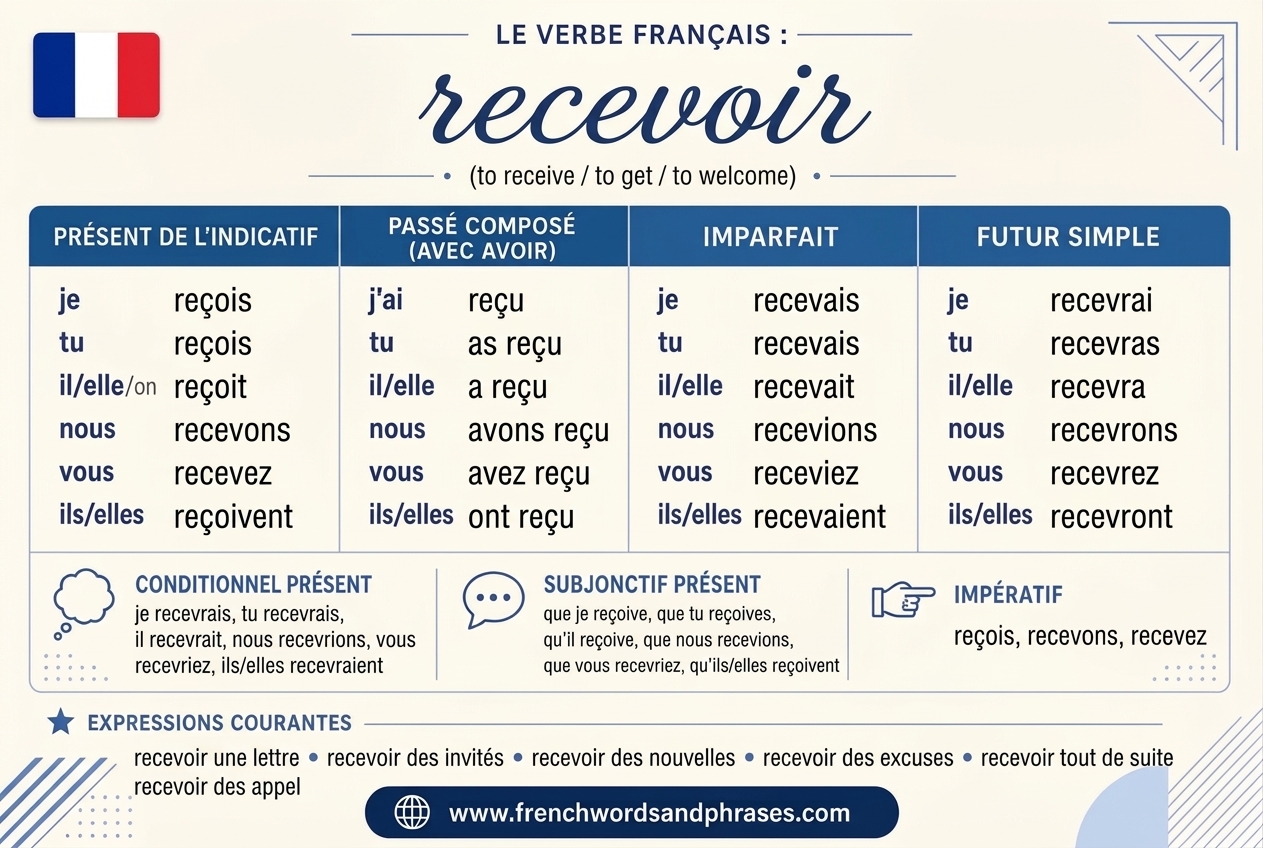
How to Conjugate Recevoir in French
/ʁə.sə.vwaʁ/
Recevoir means to receive, or to welcome.
A letter in the post, a guest at the door, good news at last — that is recevoir. It is the moment something arrives for you, and you take it in.
In this guide, you’ll learn how to conjugate recevoir in all the major French tenses and moods. Explore complete conjugation tables, French examples, English translations, and practice quizzes.
Understanding the French Verb Recevoir
Recevoir is an irregular French verb belonging to the third group of verbs, those ending in -oir.
It means to receive, or to welcome. It is commonly used to receive a letter, a parcel, a message, or a prize, and to welcome guests into your home.
Verb classification: Third group (irregular -oir verb)
Auxiliary verb: Avoir
Past participle: reçu
Present participle: recevant
English equivalents: To receive, to welcome, to get.
One important spelling detail: the stem changes in the present tense — je reçois, nous recevons, ils reçoivent — with a cedilla under the c before o in reçois, reçoit, reçoivent. The future and conditional use the stem recevr-.
Experience the Word
Recevoir is more than getting something. It is opening your door, your hands, or your heart to what arrives.
Imagine coming home to find a letter from an old friend. You open the envelope, you read the words, and for a moment the distance between you disappears.
You have not just read a letter. You have received something, and someone was thinking of you.
How to Conjugate Recevoir: Complete French Conjugation Guide
Let’s explore every major conjugation of recevoir, beginning with the indicative mood.
How to Conjugate Recevoir in the Indicative Mood
The indicative mood is used to express facts, observations, actions, and events.
How to Conjugate Recevoir in the Present Tense (Présent)
Used for actions happening now, habitual actions, and general truths.
| Subject | Conjugation |
|---|---|
| je | reçois |
| tu | reçois |
| il / elle | reçoit |
| nous | recevons |
| vous | recevez |
| ils / elles | reçoivent |
Example
Je reçois beaucoup de lettres.
I receive a lot of letters.
Quick Quiz 1
Complete the sentence:
Nous ______ beaucoup de lettres chaque mois.
Reveal the answer
recevons
Nous recevons beaucoup de lettres chaque mois.
We receive a lot of letters every month.
How to Conjugate Recevoir in the Passé Composé
Used for completed actions in the past. Recevoir takes the auxiliary verb avoir.
| Subject | Conjugation |
|---|---|
| j’ | ai reçu |
| tu | as reçu |
| il / elle | a reçu |
| nous | avons reçu |
| vous | avez reçu |
| ils / elles | ont reçu |
Example
J’ai reçu ta carte hier.
I received your card yesterday.
How to Conjugate Recevoir in the Imparfait (Imperfect Tense)
Used for habitual past actions, descriptions, and ongoing situations in the past.
| Subject | Conjugation |
|---|---|
| je | recevais |
| tu | recevais |
| il / elle | recevait |
| nous | recevions |
| vous | receviez |
| ils / elles | recevaient |
Example
Quand j’étais enfant, je recevais beaucoup de cadeaux à Noël.
When I was a child, I received a lot of presents at Christmas.
Quick Quiz 2
Choose the correct form:
When we were children, we used to receive presents at Christmas.
Quand nous étions enfants, nous ______ beaucoup de cadeaux à Noël.
Reveal the answer
recevions
Quand nous étions enfants, nous recevions beaucoup de cadeaux à Noël.
How to Conjugate Recevoir in the Plus-que-parfait
Used to describe an action that had already been completed before another past event.
| Subject | Conjugation |
|---|---|
| j’ | avais reçu |
| tu | avais reçu |
| il / elle | avait reçu |
| nous | avions reçu |
| vous | aviez reçu |
| ils / elles | avaient reçu |
Example
J’avais déjà reçu l’invitation avant Noël.
I had already received the invitation before Christmas.
How to Conjugate Recevoir in the Passé Simple
Primarily used in formal writing, literature, and historical narratives. It is rarely used in everyday conversation.
| Subject | Conjugation |
|---|---|
| je | reçus |
| tu | reçus |
| il / elle | reçut |
| nous | reçûmes |
| vous | reçûtes |
| ils / elles | reçurent |
Example
Il reçut la lettre avec joie.
He received the letter with joy.
How to Conjugate Recevoir in the Passé Antérieur
A literary tense used to express an action completed immediately before another past action, generally in the passé simple.
| Subject | Conjugation |
|---|---|
| j’ | eus reçu |
| tu | eus reçu |
| il / elle | eut reçu |
| nous | eûmes reçu |
| vous | eûtes reçu |
| ils / elles | eurent reçu |
Example
Dès qu’il eut reçu la réponse, il téléphona.
As soon as he had received the reply, he phoned.
How to Conjugate Recevoir in the Future Tense (Futur Simple)
Used to describe actions that will take place in the future.
| Subject | Conjugation |
|---|---|
| je | recevrai |
| tu | recevras |
| il / elle | recevra |
| nous | recevrons |
| vous | recevrez |
| ils / elles | recevront |
Example
Demain, nous recevrons nos invités.
Tomorrow, we will welcome our guests.
How to Conjugate Recevoir in the Futur Antérieur (Future Perfect)
Used for an action that will have been completed before a particular point in the future.
| Subject | Conjugation |
|---|---|
| j’ | aurai reçu |
| tu | auras reçu |
| il / elle | aura reçu |
| nous | aurons reçu |
| vous | aurez reçu |
| ils / elles | auront reçu |
Example
À midi, j’aurai déjà reçu le colis.
By noon, I will already have received the parcel.
How to Conjugate Recevoir in the Near Future (Futur Proche)
Used to describe something that is going to happen soon. Formed with aller + infinitive.
| Subject | Conjugation |
|---|---|
| je | vais recevoir |
| tu | vas recevoir |
| il / elle | va recevoir |
| nous | allons recevoir |
| vous | allez recevoir |
| ils / elles | vont recevoir |
Example
Je vais recevoir un message important.
I am going to receive an important message.
How to Conjugate Recevoir in the Conditional Mood
The conditional mood expresses what would happen under certain circumstances. It is also frequently used to make polite requests or express wishes.
How to Conjugate Recevoir in the Present Conditional
| Subject | Conjugation |
|---|---|
| je | recevrais |
| tu | recevrais |
| il / elle | recevrait |
| nous | recevrions |
| vous | recevriez |
| ils / elles | recevraient |
Example
Je recevrais volontiers si j’avais ton adresse.
I would gladly receive it if I had your address.
How to Conjugate Recevoir in the Past Conditional
| Subject | Conjugation |
|---|---|
| j’ | aurais reçu |
| tu | aurais reçu |
| il / elle | aurait reçu |
| nous | aurions reçu |
| vous | auriez reçu |
| ils / elles | auraient reçu |
Example
J’aurais reçu le colis si j’étais resté à la maison.
I would have received the parcel if I had stayed at home.
Recevoir in the Literary Past Conditional Form
This less common literary form uses the imperfect subjunctive of avoir.
| Subject | Conjugation |
|---|---|
| j’ | eusse reçu |
| tu | eusses reçu |
| il / elle | eût reçu |
| nous | eussions reçu |
| vous | eussiez reçu |
| ils / elles | eussent reçu |
Example
Il eût reçu plus tôt s’il avait pu.
He would have received it earlier if he had been able to.
How to Conjugate Recevoir in the Subjunctive Mood
The subjunctive is used to express wishes, emotions, doubts, necessity, and uncertainty. It frequently follows expressions such as il faut que (it is necessary that) or bien que (although).
How to Conjugate Recevoir in the Present Subjunctive
| Subject | Conjugation |
|---|---|
| que je | reçoive |
| que tu | reçoives |
| qu’il / qu’elle | reçoive |
| que nous | recevions |
| que vous | receviez |
| qu’ils / qu’elles | reçoivent |
Example
Il faut que je reçoive une réponse.
I need to receive an answer.
Quick Quiz 3
Complete the sentence using the subjunctive:
Il faut que nous ______ une réponse.
Reveal the answer
recevions
Il faut que nous recevions une réponse.
We need to receive an answer.
How to Conjugate Recevoir in the Imperfect Subjunctive
A literary tense, rarely encountered in modern spoken French.
| Subject | Conjugation |
|---|---|
| que je | reçusse |
| que tu | reçusses |
| qu’il / qu’elle | reçût |
| que nous | reçussions |
| que vous | reçussiez |
| qu’ils / qu’elles | reçussent |
Example
Il souhaitait qu’elle reçût une invitation.
He wished that she would receive an invitation.
How to Conjugate Recevoir in the Pluperfect Subjunctive
A literary construction used to express an action completed before another past action.
| Subject | Conjugation |
|---|---|
| que j’ | eusse reçu |
| que tu | eusses reçu |
| qu’il / qu’elle | eût reçu |
| que nous | eussions reçu |
| que vous | eussiez reçu |
| qu’ils / qu’elles | eussent reçu |
Example
Il regrettait que nous eussions reçu si peu de nouvelles.
He regretted that we had received so little news.
How to Conjugate Recevoir in the Past Subjunctive
| Subject | Conjugation |
|---|---|
| que j’ | aie reçu |
| que tu | aies reçu |
| qu’il / qu’elle | ait reçu |
| que nous | ayons reçu |
| que vous | ayez reçu |
| qu’ils / qu’elles | aient reçu |
Example
Je suis heureux que tu aies reçu mon message.
I am happy that you received my message.
How to Conjugate Recevoir in the Imperative
The imperative is used to give commands, instructions, invitations, or suggestions. Subject pronouns are omitted.
How to Conjugate Recevoir in the Present Imperative
| Person | Conjugation |
|---|---|
| (tu) | reçois |
| (nous) | recevons |
| (vous) | recevez |
Example
Reçois ce cadeau avec plaisir !
Accept this gift with pleasure!
Quick Quiz 4
How would you say Accept this gift, using the tu form?
Reveal the answer
Reçois ce cadeau !
French Participles of Recevoir
Participles are verb forms that can be used in compound tenses and other grammatical constructions.
Present Participle of Recevoir
recevant
En recevant le prix, il a souri.
Receiving the prize, he smiled.
Past Participle of Recevoir
reçu
Nous avons reçu beaucoup d’invités hier.
We welcomed a lot of guests yesterday.
Recevoir in Everyday French: Real-Life Examples
Now that you know the conjugations, let’s see how recevoir appears in everyday French.
Example 1 — Present
Je reçois un colis chaque semaine.
I receive a parcel every week.
Example 2 — Passé composé
Elle a reçu une invitation.
She received an invitation.
Example 3 — Imparfait
Il recevait toujours des lettres de sa famille.
He always received letters from his family.
Example 4 — Future
Ils recevront leurs amis ce soir.
They will welcome their friends tonight.
Example 5 — Conditional
Je recevrais volontiers ton message.
I would gladly receive your message.
Example 6 — Subjunctive
Bien que nous recevions beaucoup de courrier, nous lisons tout.
Although we receive a lot of mail, we read it all.
Beyond Translation: The Meaning of Recevoir
English has words such as receive, get, and welcome. Each captures part of the meaning of recevoir, but the French word covers receiving a letter, a prize, or a guest in your home.
Opening the door.
To recevoir is to take in what comes to you — a letter, a parcel, a guest, or good news. It evokes welcome, gratitude, and the pleasure of something arriving just for you.
How to Remember the French Verb Recevoir
Remember it this way: Recevoir is about receiving something, or welcoming someone.
- You open the post box and find a letter — tu reçois une lettre.
- You open your door to friends in the evening — tu reçois tes amis.
- You win a prize and take it in your hands — tu reçois un prix.
The key idea is receiving something, or welcoming someone.
Test Your Knowledge of Recevoir
Let’s see how much you’ve learned. Try answering these questions before revealing the answers.
Question 1
What auxiliary verb is used with recevoir in compound tenses?
Reveal the answer
Avoir
Question 2
How do you say I will receive in French?
Reveal the answer
Je recevrai.
Question 3
Translate: I received your card yesterday.
Reveal the answer
J’ai reçu ta carte hier.
Question 4
What is the present participle of recevoir?
Reveal the answer
Recevant.
Question 5
Complete the sentence:
Si j’étais resté à la maison, je ______ le colis.
Reveal the answer
aurais reçu
Si j’étais resté à la maison, j’aurais reçu le colis.
If I had stayed at home, I would have received the parcel.
Your Final Challenge
Can You Use It?
How would you say this in French?
Tomorrow, I want to receive a letter from my friend.
Reveal the answer
Demain, je veux recevoir une lettre de mon ami.
Tomorrow, I want to receive a letter from my friend.
A little French. A little curiosity. A richer everyday life.
LEARN FRENCH ONE WORD AT A TIME