A French Word to Live By
How to Conjugate Radoter in French
/ʁa.dɔ.te/
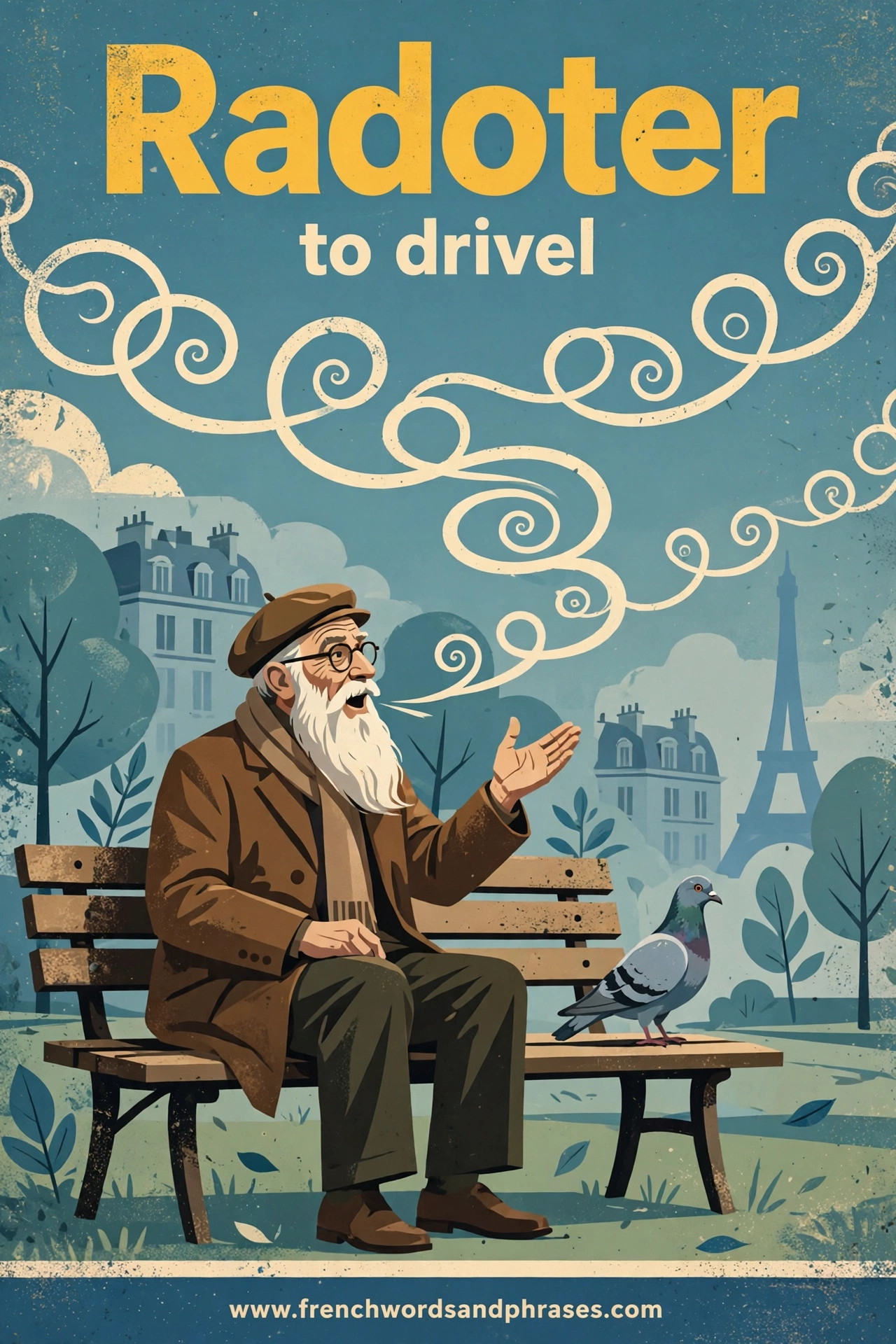
Radoter means to drivel — to ramble on, repeating yourself and talking nonsense.
The same story for the third time this lunch, the point lost somewhere around the second glass — radoter is the verb of speech that wanders off and circles back, the rambling of old age, of tiredness, of anyone talking long past their own last interesting sentence.
In this guide, you’ll learn how to conjugate radoter in all the major French tenses and moods. Explore complete conjugation tables, French examples, English translations, and practice quizzes.
Understanding the French Verb Radoter
Radoter is a regular French verb belonging to the first group of verbs, those ending in -er.
It means to drivel. It is commonly used for elderly people repeating their memories, for speakers who ramble off the point, for feverish or drunken incoherence, and self-deprecatingly by anyone who catches themselves telling a story twice.
Verb classification: First group (-er)
Auxiliary verb: Avoir
Past participle: radoté
Present participle: radotant
English equivalents: To drivel, to ramble on, to repeat oneself endlessly; un radoteur — a rambling old talker.
One important detail: radoter is rarely cruel but never flattering. It is the word for the grandfather who tells the same war story at every family meal — il radote — and for the speaker who has lost the thread: je radote, excusez-moi, I am rambling, forgive me. French also has the noun le radotage, drivel, the rambling itself. The verb suggests repetition above all: not just nonsense, but the SAME nonsense, lovingly retold.
Experience the Word
Radoter is the verb of the record stuck in its groove — the words keep coming, but they have stopped going anywhere.
Imagine a Sunday lunch that has lasted four hours. Grandfather has reached the harbour story again — the storm, the boat, the wave — and the grandchildren mouth the ending along with him, fondly, while he sails on, delighted.
Nothing new has been said for an hour. It has been radoté — retold, rewound, and retold again.
How to Conjugate Radoter: Complete French Conjugation Guide
Let’s explore every major conjugation of radoter, beginning with the indicative mood.
How to Conjugate Radoter in the Indicative Mood
The indicative mood is used to express facts, observations, actions, and events.
How to Conjugate Radoter in the Present Tense (Présent)
Used for actions happening now, habitual actions, and general truths.
| Subject | Conjugation |
|---|---|
| je | radote |
| tu | radotes |
| il / elle | radote |
| nous | radotons |
| vous | radotez |
| ils / elles | radotent |
Example
Mon grand-père radote toujours après le dessert.
My grandfather always drivels on after dessert.
Quick Quiz 1
Complete the sentence:
Nous écoutons papy qui ______ ses histoires.
Reveal the answer
radote
Nous écoutons papy qui radote ses histoires.
We listen to grandad drivelling on with his stories.
How to Conjugate Radoter in the Passé Composé
Used for completed actions in the past. Radoter takes the auxiliary verb avoir.
| Subject | Conjugation |
|---|---|
| j’ | ai radoté |
| tu | as radoté |
| il / elle | a radoté |
| nous | avons radoté |
| vous | avez radoté |
| ils / elles | ont radoté |
Example
Excuse-moi, j’ai radoté pendant une heure au téléphone.
Forgive me, I rambled on for an hour on the phone.
How to Conjugate Radoter in the Imparfait (Imperfect Tense)
Used for habitual past actions, descriptions, and ongoing situations in the past.
| Subject | Conjugation |
|---|---|
| je | radotais |
| tu | radotais |
| il / elle | radotait |
| nous | radotions |
| vous | radotiez |
| ils / elles | radotaient |
Example
Le vieux marin radotait ses tempêtes à qui voulait l’entendre.
The old sailor used to drivel on about his storms to anyone who would listen.
Quick Quiz 2
Choose the correct form:
He rambled for an hour.
Il ______ pendant une heure. (a radoté / est radoté)
Reveal the answer
a radoté
Il a radoté pendant une heure.
Radoter takes avoir.
How to Conjugate Radoter in the Plus-que-parfait
Used to describe an action that had already been completed before another past event.
| Subject | Conjugation |
|---|---|
| j’ | avais radoté |
| tu | avais radoté |
| il / elle | avait radoté |
| nous | avions radoté |
| vous | aviez radoté |
| ils / elles | avaient radoté |
Example
Il avait déjà radoté la même histoire trois fois ce soir-là.
He had already rambled through the same story three times that evening.
How to Conjugate Radoter in the Passé Simple
Primarily used in formal writing, literature, and historical narratives. It is rarely used in everyday conversation.
| Subject | Conjugation |
|---|---|
| je | radotai |
| tu | radotas |
| il / elle | radota |
| nous | radotâmes |
| vous | radotâtes |
| ils / elles | radotèrent |
Example
Le conférencier radota si longtemps que la salle se vida.
The lecturer drivelled on so long that the hall emptied.
How to Conjugate Radoter in the Passé Antérieur
A literary tense used to express an action completed immediately before another past action, generally in the passé simple.
| Subject | Conjugation |
|---|---|
| j’ | eus radoté |
| tu | eus radoté |
| il / elle | eut radoté |
| nous | eûmes radoté |
| vous | eûtes radoté |
| ils / elles | eurent radoté |
Example
Quand il eut radoté son anecdote, les invités bâillaient.
When he had rambled through his anecdote, the guests were yawning.
How to Conjugate Radoter in the Future Tense (Futur Simple)
Used to describe actions that will take place in the future.
| Subject | Conjugation |
|---|---|
| je | radoterai |
| tu | radoteras |
| il / elle | radotera |
| nous | radoterons |
| vous | radoterez |
| ils / elles | radoteront |
Example
À quatre-vingt-dix ans, je radoterai peut-être comme lui.
At ninety, I will perhaps drivel on just like him.
How to Conjugate Radoter in the Futur Antérieur (Future Perfect)
Used for an action that will have been completed before a particular point in the future.
| Subject | Conjugation |
|---|---|
| j’ | aurai radoté |
| tu | auras radoté |
| il / elle | aura radoté |
| nous | aurons radoté |
| vous | aurez radoté |
| ils / elles | auront radoté |
Example
À la fin du repas, il aura radoté toutes ses guerres.
By the end of the meal, he will have rambled through all his wars.
How to Conjugate Radoter in the Near Future (Futur Proche)
Used to describe something that is going to happen soon. Formed with aller + infinitive.
| Subject | Conjugation |
|---|---|
| je | vais radoter |
| tu | vas radoter |
| il / elle | va radoter |
| nous | allons radoter |
| vous | allez radoter |
| ils / elles | vont radoter |
Example
Attention, tu vas radoter si tu racontes encore ce voyage.
Careful, you are going to start rambling if you tell that trip story again.
How to Conjugate Radoter in the Conditional Mood
The conditional mood expresses what would happen under certain circumstances. It is also frequently used to make polite requests or express wishes.
How to Conjugate Radoter in the Present Conditional
| Subject | Conjugation |
|---|---|
| je | radoterais |
| tu | radoterais |
| il / elle | radoterait |
| nous | radoterions |
| vous | radoteriez |
| ils / elles | radoteraient |
Example
Sans son public, le vieil homme radoterait tout seul dans son jardin.
Without his audience, the old man would drivel on alone in his garden.
How to Conjugate Radoter in the Past Conditional
| Subject | Conjugation |
|---|---|
| j’ | aurais radoté |
| tu | aurais radoté |
| il / elle | aurait radoté |
| nous | aurions radoté |
| vous | auriez radoté |
| ils / elles | auraient radoté |
Example
Tu aurais radoté comme lui après une nuit sans sommeil.
You would have rambled like him after a sleepless night.
Radoter in the Literary Past Conditional Form
This less common literary form uses the imperfect subjunctive of avoir.
| Subject | Conjugation |
|---|---|
| j’ | eusse radoté |
| tu | eusses radoté |
| il / elle | eût radoté |
| nous | eussions radoté |
| vous | eussiez radoté |
| ils / elles | eussent radoté |
Example
Le vieillard eût radoté ses souvenirs jusqu’au matin.
The old man would have drivelled on about his memories until morning.
How to Conjugate Radoter in the Subjunctive Mood
The subjunctive is used to express wishes, emotions, doubts, necessity, and uncertainty. It frequently follows expressions such as il faut que (it is necessary that) or bien que (although).
How to Conjugate Radoter in the Present Subjunctive
| Subject | Conjugation |
|---|---|
| que je | radote |
| que tu | radotes |
| qu’il / qu’elle | radote |
| que nous | radotions |
| que vous | radotiez |
| qu’ils / qu’elles | radotent |
Example
Il est possible qu’il radote un peu avec l’âge.
It is possible he rambles a little with age.
Quick Quiz 3
Complete the sentence using the subjunctive:
Il est possible que vous ______ un peu ce soir.
Reveal the answer
radotiez
Il est possible que vous radotiez un peu ce soir.
It is possible you may ramble a little this evening.
How to Conjugate Radoter in the Imperfect Subjunctive
A literary tense, rarely encountered in modern spoken French.
| Subject | Conjugation |
|---|---|
| que je | radotasse |
| que tu | radotasses |
| qu’il / qu’elle | radotât |
| que nous | radotassions |
| que vous | radotassiez |
| qu’ils / qu’elles | radotassent |
Example
On craignait que le témoin radotât devant le juge.
People feared the witness might drivel on in front of the judge.
How to Conjugate Radoter in the Pluperfect Subjunctive
A literary construction used to express an action completed before another past action.
| Subject | Conjugation |
|---|---|
| que j’ | eusse radoté |
| que tu | eusses radoté |
| qu’il / qu’elle | eût radoté |
| que nous | eussions radoté |
| que vous | eussiez radoté |
| qu’ils / qu’elles | eussent radoté |
Example
Elle souriait à l’idée qu’il eût radoté la même histoire au mariage.
She smiled at the thought that he had rambled through the same story at the wedding.
How to Conjugate Radoter in the Past Subjunctive
| Subject | Conjugation |
|---|---|
| que j’ | aie radoté |
| que tu | aies radoté |
| qu’il / qu’elle | ait radoté |
| que nous | ayons radoté |
| que vous | ayez radoté |
| qu’ils / qu’elles | aient radoté |
Example
Je suis content qu’il n’ait pas radoté pendant la cérémonie.
I am glad he did not ramble on during the ceremony.
How to Conjugate Radoter in the Imperative
The imperative is used to give commands, instructions, invitations, or suggestions. Subject pronouns are omitted.
How to Conjugate Radoter in the Present Imperative
| Person | Conjugation |
|---|---|
| (tu) | radote |
| (nous) | radotons |
| (vous) | radotez |
Example
Ne radote pas, va droit au fait !
Do not ramble, get straight to the point!
Quick Quiz 4
How would you say Do not ramble, get to the point (tu form)?
Reveal the answer
Ne radote pas, va droit au fait !
French Participles of Radoter
Participles are verb forms that can be used in compound tenses and other grammatical constructions.
Present Participle of Radoter
radotant
En radotant ses histoires, il fait rire toute la table.
By drivelling on with his stories, he makes the whole table laugh.
Past Participle of Radoter
radoté
Radotées mille fois, ses anecdotes font partie de la famille.
Rambled a thousand times, his anecdotes are part of the family.
Radoter in Everyday French: Real-Life Examples
Now that you know the conjugations, let’s see how radoter appears in everyday French.
Example 1 — Present
Il radote un peu depuis quelques années.
He has been rambling a bit for a few years now.
Example 2 — Passé composé
Pardon, j’ai radoté — je me répète.
Sorry, I rambled — I am repeating myself.
Example 3 — Imparfait
Ma grand-mère radotait ses souvenirs de jeunesse.
My grandmother used to drivel on about her youthful memories.
Example 4 — Future
Tu radoteras comme ton père, tu verras.
You will ramble like your father, you will see.
Example 5 — Conditional
Je radoterais moins si je dormais mieux.
I would ramble less if I slept better.
Example 6 — Imperative
Ne radotez pas pendant la réunion !
Do not drivel on during the meeting!
Beyond Translation: The Meaning of Radoter
English drivel and ramble split the idea; French radoter holds it in one affectionate, exasperated word.
It is almost a family word.
Strangers divaguent or racontent n’importe quoi, but the grandfather at your own table — he radote, and the word carries the smile as much as the sigh.
How to Remember the French Verb Radoter
Remember it this way: Radoter is about the stuck record — the same story, lovingly retold.
- Radoter = the same story again: repetition is the heart of the word.
- Le radotage — the drivel itself; un radoteur — the rambling talker.
- Regular -er: je radote, nous radotons, past participle radoté.
The key idea is the stuck record — the same story, lovingly retold.
Test Your Knowledge of Radoter
Let’s see how much you’ve learned. Try answering these questions before revealing the answers.
Question 1
What does radoter suggest above all?
Reveal the answer
Repetition — saying the same things over and over.
Question 2
How do you say My grandfather rambles after dessert in French?
Reveal the answer
Mon grand-père radote après le dessert.
Question 3
Translate: Sorry, I am repeating myself.
Reveal the answer
Pardon, je radote — je me répète.
Question 4
What is the past participle of radoter?
Reveal the answer
Radoté.
Question 5
Complete the sentence:
Il est possible qu’il ______ un peu avec l’âge.
Reveal the answer
radote
Il est possible qu’il radote un peu avec l’âge.
It is possible he rambles a little with age.
Your Final Challenge
Can You Use It?
How would you say this in French?
The grandfather drivels on with his storm story, and the grandchildren already know the ending.
Reveal the answer
Le grand-père radote son histoire de tempête, et les petits-enfants connaissent déjà la fin.
The grandfather drivels on with his storm story, and the grandchildren already know the ending.
A little French. A little curiosity. A richer everyday life.
LEARN FRENCH ONE WORD AT A TIME