A French Word to Live By
Translate Qui vivra verra to English
/ki vi.vʁa vɛ.ʁa/
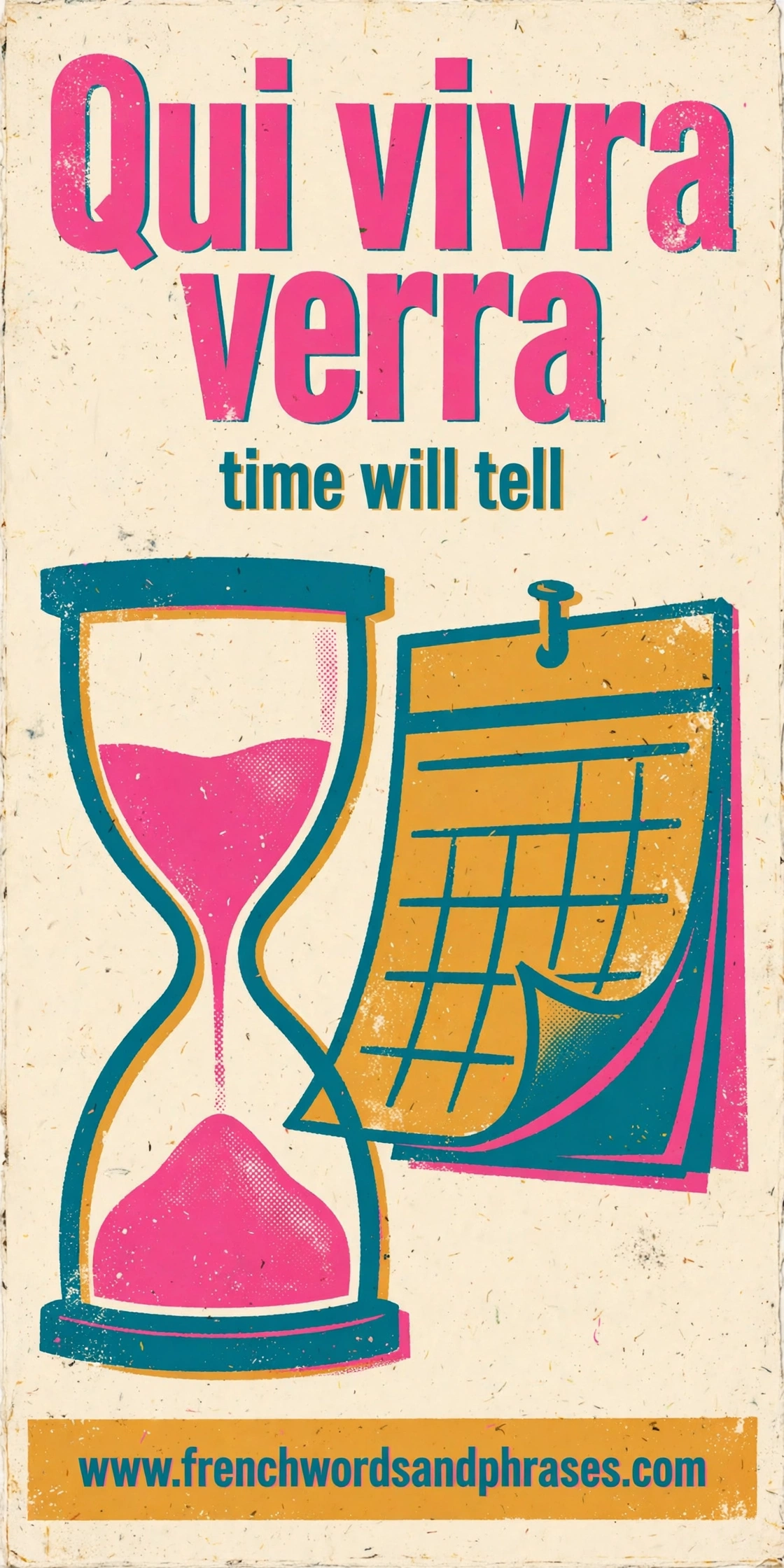
Qui vivra verra means time will tell — whoever lives long enough will see how it turns out.
Two brothers are arguing over the family orchard: will the new pear trees survive the winter, will the harvest pay, who was right about the pruning? Their grandmother, shelling peas on the step, ends the debate without looking up: « Qui vivra verra. »
Let’s explore how qui vivra verra works in French, beginning with the whole phrase on one card.
Understanding the French Phrase Qui vivra verra
Qui vivra verra is a French proverb built from qui (whoever), vivra (will live, the future of vivre) and verra (will see, the future of voir). Three words, two futures, no present at all — the whole proverb points forward, at a truth only time can deliver.
It means time will tell — wait, live, and you will see how things turn out. French speakers use it to close a speculation: about weather, results, children, plans, anything the future is keeping to itself. It can sound wise and patient, or, with a raised eyebrow, like a quiet ‘we shall see about that’.
Type: Proverb — waiting for outcomes (two future-tense verbs)
Answers the need: Ending a speculation: only time can answer this
Register: Neutral — safe everywhere; tone ranges from patient to pointed
Strength: Calm on the surface — underneath, it can carry a gentle challenge
One important usage detail: both verbs are in the future tense — vivra, verra — and the proverb is never conjugated into other tenses or persons. It is a complete answer on its own, often the last line of a discussion. Qui again means whoever, not ‘who’: nobody is asking a question.
Experience the Word
Qui vivra verra is the shortest philosophy of patience in French — three words that hand the argument over to the future.
Imagine two neighbours planting rival hedges, each certain the other’s will fail. Autumn argues, winter argues, and spring — spring simply shows the green shoots, on one side of the fence. The proverb had already said everything, months earlier, at planting time.
It is the proverb of grandparents and gardeners. It does not say you are wrong; it says the calendar is a better debater than either of you.
How to Use Qui vivra verra in French: Complete Guide
Let’s explore how qui vivra verra works in French, beginning with the whole phrase on one card.
Qui vivra verra at a Glance
The Whole Phrase on One Card
Real meaning, literal picture, English twin and register — qui vivra verra in five lines.
| Point | Qui vivra verra |
|---|---|
| What it really means | only time will show how this turns out — wait and see |
| Word for word | whoever will live will see |
| English equivalent | time will tell / wait and see / we shall see |
| Register | neutral — wise, patient, sometimes pointed |
| Use it for | closing speculations about results, plans, weather and people |
Example
Le nouveau magasin marchera-t-il ? Qui vivra verra.
Will the new shop do well? Time will tell.
Word by Word: Building the Future
Three small pieces — and every one of them points at tomorrow.
| Word | Literal meaning | Its job in the phrase |
|---|---|---|
| qui | whoever | anyone who is still around — the law is for all of us |
| vivra | will live | the future of vivre, to live — survival itself is the ticket |
| verra | will see | the future of voir, to see — the answer arrives as a sight, not a speech |
Example
Qui vivra verra si le rosier refleurit.
Time will tell whether the rose bush flowers again.
Quick Quiz 1
Which two verbs, in the future tense, make up qui vivra verra?
Reveal the answer
Vivre and voir — vivra, will live, and verra, will see: live long enough, and you will see.
Qui vivra verra le résultat des élections.
Time will tell the election result.
When You Say It: The Wait-and-See Moments
Qui vivra verra fires at moments like these — wherever the future is holding the only answer.
| Situation | Example |
|---|---|
| A doubtful plan | son projet semble fragile, mais qui vivra verra — his plan looks shaky, but time will tell |
| Weather guesses | il pleuvra dimanche, paraît-il : qui vivra verra — rain on Sunday, apparently: we shall see |
| A child’s future | elle veut être astronaute : qui vivra verra — she wants to be an astronaut: time will tell |
| A quiet challenge | tu crois que ça échouera ? qui vivra verra — you think it will fail? we shall see |
| Closing an argument | assez discuté : qui vivra verra — enough talk: time will tell |
Example
Ils parient sur la récolte, elle répond : qui vivra verra.
They bet on the harvest; she answers: time will tell.
Make It Yours: The Proverb in Use
The proverb never changes its form — its music changes with your tone of voice.
| Form | French | In English |
|---|---|---|
| The full proverb | qui vivra verra | time will tell |
| Patient | patience : qui vivra verra | patience: time will tell |
| Pointed | eh bien, qui vivra verra | well then — we shall see |
| Answering a prediction | peut-être, qui vivra verra | perhaps — time will tell |
| With a shrug | on verra bien | we’ll see — the everyday cousin, even shorter |
Example
Peut-être que tu as raison ; qui vivra verra.
Perhaps you are right; time will tell.
Quick Quiz 2
Two friends argue about who will win the match on Saturday. What closes the debate?
Reveal the answer
Qui vivra verra — Saturday holds the answer, and neither debater does.
Rendez-vous samedi : qui vivra verra.
See you Saturday: time will tell.
Everyday Expressions: Building on the Waiting
Qui vivra verra slots into these everyday frames — each one ready to use as it stands.
| Frame | In English |
|---|---|
| qui vivra verra | time will tell |
| on verra bien | we’ll see — the everyday short form |
| l’avenir nous le dira | the future will tell us — the fuller, slightly formal version |
| attendons de voir | let’s wait and see |
| le temps le dira | time will tell it — word for word the English twin |
Example
Attendons de voir : l’avenir nous le dira.
Let’s wait and see: the future will tell us.
Close Cousins: The Other Waiting Sayings
French has a whole shelf of waiting sayings — this proverb trusts time; its cousins hope, doubt or refuse to wait at all.
| Expression | The difference |
|---|---|
| qui vivra verra | time will tell — neutral trust in the future’s verdict |
| on verra bien | we’ll see — the casual everyday version, same idea, less proverb |
| l’espoir fait vivre | hope keeps us alive — waiting with hope, not just patience |
| tout vient à point à qui sait attendre | all comes in time to those who wait — waiting rewarded, a promise rather than a verdict |
| qui vivra verra, mais en attendant | time will tell, but meanwhile — the impatient rider French speakers add |
Example
L’espoir fait vivre, et qui vivra verra.
Hope keeps us alive, and time will tell.
Quick Quiz 3
Which cousin adds hope to the waiting — l’espoir fait vivre or on verra bien?
Reveal the answer
L’espoir fait vivre — hope keeps us alive. On verra bien is simply the casual twin of the proverb itself.
Elle attend les résultats avec calme : l’espoir fait vivre.
She waits for the results calmly: hope keeps us alive.
Qui vivra verra and Its Neighbours
The future shelf around the proverb — from living itself to the seeing that follows.
| French | In English |
|---|---|
| vivre | to live |
| voir | to see |
| l’avenir | the future |
| le temps | time — and also the weather, fittingly |
| un résultat | a result, an outcome |
| attendre | to wait |
Example
Le temps passe, l’avenir arrive, et qui vivra verra.
Time passes, the future arrives, and time will tell.
Watch Out: The Traps Around Qui vivra verra
The traps: a qui that asks nothing, futures that must not be conjugated away, and a tone that can sharpen.
| Trap | The truth |
|---|---|
| qui asks no question | qui here means whoever — there is no question mark and nobody is being asked who will live |
| keep both futures | vivra and verra are future tense — saying qui vit voit destroys the proverb and its patience |
| tone can sharpen it | said flatly to a boaster, it means ‘we shall see about that’ — mind the eyebrow you say it with |
| verra, not vera | voir’s future doubles the r: il verra — a spelling the proverb shows off perfectly |
Example
Il verra bien, l’an prochain, si son pommier donne des fruits.
He will see, next year, whether his apple tree bears fruit.
Quick Quiz 4
True or false: qui vivra verra can be adapted — tu vivras, tu verras keeps the proverb intact.
Reveal the answer
False — the proverb is frozen with qui and the third person; changing the person makes an ordinary sentence, not the saying.
Tu verras bien assez tôt comment ça finit.
You will see soon enough how it ends.
Qui vivra verra in Everyday French: Real-Life Examples
Now that you know the word, let’s see how qui vivra verra appears in everyday French.
Example 1 — The orchard bet
Les pommiers donneront-ils cette année ? Qui vivra verra.
Will the apple trees bear fruit this year? Time will tell.
Example 2 — The new bakery
La nouvelle boulangerie attire du monde pour l’instant : qui vivra verra.
The new bakery is drawing crowds for now: time will tell.
Example 3 — The exam
Elle a travaillé dur, mais pour le résultat, qui vivra verra.
She worked hard, but as for the result, time will tell.
Example 4 — The weather
On annonce de la neige en avril : qui vivra verra.
They forecast snow in April: we shall see.
Example 5 — The young couple
Ils ouvrent un café ensemble, tout le village dit : qui vivra verra.
They are opening a café together; the whole village says: time will tell.
Example 6 — Closing the debate
Assez de pronostics : qui vivra verra.
Enough predictions: time will tell.
Beyond Translation: The Meaning of Qui vivra verra
English gives the verdict to time itself — time will tell, as if the clock were a witness waiting to speak. French gives it to the survivors: whoever lives will see. The French version is older and more mortal; it quietly admits that the answer belongs only to those still standing when it arrives.
Qui vivra verra turns patience into a kind of appointment — the future has agreed to meet you, if you are there.
That is why it ends arguments so gently. It does not declare a winner; it books a rematch with reality.
How to Remember the French Phrase Qui vivra verra
Remember it this way: Qui vivra verra is the future’s own proverb — two future verbs, and the answer booked for later.
- You hear the double future — vivra, verra: live first, see second, in that order.
- You read qui as whoever — a law for everyone, never a question.
- You let tone do the shading — patient from a grandmother, pointed to a boaster.
The key idea is qui vivra verra means time will tell — whoever lives will see the outcome.
Test Your Knowledge of Qui vivra verra
Let’s see how much you’ve learned. Try answering these questions before revealing the answers.
Question 1
What does qui vivra verra mean?
Reveal the answer
Time will tell — wait and live, and you will see how it turns out.
Question 2
What is the literal, word-for-word meaning?
Reveal the answer
Whoever will live will see — vivra is the future of vivre, verra the future of voir.
Question 3
Friends are speculating about the election result. What do you say to close it?
Reveal the answer
Qui vivra verra — the future holds the answer, not the debate.
Question 4
What is the everyday short cousin of the proverb?
Reveal the answer
On verra bien — we’ll see: the same idea in casual dress.
Question 5
Complete the sentence:
Qui vivra ______. (Time will tell.)
Reveal the answer
verra
Qui vivra verra.
Time will tell.
Your Final Challenge
Can You Use It?
How would you say this in French?
“Time will tell.”
Reveal the answer
Qui vivra verra.
Time will tell.
A little French. A little curiosity. A richer everyday life.
LEARN FRENCH ONE WORD AT A TIME