
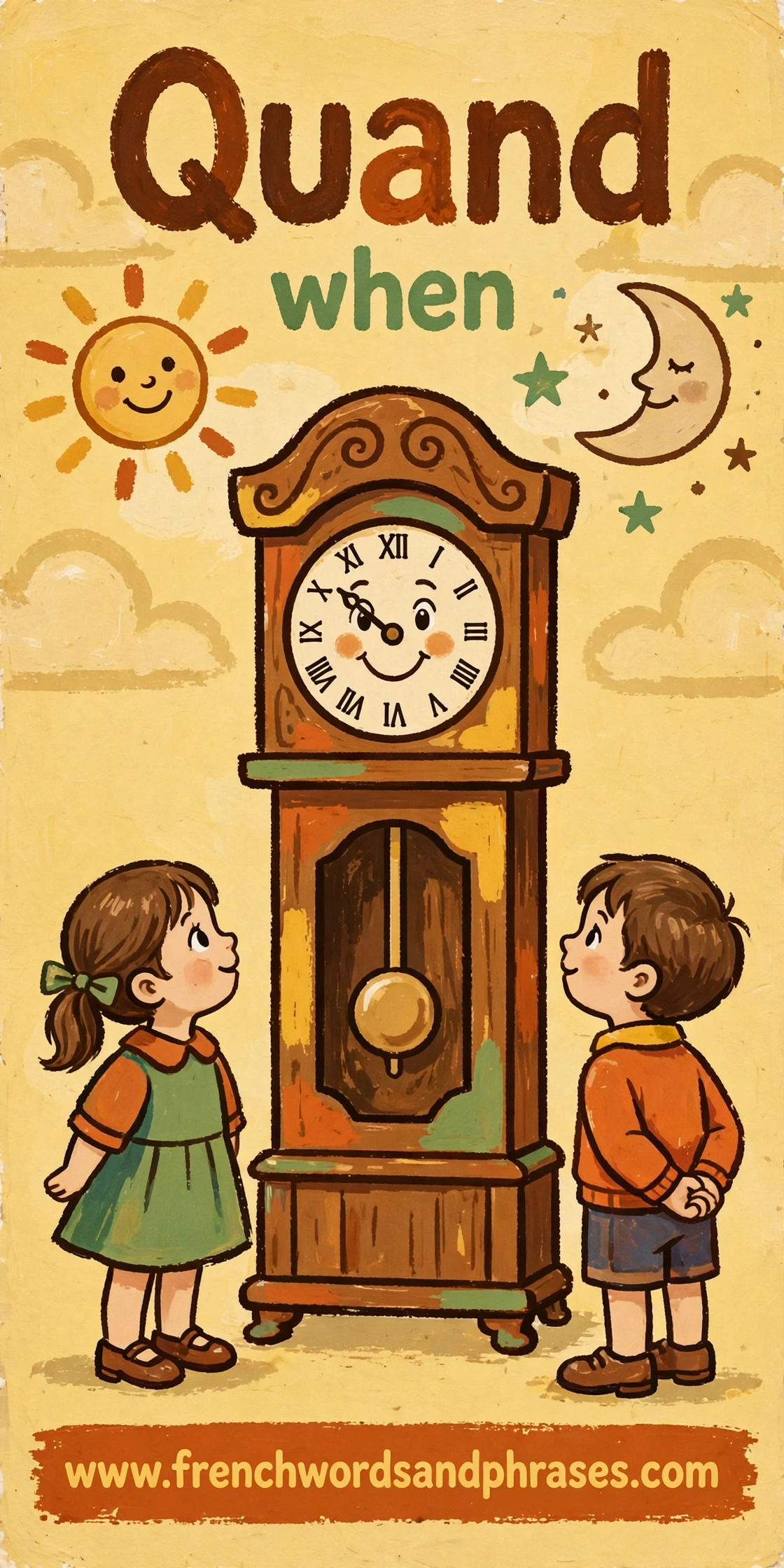
A French Word to Live By
Translate Quand to English
/kɑ̃/
Quand means when.
« Quand j’étais petit… » — when I was little… Every French memoir, every grandparent’s story, every plan for next summer begins with quand. It is the word that pins a moment to the great calendar of life.
In this guide, you’ll learn what quand means in English, why the future tense follows it for future events, how it differs from lorsque and dès que, and why quand même means something else entirely. Explore French examples, English translations, and practice quizzes.
Understanding the French Conjunction Quand
Quand is a French subordinating conjunction of time. It introduces a clause that says when the main action happens — in the past, the present, or the future.
It means when. After quand comes a full clause: quand je suis rentré, elle dormait — when I got home, she was asleep. For future events, French puts the verb after quand in the future tense, where English uses the present.
Type: Subordinating conjunction — time
What follows it: A full clause — subject + verb
Mood after it: Indicative — including the future for future events
Famous cousin: Quand même — ‘even so, anyway’ (a different animal)
The rule that surprises every learner: for a future event, quand takes the future — quand tu viendras, when you come (literally: when you will come). English hides the future; French shows it.
Experience the Word
Quand is the conjunction of the appointed hour — it does not ask if, only when; the event is treated as certain, only its moment is in play.
Imagine a grandmother at the window in April: « quand les hirondelles reviendront… » — when the swallows come back. She does not doubt the swallows. Quand is faith in the calendar.
You have not just fixed a time. You have promised that the moment will come.
How to Use Quand in French: Complete Guide
Let’s explore how quand works in French, beginning with the whole word on one card.
Quand at a Glance
Before the details, here is the whole word on one card.
The Whole Word on One Card
Meaning, job, pattern and mood — quand in four lines.
| Point | Quand |
|---|---|
| Meaning | when |
| Job | fixes the moment of the main action |
| What follows | a full clause — subject + verb |
| Mood | indicative — future included for future events |
Example
Quand je rentrerai, je t’appellerai.
When I get home, I’ll call you.
How Quand Links: Two Moments, One Sentence
Quand pins the main clause to a moment: the quand-clause is the clock, and the other clause is what the clock strikes for.
| Pattern | Example |
|---|---|
| past moment | quand j’étais enfant, je vivais à la campagne — when I was a child, I lived in the countryside |
| present habit | quand il pleut, je prends le bus — when it rains, I take the bus |
| future moment | quand tu arriveras, nous mangerons — when you arrive, we’ll eat |
| question form | quand est-ce que tu pars ? — when are you leaving? |
Example
Quand le film a commencé, tout le monde s’est tu.
When the film started, everyone fell silent.
Quick Quiz 1
For a future event, what tense follows quand — present or future?
Reveal the answer
The future — French shows it openly.
Quand tu viendras, je serai là.
When you come, I’ll be there.
The Mood Question: Indicative, With Its Future Showing
Quand never takes the subjunctive: the moment is treated as real. Its special feature is tense — future events take the future (or future anterior) after quand, exactly as in the main clause.
| After quand | Example |
|---|---|
| habits: present | quand je peux, je marche — when I can, I walk |
| past: imperfect / passé composé | quand il est arrivé, nous avons mangé — when he arrived, we ate |
| future: future simple | quand elle partira, je serai triste — when she leaves, I’ll be sad |
| future completed first: future anterior | quand tu auras fini, appelle-moi — when you’ve finished, call me |
Example
Quand nous aurons mangé, nous partirons.
When we have eaten, we’ll leave.
Where Quand Goes: Front or Middle, Always Whole
The quand-clause can open the sentence or follow the main clause. And quand, unlike que, never shortens — its final -d is written whatever follows.
| Position | Example |
|---|---|
| at the start (comma follows the clause) | quand il fait beau, on sort — when the weather is nice, we go out |
| in the middle | on sort quand il fait beau — we go out when the weather is nice |
| never shortened | quand keeps its -d in writing, even before a vowel: quand elle arrive |
| quand + est-ce que for questions | quand est-ce qu’il revient ? — when is he coming back? |
Example
Je te téléphonerai quand je serai prêt.
I’ll phone you when I’m ready.
Quick Quiz 2
True or false: quand can drop its final -d before a vowel, the way que becomes qu’.
Reveal the answer
False — quand never shortens.
Quand elle arrive, dis-le-moi.
When she arrives, tell me.
Everyday Expressions with Quand
Quand lives in questions about time — and in one rebellious phrase that means something quite different.
| Expression | In English |
|---|---|
| quand même | even so / anyway / all the same |
| de temps en temps | from time to time |
| quand bien même | even if (formal: quand bien même il viendrait…) |
| depuis quand ? | since when? / how long? |
| c’est pour quand ? | when is it for? / when’s it due? |
Example
Il pleuvait, mais nous sommes sortis quand même.
It was raining, but we went out anyway.
Close Cousins: Quand, Lorsque, Dès que, Pendant que
Time has a family in French, and the differences are about precision: a point, an instant trigger, or a long shared stretch.
| Word | The difference |
|---|---|
| quand | the everyday ‘when’ — any moment, spoken and written |
| lorsque | the same ‘when’, a little more formal and written |
| dès que | ‘as soon as’ — the moment immediately triggers the next |
| pendant que | ‘while’ — two things stretch out side by side |
Example
Dès que le train est arrivé, nous sommes montés.
As soon as the train arrived, we got on.
Quick Quiz 3
Which cousin means ‘as soon as’ — quand or dès que?
Reveal the answer
dès que.
Dès que tu arrives, appelle-moi.
As soon as you arrive, call me.
Quand and Its Neighbours
Here are the time-words that keep quand company, including the uncertain neighbour it is most often confused with.
| French | In English |
|---|---|
| lorsque | when (formal) |
| dès que | as soon as |
| pendant que | while |
| après que | after |
| si | if — the uncertain neighbour (quand treats the moment as certain) |
Example
Après que tu auras fini, on verra.
After you’ve finished, we’ll see.
Watch Out: The Traps Around Quand
One letter separates quand from a different word entirely, and one tense rule catches every learner at least once.
| Trap | The truth |
|---|---|
| quand vs quant à | quant à means ‘as for’: quant à moi — as for me. One letter, another world. |
| the future after quand | the classic trap: quand tu viendras, not ‘quand tu viens’, for a future moment |
| quand même is not ‘when same’ | it means ‘anyway / even so’ — merci quand même, thanks anyway |
| quand in musings | quand je pense… ! — when I think about it…! (speech, trailing off) |
Example
Quant à Paul, il décidera plus tard.
As for Paul, he’ll decide later.
Quick Quiz 4
Translate, with the future tense: when you arrive (tomorrow).
Reveal the answer
quand tu arriveras — the future after quand.
Quand tu arriveras demain, je t’attendrai.
When you arrive tomorrow, I’ll be waiting for you.
Quand in Everyday French: Real-Life Examples
Now that you know the word, let’s see how quand appears in everyday French.
Example 1 — Childhood
Quand j’étais petit, je jouais dans cette rue.
When I was little, I played in this street.
Example 2 — A promise
Quand je serai grand, je serai pilote.
When I grow up, I’ll be a pilot.
Example 3 — Weather habit
Quand il neige, l’école ferme parfois.
When it snows, the school sometimes closes.
Example 4 — A question
Quand est-ce que le train part ?
When does the train leave?
Example 5 — Anyway
C’est cher, mais je l’achète quand même.
It’s expensive, but I’m buying it anyway.
Example 6 — All ears
Quand elle chante, tout le monde écoute.
When she sings, everyone listens.
Beyond Translation: The Meaning of Quand
English says when for the meaning of quand — but French quand has a quiet confidence English when does not always share. It treats the future moment as a date already written in the diary, so it dresses the verb in the future tense.
Si wonders; quand waits. One doubts the event, the other only consults the clock.
And then there is its rebellious child, quand même — the shrug of a whole nation in two words: yes, it’s raining; yes, it’s expensive; yes, it’s impossible — we go anyway.
How to Remember the French Conjunction Quand
Remember it this way: Quand is the diary word — the event is certain, only the hour is negotiable.
- You treat the moment as sure — quand, not si, when you expect it to happen.
- You show the future — quand tu viendras, with the future tense after it.
- You keep the -d — quand never shortens, whatever follows.
The key idea is quand fixes a certain moment — and future moments take the future tense.
Test Your Knowledge of Quand
Let’s see how much you’ve learned. Try answering these questions before revealing the answers.
Question 1
What does quand mean?
Reveal the answer
When — it introduces a clause of time.
Question 2
What tense follows quand for a future event?
Reveal the answer
The future: quand tu viendras — when you come.
Question 3
Translate: When I was a child, I lived in Paris.
Reveal the answer
Quand j’étais enfant, j’habitais à Paris.
Question 4
What does quand même mean?
Reveal the answer
Anyway / even so: je viens quand même — I’m coming anyway.
Question 5
Complete the sentence (future):
Quand nous ______ (arriver), nous mangerons.
Reveal the answer
arriverons
Quand nous arriverons, nous mangerons.
When we arrive, we’ll eat.
Your Final Challenge
Can You Use It?
How would you say this in French?
“When the train arrives, we will leave.”
Reveal the answer
Quand le train arrivera, nous partirons.
When the train arrives, we will leave.
A little French. A little curiosity. A richer everyday life.
LEARN FRENCH ONE WORD AT A TIME




