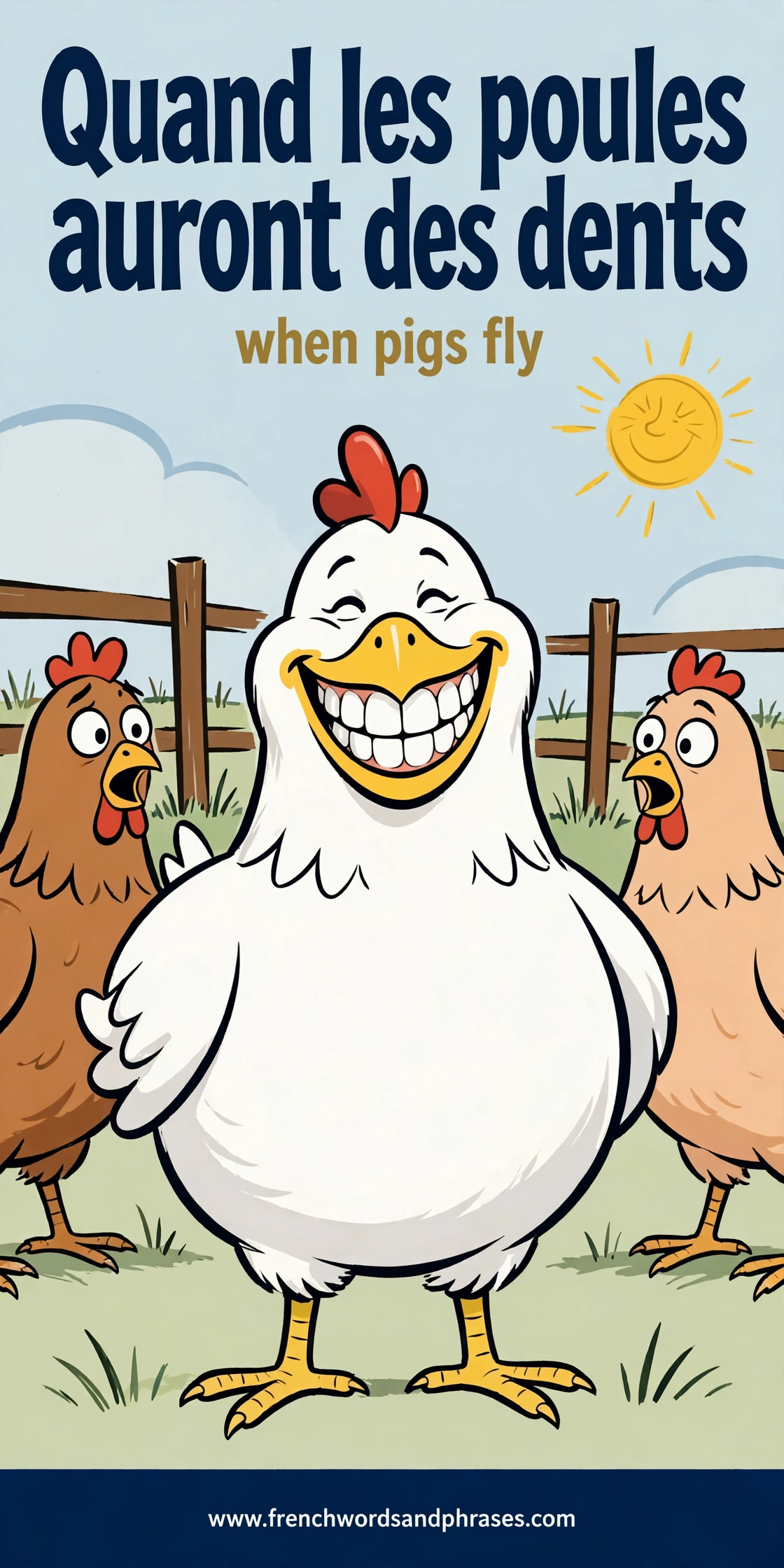
A French Word to Live By
Translate Quand les poules auront des dents to English
/kɑ̃ le pul o.ʁɔ̃ de dɑ̃/
Quand les poules auront des dents means never — when hens have teeth, which is to say, not in this lifetime.
Your neighbour has promised to repaint the garden fence for the third summer in a row. This year, he says, definitely this year. His wife, shelling peas on the step, does not even look up: « Oui, quand les poules auront des dents. »
Let’s explore how quand les poules auront des dents works in French, beginning with the whole phrase on one card.
Understanding the French Phrase Quand les poules auront des dents
Quand les poules auront des dents is a French idiomatic expression — a whole sentence, built from quand (when), les poules (the hens), auront (will have) and des dents (teeth). It is the standard French answer to any promise nobody believes: that will happen when hens grow teeth — never.
It means never — it will happen on the day hens have teeth, which is no day at all. It is the exact French twin of the English ‘when pigs fly’. Nobody is discussing poultry: the impossible animal does the work, and the phrase lands as a complete reply, dry and final, to a claim or a promise you do not believe for a second.
Type: Idiomatic expression — a whole sentence of disbelief
Answers the need: Saying ‘that will never happen’ with a smile instead of an argument
Register: Informal and humorous — everyday speech, gentle teasing
Strength: Total — not ‘unlikely’, but never, ever
One important usage detail: the verb stays in the future — auront, will have — because the joke lives in a future that will never arrive. The phrase most often stands alone as a reply, or finishes a sentence: il rangera sa chambre quand les poules auront des dents. Do not shorten it to ‘quand les poules ont des dents’ — the future tense is the punchline.
Experience the Word
Quand les poules auront des dents is disbelief with its sleeves rolled up — a whole farmyard mobilised to say no.
Imagine the promise-maker’s face: he has sworn the fence, the diet, the early mornings. The hens settle it. Somewhere in an imaginary future, a hen smiles a toothy smile — and everyone at the table understands that the fence will still be grey next summer.
Every language keeps an impossible animal for this job. France chose the hen; the joke needs only a beak and the certainty that teeth are not coming.
How to Use Quand les poules auront des dents in French: Complete Guide
Let’s explore how quand les poules auront des dents works in French, beginning with the whole phrase on one card.
Quand les poules auront des dents at a Glance
The Whole Phrase on One Card
Real meaning, literal picture, English twin and register — quand les poules auront des dents in five lines.
| Point | Quand les poules auront des dents |
|---|---|
| What it really means | never — that will simply never happen |
| Word for word | when the hens will have teeth |
| English equivalent | when pigs fly / that’ll be the day |
| Register | informal and humorous — a teasing reply |
| Use it for | unbelievable promises, hopeless predictions, ‘no chance’ moments |
Example
Il paiera sa tournée quand les poules auront des dents.
He’ll buy his round when pigs fly.
Word by Word: Building the Impossible
Five small pieces — take them one by one and the hen grows her impossible teeth.
| Word | Literal meaning | Its job in the phrase |
|---|---|---|
| quand | when | opens the imaginary future date |
| les poules | the hens | the farmyard animals chosen for the impossible event |
| auront | will have | the future of avoir — the teeth belong to a future that never comes |
| des | some | teeth in general, any teeth at all |
| dents | teeth | the thing a beak will never grow |
Example
Des dents, les poules n’en auront jamais.
Teeth — hens will never have any.
Quick Quiz 1
Why must the verb stay in the future — auront?
Reveal the answer
Because the joke is a future date that never arrives — the teeth are always still to come.
Elle viendra à l’heure quand les poules auront des dents.
She’ll arrive on time when pigs fly.
When You Say It: The Disbelief Moments
Quand les poules auront des dents fires at moments like these — a promise is made, and nobody at the table believes it.
| Situation | Example |
|---|---|
| The repeated promise | il rangera le garage quand les poules auront des dents — he’ll tidy the garage when pigs fly |
| As a complete reply | — Il va arrêter de fumer. — Quand les poules auront des dents ! — ‘He’s going to quit smoking.’ ‘When pigs fly!’ |
| About the weather of promises | les travaux finiront en juin, quand les poules auront des dents — the works will finish in June, when pigs fly |
| Teasing a friend | tu gagneras au loto quand les poules auront des dents — you’ll win the lottery when pigs fly |
| About oneself, honestly | je me lèverai à cinq heures quand les poules auront des dents — I’ll get up at five when pigs fly |
Example
Il a promis de répondre à ses mails, quand les poules auront des dents.
He promised to answer his emails — when pigs fly.
Make It Yours: The Hens for Every Sentence
The phrase is a fixed block — it either stands alone or closes a sentence; only the front half changes.
| Form | French | In English |
|---|---|---|
| Standing alone | quand les poules auront des dents ! | when pigs fly! |
| Closing a sentence | il le fera quand les poules auront des dents | he’ll do it when pigs fly |
| With a laugh | oui, c’est ça, quand les poules auront des dents | yeah, right — when pigs fly |
| Short and dry | les poules, les dents, tout ça… | the hens, the teeth, all that… (trailing off) |
| Doubtful question | vraiment ? ou quand les poules auront des dents ? | really? or when pigs fly? |
| Full certainty | ça arrivera quand les poules auront des dents | that will happen when pigs fly |
Example
Elle rendra le livre à la date prévue, quand les poules auront des dents.
She’ll return the book on the due date — when pigs fly.
Quick Quiz 2
Which is correct — quand les poules ont des dents or quand les poules auront des dents?
Reveal the answer
Quand les poules auront des dents — the future tense carries the joke: the day is always coming and never comes.
Il m’aidera quand les poules auront des dents.
He’ll help me when pigs fly.
Everyday Expressions: Building on the Hens
Quand les poules auront des dents slots into these everyday frames — each one ready to use as it stands.
| Frame | In English |
|---|---|
| quand les poules auront des dents | when pigs fly — never |
| …quand les poules auront des dents ! | …when pigs fly! (closing any sentence) |
| oui, quand les poules auront des dents | yeah, when pigs fly |
| ça, c’est quand les poules auront des dents | that — that’s when pigs fly |
| attendre que les poules aient des dents | to wait for hens to grow teeth — to wait forever |
Example
Il rendra l’argent ? Oui, quand les poules auront des dents.
He’ll give the money back? Yeah — when pigs fly.
Close Cousins: The Other Nevers
French keeps a whole shelf of impossible dates — the hens are the farmyard one; its cousins use saints, calendars and Thursdays.
| Expression | The difference |
|---|---|
| quand les poules auront des dents | when pigs fly — the everyday, farmyard never |
| à la Saint-Glinglin | on Saint Glinglin’s day — a saint who does not exist, so never; a touch more old-fashioned |
| la semaine des quatre jeudis | the week of four Thursdays — a week that cannot exist |
| aux calendes grecques | at the Greek calends — learned and literary; the Greek calendar had no calends |
| jamais de la vie | never in my life — plain refusal, no picture and no joke |
Example
À la Saint-Glinglin ou quand les poules auront des dents, c’est pareil : jamais.
Saint Glinglin’s day or when hens have teeth — same thing: never.
Quick Quiz 3
Who is Saint Glinglin, in à la Saint-Glinglin?
Reveal the answer
Nobody — the saint does not exist, which is exactly why his day means never.
Le rapport sera prêt à la Saint-Glinglin.
The report will be ready on Saint Glinglin’s day — never.
Quand les poules auront des dents and Its Neighbours
The disbelief shelf around the phrase — promises, doubts and the farmyard itself.
| French | In English |
|---|---|
| promettre | to promise |
| une promesse | a promise |
| croire | to believe |
| jamais | never |
| un coq | a rooster |
| le poulailler | the henhouse |
Example
Je ne crois plus à ses promesses : les poules auront des dents avant.
I don’t believe his promises any more: the hens will have teeth first.
Watch Out: The Traps Around Quand les poules auront des dents
The traps: a tense that must not move, an animal that must not change, and a translation that walks into a wall.
| Trap | The truth |
|---|---|
| the tense trap | auront is future — ‘quand les poules ont des dents’ kills the joke and sounds like zoology |
| the animal trap | hens, not chickens in general and not pigs — les poules is fixed; the pigs belong to English |
| word for word in English | ‘when the hens will have teeth’ means nothing in English — translate with when pigs fly |
| too teasing for bad news | the phrase mocks promises, not misfortunes — never use it about something someone is grieving |
Example
Les cochons volent en anglais ; en français, ce sont les poules qui ont des dents.
Pigs fly in English; in French, it’s the hens that have teeth.
Quick Quiz 4
True or false: the English twin of the phrase is ‘when the hens get teeth’.
Reveal the answer
False — English uses a different impossible animal: when pigs fly.
Il se mariera quand les poules auront des dents — quand les cochons voleront, comme disent les Anglais.
He’ll get married when pigs fly — as the English say.
Quand les poules auront des dents in Everyday French: Real-Life Examples
Now that you know the word, let’s see how quand les poules auront des dents appears in everyday French.
Example 1 — The garden fence
Il repeindra la clôture quand les poules auront des dents.
He’ll repaint the fence when pigs fly.
Example 2 — The reply
— Il va ranger sa chambre. — Quand les poules auront des dents !
‘He’s going to tidy his room.’ ‘When pigs fly!’
Example 3 — The lottery
Tu gagneras au loto quand les poules auront des dents.
You’ll win the lottery when pigs fly.
Example 4 — Being on time
Elle arrivera à l’heure quand les poules auront des dents.
She’ll arrive on time when pigs fly.
Example 5 — The works
Les travaux seront finis en juin, quand les poules auront des dents.
The works will be finished in June — when pigs fly.
Example 6 — About oneself
Je me lèverai à cinq heures quand les poules auront des dents.
I’ll get up at five o’clock when pigs fly.
Beyond Translation: The Meaning of Quand les poules auront des dents
English sends pigs into the sky; French grows teeth in a hen’s beak. Both languages agree on the method: pick a farmyard animal, give it the one thing it can never have, and let the picture deliver the verdict no argument could.
Quand les poules auront des dents is a calendar with one date on it — the date that is not coming.
And the future tense is the quiet genius of it: the teeth are never denied, only postponed forever.
How to Remember the French Phrase Quand les poules auront des dents
Remember it this way: Quand les poules auront des dents is the farmyard’s way of saying never — a hen, a beak, and teeth that are always about to grow.
- You picture the hen — a beak cannot grow teeth, so the promised day cannot come.
- You keep the future — auront, will have: the teeth are postponed forever, not denied.
- You swap animals across the Channel — French hens with teeth, English pigs with wings.
The key idea is quand les poules auront des dents means never — the French ‘when pigs fly’.
Test Your Knowledge of Quand les poules auront des dents
Let’s see how much you’ve learned. Try answering these questions before revealing the answers.
Question 1
What does quand les poules auront des dents mean?
Reveal the answer
Never — it will happen when hens have teeth, which is to say not at all.
Question 2
What is the English equivalent?
Reveal the answer
When pigs fly — a different impossible animal, the same impossible day.
Question 3
Why is the verb in the future tense?
Reveal the answer
Because the joke postpones the event forever — auront, will have: the teeth are always still to come.
Question 4
How do you say ‘he’ll tidy his room when pigs fly’?
Reveal the answer
Il rangera sa chambre quand les poules auront des dents — the phrase closes the sentence.
Question 5
Complete the sentence:
Elle paiera quand les poules ______ des dents. (She’ll pay when pigs fly.)
Reveal the answer
auront
Elle paiera quand les poules auront des dents.
She’ll pay when pigs fly.
Your Final Challenge
Can You Use It?
How would you say this in French?
“He’ll tidy his room when pigs fly.”
Reveal the answer
Il rangera sa chambre quand les poules auront des dents.
He’ll tidy his room when pigs fly.
A little French. A little curiosity. A richer everyday life.
LEARN FRENCH ONE WORD AT A TIME