A French Word to Live By
Translate Piéton to English
/pje.tɔ̃/
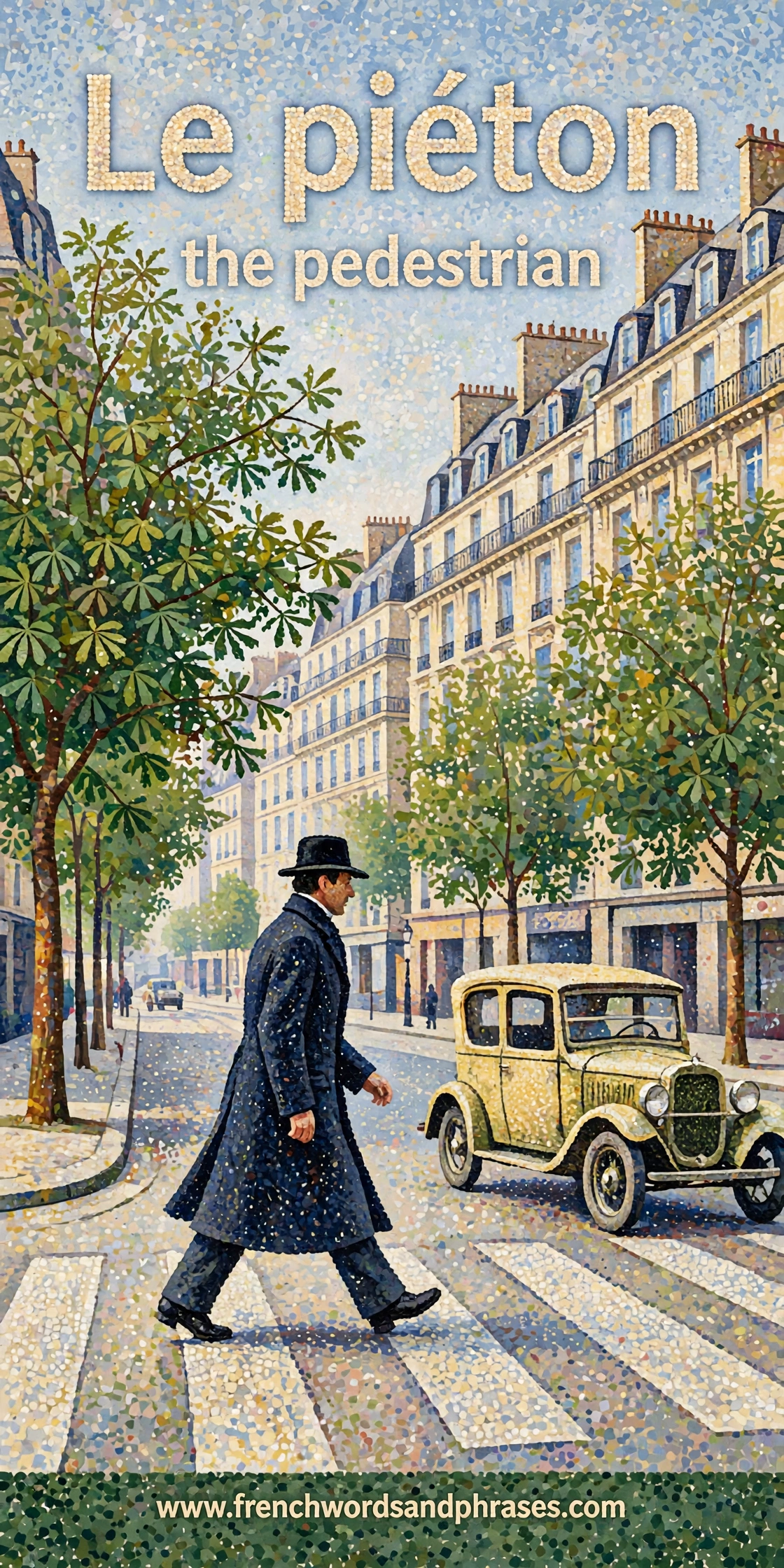
Le piéton means the pedestrian.
Waiting at the crossing, shopping bag in hand, watching the little green man: le piéton, the pedestrian — the most ancient road user of all, travelling at the speed of two feet.
In this guide, you’ll learn what piéton means in English, how to use it with its articles, how to form its plural, and how it appears in everyday French. Explore French examples, English translations, and practice quizzes.
Understanding the French Noun Piéton
Piéton is a masculine French noun, learned with its article: le piéton, un piéton. It is built on pied, foot — the piéton is simply the person on foot. A woman pedestrian is une piétonne. The word also works as an adjective: une rue piétonne, a pedestrian street, un passage piéton, a pedestrian crossing.
It means a pedestrian — a person walking in the street or along the road: les piétons traversent au passage piéton, pedestrians cross at the crossing. Town planning has made the word a badge of honour: une zone piétonne, a pedestrian zone, une rue piétonne, a street closed to cars. The verb for what the piéton fears is renverser or écraser — to knock down — and road safety campaigns speak endlessly of la sécurité des piétons.
Gender: Masculine — le piéton (feminine: une piétonne)
Definite article: le — le piéton (the pedestrian)
Indefinite article: un — un piéton (a pedestrian)
Plural: les piétons — regular, with a simple -s
Spelling note: built on pied, foot — the piéton is the one on foot
Also an adjective: une rue piétonne, a pedestrian street; un passage piéton, a crossing
English equivalents: The pedestrian.
Crossing vocabulary is built around the piéton: un passage piéton (also un passage clouté in older French) is the zebra crossing, and the green man is le petit bonhomme vert. Drivers must laisser passer les piétons, let pedestrians cross. Note the adjective agreement: masculine piéton, feminine piétonne — un passage piéton but une rue piétonne.
Experience the Word
Piéton is the citizen in his oldest form: no engine, no ticket, just legs and the right of way the law is learning to give back.
Imagine the rue piétonne on a Saturday — no cars, café tables in the middle of the street, children running ahead: the piéton has taken his city back.
You have not just named a walker. You have named the human scale of the street — le piéton, the pedestrian, king of the crossing.
How to Use Piéton in French: Complete Guide
Let’s explore how piéton works in French, beginning with its articles — le piéton, un piéton, le passage piéton.
Piéton with the Definite Article (Le, Les)
Used for a specific pedestrian — the one at the crossing, the one with the red coat.
| Form | French |
|---|---|
| Masculine singular | le piéton |
| Plural | les piétons |
Example
Le piéton attend le petit bonhomme vert.
The pedestrian waits for the green man.
Piéton with the Indefinite Article (Un, Des)
Used for a pedestrian in general — anyone on foot among the traffic.
| Form | French |
|---|---|
| Masculine singular | un piéton |
| Plural | des piétons |
Example
Un piéton traverse en regardant son téléphone.
A pedestrian is crossing while looking at his phone.
The Piéton’s World (Passage, Rue Piétonne, Trottoir…)
Crossings, pavements and car-free streets — the pedestrian’s territory.
| Thing | French |
|---|---|
| a pedestrian crossing | un passage piéton |
| a pedestrian street | une rue piétonne |
| a pedestrian zone | une zone piétonne |
| the pavement, the sidewalk | le trottoir |
| the green man | le petit bonhomme vert |
Example
Cette rue piétonne est pleine de cafés.
This pedestrian street is full of cafés.
Quick Quiz 1
Complete the sentence:
______ piétons ont la priorité au passage piéton. (the)
Reveal the answer
Les
Les piétons ont la priorité au passage piéton.
Pedestrians have right of way at the crossing — les, for the plural.
The Plural of Piéton
Piéton takes a regular plural in -s — crowds of them fill the pedestrian streets.
| Number | French |
|---|---|
| Singular | le piéton |
| Plural | les piétons |
Example
Les piétons envahissent la place le samedi.
Pedestrians fill the square on Saturdays.
Piéton with Possessive Adjectives (Mon, Ton, Son…)
Possessives agree with the noun: piéton is masculine, so mon, ton, son in the singular.
| Owner | French |
|---|---|
| my | mon piéton |
| your (tu) | ton piéton |
| his / her | son piéton |
| our | notre piéton |
| your (vous) | votre piéton |
| their | leur piéton |
Example
« Son piéton préféré traverse ici tous les matins », dit le conducteur en souriant.
“His favourite pedestrian crosses here every morning,” says the driver with a smile.
Quick Quiz 2
Complete the sentence:
Attention, ______ piéton traverse sans regarder ! (a)
Reveal the answer
un
Attention, un piéton traverse sans regarder !
Careful, a pedestrian is crossing without looking! — un, because piéton is masculine.
Piéton with Demonstrative Adjectives (Ce, Ces)
Used to point: ce piéton, this pedestrian — this one, in the middle of the road.
| Form | French |
|---|---|
| Masculine singular | ce piéton |
| Plural | ces piétons |
Example
Ce piéton attend depuis cinq minutes.
This pedestrian has been waiting for five minutes.
Piéton with Adjectives
Adjectives agree with piéton — masculine singular: un piéton prudent, un piéton distrait.
| Adjective | With Piéton |
|---|---|
| prudent (careful) | un piéton prudent |
| distrait (distracted) | un piéton distrait |
| pressé (in a hurry) | un piéton pressé |
| âgé (elderly) | un piéton âgé |
| blessé (injured) | un piéton blessé |
Example
Un piéton prudent regarde des deux côtés.
A careful pedestrian looks both ways.
Quick Quiz 3
Complete the sentence:
C’est un piéton très ______, il ne regarde jamais avant de traverser. (distracted)
Reveal the answer
distrait
C’est un piéton très distrait, il ne regarde jamais avant de traverser.
He’s a very distracted pedestrian, he never looks before crossing — distrait, masculine, to agree with piéton.
Everyday Expressions with Piéton
Crossings and car-free streets — the piéton phrases of daily life.
| Expression | In English |
|---|---|
| un passage piéton | a pedestrian crossing |
| une rue piétonne | a pedestrian street |
| laisser passer les piétons | to let pedestrians cross |
| traverser au passage piéton | to cross at the crossing |
| la sécurité des piétons | pedestrian safety |
Example
Les enfants traversent au passage piéton.
The children cross at the pedestrian crossing.
Words from the Same Family as Piéton
Feet and streets — the words that travel with piéton.
| French | In English |
|---|---|
| le pied | the foot — the root of the word |
| le trottoir | the pavement, the sidewalk |
| traverser | to cross (the verb) |
| un passant | a passer-by |
| à pied | on foot |
Example
Les passants marchent sur le trottoir.
The passers-by walk on the pavement.
Quick Quiz 4
What is un passage piéton?
Reveal the answer
A pedestrian crossing — the striped place where pedestrians have priority.
Traverse toujours au passage piéton.
Always cross at the pedestrian crossing.
Piéton in Everyday French: Real-Life Examples
Now that you know the word, let’s see how piéton appears in everyday French.
Example 1 — Crossing
Le piéton attend le vert pour traverser.
The pedestrian waits for the green light to cross.
Example 2 — Driving
Le conducteur laisse passer les piétons.
The driver lets the pedestrians cross.
Example 3 — Car-free
La rue piétonne est interdite aux voitures.
The pedestrian street is closed to cars.
Example 4 — Safety
Les enfants apprennent la sécurité des piétons.
The children are learning pedestrian safety.
Example 5 — Hurry
Un piéton pressé court vers la gare.
A pedestrian in a hurry is running towards the station.
Example 6 — Evening
Les piétons profitent de la place en été.
Pedestrians enjoy the square in summer.
Beyond Translation: The Meaning of Piéton
The piéton is older than every vehicle he dodges: for most of history, walking was not a category of road user, it was simply how everyone travelled. The car made him a category — and a vulnerable one. France’s answer, since the 1970s, has been to hand him streets of his own: the rue piétonne, born in Rouen, is now the beating heart of every French town centre, proof that the oldest way of moving is also the most convivial.
To say piéton is to defend the human pace of the city.
It evokes the crossing, the green man and the car-free square — the street returned to its first owners.
How to Remember the French Noun Piéton
Remember it this way: Piéton is the pedestrian — masculine: le piéton, built on pied, the foot. As an adjective it is piéton / piétonne.
- Always masculine as a noun — le piéton, un piéton; a woman is une piétonne.
- The crossing — un passage piéton, where piétons have priority.
- The adjective pair — un passage piéton but une rue piétonne.
The key idea is le piéton — the pedestrian, masculine; un passage piéton = a crossing.
Test Your Knowledge of Piéton
Let’s see how much you’ve learned. Try answering these questions before revealing the answers.
Question 1
Is piéton masculine or feminine?
Reveal the answer
Masculine — le piéton, un piéton (feminine: une piétonne).
Question 2
How do you say a pedestrian crossing?
Reveal the answer
Un passage piéton.
Question 3
Translate: Pedestrians have right of way at the crossing.
Reveal the answer
Les piétons ont la priorité au passage piéton.
Question 4
What is une rue piétonne?
Reveal the answer
A pedestrian street — a street closed to cars, for walkers only.
Question 5
Complete the sentence:
______ piétons attendent au coin de la rue. (the)
Reveal the answer
Les
Les piétons attendent au coin de la rue.
The pedestrians are waiting at the street corner.
Your Final Challenge
Can You Use It?
How would you say this in French?
“The children cross at the pedestrian crossing.”
Reveal the answer
Les enfants traversent au passage piéton.
The children cross at the pedestrian crossing.
A little French. A little curiosity. A richer everyday life.
LEARN FRENCH ONE WORD AT A TIME