A French Word to Live By
Translate Pierre qui roule n’amasse pas mousse to English
/pjɛʁ ki ʁul na.mas pa mus/
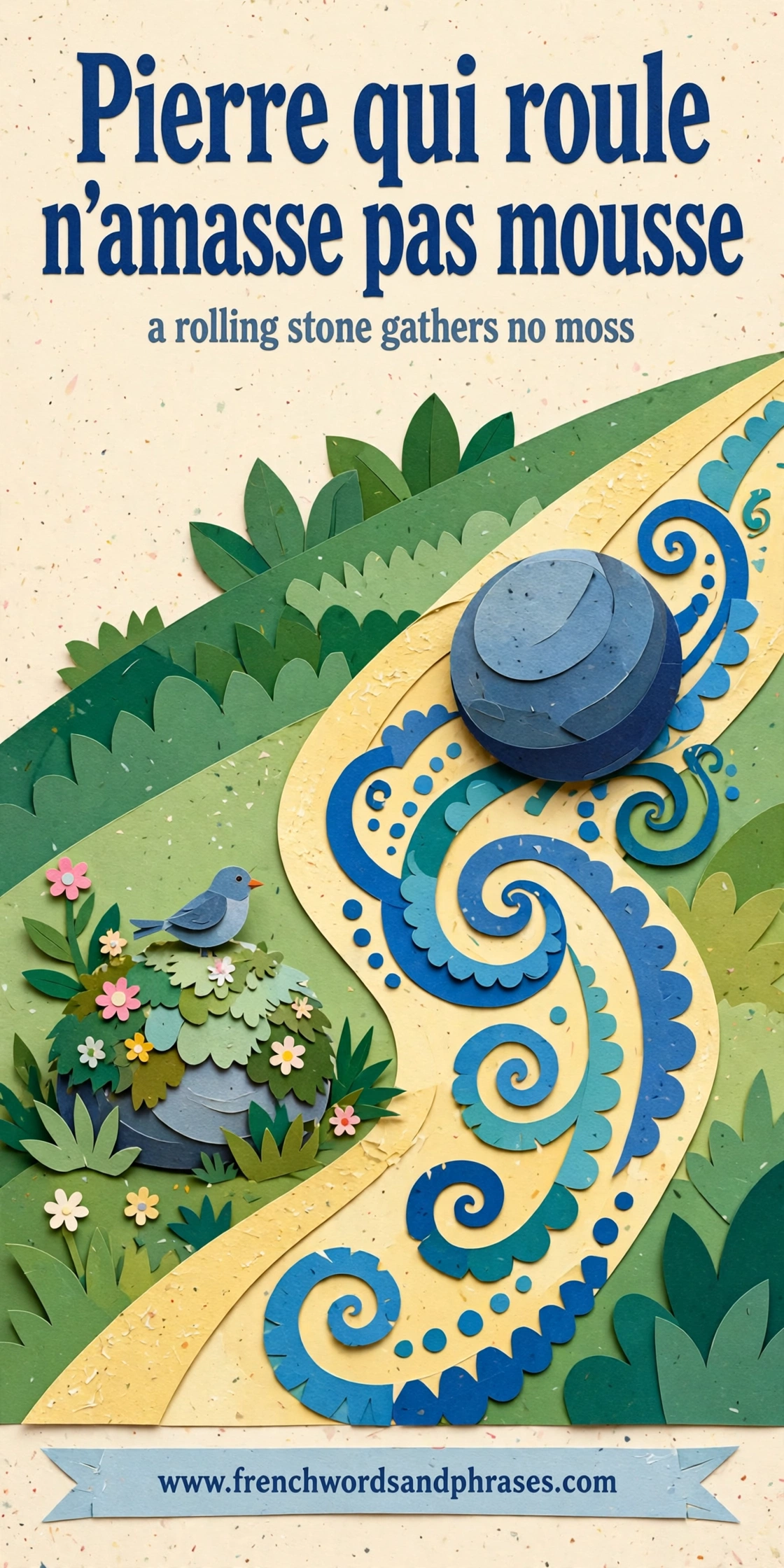
Pierre qui roule n’amasse pas mousse means a rolling stone gathers no moss — keep moving forever and you never put down roots or build up anything lasting.
Your cousin is packing again — fourth city in five years, same two suitcases, same grin. His grandmother watches from the doorway, arms crossed, and delivers the family’s verdict in the words French grandmothers have used for centuries: « Pierre qui roule n’amasse pas mousse. »
Let’s explore how pierre qui roule n’amasse pas mousse works in French, beginning with the whole phrase on one card.
Understanding the French Phrase Pierre qui roule n’amasse pas mousse
Pierre qui roule n’amasse pas mousse is a full proverb — a complete sentence built from une pierre (a stone), rouler (to roll), amasser (to gather, to accumulate) and la mousse (moss). It is one of the oldest travelling sayings in Europe, known since Latin times, and French keeps it in its classic form.
It means that a person who never settles — always changing town, job or trade — never accumulates the good slow things of life: savings, a home, deep friendships, a reputation. The moss is the treasure here. In the traditional French reading, the proverb is a warning, not a compliment: moss is what a stone earns by staying. English speakers sometimes flip the saying into praise of staying fresh and unencumbered, so the same proverb can scold in French and celebrate in English — a famous little trap between the two languages.
Type: Proverb — a complete sentence (stone + rolling + moss)
Answers the need: Warning that a restless life builds nothing lasting
Register: Neutral, proverbial — grandmothers, teachers and editorial pages
Literal picture: A stone that keeps rolling stays bare; the moss grows only on the stone that rests
One important usage detail: in French, read the moss as a good thing — roots, savings, stability. The proverb traditionally criticises the roller. You will often hear only its first half as a knowing shorthand — pierre qui roule… — with the rest left hanging, because everyone knows how it ends. And note the old negative: n’amasse pas, with ne worn down to n’ before the vowel, exactly as proverbs preserve it.
Experience the Word
Pierre qui roule n’amasse pas mousse is the settled world’s postcard to the restless — sent with love, and with a raised eyebrow.
Imagine two brothers. One stays in the village, repairs his roof, plants trees whose shade he will sit in at seventy. The other is a postcard from everywhere and a resident of nowhere. At the family table, the proverb does not need to be spoken; the orchard speaks it, leaf by leaf.
But the stone has its defenders, and modern life is full of happy rollers. The proverb survives because both sides keep quoting it — one as a warning, the other as a battle cry.
How to Use Pierre qui roule n’amasse pas mousse in French: Complete Guide
Let’s explore how pierre qui roule n’amasse pas mousse works in French, beginning with the whole phrase on one card.
Pierre qui roule n’amasse pas mousse at a Glance
The Whole Phrase on One Card
Real meaning, literal picture, English twin and register — the rolling stone in five lines.
| Point | Pierre qui roule n’amasse pas mousse |
|---|---|
| What it really means | whoever never settles never builds up roots, savings or stability |
| Word for word | a stone that rolls gathers no moss |
| English equivalent | a rolling stone gathers no moss — the identical proverb |
| Register | proverbial and neutral — advice, often from the older generation |
| Use it for | commenting on restless lives, serial movers, job-hoppers — or defending them |
Example
Encore un déménagement ? Pierre qui roule n’amasse pas mousse, tu sais.
Moving again? A rolling stone gathers no moss, you know.
Word by Word: Building the Stone
Five pieces — a stone, a roll, and the moss that never gets its chance.
| Word | Literal meaning | Its job in the phrase |
|---|---|---|
| pierre | a stone | the person in disguise — the subject of the whole lesson |
| qui roule | that rolls, that keeps rolling | the restless habit — motion without pause |
| n’amasse pas | does not gather, does not accumulate | the cost — amasser is the verb of piling up savings and goods |
| mousse | moss | the prize: roots, wealth, stability — everything slow that grows on what stays still |
Example
Il a roulé sa bosse partout, et la mousse n’a jamais eu le temps de pousser.
He knocked about everywhere, and the moss never had time to grow.
Quick Quiz 1
In the traditional French reading, is the moss a good thing or a bad thing?
Reveal the answer
A good thing — moss stands for roots, savings and stability; the rolling stone is the one being warned.
Reste un peu, laisse la mousse pousser.
Stay a while, let the moss grow.
When You Say It: The Restless Moments
The proverb is quoted at moments like these — usually with a suitcase in view.
| Situation | Example |
|---|---|
| The serial mover | quatrième ville en cinq ans — pierre qui roule n’amasse pas mousse — fourth city in five years: a rolling stone gathers no moss |
| The job-hopper | il change de métier tous les ans — he changes trade every year, and builds nothing |
| The defence | moi, je roule, et je préfère ça à la mousse — me, I roll, and I prefer it to the moss |
| The gentle tease | alors, pierre qui roule, tu restes dîner ? — so, rolling stone, are you staying for dinner? |
Example
Ma grand-mère me le répète à chaque déménagement : pierre qui roule n’amasse pas mousse.
My grandmother repeats it at every move: a rolling stone gathers no moss.
Make It Yours: Quoting the Proverb
Proverbs bend a little — quote it whole, quote it short, or aim it at yourself.
| Form | French | In English |
|---|---|---|
| The full proverb | pierre qui roule n’amasse pas mousse | a rolling stone gathers no moss |
| The shorthand | pierre qui roule… | a rolling stone… (everyone finishes it silently) |
| About him | c’est une pierre qui roule | he is a rolling stone |
| The defence | la mousse, très peu pour moi | moss? no thanks — not for me |
| Half-settled | je roule encore, mais plus lentement | I still roll, but more slowly |
Example
C’est une pierre qui roule : trois pays, quatre métiers, zéro meuble.
He is a rolling stone: three countries, four trades, zero furniture.
Quick Quiz 2
Why do speakers often say only « pierre qui roule… » and stop?
Reveal the answer
Because everyone knows the ending — the trailing half-proverb is a wink; the listener’s memory supplies the moss.
Encore un départ ? Pierre qui roule…
Leaving again? A rolling stone…
Everyday Expressions: Building on the Stone
The rolling stone slots into these everyday frames — each one ready to use as it stands.
| Frame | In English |
|---|---|
| pierre qui roule n’amasse pas mousse | a rolling stone gathers no moss |
| être une pierre qui roule | to be a rolling stone, a restless soul |
| laisser pousser la mousse | to let the moss grow — to settle down at last |
| rouler sa bosse | to knock about the world — to travel and live by your wits |
Example
Après vingt ans à rouler sa bosse, il a enfin laissé pousser la mousse.
After twenty years knocking about, he finally let the moss grow.
Close Cousins: The Other Settling Phrases
French advises on roots and wings from several angles — the stone is the eldest voice at the table.
| Expression | The difference |
|---|---|
| pierre qui roule n’amasse pas mousse | the classic warning: no settling, no accumulating |
| rouler sa bosse | to knock about the world — the rolling life itself, told without judgement |
| prendre racine | to put down roots — the stone’s happy ending, moss and all |
| poser ses valises | to set down your suitcases — to settle somewhere, finally |
| avoir la bougeotte | to have the fidgets — the restlessness that starts the rolling (informal) |
Example
Elle a eu la bougeotte jeune, puis elle a posé ses valises et pris racine.
She had itchy feet young, then set down her suitcases and put down roots.
Quick Quiz 3
Which cousin means ‘to put down roots’?
Reveal the answer
Prendre racine — the exact happy ending the rolling stone never reaches.
Ils ont pris racine dans ce village.
They put down roots in this village.
Pierre qui roule n’amasse pas mousse and Its Neighbours
The settler’s shelf around the proverb — stones, moss and everything that grows slowly.
| French | In English |
|---|---|
| la mousse | moss — the green reward of staying still |
| une racine | a root |
| amasser | to accumulate, to pile up — savings, goods, years |
| un déménagement | a house move — the roller’s regular ceremony |
| s’installer | to settle in, to set yourself up |
| un nomade | a nomad — the professional rolling stone |
Example
Amasser prend du temps ; rouler prend la route.
Accumulating takes time; rolling takes the road.
Watch Out: The Traps Around the Rolling Stone
The traps: a proverb that changes sides at the Channel, and a moss with two reputations.
| Trap | The truth |
|---|---|
| the English flip | many English speakers quote the proverb as praise — moss as stagnation; the traditional French reading treats moss as the prize, so check which side your speaker is on |
| not about gardening | no stone, no moss, no lawn: the whole sentence is a life philosophy in costume |
| the worn-down ne | the proverb keeps the old clipped negative n’amasse pas — do not ‘correct’ it into modern spelling inside the saying |
| tone can wound | aimed at a happy nomad it can sound like a scolding — quote it with a smile, or about yourself |
Example
Il cite le proverbe en souriant : sa mousse à lui, c’est le voyage.
He quotes the proverb with a smile: his moss, for him, is the travelling itself.
Quick Quiz 4
True or false: in French the proverb is traditionally a compliment to restless people.
Reveal the answer
False — traditionally it warns them: the moss (roots, savings) is the good thing they will never gather.
La mousse pousse sur la pierre qui reste.
Moss grows on the stone that stays.
Pierre qui roule n’amasse pas mousse in Everyday French: Real-Life Examples
Now that you know the word, let’s see how pierre qui roule n’amasse pas mousse appears in everyday French.
Example 1 — The fourth move
Quatrième déménagement en cinq ans : pierre qui roule n’amasse pas mousse.
Fourth move in five years: a rolling stone gathers no moss.
Example 2 — Grandmother’s verdict
Grand-mère secoue la tête : « Pierre qui roule n’amasse pas mousse, mon petit. »
Grandmother shakes her head: ‘A rolling stone gathers no moss, my dear.’
Example 3 — The job-hopper
Il change de travail chaque année, une vraie pierre qui roule.
He changes job every year, a real rolling stone.
Example 4 — The proud defence
« Pierre qui roule, d’accord — mais je n’aime pas la mousse. »
‘A rolling stone, fine — but I do not like moss.’
Example 5 — Settling at last
À quarante ans, la pierre qui roule a enfin trouvé son jardin.
At forty, the rolling stone finally found its garden.
Example 6 — The shorthand
Encore un pays ? Pierre qui roule…
Another country? A rolling stone…
Beyond Translation: The Meaning of Pierre qui roule n’amasse pas mousse
It may be the most double-faced proverb in Europe. Born in Latin, at home everywhere, it praises stillness in one village and freedom in the next — the moss is fortune to the farmer and mildew to the sailor, and both are quoting the same stone.
French tradition sides with the moss: what grows slowly on a settled life — savings, friendships, a name in a village — is wealth.
But the stone rolls on through the language anyway, unrepentant, gathering songs, stories and grandmothers’ warnings instead. Perhaps that is its own kind of moss.
How to Remember the French Phrase Pierre qui roule n’amasse pas mousse
Remember it this way: Pierre qui roule n’amasse pas mousse is the still stone’s revenge — everything good in life grows slowly, and only on what stays.
- You see the two stones — the roller, bare and shiny; the rester, green with everything it has gathered.
- You keep the French side of the argument — here, mousse is the prize, not the problem.
- You can quote half — pierre qui roule… and let the room finish the proverb for you.
The key idea is pierre qui roule n’amasse pas mousse means a rolling stone gathers no moss — never settling means never building up roots or savings.
Test Your Knowledge of Pierre qui roule n’amasse pas mousse
Let’s see how much you’ve learned. Try answering these questions before revealing the answers.
Question 1
What does pierre qui roule n’amasse pas mousse mean?
Reveal the answer
A rolling stone gathers no moss — someone who never settles never accumulates roots, savings or stability.
Question 2
In the French reading, is the moss good or bad?
Reveal the answer
Good — moss stands for everything slow and valuable that grows on a settled life; that is why the proverb warns the roller.
Question 3
How do you call someone a rolling stone in French?
Reveal the answer
C’est une pierre qui roule — the proverb’s stone becomes the person’s nickname.
Question 4
What does rouler sa bosse mean?
Reveal the answer
To knock about the world — to travel widely and live by your wits, the rolling life told without judgement.
Question 5
Complete the sentence:
Pierre qui roule n’amasse pas ______. (A rolling stone gathers no moss.)
Reveal the answer
mousse
Pierre qui roule n’amasse pas mousse.
A rolling stone gathers no moss.
Your Final Challenge
Can You Use It?
How would you say this in French?
“My brother has lived in six cities, and my grandmother always says that a rolling stone gathers no moss.”
Reveal the answer
Mon frère a vécu dans six villes, et ma grand-mère dit toujours que pierre qui roule n’amasse pas mousse.
My brother has lived in six cities, and my grandmother always says that a rolling stone gathers no moss.
A little French. A little curiosity. A richer everyday life.
LEARN FRENCH ONE WORD AT A TIME