
A French Word to Live By
How to Conjugate Payer in French
/pɛ.je/
Payer means to pay — to hand over money for what you owe or buy: the bill, the rent, the round of drinks — and, in its figurative life, to pay for one’s mistakes, dearly or in kind.
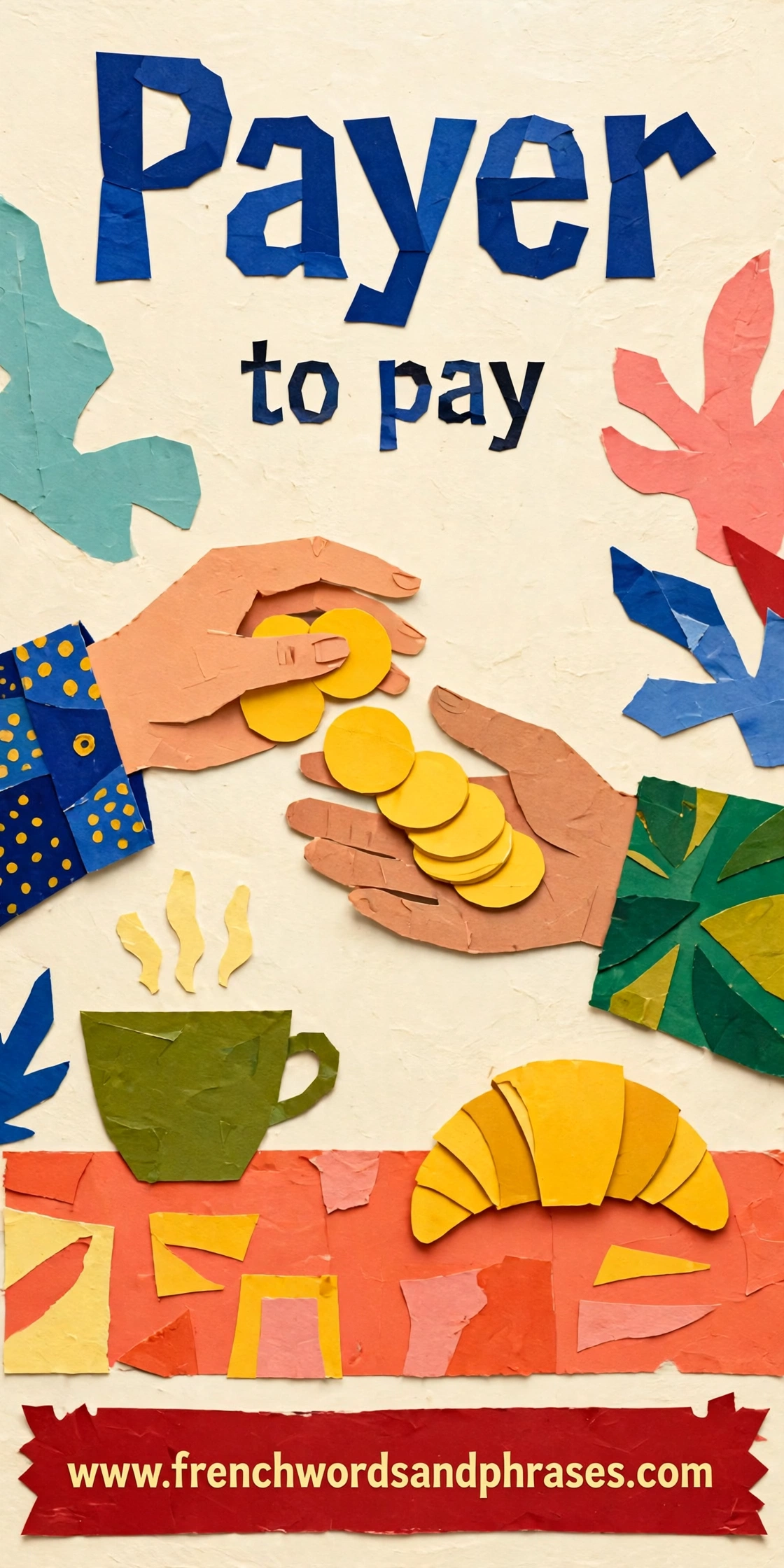
The card hovering over the little machine, the coins counted onto the café counter, the envelope of rent money handed over on the first of the month — payer is the verb of settlement: the moment a debt, a bill or a promise turns into money changing hands.
In this guide, you’ll learn how to conjugate payer in all the major French tenses and moods. Explore complete conjugation tables, French examples, English translations, and practice quizzes.
Understanding the French Verb Payer
Payer is a French verb ending in -er with a spelling change: the y of the stem becomes i before a silent ending — je paie — while the rest of the conjugation follows the regular first group.
It means to pay. Payer takes the thing bought or the person paid as its object: payer le loyer (the rent), payer le boulanger (the baker). With a double construction, payer quelque chose à quelqu’un is to pay someone for something, and payer un café à un ami is to buy a friend a coffee. The reflexive se payer is a treat: se payer un bon restaurant, to treat oneself to a good restaurant. And the figurative bill always arrives: payer ses erreurs, payer les pots cassés — to pay for the damage, literally the broken pots.
Verb classification: First group (-er), y → i stem change
Auxiliary verb: Avoir
Past participle: payé
Present participle: payant
English equivalents: To pay, to pay for; payer l’addition — to pay the bill; payer en espèces — to pay in cash; payer par carte — to pay by card; payer quelqu’un — to pay someone (their wages); se payer quelque chose — to treat oneself to something; payer cher — to pay dearly.
One important detail: payer changes its y to i wherever the ending is silent: je paie, tu paies, il paie, ils paient in the present, que je paie in the subjunctive, and the tu imperative paie ! Where the ending is sounded, the y stays: nous payons, vous payez, je payais, future je paierai (also written je payerai). The older y-spellings — je paye, tu payes — are still accepted, but the i forms are the ones taught and preferred today. Past participle payé.
Experience the Word
Payer is the verb of the square account — the moment owing becomes owning, and the table is cleared.
Imagine the little restaurant at closing time, the last table, the addition arriving folded on its saucer. The grandfather takes out his wallet with ceremony, counts, adds a coin for the service, and nods: « C’est moi qui paie. » — I’m paying. Around him the protests are ritual, the pleasure is real: payer, done well, is a form of generosity.
The bill has not changed. But it has been paid — payée — and the evening ends in credit, not in debt.
How to Conjugate Payer: Complete French Conjugation Guide
Let’s explore every major conjugation of payer, beginning with the indicative mood.
How to Conjugate Payer in the Indicative Mood
The indicative mood is used to express facts, observations, actions, and events.
How to Conjugate Payer in the Present Tense (Présent)
Used for actions happening now, habitual actions, and general truths.
| Subject | Conjugation |
|---|---|
| je | paie |
| tu | paies |
| il / elle | paie |
| nous | payons |
| vous | payez |
| ils / elles | paient |
Example
Je paie toujours en espèces.
I always pay in cash.
Quick Quiz 1
Complete the sentence:
Nous ______ toujours par carte.
Reveal the answer
payons
Nous payons toujours par carte.
We always pay by card — the nous form keeps the y.
How to Conjugate Payer in the Passé Composé
Used for completed actions in the past. Payer takes the auxiliary verb avoir.
| Subject | Conjugation |
|---|---|
| j’ | ai payé |
| tu | as payé |
| il / elle | a payé |
| nous | avons payé |
| vous | avez payé |
| ils / elles | ont payé |
Example
Nous avons payé l’addition pour tout le monde.
We paid the bill for everyone.
How to Conjugate Payer in the Imparfait (Imperfect Tense)
Used for habitual past actions, descriptions, and ongoing situations in the past.
| Subject | Conjugation |
|---|---|
| je | payais |
| tu | payais |
| il / elle | payait |
| nous | payions |
| vous | payiez |
| ils / elles | payaient |
Example
Autrefois, on payait le loyer en liquide.
In the old days, people paid the rent in cash.
Quick Quiz 2
Choose the correct form:
She paid the invoice.
Elle ______ la facture. (a payé / a paie)
Reveal the answer
a payé
Elle a payé la facture.
Payer takes avoir, past participle payé.
How to Conjugate Payer in the Plus-que-parfait
Used to describe an action that had already been completed before another past event.
| Subject | Conjugation |
|---|---|
| j’ | avais payé |
| tu | avais payé |
| il / elle | avait payé |
| nous | avions payé |
| vous | aviez payé |
| ils / elles | avaient payé |
Example
Elle avait déjà payé la facture quand l’erreur est apparue.
She had already paid the invoice when the mistake appeared.
How to Conjugate Payer in the Passé Simple
Primarily used in formal writing, literature, and historical narratives. It is rarely used in everyday conversation.
| Subject | Conjugation |
|---|---|
| je | payai |
| tu | payas |
| il / elle | paya |
| nous | payâmes |
| vous | payâtes |
| ils / elles | payèrent |
Example
Le roi paya une rançon énorme.
The king paid an enormous ransom.
How to Conjugate Payer in the Passé Antérieur
A literary tense used to express an action completed immediately before another past action, generally in the passé simple.
| Subject | Conjugation |
|---|---|
| j’ | eus payé |
| tu | eus payé |
| il / elle | eut payé |
| nous | eûmes payé |
| vous | eûtes payé |
| ils / elles | eurent payé |
Example
Quand il eut payé ses dettes, il quitta la ville.
When he had paid his debts, he left the town.
How to Conjugate Payer in the Future Tense (Futur Simple)
Used to describe actions that will take place in the future.
| Subject | Conjugation |
|---|---|
| je | payerai |
| tu | payeras |
| il / elle | payera |
| nous | payerons |
| vous | payerez |
| ils / elles | payeront |
Example
Demain, je paierai la facture d’électricité.
Tomorrow, I will pay the electricity bill.
How to Conjugate Payer in the Futur Antérieur (Future Perfect)
Used for an action that will have been completed before a particular point in the future.
| Subject | Conjugation |
|---|---|
| j’ | aurai payé |
| tu | auras payé |
| il / elle | aura payé |
| nous | aurons payé |
| vous | aurez payé |
| ils / elles | auront payé |
Example
À la fin du mois, ils auront payé toutes les factures.
By the end of the month, they will have paid all the bills.
How to Conjugate Payer in the Near Future (Futur Proche)
Used to describe something that is going to happen soon. Formed with aller + infinitive.
| Subject | Conjugation |
|---|---|
| je | vais payer |
| tu | vas payer |
| il / elle | va payer |
| nous | allons payer |
| vous | allez payer |
| ils / elles | vont payer |
Example
Attends, je vais payer nos cafés.
Wait, I am going to pay for our coffees.
How to Conjugate Payer in the Conditional Mood
The conditional mood expresses what would happen under certain circumstances. It is also frequently used to make polite requests or express wishes.
How to Conjugate Payer in the Present Conditional
| Subject | Conjugation |
|---|---|
| je | payerais |
| tu | payerais |
| il / elle | payerait |
| nous | payerions |
| vous | payeriez |
| ils / elles | payeraient |
Example
Avec plaisir, je paierais le dîner pour tous.
With pleasure, I would pay for dinner for everyone.
How to Conjugate Payer in the Past Conditional
| Subject | Conjugation |
|---|---|
| j’ | aurais payé |
| tu | aurais payé |
| il / elle | aurait payé |
| nous | aurions payé |
| vous | auriez payé |
| ils / elles | auraient payé |
Example
Tu aurais payé moins cher en réservant tôt.
You would have paid less by booking early.
Payer in the Literary Past Conditional Form
This less common literary form uses the imperfect subjunctive of avoir.
| Subject | Conjugation |
|---|---|
| j’ | eusse payé |
| tu | eusses payé |
| il / elle | eût payé |
| nous | eussions payé |
| vous | eussiez payé |
| ils / elles | eussent payé |
Example
Il eût payé le double pour revoir sa maison.
He would have paid double to see his house again.
How to Conjugate Payer in the Subjunctive Mood
The subjunctive is used to express wishes, emotions, doubts, necessity, and uncertainty. It frequently follows expressions such as il faut que (it is necessary that) or bien que (although).
How to Conjugate Payer in the Present Subjunctive
| Subject | Conjugation |
|---|---|
| que je | paie |
| que tu | paies |
| qu’il / qu’elle | paie |
| que nous | payions |
| que vous | payiez |
| qu’ils / qu’elles | paient |
Example
Il faut que tu paies avant la fin du mois.
You must pay before the end of the month.
Quick Quiz 3
Complete the sentence using the subjunctive:
Il faut que tu ______ à temps.
Reveal the answer
paies
Il faut que tu paies à temps.
You must pay on time — subjunctive with the i stem.
How to Conjugate Payer in the Imperfect Subjunctive
A literary tense, rarely encountered in modern spoken French.
| Subject | Conjugation |
|---|---|
| que je | payasse |
| que tu | payasses |
| qu’il / qu’elle | payât |
| que nous | payassions |
| que vous | payassiez |
| qu’ils / qu’elles | payassent |
Example
Je doutais qu’elle payât la totalité en une fois.
I doubted she would pay the whole amount at once.
How to Conjugate Payer in the Pluperfect Subjunctive
A literary construction used to express an action completed before another past action.
| Subject | Conjugation |
|---|---|
| que j’ | eusse payé |
| que tu | eusses payé |
| qu’il / qu’elle | eût payé |
| que nous | eussions payé |
| que vous | eussiez payé |
| qu’ils / qu’elles | eussent payé |
Example
On s’étonnait qu’il eût payé si vite.
People were surprised he had paid so quickly.
How to Conjugate Payer in the Past Subjunctive
| Subject | Conjugation |
|---|---|
| que j’ | aie payé |
| que tu | aies payé |
| qu’il / qu’elle | ait payé |
| que nous | ayons payé |
| que vous | ayez payé |
| qu’ils / qu’elles | aient payé |
Example
Je suis content que vous ayez payé à temps.
I am glad you paid on time.
How to Conjugate Payer in the Imperative
The imperative is used to give commands, instructions, invitations, or suggestions. Subject pronouns are omitted.
How to Conjugate Payer in the Present Imperative
| Person | Conjugation |
|---|---|
| (tu) | paie |
| (nous) | payons |
| (vous) | payez |
Example
Paie le boulanger en partant !
Pay the baker on your way out!
Quick Quiz 4
How would you say Pay the baker (tu form)?
Reveal the answer
Paie le boulanger !
French Participles of Payer
Participles are verb forms that can be used in compound tenses and other grammatical constructions.
Present Participle of Payer
payant
En payant comptant, elle a obtenu une réduction.
By paying cash up front, she got a discount.
Past Participle of Payer
payé
Payée à temps, la facture ne coûte rien de plus.
Paid on time, the invoice costs nothing extra.
Payer in Everyday French: Real-Life Examples
Now that you know the conjugations, let’s see how payer appears in everyday French.
Example 1 — Present
Je paie par carte, merci.
I’ll pay by card, thank you.
Example 2 — Passé composé
Nous avons payé l’addition.
We paid the bill.
Example 3 — Imparfait
On payait le loyer le premier du mois.
People paid the rent on the first of the month.
Example 4 — Future
Je paierai demain matin.
I will pay tomorrow morning.
Example 5 — Conditional
Je paierais volontiers pour tout le monde.
I would gladly pay for everyone.
Example 6 — Imperative
Paie d’abord, discute après !
Pay first, argue afterwards!
Beyond Translation: The Meaning of Payer
Payer comes from the Latin pacare — to pacify, from pax, peace: to pay a man was originally to make peace with him, to settle the quarrel a debt creates. The word still carries that old diplomacy: an account paid is a peace signed. Its y-to-i spelling change is a small monument to French spelling history — the y was kept where the voice sounds it, and softened to i in the silent endings, the forms every learner meets first: je paie.
To payer is to make peace with the bill.
Learn it with its instruments: en espèces, par carte, comptant — and its shadow: payer les pots cassés, to pay for what others broke.
How to Remember the French Verb Payer
Remember it this way: Payer is about the grandfather’s c’est moi qui paie — peace made with the bill.
- The y becomes i before silent endings: je paie, tu paies, ils paient — but nous payons, vous payez keep the y.
- Regular elsewhere: future je paierai, past participle payé, imperfect je payais.
- The frames: payer l’addition, payer en espèces, payer par carte; se payer un restaurant — to treat oneself.
The key idea is the grandfather’s c’est moi qui paie — peace made with the bill.
Test Your Knowledge of Payer
Let’s see how much you’ve learned. Try answering these questions before revealing the answers.
Question 1
How do you write “I pay” with payer — with a y or an i?
Reveal the answer
Je paie, with an i — the y becomes i before a silent ending (je paye is also accepted but older).
Question 2
How do you say We paid the bill for everyone in French?
Reveal the answer
Nous avons payé l’addition pour tout le monde.
Question 3
Translate: I always pay in cash.
Reveal the answer
Je paie toujours en espèces.
Question 4
What is the past participle of payer?
Reveal the answer
Payé.
Question 5
Complete the sentence:
Il faut que tu ______ avant la fin du mois.
Reveal the answer
paies
Il faut que tu paies avant la fin du mois.
You must pay before the end of the month — subjunctive, with the i stem.
Your Final Challenge
Can You Use It?
How would you say this in French?
I’m paying the bill tonight.
Reveal the answer
C’est moi qui paie l’addition ce soir.
I’m paying the bill tonight.
A little French. A little curiosity. A richer everyday life.
LEARN FRENCH ONE WORD AT A TIME




