A French Word to Live By
Translate Page to English
/paʒ/
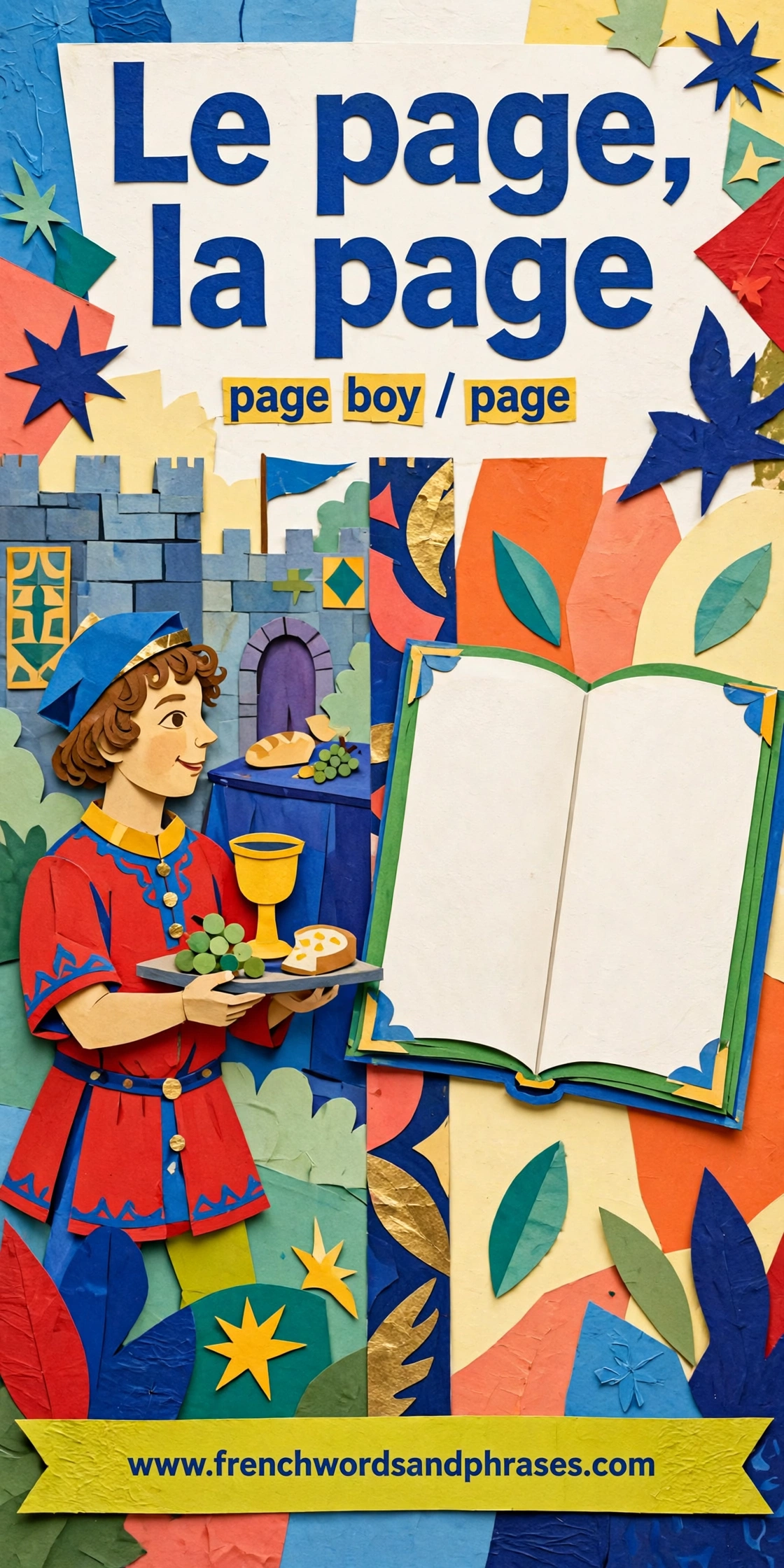
Le page means page boy — but la page means page of a book.
Two scenes, one word. In a château of long ago, a boy in livery hurries down a corridor carrying a letter on a silver tray: le page, the page boy. In a quiet room today, a reader turns one more sheet before sleep: la page, the page of a book. The servant is masculine; the sheet of paper is feminine — only the article tells them apart.
In this guide, you’ll learn what page means in English, how to use it with its articles, how to form its plural, and how it appears in everyday French. Explore French examples, English translations, and practice quizzes.
Understanding the French Noun Page
Page is a two-gender noun: the article chooses the meaning. Masculine, le page is a page boy — the young servant of a king, a noble house or a grand hotel, a word that belongs mostly to history and stories. Feminine, la page is the page of a book, a notebook or a website — one of the most useful words in daily life. Learn the article with the meaning, every time.
It means a page boy when it is masculine: le page du roi (the king’s page), a boy in training for service at court — you will meet him in novels, in museums, and in the old title of hotel messengers. It means a page when it is feminine: la page vingt (page twenty), tourner la page (to turn the page), une page blanche (a blank page), la page d’accueil (the homepage of a website).
Gender: Both — masculine and feminine, with different meanings
Definite article: le — le page (the page boy); la — la page (the page of a book)
Indefinite article: un — un page (a page boy); une — une page (a page)
Plural: les pages (the pages; page boys in stories)
English equivalents: Masculine: the page boy. Feminine: the page.
One important usage detail: in modern French the feminine does nearly all the work. You read la page, you count les pages, you land on la page d’accueil — and the phrase tourner la page has a second, figurative life: to turn the page on something, to move on and leave it behind. The masculine survives in costume dramas and châteaux — le page, the boy with the tray, waiting in the corridor of every historical novel.
Experience the Word
Page joins the oldest world to the everyday one. The masculine bows in a corridor of Versailles; the feminine waits on your bedside table, folded at the corner where you stopped last night.
Imagine the château at candle-lighting time: the little page runs with the letter, while upstairs the king’s daughter reads by candlelight, turning page after page — le page in the corridor, la page in her hands, one word serving them both.
You have not just learned a word. You have learned that French staffs its castles in the masculine and prints its books in the feminine.
How to Use Page in French: Complete Guide
Let’s explore how page works in French — beginning with the article, because here the article is everything.
Page with the Definite Article (Le, La, Les)
Le page carries the letter; la page carries the story.
| Gender | French |
|---|---|
| Masculine | le page — the page boy |
| Feminine | la page — the page of a book |
| Plural | les pages — the pages |
Example
La page dix est illustrée en couleurs.
Page ten is illustrated in colour.
Page with the Indefinite Article (Un, Une, Des)
Un page belongs to a château; une page belongs to every book you own.
| Gender | French |
|---|---|
| Masculine | un page — a page boy |
| Feminine | une page — a page |
| Plural | des pages — pages |
Example
Ce livre a plus de trois cents pages.
This book has more than three hundred pages.
Le Page or La Page? The Two Meanings Side by Side
The corridor of the château on one side, the open book on the other.
| French | In English |
|---|---|
| le page du roi | the king’s page boy |
| un jeune page | a young page boy |
| la page vingt | page twenty |
| tourner la page | to turn the page |
| une page blanche | a blank page |
| la page d’accueil | the homepage |
Example
Tourne la page, l’histoire continue.
Turn the page, the story goes on.
Quick Quiz 1
You are reading and your friend asks: « Tu es à ______ page ? » Which article — le or la?
Reveal the answer
La — the page of a book is feminine.
Tu es à la page ?
Which page are you on?
The Plural of Page
The plural les pages belongs to books: hundreds of pages, read one at a time.
| Number | French |
|---|---|
| Singular | le page / la page |
| Plural | les pages |
Example
Les pages de ce vieux livre sont jaunes.
The pages of this old book are yellow.
Page with Possessive Adjectives (Mon, Ma…)
Possessives follow the gender of the meaning: mon page for the servant in the story, ma page for the sheet you are writing on. Notre, votre and leur serve both senses.
| Owner | French |
|---|---|
| my | mon page (page boy) / ma page (page) |
| your (tu) | ton page / ta page |
| his / her | son page / sa page |
| our | notre page (both senses) |
| your (vous) | votre page (both senses) |
| their | leur page (both senses) |
Example
J’ai perdu ma page, où en étais-je ?
I’ve lost my page, where was I?
Quick Quiz 2
Complete the sentence:
Le roi appelle ______ page et lui donne une lettre. (his)
Reveal the answer
son
Le roi appelle son page et lui donne une lettre.
The king calls his page boy and gives him a letter — the servant is masculine, so son.
Page with Demonstrative Adjectives (Ce, Cette, Ces)
Ce page points at the boy in livery; cette page points at the sheet in front of you.
| Gender | French |
|---|---|
| Masculine | ce page — this page boy |
| Feminine | cette page — this page |
| Plural | ces pages — these pages |
Example
Cette page est la plus belle du roman.
This page is the finest in the novel.
Page with Adjectives
Adjectives agree with the gender of the sense — jeune for the boy, blanche for the blank page.
| Adjective | Masculine sense | Feminine sense |
|---|---|---|
| jeune (young) | un jeune page | une page jeune (rare) |
| blanc / blanche (white, blank) | un page blanc (rare) | une page blanche |
| premier / première (first) | le premier page (rare) | la première page |
| dernier / dernière (last) | le dernier page (rare) | la dernière page |
Example
La première page du livre présente les personnages.
The first page of the book introduces the characters.
Quick Quiz 3
Complete the sentence:
Écris ton nom en haut de la ______ page. (first)
Reveal the answer
première
Écris ton nom en haut de la première page.
Write your name at the top of the first page — page is feminine here, so première.
Everyday Expressions with Page
Reading, websites and moving on — the page phrases of daily life.
| Expression | In English |
|---|---|
| tourner la page | to turn the page; to move on |
| être à la page | to be up to date |
| une page blanche | a blank page |
| la page d’accueil | the homepage |
| à la page vingt | on page twenty |
| le page du roi | the king’s page boy |
Example
Après cet échec, il faut tourner la page.
After this failure, we must turn the page and move on.
Words from the Same Family as Page
Books, courts and paper — the words that travel with page in both its lives.
| French | In English |
|---|---|
| le livre | the book |
| la feuille | the sheet of paper, the leaf |
| le chapitre | the chapter |
| le serviteur | the servant |
| la cour | the court |
| lire | to read |
Example
Elle lit une page du livre chaque soir.
She reads a page of the book every evening.
Quick Quiz 4
Your friend, reading a novel, announces: « Je suis au page cent. » What is wrong?
Reveal the answer
The article — the page of a book is feminine: à la page cent. Au page would send him to the page boy, who is not in his novel… or is he?
Je suis à la page cent.
I’m on page one hundred.
Page in Everyday French: Real-Life Examples
Now that you know the word, let’s see how page appears in everyday French.
Example 1 — Reading in bed
Je lis encore une page et j’éteins la lumière.
I’ll read one more page and turn off the light.
Example 2 — In class
Ouvrez vos livres à la page quarante-deux.
Open your books at page forty-two.
Example 3 — Online
La page d’accueil du site est très claire.
The site’s homepage is very clear.
Example 4 — Moving on
Il est temps de tourner la page et de recommencer.
It’s time to turn the page and start again.
Example 5 — In a story
Le page apporte le message au roi.
The page boy brings the message to the king.
Example 6 — Staying current
Ce journaliste est toujours à la page.
This journalist is always up to date.
Beyond Translation: The Meaning of Page
The page boy and the page of a book really are cousins: both descend from the Latin world of service and sheets — the boy was named for the young servants of Italian courts, and the sheet took its name from the Latin pagina, a column of writing fastened to a frame. French received both, kept the boy masculine like the young men who held the job, and the sheet feminine like the pagina it came from. History retired the boy to novels and museums; the sheet conquered the world, and then the screen.
To say page is to choose between the servant and the sheet.
It evokes the tray in the corridor and the corner folded down at midnight, the king’s letter and the reader’s sigh — one word, once for the court, now for the book.
How to Remember the French Noun Page
Remember it this way: Page is two words in one: le page, the boy who serves — la page, the sheet you read.
- You read — tu tournes la page, feminine, du livre.
- You visit the château — le page du roi, masculine, porte la lettre.
- You move on — tourner la page, and start again.
The key idea is le page serves — la page is read.
Test Your Knowledge of Page
Let’s see how much you’ve learned. Try answering these questions before revealing the answers.
Question 1
What does la page mean?
Reveal the answer
The page of a book — feminine page is the sheet you read, in a book or on a screen.
Question 2
How do you say the king’s page boy in French?
Reveal the answer
Le page du roi — with le, because the servant is masculine.
Question 3
Translate: Turn the page, please.
Reveal the answer
Tourne la page, s’il te plaît.
Question 4
What does être à la page mean?
Reveal the answer
To be up to date — to be on the current page, as it were, of what is happening.
Question 5
Complete the sentence:
Ouvrez le livre à ______ page dix.
Reveal the answer
la
Ouvrez le livre à la page dix.
Open the book at page ten.
Your Final Challenge
Can You Use It?
How would you say this in French?
“Turn the page, please.”
Reveal the answer
Tourne la page, s’il te plaît.
Turn the page, please.
A little French. A little curiosity. A richer everyday life.
LEARN FRENCH ONE WORD AT A TIME