
A French Word to Live By
How to Conjugate Ovationner in French
/ɔ.va.sjɔ.ne/
Ovationner means to give an ovation — to applaud long and loud, often standing.
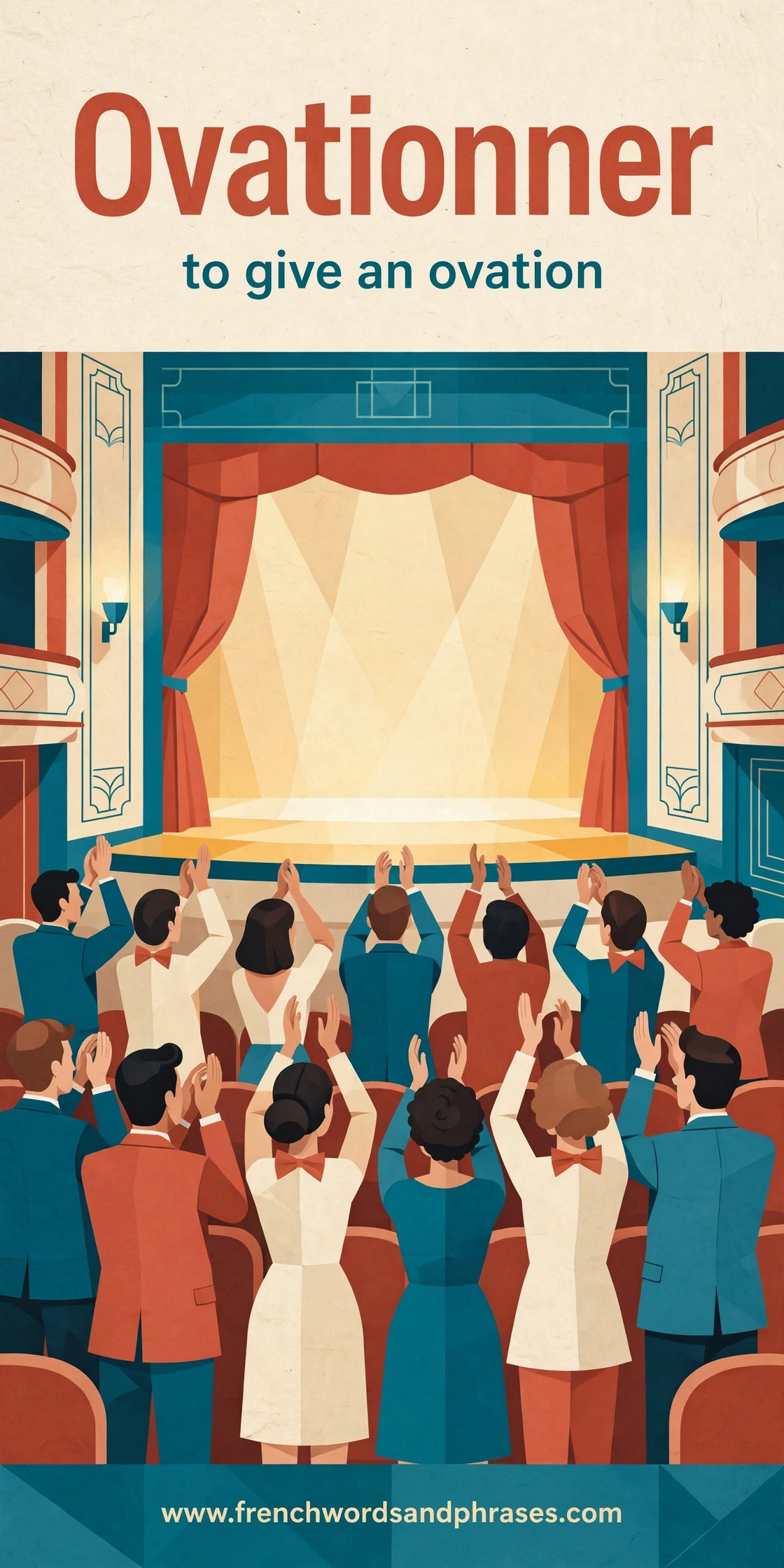
The final chord fades, a heartbeat of silence, and then the whole hall rises as one — hands clapping, voices cheering, feet stamping. That roaring wave of applause is ovationner: the audience on its feet, refusing to let the performers go.
In this guide, you’ll learn how to conjugate ovationner in all the major French tenses and moods. Explore complete conjugation tables, French examples, English translations, and practice quizzes.
Understanding the French Verb Ovationner
Ovationner is a regular French verb belonging to the first group of verbs, those ending in -er.
It means to give an ovation. It is commonly used in theatres and concert halls when an audience rises to applaud, in stadiums when supporters cheer a winning team, and at ceremonies and prize-givings when a crowd honours a speaker or a hero.
Verb classification: First group (-er)
Auxiliary verb: Avoir
Past participle: ovationné
Present participle: ovationnant
English equivalents: To give an ovation, to applaud standing; une ovation debout — a standing ovation; ovationner un artiste — to give an artist a standing ovation; ovationner une équipe — to cheer a team to the echo.
One important detail: ovationner is built on une ovation, and the double n of the noun stays through the whole verb: j’ovationne, nous ovationnons, ovationné. Do not drop it. A standing ovation is une ovation debout, and the verb goes one step further than applaudir: you can applaud sitting down, but to ovationner is to give that long, loud, whole-room salute, very often on your feet.
Experience the Word
Ovationner is applause with the whole body — hands, voice and feet all voting yes at once.
Imagine the opera house on a great night. The young soprano holds her last note until it seems to hang in the chandeliers, the curtain falls, and two thousand people are suddenly standing, ovationnant, calling her back again and again.
Ordinary applause thanks a performance. An ovation crowns it — the room itself stands up to say so.
How to Conjugate Ovationner: Complete French Conjugation Guide
Let’s explore every major conjugation of ovationner, beginning with the indicative mood.
How to Conjugate Ovationner in the Indicative Mood
The indicative mood is used to express facts, observations, actions, and events.
How to Conjugate Ovationner in the Present Tense (Présent)
Used for actions happening now, habitual actions, and general truths.
| Subject | Conjugation |
|---|---|
| je | ovationne |
| tu | ovationnes |
| il / elle | ovationne |
| nous | ovationnons |
| vous | ovationnez |
| ils / elles | ovationnent |
Example
Le public ovationne les comédiens à la fin du spectacle.
The audience gives the actors an ovation at the end of the show.
Quick Quiz 1
Complete the sentence:
Nous ______ le chef d’orchestre.
Reveal the answer
ovationnons
Nous ovationnons le chef d’orchestre.
We give the conductor an ovation.
How to Conjugate Ovationner in the Passé Composé
Used for completed actions in the past. Ovationner takes the auxiliary verb avoir.
| Subject | Conjugation |
|---|---|
| j’ | ai ovationné |
| tu | as ovationné |
| il / elle | a ovationné |
| nous | avons ovationné |
| vous | avez ovationné |
| ils / elles | ont ovationné |
Example
La salle entière a ovationné la jeune pianiste.
The whole hall gave the young pianist an ovation.
How to Conjugate Ovationner in the Imparfait (Imperfect Tense)
Used for habitual past actions, descriptions, and ongoing situations in the past.
| Subject | Conjugation |
|---|---|
| je | ovationnais |
| tu | ovationnais |
| il / elle | ovationnait |
| nous | ovationnions |
| vous | ovationniez |
| ils / elles | ovationnaient |
Example
Autrefois, on ovationnait les ténors pendant de longues minutes.
In the old days, people used to give tenors ovations lasting long minutes.
Quick Quiz 2
Choose the correct form:
The hall gave the pianist an ovation.
La salle ______ la pianiste. (a ovationné / est ovationnée)
Reveal the answer
a ovationné
La salle a ovationné la pianiste.
Ovationner takes avoir.
How to Conjugate Ovationner in the Plus-que-parfait
Used to describe an action that had already been completed before another past event.
| Subject | Conjugation |
|---|---|
| j’ | avais ovationné |
| tu | avais ovationné |
| il / elle | avait ovationné |
| nous | avions ovationné |
| vous | aviez ovationné |
| ils / elles | avaient ovationné |
Example
Le public avait ovationné l’équipe avant même la fin du match.
The crowd had given the team an ovation even before the end of the match.
How to Conjugate Ovationner in the Passé Simple
Primarily used in formal writing, literature, and historical narratives. It is rarely used in everyday conversation.
| Subject | Conjugation |
|---|---|
| je | ovationnai |
| tu | ovationnas |
| il / elle | ovationna |
| nous | ovationnâmes |
| vous | ovationnâtes |
| ils / elles | ovationnèrent |
Example
La foule ovationna le vainqueur dès son arrivée.
The crowd gave the winner an ovation as soon as he arrived.
How to Conjugate Ovationner in the Passé Antérieur
A literary tense used to express an action completed immediately before another past action, generally in the passé simple.
| Subject | Conjugation |
|---|---|
| j’ | eus ovationné |
| tu | eus ovationné |
| il / elle | eut ovationné |
| nous | eûmes ovationné |
| vous | eûtes ovationné |
| ils / elles | eurent ovationné |
Example
Quand la salle eut ovationné les acteurs, le rideau se releva.
When the hall had given the actors an ovation, the curtain rose again.
How to Conjugate Ovationner in the Future Tense (Futur Simple)
Used to describe actions that will take place in the future.
| Subject | Conjugation |
|---|---|
| je | ovationnerai |
| tu | ovationneras |
| il / elle | ovationnera |
| nous | ovationnerons |
| vous | ovationnerez |
| ils / elles | ovationneront |
Example
Ce soir, les spectateurs ovationneront la troupe entière.
Tonight, the spectators will give the whole company an ovation.
How to Conjugate Ovationner in the Futur Antérieur (Future Perfect)
Used for an action that will have been completed before a particular point in the future.
| Subject | Conjugation |
|---|---|
| j’ | aurai ovationné |
| tu | auras ovationné |
| il / elle | aura ovationné |
| nous | aurons ovationné |
| vous | aurez ovationné |
| ils / elles | auront ovationné |
Example
À la fin du concert, le public aura ovationné trois fois le chef d’orchestre.
By the end of the concert, the audience will have given the conductor three ovations.
How to Conjugate Ovationner in the Near Future (Futur Proche)
Used to describe something that is going to happen soon. Formed with aller + infinitive.
| Subject | Conjugation |
|---|---|
| je | vais ovationner |
| tu | vas ovationner |
| il / elle | va ovationner |
| nous | allons ovationner |
| vous | allez ovationner |
| ils / elles | vont ovationner |
Example
Regarde-les : ils vont ovationner la chanteuse.
Look at them: they are going to give the singer an ovation.
How to Conjugate Ovationner in the Conditional Mood
The conditional mood expresses what would happen under certain circumstances. It is also frequently used to make polite requests or express wishes.
How to Conjugate Ovationner in the Present Conditional
| Subject | Conjugation |
|---|---|
| je | ovationnerais |
| tu | ovationnerais |
| il / elle | ovationnerait |
| nous | ovationnerions |
| vous | ovationneriez |
| ils / elles | ovationneraient |
Example
Avec un tel spectacle, on ovationnerait les artistes tous les soirs.
With a show like that, people would give the artists an ovation every night.
How to Conjugate Ovationner in the Past Conditional
| Subject | Conjugation |
|---|---|
| j’ | aurais ovationné |
| tu | aurais ovationné |
| il / elle | aurait ovationné |
| nous | aurions ovationné |
| vous | auriez ovationné |
| ils / elles | auraient ovationné |
Example
Le public aurait ovationné l’acteur s’il était revenu saluer.
The audience would have given the actor an ovation if he had come back to take a bow.
Ovationner in the Literary Past Conditional Form
This less common literary form uses the imperfect subjunctive of avoir.
| Subject | Conjugation |
|---|---|
| j’ | eusse ovationné |
| tu | eusses ovationné |
| il / elle | eût ovationné |
| nous | eussions ovationné |
| vous | eussiez ovationné |
| ils / elles | eussent ovationné |
Example
La salle eût ovationné le pianiste sans ce retard.
The hall would have given the pianist an ovation if not for that delay.
How to Conjugate Ovationner in the Subjunctive Mood
The subjunctive is used to express wishes, emotions, doubts, necessity, and uncertainty. It frequently follows expressions such as il faut que (it is necessary that) or bien que (although).
How to Conjugate Ovationner in the Present Subjunctive
| Subject | Conjugation |
|---|---|
| que je | ovationne |
| que tu | ovationnes |
| qu’il / qu’elle | ovationne |
| que nous | ovationnions |
| que vous | ovationniez |
| qu’ils / qu’elles | ovationnent |
Example
Il est rare qu’un public ovationne un premier rôle inconnu.
It is rare for an audience to give an unknown lead an ovation.
Quick Quiz 3
Complete the sentence using the subjunctive:
Il est rare qu’un public ______ un inconnu.
Reveal the answer
ovationne
Il est rare qu’un public ovationne un inconnu.
It is rare for an audience to give an unknown performer an ovation.
How to Conjugate Ovationner in the Imperfect Subjunctive
A literary tense, rarely encountered in modern spoken French.
| Subject | Conjugation |
|---|---|
| que je | ovationnasse |
| que tu | ovationnasses |
| qu’il / qu’elle | ovationnât |
| que nous | ovationnassions |
| que vous | ovationnassiez |
| qu’ils / qu’elles | ovationnassent |
Example
Le directeur espérait que la salle ovationnât la troupe.
The director hoped the hall would give the company an ovation.
How to Conjugate Ovationner in the Pluperfect Subjunctive
A literary construction used to express an action completed before another past action.
| Subject | Conjugation |
|---|---|
| que j’ | eusse ovationné |
| que tu | eusses ovationné |
| qu’il / qu’elle | eût ovationné |
| que nous | eussions ovationné |
| que vous | eussiez ovationné |
| qu’ils / qu’elles | eussent ovationné |
Example
On racontait que le public eût ovationné le ténor pendant dix minutes.
It was said that the audience had given the tenor a ten-minute ovation.
How to Conjugate Ovationner in the Past Subjunctive
| Subject | Conjugation |
|---|---|
| que j’ | aie ovationné |
| que tu | aies ovationné |
| qu’il / qu’elle | ait ovationné |
| que nous | ayons ovationné |
| que vous | ayez ovationné |
| qu’ils / qu’elles | aient ovationné |
Example
Je suis ému que vous ayez ovationné nos élèves.
I am moved that you gave our pupils an ovation.
How to Conjugate Ovationner in the Imperative
The imperative is used to give commands, instructions, invitations, or suggestions. Subject pronouns are omitted.
How to Conjugate Ovationner in the Present Imperative
| Person | Conjugation |
|---|---|
| (tu) | ovationne |
| (nous) | ovationnons |
| (vous) | ovationnez |
Example
Ovationnez-les, ils l’ont bien mérité !
Give them an ovation, they have truly earned it!
Quick Quiz 4
How would you say Give them an ovation (vous form)?
Reveal the answer
Ovationnez-les !
French Participles of Ovationner
Participles are verb forms that can be used in compound tenses and other grammatical constructions.
Present Participle of Ovationner
ovationnant
En ovationnant les comédiens, le public s’est levé comme un seul homme.
In giving the actors an ovation, the audience rose as one.
Past Participle of Ovationner
ovationné
Ovationnée par la salle entière, la chanteuse a fondu en larmes.
Given an ovation by the whole hall, the singer burst into tears.
Ovationner in Everyday French: Real-Life Examples
Now that you know the conjugations, let’s see how ovationner appears in everyday French.
Example 1 — Present
Le public ovationne les danseurs.
The audience gives the dancers an ovation.
Example 2 — Passé composé
Nous avons ovationné le chef d’orchestre.
We gave the conductor an ovation.
Example 3 — Imparfait
Les spectateurs ovationnaient chaque soir le même ténor.
The spectators gave the same tenor an ovation every evening.
Example 4 — Future
Ils ovationneront l’équipe championne.
They will give the champion team an ovation.
Example 5 — Conditional
Je les ovationnerais volontiers encore une fois.
I would gladly give them an ovation once more.
Example 6 — Imperative
Ovationne ton équipe, elle a gagné !
Give your team an ovation, it won!
Beyond Translation: The Meaning of Ovationner
English keeps ovation as a noun — you give one, you receive one, but you cannot quite ovation anyone. French simply turns the noun into a verb: ovationner.
One step beyond applaudir.
Applaudir is to clap; ovationner is the full standing salute, the applause that will not sit down — learn the pair and you can grade any audience in French.
How to Remember the French Verb Ovationner
Remember it this way: Ovationner is about the whole hall on its feet, applauding and cheering as one.
- Une ovation — an ovation; add -ner and the ovation becomes an action: ovationner.
- Mind the double n everywhere: j’ovationne, nous ovationnons, ovationné.
- Regular -er: je ovationne, nous ovationnons, past participle ovationné.
The key idea is the whole hall on its feet, applauding and cheering as one.
Test Your Knowledge of Ovationner
Let’s see how much you’ve learned. Try answering these questions before revealing the answers.
Question 1
How do you say to give an ovation in French?
Reveal the answer
Ovationner.
Question 2
How do you say The audience gives the dancers an ovation in French?
Reveal the answer
Le public ovationne les danseurs.
Question 3
Translate: We gave the conductor an ovation.
Reveal the answer
Nous avons ovationné le chef d’orchestre.
Question 4
What is the past participle of ovationner?
Reveal the answer
Ovationné.
Question 5
Complete the sentence:
Il est rare qu’un public ______ un inconnu.
Reveal the answer
ovationne
Il est rare qu’un public ovationne un inconnu.
It is rare for an audience to give an unknown performer an ovation.
Your Final Challenge
Can You Use It?
How would you say this in French?
When the curtain falls, the whole hall gives the actors a standing ovation.
Reveal the answer
Quand le rideau tombe, toute la salle ovationne les comédiens debout.
When the curtain falls, the whole hall gives the actors a standing ovation.
A little French. A little curiosity. A richer everyday life.
LEARN FRENCH ONE WORD AT A TIME




