
A French Word to Live By
How to Conjugate Ouvrager in French
/u.vʁa.ʒe/
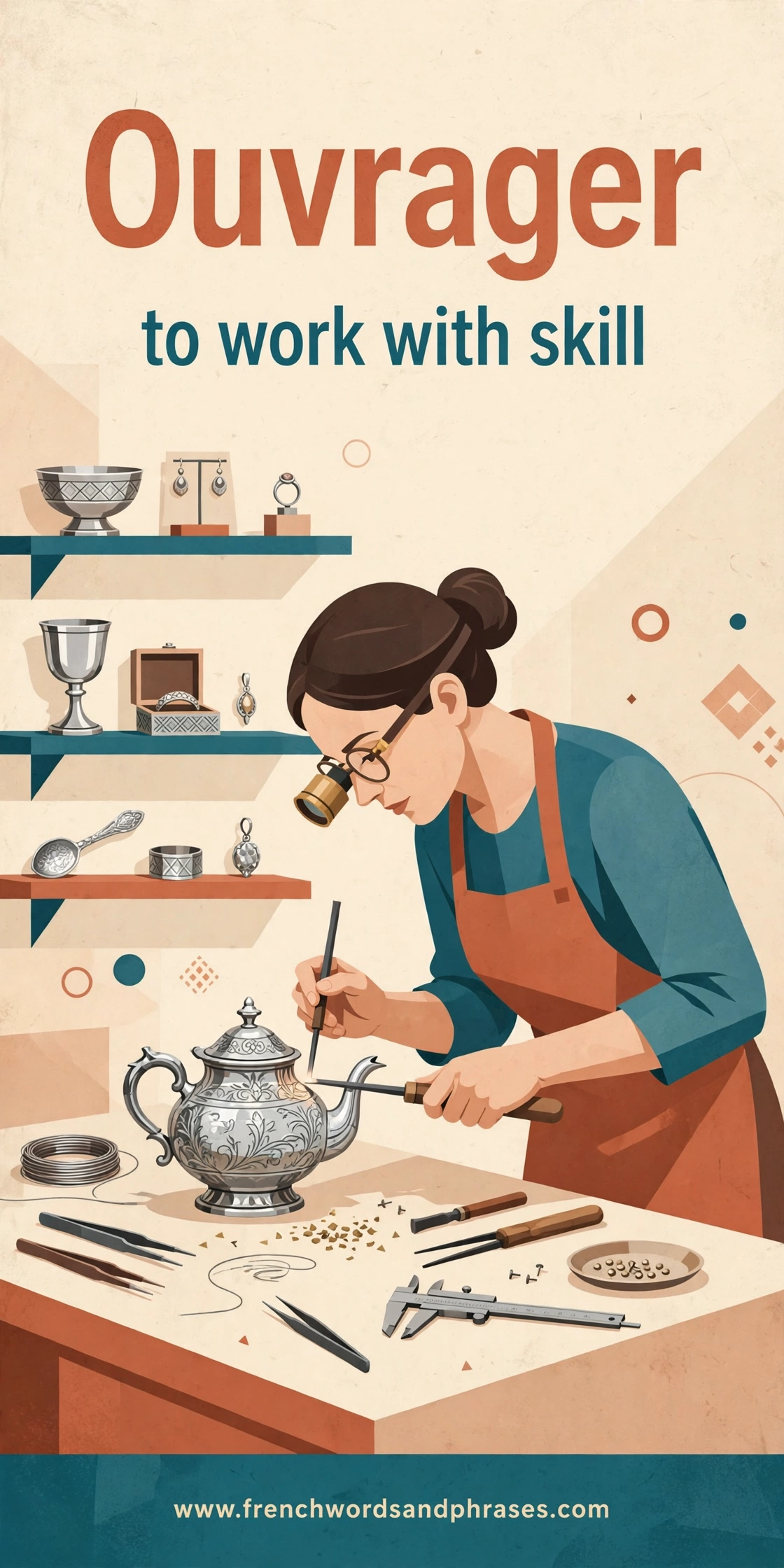
Ouvrager means to work with skill — to craft a material carefully, by hand, into a finished work.
Under the goldsmith’s lamp, a plain band of silver slowly grows leaves and scrolls, each one coaxed out of the metal with a graver — ouvrager is the verb of skilled hands turning raw material into a work, un ouvrage.
In this guide, you’ll learn how to conjugate ouvrager in all the major French tenses and moods. Explore complete conjugation tables, French examples, English translations, and practice quizzes.
Understanding the French Verb Ouvrager
Ouvrager is a regular French verb belonging to the first group of verbs, those ending in -er.
It means to work with skill. It is commonly used of goldsmiths, jewellers, carvers, blacksmiths and embroiderers whose patient work turns metal, wood or thread into something precious, and in descriptions of finely worked objects of every kind.
Verb classification: First group (-er)
Auxiliary verb: Avoir
Past participle: ouvragé
Present participle: ouvrageant
English equivalents: To work with skill, to craft finely; ouvrager un métal — to work a metal with skill; un coffret ouvragé — a finely wrought casket; un ouvrage — a work, a piece of workmanship; ouvragé — finely wrought, elaborately worked.
One important detail: ouvrager is a -ger verb built on un ouvrage, a work — so it keeps the e that softens the g before a and o: nous ouvrageons, j’ouvrageais, present participle ouvrageant. Its past participle ouvragé is the word you will meet most often, in descriptions: un portail ouvragé, a wrought-iron gate; une dentelle ouvragée, finely worked lace. The verb itself is rare and a little literary — the language of workshops and catalogues.
Experience the Word
Ouvrager is the verb of the master’s hands — slow, exact, and impossible to hurry.
Imagine a forge at the edge of a village. The blacksmith is not merely bending iron today; he ouvrage la rampe — heating, hammering, twisting each bar into leaves and curls for a staircase that will outlive him. A machine could make a railing in an hour. This one takes a season, and it shows.
The iron has not just been shaped. It has been ouvragé — worked until the work became art.
How to Conjugate Ouvrager: Complete French Conjugation Guide
Let’s explore every major conjugation of ouvrager, beginning with the indicative mood.
How to Conjugate Ouvrager in the Indicative Mood
The indicative mood is used to express facts, observations, actions, and events.
How to Conjugate Ouvrager in the Present Tense (Présent)
Used for actions happening now, habitual actions, and general truths.
| Subject | Conjugation |
|---|---|
| je | ouvrage |
| tu | ouvrages |
| il / elle | ouvrage |
| nous | ouvrageons |
| vous | ouvragez |
| ils / elles | ouvragent |
Example
L’orfèvre ouvrage l’argent avec une patience infinie.
The goldsmith works the silver with infinite patience.
Quick Quiz 1
Complete the sentence:
L’orfèvre ______ l’argent avec patience.
Reveal the answer
ouvrage
L’orfèvre ouvrage l’argent avec patience.
The goldsmith works the silver patiently.
How to Conjugate Ouvrager in the Passé Composé
Used for completed actions in the past. Ouvrager takes the auxiliary verb avoir.
| Subject | Conjugation |
|---|---|
| j’ | ai ouvragé |
| tu | as ouvragé |
| il / elle | a ouvragé |
| nous | avons ouvragé |
| vous | avez ouvragé |
| ils / elles | ont ouvragé |
Example
Elle a ouvragé ce coffret pendant des mois.
She worked on this casket with skill for months.
How to Conjugate Ouvrager in the Imparfait (Imperfect Tense)
Used for habitual past actions, descriptions, and ongoing situations in the past.
| Subject | Conjugation |
|---|---|
| je | ouvrageais |
| tu | ouvrageais |
| il / elle | ouvrageait |
| nous | ouvragions |
| vous | ouvragiez |
| ils / elles | ouvrageaient |
Example
Autrefois, les artisans ouvrageaient chaque pièce à la main.
In the old days, craftsmen used to work every piece by hand.
Quick Quiz 2
Choose the correct form:
She crafted the casket.
Elle ______ le coffret. (a ouvragé / est ouvragée)
Reveal the answer
a ouvragé
Elle a ouvragé le coffret.
Ouvrager takes avoir.
How to Conjugate Ouvrager in the Plus-que-parfait
Used to describe an action that had already been completed before another past event.
| Subject | Conjugation |
|---|---|
| j’ | avais ouvragé |
| tu | avais ouvragé |
| il / elle | avait ouvragé |
| nous | avions ouvragé |
| vous | aviez ouvragé |
| ils / elles | avaient ouvragé |
Example
Il avait ouvragé la rampe avant l’hiver.
He had wrought the banister before winter.
How to Conjugate Ouvrager in the Passé Simple
Primarily used in formal writing, literature, and historical narratives. It is rarely used in everyday conversation.
| Subject | Conjugation |
|---|---|
| je | ouvrageai |
| tu | ouvrageas |
| il / elle | ouvragea |
| nous | ouvrageâmes |
| vous | ouvrageâtes |
| ils / elles | ouvrageèrent |
Example
Le sculpteur ouvragea le bois jusqu’à la perfection.
The sculptor worked the wood with skill until it was perfect.
How to Conjugate Ouvrager in the Passé Antérieur
A literary tense used to express an action completed immediately before another past action, generally in the passé simple.
| Subject | Conjugation |
|---|---|
| j’ | eus ouvragé |
| tu | eus ouvragé |
| il / elle | eut ouvragé |
| nous | eûmes ouvragé |
| vous | eûtes ouvragé |
| ils / elles | eurent ouvragé |
Example
Quand elle eut ouvragé la dentelle, elle l’offrit à sa fille.
When she had worked the lace with skill, she gave it to her daughter.
How to Conjugate Ouvrager in the Future Tense (Futur Simple)
Used to describe actions that will take place in the future.
| Subject | Conjugation |
|---|---|
| je | ouvragerai |
| tu | ouvrageras |
| il / elle | ouvragera |
| nous | ouvragerons |
| vous | ouvragerez |
| ils / elles | ouvrageront |
Example
Demain, nous ouvragerons la grille du jardin.
Tomorrow, we will work the garden gate with skill.
How to Conjugate Ouvrager in the Futur Antérieur (Future Perfect)
Used for an action that will have been completed before a particular point in the future.
| Subject | Conjugation |
|---|---|
| j’ | aurai ouvragé |
| tu | auras ouvragé |
| il / elle | aura ouvragé |
| nous | aurons ouvragé |
| vous | aurez ouvragé |
| ils / elles | auront ouvragé |
Example
À Noël, elle aura ouvragé toutes les pièces de la commande.
By Christmas, she will have crafted all the pieces of the order.
How to Conjugate Ouvrager in the Near Future (Futur Proche)
Used to describe something that is going to happen soon. Formed with aller + infinitive.
| Subject | Conjugation |
|---|---|
| je | vais ouvrager |
| tu | vas ouvrager |
| il / elle | va ouvrager |
| nous | allons ouvrager |
| vous | allez ouvrager |
| ils / elles | vont ouvrager |
Example
Je vais ouvrager ce bracelet pour l’exposition.
I am going to work this bracelet with skill for the exhibition.
How to Conjugate Ouvrager in the Conditional Mood
The conditional mood expresses what would happen under certain circumstances. It is also frequently used to make polite requests or express wishes.
How to Conjugate Ouvrager in the Present Conditional
| Subject | Conjugation |
|---|---|
| je | ouvragerais |
| tu | ouvragerais |
| il / elle | ouvragerait |
| nous | ouvragerions |
| vous | ouvrageriez |
| ils / elles | ouvrageraient |
Example
Avec de meilleurs outils, tu ouvragerais des pièces plus fines.
With better tools, you would craft finer pieces.
How to Conjugate Ouvrager in the Past Conditional
| Subject | Conjugation |
|---|---|
| j’ | aurais ouvragé |
| tu | aurais ouvragé |
| il / elle | aurait ouvragé |
| nous | aurions ouvragé |
| vous | auriez ouvragé |
| ils / elles | auraient ouvragé |
Example
Il aurait ouvragé la coupe si l’argent avait été plus pur.
He would have wrought the cup if the silver had been purer.
Ouvrager in the Literary Past Conditional Form
This less common literary form uses the imperfect subjunctive of avoir.
| Subject | Conjugation |
|---|---|
| j’ | eusse ouvragé |
| tu | eusses ouvragé |
| il / elle | eût ouvragé |
| nous | eussions ouvragé |
| vous | eussiez ouvragé |
| ils / elles | eussent ouvragé |
Example
Elle eût ouvragé le coffret avant la fête.
She would have crafted the casket before the feast.
How to Conjugate Ouvrager in the Subjunctive Mood
The subjunctive is used to express wishes, emotions, doubts, necessity, and uncertainty. It frequently follows expressions such as il faut que (it is necessary that) or bien que (although).
How to Conjugate Ouvrager in the Present Subjunctive
| Subject | Conjugation |
|---|---|
| que je | ouvrage |
| que tu | ouvrages |
| qu’il / qu’elle | ouvrage |
| que nous | ouvragions |
| que vous | ouvragiez |
| qu’ils / qu’elles | ouvragent |
Example
Il faut que nous ouvragions ce métal doucement.
We must work this metal gently and with skill.
Quick Quiz 3
Complete the sentence using the subjunctive:
Il faut que nous ______ ce métal doucement.
Reveal the answer
ouvragions
Il faut que nous ouvragions ce métal doucement.
We must work this metal gently and with skill.
How to Conjugate Ouvrager in the Imperfect Subjunctive
A literary tense, rarely encountered in modern spoken French.
| Subject | Conjugation |
|---|---|
| que je | ouvragasse |
| que tu | ouvragasses |
| qu’il / qu’elle | ouvragât |
| que nous | ouvragassions |
| que vous | ouvragassiez |
| qu’ils / qu’elles | ouvragassent |
Example
Je voulais qu’il ouvrageât la rampe en fer forgé.
I wanted him to work the banister in wrought iron.
How to Conjugate Ouvrager in the Pluperfect Subjunctive
A literary construction used to express an action completed before another past action.
| Subject | Conjugation |
|---|---|
| que j’ | eusse ouvragé |
| que tu | eusses ouvragé |
| qu’il / qu’elle | eût ouvragé |
| que nous | eussions ouvragé |
| que vous | eussiez ouvragé |
| qu’ils / qu’elles | eussent ouvragé |
Example
On admirait qu’elle eût ouvragé une si fine dentelle.
People admired that she had worked such fine lace.
How to Conjugate Ouvrager in the Past Subjunctive
| Subject | Conjugation |
|---|---|
| que j’ | aie ouvragé |
| que tu | aies ouvragé |
| qu’il / qu’elle | ait ouvragé |
| que nous | ayons ouvragé |
| que vous | ayez ouvragé |
| qu’ils / qu’elles | aient ouvragé |
Example
Je suis fier que tu aies ouvragé ce bijou toi-même.
I am proud that you crafted this jewel yourself.
How to Conjugate Ouvrager in the Imperative
The imperative is used to give commands, instructions, invitations, or suggestions. Subject pronouns are omitted.
How to Conjugate Ouvrager in the Present Imperative
| Person | Conjugation |
|---|---|
| (tu) | ouvrage |
| (nous) | ouvrageons |
| (vous) | ouvragez |
Example
Ouvrageons cette pièce comme les anciens !
Let us work this piece the way the old masters did!
Quick Quiz 4
How would you say Work this metal gently (tu form)?
Reveal the answer
Ouvrage ce métal doucement !
French Participles of Ouvrager
Participles are verb forms that can be used in compound tenses and other grammatical constructions.
Present Participle of Ouvrager
ouvrageant
En ouvrageant le fer, il chante de vieilles chansons.
While working the iron with skill, he sings old songs.
Past Participle of Ouvrager
ouvragé
Ouvragé à la main, le coffret vaut une fortune.
Worked by hand, the casket is worth a fortune.
Ouvrager in Everyday French: Real-Life Examples
Now that you know the conjugations, let’s see how ouvrager appears in everyday French.
Example 1 — Present
L’orfèvre ouvrage l’argent avec patience.
The goldsmith works the silver patiently.
Example 2 — Passé composé
Elle a ouvragé ce coffret pendant des mois.
She crafted this casket over months.
Example 3 — Imparfait
Les artisans ouvrageaient chaque pièce à la main.
Craftsmen used to work every piece by hand.
Example 4 — Future
Nous ouvragerons la grille du jardin.
We will work the garden gate with skill.
Example 5 — Conditional
Tu ouvragerais des pièces plus fines avec ces outils.
You would craft finer pieces with these tools.
Example 6 — Imperative
Ouvrage ce métal doucement !
Work this metal gently!
Beyond Translation: The Meaning of Ouvrager
English reaches for several words — wrought, finely worked, crafted — where French has one family: un ouvrage is the work, un ouvrier is the worker, and ouvrager is the working of it.
Work raised to a work.
The same word ouvrage also means a book, a published work — French makes no hard border between the work of the hands and the work of the mind. To ouvrager is to treat matter the way an author treats a page.
How to Remember the French Verb Ouvrager
Remember it this way: Ouvrager is about skilled hands turning matter into a work.
- A -ger verb: keep the e before a and o — nous ouvrageons, j’ouvrageais.
- Un ouvrage is a work; ouvragé describes anything finely wrought.
- The verb is rare and literary — its participle ouvragé is the everyday survivor.
The key idea is skilled hands turning matter into a work.
Test Your Knowledge of Ouvrager
Let’s see how much you’ve learned. Try answering these questions before revealing the answers.
Question 1
How do you say to work a metal with skill in French?
Reveal the answer
Ouvrager un métal.
Question 2
How do you say The goldsmith works the silver patiently in French?
Reveal the answer
L’orfèvre ouvrage l’argent avec patience.
Question 3
Translate: She crafted this casket over months.
Reveal the answer
Elle a ouvragé ce coffret pendant des mois.
Question 4
What is the past participle of ouvrager?
Reveal the answer
Ouvragé.
Question 5
Complete the sentence:
Il faut que nous ______ ce métal doucement.
Reveal the answer
ouvragions
Il faut que nous ouvragions ce métal doucement.
We must work this metal gently and with skill.
Your Final Challenge
Can You Use It?
How would you say this in French?
The goldsmith works the silver with skill, and the metal becomes a jewel.
Reveal the answer
L’orfèvre ouvrage l’argent, et le métal devient un bijou.
The goldsmith works the silver with skill, and the metal becomes a jewel.
A little French. A little curiosity. A richer everyday life.
LEARN FRENCH ONE WORD AT A TIME




