
A French Word to Live By
How to Conjugate Ourler in French
/uʁ.le/
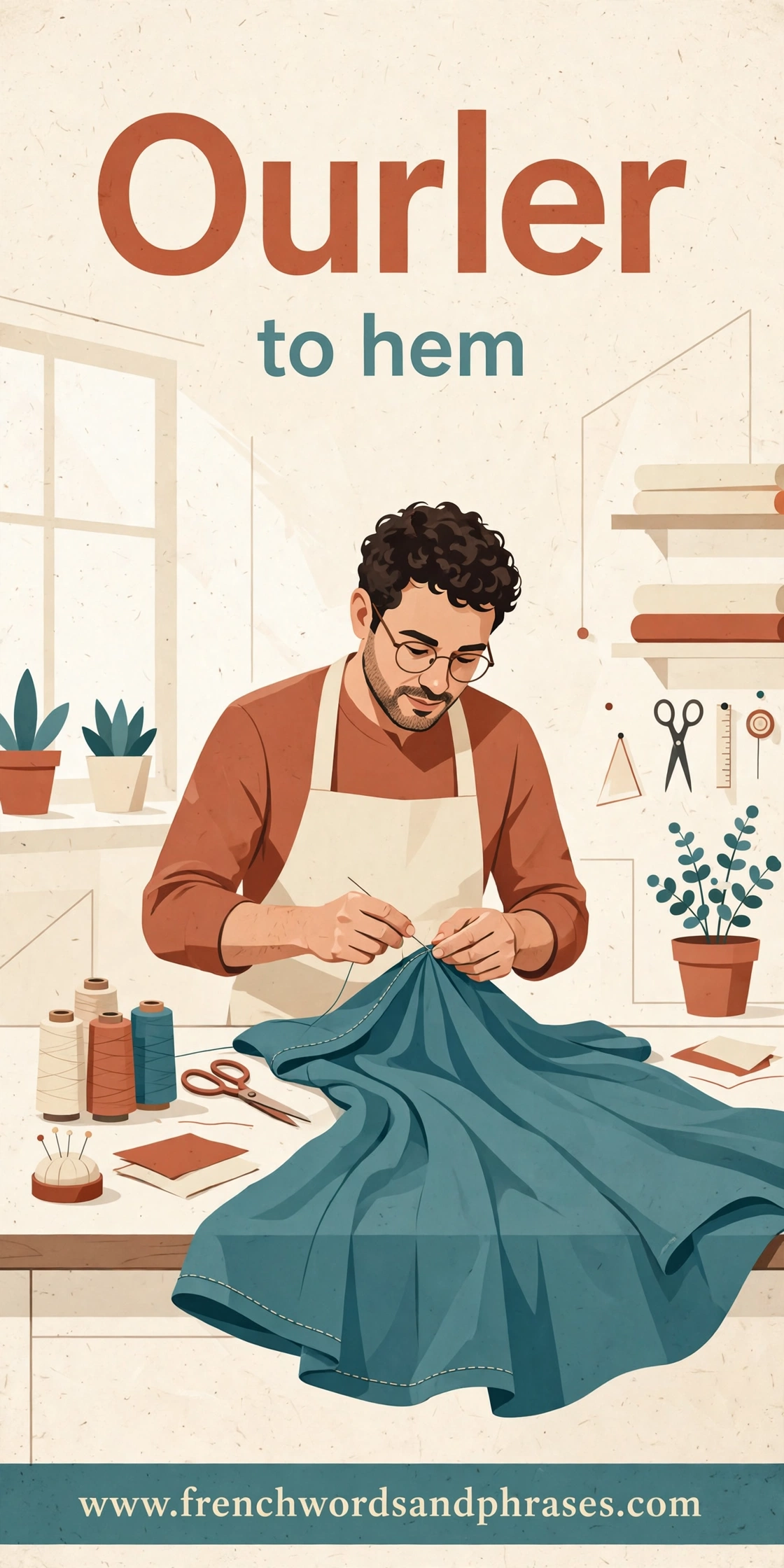
Ourler means to hem — to fold the edge of a fabric over and stitch it down neatly.
A dress turning slowly on the dressmaker’s stand, a line of pins marking exactly where the skirt will end — ourler is the verb of the hem, the small folded edge that finishes a garment and keeps it from fraying.
In this guide, you’ll learn how to conjugate ourler in all the major French tenses and moods. Explore complete conjugation tables, French examples, English translations, and practice quizzes.
Understanding the French Verb Ourler
Ourler is a regular French verb belonging to the first group of verbs, those ending in -er.
It means to hem. It is commonly used in sewing for hemming dresses, trousers, curtains and tablecloths, and in descriptions for anything neatly edged or finished with a clean border.
Verb classification: First group (-er)
Auxiliary verb: Avoir
Past participle: ourlé
Present participle: ourlant
English equivalents: To hem; ourler un pantalon — to hem a pair of trousers; un ourlet — a hem; faire un ourlet — to make a hem; une nappe ourlée de dentelle — a tablecloth edged with lace.
One important detail: the noun comes first in the family — un ourlet is the hem itself, and ourler is the work of making it. The verb is a regular -er verb: j’ourle, nous ourlons, past participle ourlé. French also uses it for edges beyond sewing: des lèvres bien ourlées are full, well-defined lips, and a cloth can be ourlée de dentelle, edged with lace.
Experience the Word
Ourler is the verb of the last centimetre — the garment is not finished until its edges are folded and held.
Imagine a dressmaker’s atelier the night before a wedding. The dress is cut, fitted and sewn; only the hem remains. Kneeling with pins between her lips, the couturière measures twice from the floor, folds the silk once, and ourle — because a dress is judged, in the end, by how it falls.
Tomorrow the skirt will swing clean and even. It has been ourlée — finished at the very edge.
How to Conjugate Ourler: Complete French Conjugation Guide
Let’s explore every major conjugation of ourler, beginning with the indicative mood.
How to Conjugate Ourler in the Indicative Mood
The indicative mood is used to express facts, observations, actions, and events.
How to Conjugate Ourler in the Present Tense (Présent)
Used for actions happening now, habitual actions, and general truths.
| Subject | Conjugation |
|---|---|
| je | ourle |
| tu | ourles |
| il / elle | ourle |
| nous | ourlons |
| vous | ourlez |
| ils / elles | ourlent |
Example
La couturière ourle la robe avant l’essayage.
The dressmaker hems the dress before the fitting.
Quick Quiz 1
Complete the sentence:
La couturière ______ la robe avant l’essayage.
Reveal the answer
ourle
La couturière ourle la robe avant l’essayage.
The dressmaker hems the dress before the fitting.
How to Conjugate Ourler in the Passé Composé
Used for completed actions in the past. Ourler takes the auxiliary verb avoir.
| Subject | Conjugation |
|---|---|
| j’ | ai ourlé |
| tu | as ourlé |
| il / elle | a ourlé |
| nous | avons ourlé |
| vous | avez ourlé |
| ils / elles | ont ourlé |
Example
J’ai ourlé le pantalon de mon fils hier soir.
I hemmed my son’s trousers last night.
How to Conjugate Ourler in the Imparfait (Imperfect Tense)
Used for habitual past actions, descriptions, and ongoing situations in the past.
| Subject | Conjugation |
|---|---|
| je | ourlais |
| tu | ourlais |
| il / elle | ourlait |
| nous | ourlions |
| vous | ourliez |
| ils / elles | ourlaient |
Example
Ma grand-mère ourlait tout à la main, sans machine.
My grandmother used to hem everything by hand, without a machine.
Quick Quiz 2
Choose the correct form:
She hemmed the curtains.
Elle ______ les rideaux. (a ourlé / est ourlée)
Reveal the answer
a ourlé
Elle a ourlé les rideaux.
Ourler takes avoir.
How to Conjugate Ourler in the Plus-que-parfait
Used to describe an action that had already been completed before another past event.
| Subject | Conjugation |
|---|---|
| j’ | avais ourlé |
| tu | avais ourlé |
| il / elle | avait ourlé |
| nous | avions ourlé |
| vous | aviez ourlé |
| ils / elles | avaient ourlé |
Example
Elle avait ourlé les rideaux avant l’arrivée des invités.
She had hemmed the curtains before the guests arrived.
How to Conjugate Ourler in the Passé Simple
Primarily used in formal writing, literature, and historical narratives. It is rarely used in everyday conversation.
| Subject | Conjugation |
|---|---|
| je | ourlai |
| tu | ourlas |
| il / elle | ourla |
| nous | ourlâmes |
| vous | ourlâtes |
| ils / elles | ourlèrent |
Example
Elle ourla la jupe en quelques points rapides.
She hemmed the skirt with a few quick stitches.
How to Conjugate Ourler in the Passé Antérieur
A literary tense used to express an action completed immediately before another past action, generally in the passé simple.
| Subject | Conjugation |
|---|---|
| j’ | eus ourlé |
| tu | eus ourlé |
| il / elle | eut ourlé |
| nous | eûmes ourlé |
| vous | eûtes ourlé |
| ils / elles | eurent ourlé |
Example
Quand il eut ourlé la nappe, il la repassa.
When he had hemmed the tablecloth, he ironed it.
How to Conjugate Ourler in the Future Tense (Futur Simple)
Used to describe actions that will take place in the future.
| Subject | Conjugation |
|---|---|
| je | ourlerai |
| tu | ourleras |
| il / elle | ourlera |
| nous | ourlerons |
| vous | ourlerez |
| ils / elles | ourleront |
Example
Demain, nous ourlerons les manches de la veste.
Tomorrow, we will hem the sleeves of the jacket.
How to Conjugate Ourler in the Futur Antérieur (Future Perfect)
Used for an action that will have been completed before a particular point in the future.
| Subject | Conjugation |
|---|---|
| j’ | aurai ourlé |
| tu | auras ourlé |
| il / elle | aura ourlé |
| nous | aurons ourlé |
| vous | aurez ourlé |
| ils / elles | auront ourlé |
Example
À midi, elle aura ourlé les deux rideaux.
By noon, she will have hemmed both curtains.
How to Conjugate Ourler in the Near Future (Futur Proche)
Used to describe something that is going to happen soon. Formed with aller + infinitive.
| Subject | Conjugation |
|---|---|
| je | vais ourler |
| tu | vas ourler |
| il / elle | va ourler |
| nous | allons ourler |
| vous | allez ourler |
| ils / elles | vont ourler |
Example
Je vais ourler cette robe, elle est trop longue.
I am going to hem this dress, it is too long.
How to Conjugate Ourler in the Conditional Mood
The conditional mood expresses what would happen under certain circumstances. It is also frequently used to make polite requests or express wishes.
How to Conjugate Ourler in the Present Conditional
| Subject | Conjugation |
|---|---|
| je | ourlerais |
| tu | ourlerais |
| il / elle | ourlerait |
| nous | ourlerions |
| vous | ourleriez |
| ils / elles | ourleraient |
Example
Avec un fil assorti, tu ourlerais une finition invisible.
With matching thread, you would hem an invisible finish.
How to Conjugate Ourler in the Past Conditional
| Subject | Conjugation |
|---|---|
| j’ | aurais ourlé |
| tu | aurais ourlé |
| il / elle | aurait ourlé |
| nous | aurions ourlé |
| vous | auriez ourlé |
| ils / elles | auraient ourlé |
Example
Il aurait ourlé le pantalon si l’aiguille n’avait pas cassé.
He would have hemmed the trousers if the needle had not broken.
Ourler in the Literary Past Conditional Form
This less common literary form uses the imperfect subjunctive of avoir.
| Subject | Conjugation |
|---|---|
| j’ | eusse ourlé |
| tu | eusses ourlé |
| il / elle | eût ourlé |
| nous | eussions ourlé |
| vous | eussiez ourlé |
| ils / elles | eussent ourlé |
Example
Elle eût ourlé la robe avant la fête.
She would have hemmed the dress before the party.
How to Conjugate Ourler in the Subjunctive Mood
The subjunctive is used to express wishes, emotions, doubts, necessity, and uncertainty. It frequently follows expressions such as il faut que (it is necessary that) or bien que (although).
How to Conjugate Ourler in the Present Subjunctive
| Subject | Conjugation |
|---|---|
| que je | ourle |
| que tu | ourles |
| qu’il / qu’elle | ourle |
| que nous | ourlions |
| que vous | ourliez |
| qu’ils / qu’elles | ourlent |
Example
Il faut que nous ourlions les rideaux ce week-end.
We must hem the curtains this weekend.
Quick Quiz 3
Complete the sentence using the subjunctive:
Il faut que nous ______ les manches.
Reveal the answer
ourlions
Il faut que nous ourlions les manches.
We must hem the sleeves.
How to Conjugate Ourler in the Imperfect Subjunctive
A literary tense, rarely encountered in modern spoken French.
| Subject | Conjugation |
|---|---|
| que je | ourlasse |
| que tu | ourlasses |
| qu’il / qu’elle | ourlât |
| que nous | ourlassions |
| que vous | ourlassiez |
| qu’ils / qu’elles | ourlassent |
Example
Je voulais qu’elle ourlât la jupe un peu plus court.
I wanted her to hem the skirt a little shorter.
How to Conjugate Ourler in the Pluperfect Subjunctive
A literary construction used to express an action completed before another past action.
| Subject | Conjugation |
|---|---|
| que j’ | eusse ourlé |
| que tu | eusses ourlé |
| qu’il / qu’elle | eût ourlé |
| que nous | eussions ourlé |
| que vous | eussiez ourlé |
| qu’ils / qu’elles | eussent ourlé |
Example
On disait qu’elle eût ourlé la robe en une heure.
People said she had hemmed the dress in one hour.
How to Conjugate Ourler in the Past Subjunctive
| Subject | Conjugation |
|---|---|
| que j’ | aie ourlé |
| que tu | aies ourlé |
| qu’il / qu’elle | ait ourlé |
| que nous | ayons ourlé |
| que vous | ayez ourlé |
| qu’ils / qu’elles | aient ourlé |
Example
Je suis ravi que tu aies ourlé les manches.
I am delighted that you hemmed the sleeves.
How to Conjugate Ourler in the Imperative
The imperative is used to give commands, instructions, invitations, or suggestions. Subject pronouns are omitted.
How to Conjugate Ourler in the Present Imperative
| Person | Conjugation |
|---|---|
| (tu) | ourle |
| (nous) | ourlons |
| (vous) | ourlez |
Example
Ourle le bas du pantalon, deux centimètres suffisent !
Hem the bottom of the trousers, two centimetres are enough!
Quick Quiz 4
How would you say Hem the trousers (tu form)?
Reveal the answer
Ourle le pantalon !
French Participles of Ourler
Participles are verb forms that can be used in compound tenses and other grammatical constructions.
Present Participle of Ourler
ourlant
En ourlant la nappe, elle a choisi un fil doré.
While hemming the tablecloth, she chose a gold thread.
Past Participle of Ourler
ourlé
Ourlée de dentelle, la robe semblait flotter.
Edged with lace, the dress seemed to float.
Ourler in Everyday French: Real-Life Examples
Now that you know the conjugations, let’s see how ourler appears in everyday French.
Example 1 — Present
La couturière ourle la robe.
The dressmaker hems the dress.
Example 2 — Passé composé
J’ai ourlé mon pantalon hier.
I hemmed my trousers yesterday.
Example 3 — Imparfait
Elle ourlait tout à la main.
She used to hem everything by hand.
Example 4 — Future
Nous ourlerons les rideaux samedi.
We will hem the curtains on Saturday.
Example 5 — Conditional
Tu ourlerais plus droit avec un guide.
You would hem straighter with a guide.
Example 6 — Imperative
Ourlez les manches avant l’essayage !
Hem the sleeves before the fitting!
Beyond Translation: The Meaning of Ourler
English uses one word, hem, for both the thing and the action; French splits the pair cleanly: un ourlet is the hem, ourler is hemming it.
The edge is the signature.
That is why French reaches for ourler beyond the sewing basket — lips bien ourlées, a handkerchief ourlé de dentelle: wherever an edge is finished with care, the verb of the hem is at home.
How to Remember the French Verb Ourler
Remember it this way: Ourler is about the little folded edge that finishes the garment.
- Un ourlet is the hem; ourler is making it — fold, pin, stitch.
- Regular -er: j’ourle, nous ourlons, past participle ourlé.
- Ourlé de dentelle — edged with lace; des lèvres bien ourlées — well-defined lips.
The key idea is the little folded edge that finishes the garment.
Test Your Knowledge of Ourler
Let’s see how much you’ve learned. Try answering these questions before revealing the answers.
Question 1
How do you say to hem a pair of trousers in French?
Reveal the answer
Ourler un pantalon.
Question 2
How do you say The dressmaker hems the dress in French?
Reveal the answer
La couturière ourle la robe.
Question 3
Translate: I hemmed my trousers yesterday.
Reveal the answer
J’ai ourlé mon pantalon hier.
Question 4
What is the past participle of ourler?
Reveal the answer
Ourlé.
Question 5
Complete the sentence:
Il faut que nous ______ les rideaux ce week-end.
Reveal the answer
ourlions
Il faut que nous ourlions les rideaux ce week-end.
We must hem the curtains this weekend.
Your Final Challenge
Can You Use It?
How would you say this in French?
She hems the dress, and the garment is finally finished.
Reveal the answer
Elle ourle la robe, et le vêtement est enfin terminé.
She hems the dress, and the garment is finally finished.
A little French. A little curiosity. A richer everyday life.
LEARN FRENCH ONE WORD AT A TIME




