
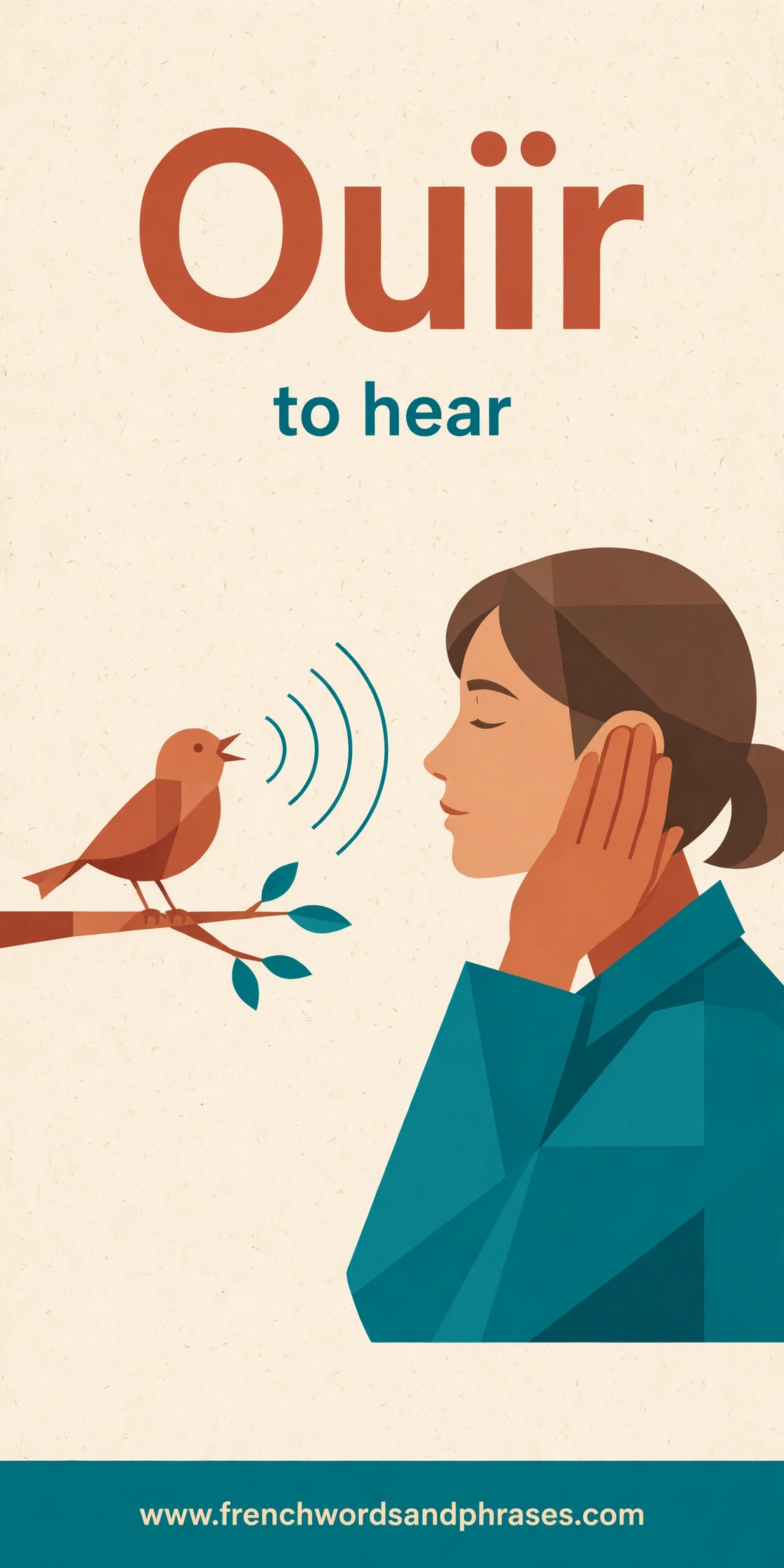
A French Word to Live By
How to Conjugate Ouïr in French
/wiʁ/
Ouïr means to hear — the old verb that modern French replaced with entendre, surviving in literature and in one famous phrase.
A town crier in a market square crying « Oyez, oyez ! », a poet listening to the night wind — ouïr is the old verb for to hear, the one French spoke for centuries before entendre quietly took its place.
In this guide, you’ll learn how to conjugate ouïr in all the major French tenses and moods. Explore complete conjugation tables, French examples, English translations, and practice quizzes.
Understanding the French Verb Ouïr
Ouïr is an irregular and archaic French verb ending in -ir: modern French prefers entendre, and ouïr survives in set phrases and literature.
It means to hear. It is used today in literature and poetry for hearing, in the town crier’s cry oyez, oyez (hear ye), in legal and formal echoes, and above all in the set phrase ouï-dire — hearsay — and j’ai ouï dire que, I have heard it said that.
Verb classification: Irregular (-ir), archaic
Auxiliary verb: Avoir
Past participle: ouï
Present participle: oyant
English equivalents: To hear (archaic); j’ai ouï dire que… — I have heard it said that…; oyez ! — hear ye!, the town crier’s call; l’ouïe — the sense of hearing.
One important detail: ouïr wears its age in its spelling — the tréma on the ï keeps every syllable separate, and the forms wander between two stems: j’ois, il oit in the present, but nous oyons, vous oyez, and a passé simple j’ouïs. Its past participle ouï survives in the one phrase every French speaker knows: j’ai ouï dire que… — I have heard it said that… And its noun l’ouïe is still the everyday word for the sense of hearing.
Experience the Word
Ouïr is the verb of ears in old books — hearing as it was written before entendre won.
Imagine a village square in 1450. The crier unrolls his parchment, takes a breath, and opens with the words every crowd knew: « Oyez, oyez, braves gens ! » — hear ye, hear ye — and the whole square becomes one ear.
The verb has retired from daily speech. But in ouï-dire, it still carries every rumour in France.
How to Conjugate Ouïr: Complete French Conjugation Guide
Let’s explore every major conjugation of ouïr, beginning with the indicative mood.
How to Conjugate Ouïr in the Indicative Mood
The indicative mood is used to express facts, observations, actions, and events.
How to Conjugate Ouïr in the Present Tense (Présent)
Used for actions happening now, habitual actions, and general truths.
| Subject | Conjugation |
|---|---|
| je | ois |
| tu | ois |
| il / elle | oit |
| nous | oyons |
| vous | oyez |
| ils / elles | oient |
Example
J’ois le vent dans les peupliers, comme dans les vieux poèmes.
I hear the wind in the poplars, as in the old poems.
Quick Quiz 1
Complete the sentence:
Nous ______ les cloches au loin.
Reveal the answer
oyons
Nous oyons les cloches au loin.
We hear the bells in the distance.
How to Conjugate Ouïr in the Passé Composé
Used for completed actions in the past. Ouïr takes the auxiliary verb avoir.
| Subject | Conjugation |
|---|---|
| j’ | ai ouï |
| tu | as ouï |
| il / elle | a ouï |
| nous | avons ouï |
| vous | avez ouï |
| ils / elles | ont ouï |
Example
J’ai ouï dire que le château était à vendre.
I have heard it said that the castle was for sale.
How to Conjugate Ouïr in the Imparfait (Imperfect Tense)
Used for habitual past actions, descriptions, and ongoing situations in the past.
| Subject | Conjugation |
|---|---|
| je | oyais |
| tu | oyais |
| il / elle | oyait |
| nous | oyions |
| vous | oyiez |
| ils / elles | oyaient |
Example
De sa fenêtre, elle oyait les cloches du village.
From her window, she could hear the village bells.
Quick Quiz 2
Choose the correct form:
I have heard it said.
J’______ ouï dire. (ai / suis)
Reveal the answer
ai
J’ai ouï dire.
Ouïr takes avoir.
How to Conjugate Ouïr in the Plus-que-parfait
Used to describe an action that had already been completed before another past event.
| Subject | Conjugation |
|---|---|
| j’ | avais ouï |
| tu | avais ouï |
| il / elle | avait ouï |
| nous | avions ouï |
| vous | aviez ouï |
| ils / elles | avaient ouï |
Example
Il avait ouï la nouvelle avant tout le monde.
He had heard the news before everyone else.
How to Conjugate Ouïr in the Passé Simple
Primarily used in formal writing, literature, and historical narratives. It is rarely used in everyday conversation.
| Subject | Conjugation |
|---|---|
| je | ouïs |
| tu | ouïs |
| il / elle | ouït |
| nous | ouîmes |
| vous | ouîtes |
| ils / elles | ouïrent |
Example
Le roi ouït la plainte du paysan et se tut.
The king heard the peasant’s complaint and fell silent.
How to Conjugate Ouïr in the Passé Antérieur
A literary tense used to express an action completed immediately before another past action, generally in the passé simple.
| Subject | Conjugation |
|---|---|
| j’ | eus ouï |
| tu | eus ouï |
| il / elle | eut ouï |
| nous | eûmes ouï |
| vous | eûtes ouï |
| ils / elles | eurent ouï |
Example
Quand il eut ouï la sentence, il baissa la tête.
When he had heard the sentence, he bowed his head.
How to Conjugate Ouïr in the Future Tense (Futur Simple)
Used to describe actions that will take place in the future.
| Subject | Conjugation |
|---|---|
| je | ouïrai |
| tu | ouïras |
| il / elle | ouïra |
| nous | ouïrons |
| vous | ouïrez |
| ils / elles | ouïront |
Example
Un jour, vous ouïrez la vérité de sa propre bouche.
One day, you will hear the truth from his own mouth.
How to Conjugate Ouïr in the Futur Antérieur (Future Perfect)
Used for an action that will have been completed before a particular point in the future.
| Subject | Conjugation |
|---|---|
| j’ | aurai ouï |
| tu | auras ouï |
| il / elle | aura ouï |
| nous | aurons ouï |
| vous | aurez ouï |
| ils / elles | auront ouï |
Example
À la fin du conte, tu auras ouï bien des merveilles.
By the end of the tale, you will have heard many wonders.
How to Conjugate Ouïr in the Near Future (Futur Proche)
Used to describe something that is going to happen soon. Formed with aller + infinitive.
| Subject | Conjugation |
|---|---|
| je | vais ouïr |
| tu | vas ouïr |
| il / elle | va ouïr |
| nous | allons ouïr |
| vous | allez ouïr |
| ils / elles | vont ouïr |
Example
Approche-toi, tu vas ouïr une drôle d’histoire.
Come closer, you are going to hear a strange story.
How to Conjugate Ouïr in the Conditional Mood
The conditional mood expresses what would happen under certain circumstances. It is also frequently used to make polite requests or express wishes.
How to Conjugate Ouïr in the Present Conditional
| Subject | Conjugation |
|---|---|
| je | ouïrais |
| tu | ouïrais |
| il / elle | ouïrait |
| nous | ouïrions |
| vous | ouïriez |
| ils / elles | ouïraient |
Example
Sans le silence du soir, nous n’ouïrions pas le hibou.
Without the evening silence, we would not hear the owl.
How to Conjugate Ouïr in the Past Conditional
| Subject | Conjugation |
|---|---|
| j’ | aurais ouï |
| tu | aurais ouï |
| il / elle | aurait ouï |
| nous | aurions ouï |
| vous | auriez ouï |
| ils / elles | auraient ouï |
Example
Elle aurait ouï la cloche si elle avait ouvert la fenêtre.
She would have heard the bell if she had opened the window.
Ouïr in the Literary Past Conditional Form
This less common literary form uses the imperfect subjunctive of avoir.
| Subject | Conjugation |
|---|---|
| j’ | eusse ouï |
| tu | eusses ouï |
| il / elle | eût ouï |
| nous | eussions ouï |
| vous | eussiez ouï |
| ils / elles | eussent ouï |
Example
Il eût ouï les cloches, s’il était resté au village.
He would have heard the bells, if he had stayed in the village.
How to Conjugate Ouïr in the Subjunctive Mood
The subjunctive is used to express wishes, emotions, doubts, necessity, and uncertainty. It frequently follows expressions such as il faut que (it is necessary that) or bien que (although).
How to Conjugate Ouïr in the Present Subjunctive
| Subject | Conjugation |
|---|---|
| que je | oie |
| que tu | oies |
| qu’il / qu’elle | oie |
| que nous | oyions |
| que vous | oyiez |
| qu’ils / qu’elles | oient |
Example
Il faut que j’oie ce chant une fois dans ma vie.
I must hear this song once in my life.
Quick Quiz 3
Complete the sentence using the subjunctive:
Il faut que j’______ ce chant une fois.
Reveal the answer
oie
Il faut que j’oie ce chant une fois.
I must hear this song once.
How to Conjugate Ouïr in the Imperfect Subjunctive
A literary tense, rarely encountered in modern spoken French.
| Subject | Conjugation |
|---|---|
| que je | ouïsse |
| que tu | ouïsses |
| qu’il / qu’elle | ouït |
| que nous | ouïssions |
| que vous | ouïssiez |
| qu’ils / qu’elles | ouïssent |
Example
Le juge exigea que le témoin ouït la question une seconde fois.
The judge demanded that the witness hear the question a second time.
How to Conjugate Ouïr in the Pluperfect Subjunctive
A literary construction used to express an action completed before another past action.
| Subject | Conjugation |
|---|---|
| que j’ | eusse ouï |
| que tu | eusses ouï |
| qu’il / qu’elle | eût ouï |
| que nous | eussions ouï |
| que vous | eussiez ouï |
| qu’ils / qu’elles | eussent ouï |
Example
On disait qu’il eût ouï la voix des anciens.
It was said he had heard the voice of the ancients.
How to Conjugate Ouïr in the Past Subjunctive
| Subject | Conjugation |
|---|---|
| que j’ | aie ouï |
| que tu | aies ouï |
| qu’il / qu’elle | ait ouï |
| que nous | ayons ouï |
| que vous | ayez ouï |
| qu’ils / qu’elles | aient ouï |
Example
Je suis heureux que vous ayez ouï cette histoire.
I am happy that you heard this story.
How to Conjugate Ouïr in the Imperative
The imperative is used to give commands, instructions, invitations, or suggestions. Subject pronouns are omitted.
How to Conjugate Ouïr in the Present Imperative
| Person | Conjugation |
|---|---|
| (tu) | ois |
| (nous) | oyons |
| (vous) | oyez |
Example
Oyez, oyez, braves gens, la proclamation du roi !
Hear ye, hear ye, good people, the king’s proclamation!
Quick Quiz 4
How would you say Hear ye (vous form)?
Reveal the answer
Oyez !
French Participles of Ouïr
Participles are verb forms that can be used in compound tenses and other grammatical constructions.
Present Participle of Ouïr
oyant
En oyant les cloches, le vieillard sourit doucement.
Hearing the bells, the old man smiled gently.
Past Participle of Ouïr
ouï
Ouïe par tout le village, la nouvelle se répandit en une heure.
Heard by the whole village, the news spread within an hour.
Ouïr in Everyday French: Real-Life Examples
Now that you know the conjugations, let’s see how ouïr appears in everyday French.
Example 1 — Present
J’ois les cloches au loin.
I hear the bells in the distance.
Example 2 — Passé composé
J’ai ouï dire qu’il revenait au printemps.
I have heard it said that he was coming back in spring.
Example 3 — Imparfait
Elle oyait la mer depuis sa chambre.
She could hear the sea from her room.
Example 4 — Future
Vous ouïrez la cloche à midi précis.
You will hear the bell at noon sharp.
Example 5 — Conditional
Nous ouïrions mieux sans ce vent.
We would hear better without this wind.
Example 6 — Imperative
Oyez la bonne nouvelle !
Hear the good news!
Beyond Translation: The Meaning of Ouïr
English once had its own cry — oyez, borrowed straight from this verb, and it still opens courts in some places today.
Entendre won the present; ouïr kept the poetry.
And in j’ai ouï dire, the old verb still does one modern job perfectly: reporting a rumour without swearing that it is true.
How to Remember the French Verb Ouïr
Remember it this way: Ouïr is about the town crier’s verb — Oyez, oyez, and j’ai ouï dire.
- J’ai ouï dire que… — I have heard it said that…: the living survival of ouïr.
- Oyez, oyez ! — hear ye!: the town crier’s call, the vous imperative.
- L’ouïe — the sense of hearing: the noun is still everyday French.
The key idea is the town crier’s verb — Oyez, oyez, and j’ai ouï dire.
Test Your Knowledge of Ouïr
Let’s see how much you’ve learned. Try answering these questions before revealing the answers.
Question 1
What does j’ai ouï dire que… mean?
Reveal the answer
I have heard it said that… — the set phrase where ouïr still lives in modern French.
Question 2
How do you say I have heard it said that he is coming back in French?
Reveal the answer
J’ai ouï dire qu’il revenait.
Question 3
Translate: From her window, she could hear the bells.
Reveal the answer
De sa fenêtre, elle oyait les cloches.
Question 4
What is the past participle of ouïr?
Reveal the answer
Ouï — as in j’ai ouï dire, I have heard it said.
Question 5
Complete the sentence:
______, ______, braves gens, la proclamation du roi !
Reveal the answer
Oyez, oyez
Oyez, oyez, braves gens, la proclamation du roi !
Hear ye, hear ye, good people, the king’s proclamation!
Your Final Challenge
Can You Use It?
How would you say this in French?
I have heard it said that you are coming back, and tonight I hear the bells announcing it.
Reveal the answer
J’ai ouï dire que tu reviens, et ce soir j’ois les cloches qui l’annoncent.
I have heard it said that you are coming back, and tonight I hear the bells announcing it.
A little French. A little curiosity. A richer everyday life.
LEARN FRENCH ONE WORD AT A TIME




