A French Word to Live By
Translate Or to English
/ɔʁ/
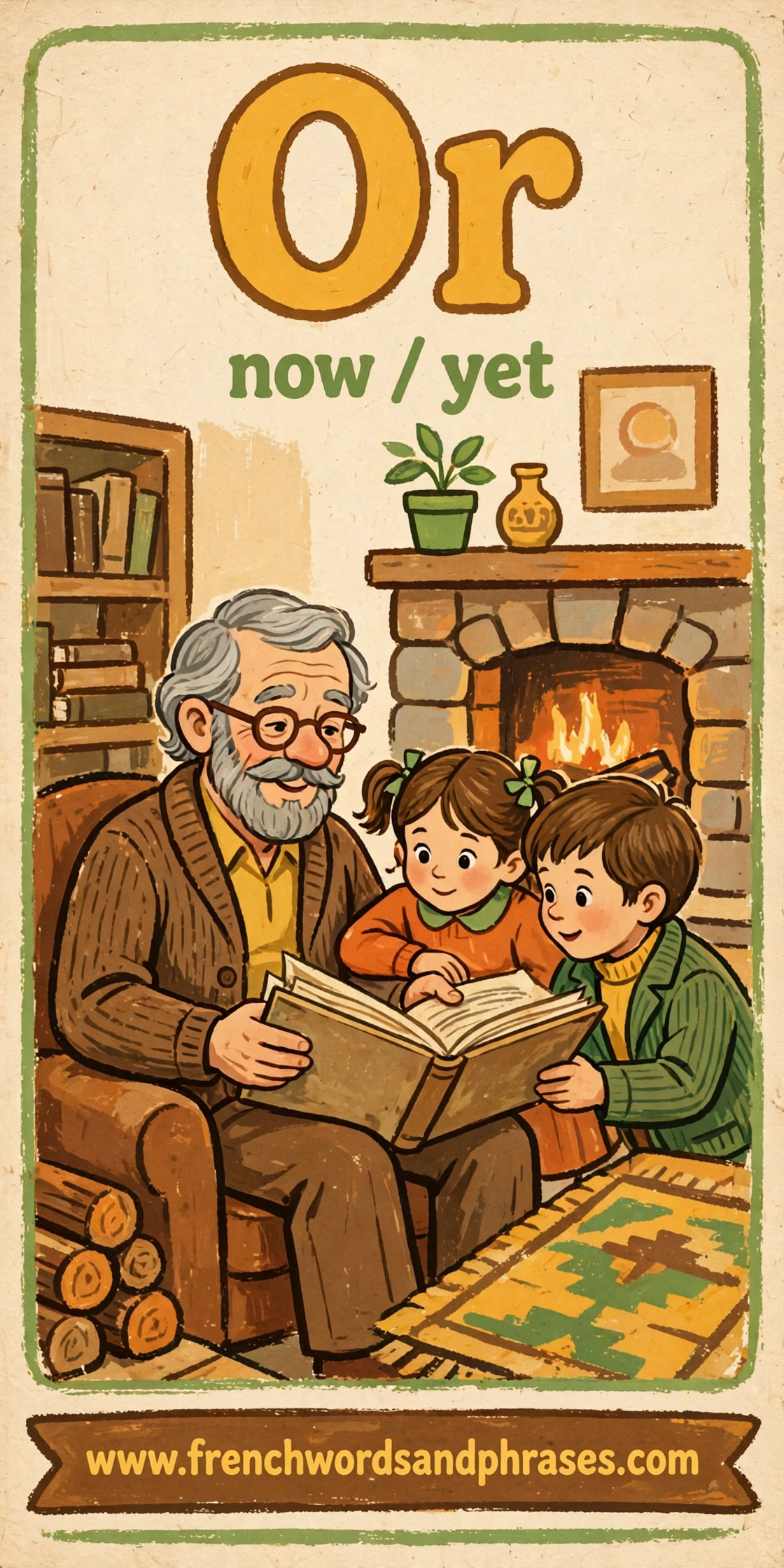
Or means now / yet.
He had promised to write every week. Or, the letters never came. That small word at the start of the second sentence is pure storytelling — a raised eyebrow in word form, the hinge on which a French tale turns.
In this guide, you’ll learn what or means in English, why this little literary conjunction is not the English word ‘or’, how it opens a sentence to spring a surprise, and how it differs from mais and cependant. Explore French examples, English translations, and practice quizzes.
Understanding the French Conjunction Or
Or is a French coordinating conjunction of the written language — a storyteller’s word. Placed at the head of a sentence, it introduces a fact that changes everything: it means something like now, yet, or and yet.
It means now or yet — never ‘or’ in the English sense of a choice. Il avait promis de venir. Or, il n’est jamais arrivé. — He had promised to come. Yet he never arrived. Or presents the new fact and lets the reader feel the jolt.
Type: Coordinating conjunction — literary, written register
Job: Introduces a surprising new fact — a turning point
What follows it: A comma, then a full clause
Mood after it: Indicative — it links statements, not doubts
One important usage detail: or is also the French word for gold — l’or, a masculine noun, as in une montre en or, a gold watch. Same spelling, same sound, no relation in the sentence: the conjunction stands at the head of a sentence; the metal never does.
Experience the Word
Or is the conjunction of the plot twist — two small letters that tell the reader: pay attention, the story is about to turn.
Imagine a grandfather beginning a tale by the fire: « il était une fois un meunier qui n’avait qu’un âne. Or, cet âne parlait. » The children sit up at once — or has promised them a marvel.
You have not just continued the story. You have turned it.
How to Use Or in French: Complete Guide
Let’s explore how or works in French, beginning with the whole word on one card.
Or at a Glance
Before the details, here is the whole word on one card.
The Whole Word on One Card
Meaning, job, pattern and mood — or in four lines.
| Point | Or |
|---|---|
| Meaning | now / yet (never the English ‘or’ of choice) |
| Job | opens a sentence with a new, often surprising fact |
| What follows | a comma, then a complete clause |
| Mood | indicative |
Example
Tout semblait calme. Or, la tempête approchait.
Everything seemed calm. Yet the storm was approaching.
How Or Links: One Sentence Ends, the Story Turns
Or does not glue two clauses inside one sentence like et or mais. It stands at the gate of a new sentence and links it back to everything said before.
| Pattern | Example |
|---|---|
| fact. Or, twist. | il avait deux fils. Or, le plus jeune était le plus sage. — he had two sons. Now, the youngest was the wisest |
| promise. Or, reality. | elle devait arriver à midi. Or, son train avait trois heures de retard. — she was due at noon. Yet her train was three hours late |
| calm. Or, danger. | la mer était tranquille. Or, un requin nageait près de la plage. — the sea was calm. Yet a shark was swimming near the beach |
| in a tale’s unfolding | or, il faut savoir que le roi était très vieux — now, you should know that the king was very old |
Example
Le village dormait. Or, quelqu’un marchait dans la rue.
The village was asleep. Yet someone was walking in the street.
Quick Quiz 1
Does French or offer a choice, like English ‘tea or coffee’?
Reveal the answer
No — or never means the ‘or’ of choice; that is ou. Or means ‘now / yet’ and opens a sentence.
Il faisait nuit. Or, la lune se levait.
It was night. Yet the moon was rising.
The Mood Question: Statements Only, Indicative Only
Or links facts, so everything around it stays in the indicative. It is a conjunction of narration, not of doubt, wishes or hypotheses.
| Situation | Example |
|---|---|
| Past narration | or, le lendemain, tout avait changé — now, the next day, everything had changed |
| Present fact | or, tu connais la vérité — yet you know the truth |
| With a negative | or, personne ne le savait — yet nobody knew it |
| Never with the subjunctive | or introduces what IS, not what might be |
Example
Il souriait. Or, ses yeux étaient tristes.
He was smiling. Yet his eyes were sad.
Where Or Goes: At the Very Start, With a Comma
Or has one home only: the first word of a sentence (or of a clause after a semicolon), almost always followed by a comma. It never sits in the middle of a clause.
| Position | Example |
|---|---|
| Start of a sentence + comma | or, écoutez bien — now, listen carefully |
| After a semicolon | tout était prêt ; or, l’invité ne venait pas — everything was ready; yet the guest was not coming |
| Register | written and literary — novels, essays, speeches; rare in casual chat |
| Spoken stand-ins | in conversation, mais or alors does the job instead |
Example
La porte était fermée. Or, la clé était sous le tapis.
The door was locked. Yet the key was under the mat.
Quick Quiz 2
Where does or stand in its sentence — middle, end, or first word?
Reveal the answer
First word — or always opens its sentence, usually with a comma after it.
Or, la vérité était tout autre.
Yet the truth was quite different.
Everyday Expressions with Or
‘Everyday’ is generous for so literary a word — but these are the shapes in which you will meet or again and again in French books and speeches.
| Expression | In English |
|---|---|
| or, il se trouve que… | now, it so happens that… |
| or donc | now then (old-fashioned, in tales and speeches) |
| or, écoutez… | now, listen… |
| or ça ! | well now! (very old-fashioned surprise) |
| d’or (the other or) | golden — as in la poule aux œufs d’or, the hen with the golden eggs |
Example
Or, il se trouve que le trésor était faux.
Now, it so happens that the treasure was fake.
Close Cousins: Or, Mais, Cependant, Pourtant
Several words can mark a contrast. Or is the only one that must open a fresh sentence — and the only one that smells of the library.
| Word | The difference |
|---|---|
| or | literary; opens a new sentence; introduces the turning point |
| mais | the everyday ‘but’; links clauses inside one sentence |
| cependant | ‘however’; written, but sits inside the sentence, set off by commas |
| pourtant | ‘yet, however’; mid-sentence, and common in speech too |
Example
Elle travaillait pourtant dur. Or, le succès ne venait pas.
She worked hard, though. Yet success did not come.
Quick Quiz 3
Which cousin can link two clauses inside a single sentence — or or mais?
Reveal the answer
mais — or must open a new sentence of its own.
Il est petit mais fort ; or, ne le sous-estimez pas.
He is small but strong; yet do not underestimate him.
Or and Its Neighbours
Around or gather the words of turning points and storytelling — plus the glittering homonym that shares its name.
| French | In English |
|---|---|
| mais | but |
| pourtant | yet, however |
| cependant | however, nevertheless |
| alors | then, so — the storyteller’s next step |
| l’or (noun) | gold — une bague en or, a gold ring |
Example
Alors le roi parla. Or, personne n’osa répondre.
Then the king spoke. Yet no one dared answer.
Watch Out: The Traps Around Or
One trap towers over the rest: the English eye reads ‘or’ and thinks of choice. Two smaller traps follow behind it.
| Trap | The truth |
|---|---|
| reading or as English ‘or’ | a choice is ou in French — thé ou café. Or = now / yet, and it opens a sentence |
| using or in casual speech | it sounds like a novel; in conversation prefer mais, pourtant or alors |
| forgetting the comma | or is followed by a comma: or, la nuit tombait |
| confusing or with l’or | context decides: sentence-initial or is the conjunction; en or / d’or is the metal, gold |
Example
Tu veux du thé ou du café ? Or, choisis vite, il se fait tard.
Do you want tea or coffee? Now choose quickly, it’s getting late.
Quick Quiz 4
‘Tea or coffee?’ — is the French word ou or or?
Reveal the answer
ou — choices take ou. Or means ‘now / yet’ and belongs to written storytelling.
Thé ou café ?
Tea or coffee?
Or in Everyday French: Real-Life Examples
Now that you know the word, let’s see how or appears in everyday French.
Example 1 — A tale begins
Il était une fois un roi. Or, ce roi avait trois filles.
Once upon a time there was a king. Now, this king had three daughters.
Example 2 — A twist
Tout allait bien. Or, un matin, la rivière déborda.
Everything was going well. Then one morning, the river flooded.
Example 3 — In an essay
On nous promet la simplicité. Or, le réel est compliqué.
We are promised simplicity. Yet reality is complicated.
Example 4 — A speech
Nous avons gagné une bataille. Or, la guerre n’est pas finie.
We have won a battle. Yet the war is not over.
Example 5 — A mystery
La chambre était fermée de l’intérieur. Or, la fenêtre était ouverte.
The room was locked from the inside. Yet the window was open.
Example 6 — The other or
Elle porte une chaîne en or.
She is wearing a gold chain.
Beyond Translation: The Meaning of Or
English says now or yet for the meaning of or — pale translations for a word that in French carries the rustle of turning pages. Or is the breath a storyteller takes before the marvel, the raised finger of the essayist before the objection.
Or teaches you that French narration loves its hinges: a sentence ends, a door opens, and one small word invites you through.
And then there is the happy accident of its twin: l’or, gold. The conjunction is worth about as much — two letters of pure narrative gold, placed exactly where the story turns.
How to Remember the French Conjunction Or
Remember it this way: Or is the storyteller’s raised finger — first word of the sentence, comma after it, surprise coming.
- You never use it for a choice — thé ou café takes ou, not or.
- You place it at the very start — or, … — and let the new fact land.
- You save it for writing — tales, essays, speeches; in chat, mais does the work.
The key idea is or opens a sentence in written French and means now / yet — never a choice.
Test Your Knowledge of Or
Let’s see how much you’ve learned. Try answering these questions before revealing the answers.
Question 1
What does the conjunction or mean?
Reveal the answer
Now / yet — it opens a sentence with a new, often surprising fact. It never offers a choice.
Question 2
How do you say ‘tea or coffee’ in French?
Reveal the answer
Thé ou café — choices take ou, not or.
Question 3
Where does or stand in a sentence?
Reveal the answer
At the very start, usually followed by a comma: or, la nuit tombait.
Question 4
What else does or mean as a noun?
Reveal the answer
Gold — l’or: une montre en or, a gold watch.
Question 5
Complete the pair of sentences:
Tout semblait perdu. ______, un ami arriva.
Reveal the answer
Or
Tout semblait perdu. Or, un ami arriva.
Everything seemed lost. Then a friend arrived.
Your Final Challenge
Can You Use It?
How would you say this in French?
“Everything was ready. Yet the guests were late.”
Reveal the answer
Tout était prêt. Or, les invités étaient en retard.
Everything was ready. Yet the guests were late.
A little French. A little curiosity. A richer everyday life.
LEARN FRENCH ONE WORD AT A TIME