A French Word to Live By
How to Conjugate Offenser in French
/ɔ.fɑ̃.se/
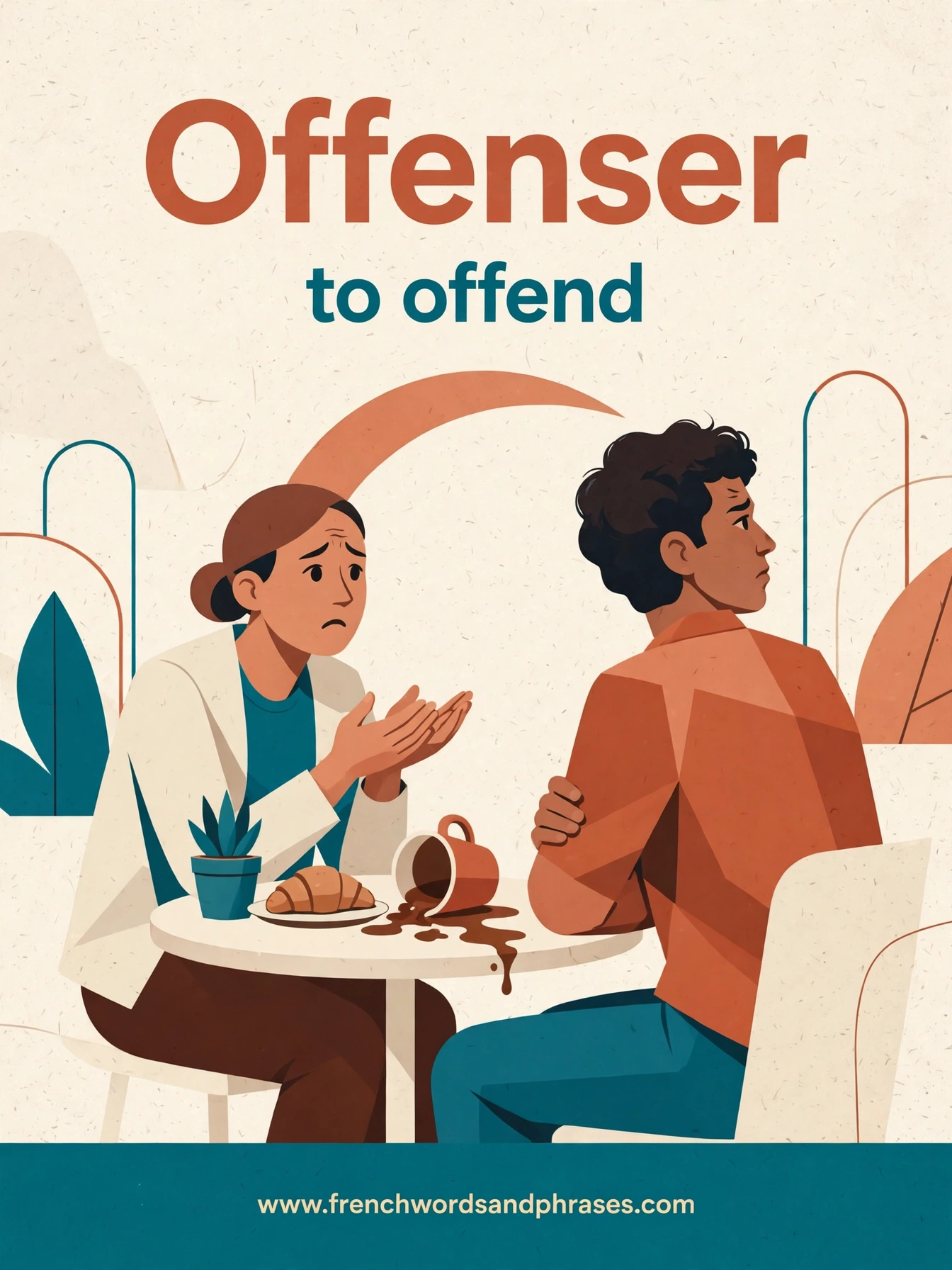
Offenser means to offend — to hurt someone’s feelings or dignity with a word or an act.
One careless sentence at the dinner table, and a chair scrapes back — offenser is the verb of the wounded feeling, the remark that lands too hard and cannot be unsaid.
In this guide, you’ll learn how to conjugate offenser in all the major French tenses and moods. Explore complete conjugation tables, French examples, English translations, and practice quizzes.
Understanding the French Verb Offenser
Offenser is a regular French verb belonging to the first group of verbs, those ending in -er.
It means to offend. It is commonly used for remarks, jokes and gestures that hurt feelings, in apologies — je ne voulais pas vous offenser, I did not mean to offend you — and in the reflexive for people who take offence, sometimes a little too quickly.
Verb classification: First group (-er)
Auxiliary verb: Avoir
Past participle: offensé
Present participle: offensant
English equivalents: To offend, to give offence; offenser quelqu’un — to offend someone; s’offenser de — to take offence at; une offense — an offence, an insult.
One important detail: offenser starts with a vowel sound, so je becomes j’: j’offense, j’ai offensé. The verb itself is a regular -er verb. Its everyday partner is the reflexive s’offenser de, to take offence at something: elle s’est offensée de sa remarque — she took offence at his remark. Offenser wounds; s’offenser feels the wound.
Experience the Word
Offenser is the verb of the sentence you wish you could take back — it lives in the silence after the words.
Imagine a family dinner. Uncle Bernard tells his famous joke, the one about mothers-in-law, and the room goes quiet: his daughter-in-law sets down her fork. He has offended her, and everyone at the table knows it before he does.
The joke cannot be untold. She has been offended — offensée — and dessert will be served in silence.
How to Conjugate Offenser: Complete French Conjugation Guide
Let’s explore every major conjugation of offenser, beginning with the indicative mood.
How to Conjugate Offenser in the Indicative Mood
The indicative mood is used to express facts, observations, actions, and events.
How to Conjugate Offenser in the Present Tense (Présent)
Used for actions happening now, habitual actions, and general truths.
| Subject | Conjugation |
|---|---|
| je | offense |
| tu | offenses |
| il / elle | offense |
| nous | offensons |
| vous | offensez |
| ils / elles | offensent |
Example
Cette remarque offense toujours les invités.
This remark always offends the guests.
Quick Quiz 1
Complete the sentence:
Nous n’______ personne avec nos blagues.
Reveal the answer
offensons
Nous n’offensons personne avec nos blagues.
We offend nobody with our jokes.
How to Conjugate Offenser in the Passé Composé
Used for completed actions in the past. Offenser takes the auxiliary verb avoir.
| Subject | Conjugation |
|---|---|
| j’ | ai offensé |
| tu | as offensé |
| il / elle | a offensé |
| nous | avons offensé |
| vous | avez offensé |
| ils / elles | ont offensé |
Example
J’ai offensé mon ami sans le vouloir.
I offended my friend without meaning to.
How to Conjugate Offenser in the Imparfait (Imperfect Tense)
Used for habitual past actions, descriptions, and ongoing situations in the past.
| Subject | Conjugation |
|---|---|
| je | offensais |
| tu | offensais |
| il / elle | offensait |
| nous | offensions |
| vous | offensiez |
| ils / elles | offensaient |
Example
Ses blagues offensaient souvent les voisins.
His jokes often used to offend the neighbours.
Quick Quiz 2
Choose the correct form:
He offended his host.
Il ______ son hôte. (a offensé / est offensé)
Reveal the answer
a offensé
Il a offensé son hôte.
Offenser takes avoir.
How to Conjugate Offenser in the Plus-que-parfait
Used to describe an action that had already been completed before another past event.
| Subject | Conjugation |
|---|---|
| j’ | avais offensé |
| tu | avais offensé |
| il / elle | avait offensé |
| nous | avions offensé |
| vous | aviez offensé |
| ils / elles | avaient offensé |
Example
Il s’était offensé d’un simple malentendu.
He had taken offence at a simple misunderstanding.
How to Conjugate Offenser in the Passé Simple
Primarily used in formal writing, literature, and historical narratives. It is rarely used in everyday conversation.
| Subject | Conjugation |
|---|---|
| je | offensai |
| tu | offensas |
| il / elle | offensa |
| nous | offensâmes |
| vous | offensâtes |
| ils / elles | offensèrent |
Example
Le critique offensa l’auteur par un seul mot.
The critic offended the author with a single word.
How to Conjugate Offenser in the Passé Antérieur
A literary tense used to express an action completed immediately before another past action, generally in the passé simple.
| Subject | Conjugation |
|---|---|
| j’ | eus offensé |
| tu | eus offensé |
| il / elle | eut offensé |
| nous | eûmes offensé |
| vous | eûtes offensé |
| ils / elles | eurent offensé |
Example
Quand il eut offensé toute la famille, il quitta la table.
When he had offended the whole family, he left the table.
How to Conjugate Offenser in the Future Tense (Futur Simple)
Used to describe actions that will take place in the future.
| Subject | Conjugation |
|---|---|
| je | offenserai |
| tu | offenseras |
| il / elle | offensera |
| nous | offenserons |
| vous | offenserez |
| ils / elles | offenseront |
Example
Ce discours offensera une partie du public.
This speech will offend part of the audience.
How to Conjugate Offenser in the Futur Antérieur (Future Perfect)
Used for an action that will have been completed before a particular point in the future.
| Subject | Conjugation |
|---|---|
| j’ | aurai offensé |
| tu | auras offensé |
| il / elle | aura offensé |
| nous | aurons offensé |
| vous | aurez offensé |
| ils / elles | auront offensé |
Example
À la fin de la soirée, il aura offensé la moitié des invités.
By the end of the evening, he will have offended half the guests.
How to Conjugate Offenser in the Near Future (Futur Proche)
Used to describe something that is going to happen soon. Formed with aller + infinitive.
| Subject | Conjugation |
|---|---|
| je | vais offenser |
| tu | vas offenser |
| il / elle | va offenser |
| nous | allons offenser |
| vous | allez offenser |
| ils / elles | vont offenser |
Example
Attention, tu vas offenser ta belle-mère.
Careful, you are going to offend your mother-in-law.
How to Conjugate Offenser in the Conditional Mood
The conditional mood expresses what would happen under certain circumstances. It is also frequently used to make polite requests or express wishes.
How to Conjugate Offenser in the Present Conditional
| Subject | Conjugation |
|---|---|
| je | offenserais |
| tu | offenserais |
| il / elle | offenserait |
| nous | offenserions |
| vous | offenseriez |
| ils / elles | offenseraient |
Example
Un mot de plus offenserait tout le monde.
One more word would offend everyone.
How to Conjugate Offenser in the Past Conditional
| Subject | Conjugation |
|---|---|
| j’ | aurais offensé |
| tu | aurais offensé |
| il / elle | aurait offensé |
| nous | aurions offensé |
| vous | auriez offensé |
| ils / elles | auraient offensé |
Example
Je ne t’aurais pas offensé si j’avais su la vérité.
I would not have offended you if I had known the truth.
Offenser in the Literary Past Conditional Form
This less common literary form uses the imperfect subjunctive of avoir.
| Subject | Conjugation |
|---|---|
| j’ | eusse offensé |
| tu | eusses offensé |
| il / elle | eût offensé |
| nous | eussions offensé |
| vous | eussiez offensé |
| ils / elles | eussent offensé |
Example
Il eût offensé le roi par son silence.
He would have offended the king by his silence.
How to Conjugate Offenser in the Subjunctive Mood
The subjunctive is used to express wishes, emotions, doubts, necessity, and uncertainty. It frequently follows expressions such as il faut que (it is necessary that) or bien que (although).
How to Conjugate Offenser in the Present Subjunctive
| Subject | Conjugation |
|---|---|
| que je | offense |
| que tu | offenses |
| qu’il / qu’elle | offense |
| que nous | offensions |
| que vous | offensiez |
| qu’ils / qu’elles | offensent |
Example
Je regrette que ce mot vous offense.
I am sorry that this word offends you.
Quick Quiz 3
Complete the sentence using the subjunctive:
Je crains que vous ______ les invités.
Reveal the answer
offensiez
Je crains que vous offensiez les invités.
I fear you may offend the guests.
How to Conjugate Offenser in the Imperfect Subjunctive
A literary tense, rarely encountered in modern spoken French.
| Subject | Conjugation |
|---|---|
| que je | offensasse |
| que tu | offensasses |
| qu’il / qu’elle | offensât |
| que nous | offensassions |
| que vous | offensassiez |
| qu’ils / qu’elles | offensassent |
Example
Elle craignait qu’il offensât ses parents.
She feared he might offend her parents.
How to Conjugate Offenser in the Pluperfect Subjunctive
A literary construction used to express an action completed before another past action.
| Subject | Conjugation |
|---|---|
| que j’ | eusse offensé |
| que tu | eusses offensé |
| qu’il / qu’elle | eût offensé |
| que nous | eussions offensé |
| que vous | eussiez offensé |
| qu’ils / qu’elles | eussent offensé |
Example
On disait qu’il eût offensé le maire lui-même.
People said he had offended the mayor himself.
How to Conjugate Offenser in the Past Subjunctive
| Subject | Conjugation |
|---|---|
| que j’ | aie offensé |
| que tu | aies offensé |
| qu’il / qu’elle | ait offensé |
| que nous | ayons offensé |
| que vous | ayez offensé |
| qu’ils / qu’elles | aient offensé |
Example
Je suis désolé que ma remarque t’ait offensée.
I am sorry my remark offended you.
How to Conjugate Offenser in the Imperative
The imperative is used to give commands, instructions, invitations, or suggestions. Subject pronouns are omitted.
How to Conjugate Offenser in the Present Imperative
| Person | Conjugation |
|---|---|
| (tu) | offense |
| (nous) | offensons |
| (vous) | offensez |
Example
N’offense personne avec tes blagues !
Do not offend anyone with your jokes!
Quick Quiz 4
How would you say Do not offend anyone (tu form)?
Reveal the answer
N’offense personne !
French Participles of Offenser
Participles are verb forms that can be used in compound tenses and other grammatical constructions.
Present Participle of Offenser
offensant
En offensant son hôte, il a gâché la soirée.
By offending his host, he ruined the evening.
Past Participle of Offenser
offensé
Offensée par la remarque, elle a quitté la pièce sans un mot.
Offended by the remark, she left the room without a word.
Offenser in Everyday French: Real-Life Examples
Now that you know the conjugations, let’s see how offenser appears in everyday French.
Example 1 — Present
Cette remarque offense les invités.
This remark offends the guests.
Example 2 — Passé composé
Elle s’est offensée de sa remarque.
She took offence at his remark.
Example 3 — Imparfait
Ses blagues offensaient les voisins.
His jokes used to offend the neighbours.
Example 4 — Future
Ce discours offensera une partie du public.
This speech will offend part of the audience.
Example 5 — Conditional
Un mot de plus offenserait tout le monde.
One more word would offend everyone.
Example 6 — Imperative
N’offensez personne !
Do not offend anyone!
Beyond Translation: The Meaning of Offenser
English offend and French offenser are close cousins, but French keeps the drama in the family: the same root gives une offense, an insult, and the courtroom’s offense au chef de l’État.
The reflexive is where daily life happens.
S’offenser de — to take offence at — is the verb of dinner tables and office corridors, of remarks replayed at midnight and apologies rehearsed by morning.
How to Remember the French Verb Offenser
Remember it this way: Offenser is about the remark that lands too hard — and the apology after it.
- Offenser wounds; s’offenser de feels it — to take offence at.
- Je ne voulais pas vous offenser — the classic French apology: I meant no offence.
- Regular -er with elision: j’offense, nous offensons, past participle offensé.
The key idea is the remark that lands too hard — and the apology after it.
Test Your Knowledge of Offenser
Let’s see how much you’ve learned. Try answering these questions before revealing the answers.
Question 1
How do you say I did not mean to offend you in French?
Reveal the answer
Je ne voulais pas vous offenser.
Question 2
How do you say She took offence at his remark in French?
Reveal the answer
Elle s’est offensée de sa remarque.
Question 3
Translate: I offended my friend without meaning to.
Reveal the answer
J’ai offensé mon ami sans le vouloir.
Question 4
What is the past participle of offenser?
Reveal the answer
Offensé.
Question 5
Complete the sentence:
Je regrette que ce mot vous ______.
Reveal the answer
offense
Je regrette que ce mot vous offense.
I am sorry that this word offends you.
Your Final Challenge
Can You Use It?
How would you say this in French?
He offended his mother-in-law with a single sentence, and Sunday lunch ended before dessert.
Reveal the answer
Il a offensé sa belle-mère avec une seule phrase, et le repas de dimanche s’est terminé avant le dessert.
He offended his mother-in-law with a single sentence, and Sunday lunch ended before dessert.
A little French. A little curiosity. A richer everyday life.
LEARN FRENCH ONE WORD AT A TIME