A French Word to Live By
How to Conjugate Nucléer in French
/ny.kle.e/
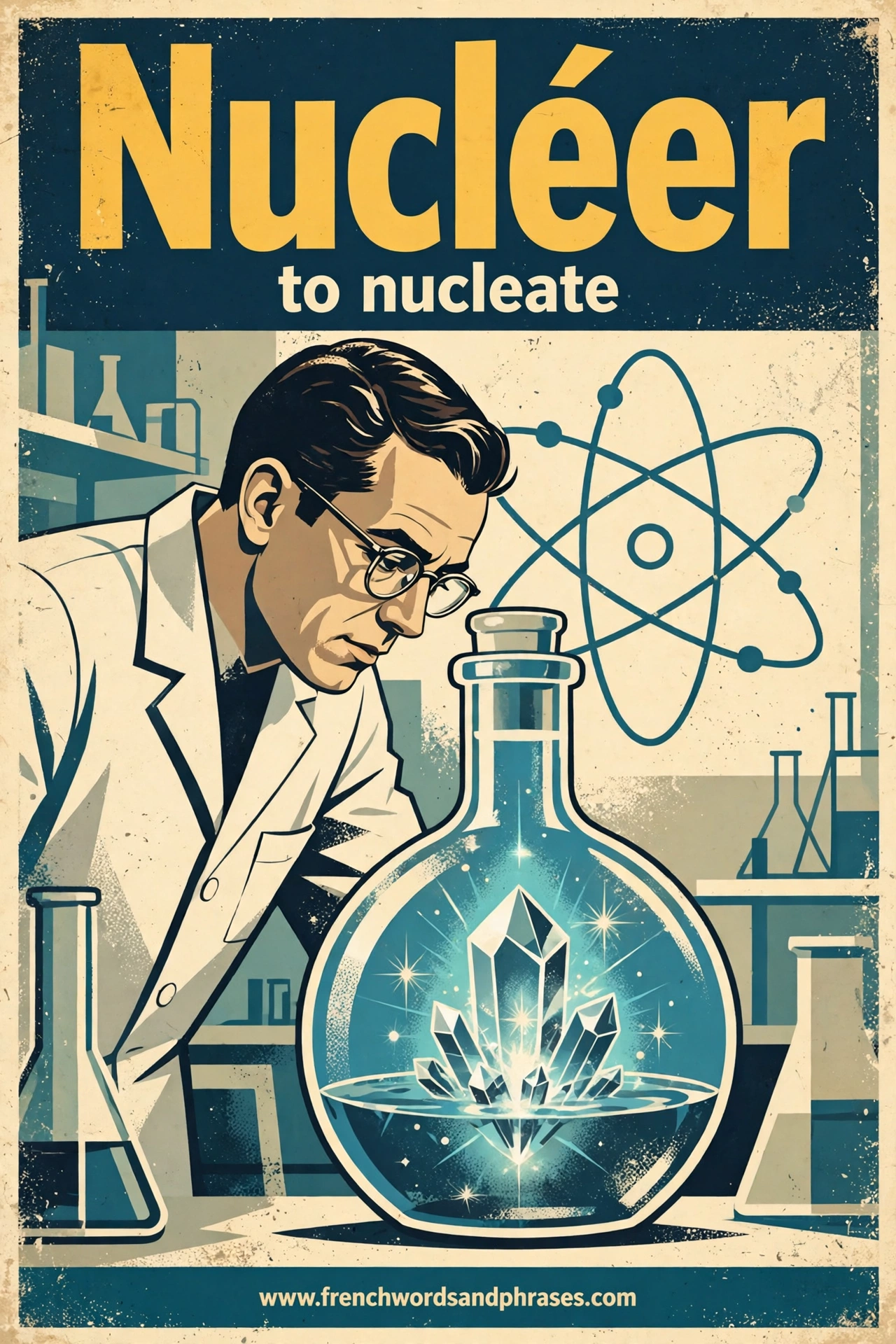
Nucléer means to nucleate — to form a tiny seed, a nucleus, around which a crystal, a droplet or a bubble can grow.
A pane of glass breathing fog on a winter morning, each droplet born around an invisible speck of dust — nucléer is the quiet scientific verb for that first seed forming, the moment a new phase of matter begins.
In this guide, you’ll learn how to conjugate nucléer in all the major French tenses and moods. Explore complete conjugation tables, French examples, English translations, and practice quizzes.
Understanding the French Verb Nucléer
Nucléer is a regular French verb belonging to the first group of verbs, those ending in -er.
It means to nucleate. It is commonly used in physics and chemistry for the birth of crystals in a solution, droplets in a vapour and bubbles in a liquid — anywhere a new phase needs a first tiny seed to grow from, and almost nowhere outside the laboratory.
Verb classification: First group (-er)
Auxiliary verb: Avoir
Past participle: nucléé
Present participle: nucléant
English equivalents: To nucleate, to form a nucleus; nucléer un cristal — to seed a crystal; la nucléation — nucleation, the forming of the first seed.
One important detail: nucléer is an -éer verb, conjugated exactly like créer: je nucléé, tu nucléés, il nucléé, nous nucléons, vous nuclééz, ils nucléent, past participle nucléé and passé simple je nucléai. The double é looks strange but is perfectly regular for this small family. Honestly, it is a rare verb: outside physics and chemistry laboratories you will almost never meet it, and even scientists often prefer the noun la nucléation.
Experience the Word
Nucléer is the verb of the first seed — nothing exists, then a speck forms, and everything gathers around it.
Imagine a chemist cooling a clear solution in a quiet laboratory. Nothing happens for a long minute — then, around a single grain of dust, the first crystal nucléé — nucleates — and within seconds the whole flask sparkles with new growth.
A whole crystal world from one speck of dust. It has nucléé — a seed has formed, and matter has followed.
How to Conjugate Nucléer: Complete French Conjugation Guide
Let’s explore every major conjugation of nucléer, beginning with the indicative mood.
How to Conjugate Nucléer in the Indicative Mood
The indicative mood is used to express facts, observations, actions, and events.
How to Conjugate Nucléer in the Present Tense (Présent)
Used for actions happening now, habitual actions, and general truths.
| Subject | Conjugation |
|---|---|
| je | nuclée |
| tu | nuclées |
| il / elle | nuclée |
| nous | nucléons |
| vous | nucléez |
| ils / elles | nucléent |
Example
Dans le liquide surfondu, les cristaux nucléent lentement.
In the supercooled liquid, the crystals nucleate slowly.
Quick Quiz 1
Complete the sentence:
Les cristaux ______ lentement dans le liquide.
Reveal the answer
nucléent
Les cristaux nucléent lentement dans le liquide.
The crystals nucleate slowly in the liquid.
How to Conjugate Nucléer in the Passé Composé
Used for completed actions in the past. Nucléer takes the auxiliary verb avoir.
| Subject | Conjugation |
|---|---|
| j’ | ai nucléé |
| tu | as nucléé |
| il / elle | a nucléé |
| nous | avons nucléé |
| vous | avez nucléé |
| ils / elles | ont nucléé |
Example
Les gouttelettes ont nucléé autour des poussières de l’air.
The droplets nucleated around the dust particles in the air.
How to Conjugate Nucléer in the Imparfait (Imperfect Tense)
Used for habitual past actions, descriptions, and ongoing situations in the past.
| Subject | Conjugation |
|---|---|
| je | nucléais |
| tu | nucléais |
| il / elle | nucléait |
| nous | nucléions |
| vous | nucléiez |
| ils / elles | nucléaient |
Example
La vapeur nucléait sur les parois froides du ballon.
The vapour used to nucleate on the cold walls of the flask.
Quick Quiz 2
Choose the correct form:
The droplets nucleated around the dust.
Les gouttelettes ______ autour de la poussière. (ont nucléé / sont nucléées)
Reveal the answer
ont nucléé
Les gouttelettes ont nucléé autour de la poussière.
Nucléer takes avoir.
How to Conjugate Nucléer in the Plus-que-parfait
Used to describe an action that had already been completed before another past event.
| Subject | Conjugation |
|---|---|
| j’ | avais nucléé |
| tu | avais nucléé |
| il / elle | avait nucléé |
| nous | avions nucléé |
| vous | aviez nucléé |
| ils / elles | avaient nucléé |
Example
Les premiers cristaux avaient nucléé dès la première heure.
The first crystals had nucleated within the first hour.
How to Conjugate Nucléer in the Passé Simple
Primarily used in formal writing, literature, and historical narratives. It is rarely used in everyday conversation.
| Subject | Conjugation |
|---|---|
| je | nucléai |
| tu | nucléas |
| il / elle | nucléa |
| nous | nucléâmes |
| vous | nucléâtes |
| ils / elles | nucléèrent |
Example
Au contact du grain de poussière, la goutte nucléa aussitôt.
On contact with the grain of dust, the droplet nucleated at once.
How to Conjugate Nucléer in the Passé Antérieur
A literary tense used to express an action completed immediately before another past action, generally in the passé simple.
| Subject | Conjugation |
|---|---|
| j’ | eus nucléé |
| tu | eus nucléé |
| il / elle | eut nucléé |
| nous | eûmes nucléé |
| vous | eûtes nucléé |
| ils / elles | eurent nucléé |
Example
Quand la solution eut nucléé, les cristaux grandirent rapidement.
When the solution had nucleated, the crystals grew quickly.
How to Conjugate Nucléer in the Future Tense (Futur Simple)
Used to describe actions that will take place in the future.
| Subject | Conjugation |
|---|---|
| je | nucléerai |
| tu | nucléeras |
| il / elle | nucléera |
| nous | nucléerons |
| vous | nucléerez |
| ils / elles | nucléeront |
Example
Sans impuretés, le liquide ne nucléera pas facilement.
Without impurities, the liquid will not nucleate easily.
How to Conjugate Nucléer in the Futur Antérieur (Future Perfect)
Used for an action that will have been completed before a particular point in the future.
| Subject | Conjugation |
|---|---|
| j’ | aurai nucléé |
| tu | auras nucléé |
| il / elle | aura nucléé |
| nous | aurons nucléé |
| vous | aurez nucléé |
| ils / elles | auront nucléé |
Example
À cette température, les bulles auront nucléé partout dans le liquide.
At this temperature, the bubbles will have nucleated everywhere in the liquid.
How to Conjugate Nucléer in the Near Future (Futur Proche)
Used to describe something that is going to happen soon. Formed with aller + infinitive.
| Subject | Conjugation |
|---|---|
| je | vais nucléer |
| tu | vas nucléer |
| il / elle | va nucléer |
| nous | allons nucléer |
| vous | allez nucléer |
| ils / elles | vont nucléer |
Example
Regardez la vitre : la glace va nucléer dans un instant.
Look at the windowpane: the ice is going to nucleate in a moment.
How to Conjugate Nucléer in the Conditional Mood
The conditional mood expresses what would happen under certain circumstances. It is also frequently used to make polite requests or express wishes.
How to Conjugate Nucléer in the Present Conditional
| Subject | Conjugation |
|---|---|
| je | nucléerais |
| tu | nucléerais |
| il / elle | nucléerait |
| nous | nucléerions |
| vous | nucléeriez |
| ils / elles | nucléeraient |
Example
Avec un germe de cristal, la solution nucléerait beaucoup plus vite.
With a seed crystal, the solution would nucleate much faster.
How to Conjugate Nucléer in the Past Conditional
| Subject | Conjugation |
|---|---|
| j’ | aurais nucléé |
| tu | aurais nucléé |
| il / elle | aurait nucléé |
| nous | aurions nucléé |
| vous | auriez nucléé |
| ils / elles | auraient nucléé |
Example
Le mélange aurait nucléé si on l’avait refroidi brusquement.
The mixture would have nucleated if it had been cooled suddenly.
Nucléer in the Literary Past Conditional Form
This less common literary form uses the imperfect subjunctive of avoir.
| Subject | Conjugation |
|---|---|
| j’ | eusse nucléé |
| tu | eusses nucléé |
| il / elle | eût nucléé |
| nous | eussions nucléé |
| vous | eussiez nucléé |
| ils / elles | eussent nucléé |
Example
Le cristal eût nucléé sans ce retard de quelques secondes.
The crystal would have nucleated without that delay of a few seconds.
How to Conjugate Nucléer in the Subjunctive Mood
The subjunctive is used to express wishes, emotions, doubts, necessity, and uncertainty. It frequently follows expressions such as il faut que (it is necessary that) or bien que (although).
How to Conjugate Nucléer in the Present Subjunctive
| Subject | Conjugation |
|---|---|
| que je | nuclée |
| que tu | nuclées |
| qu’il / qu’elle | nuclée |
| que nous | nucléions |
| que vous | nucléiez |
| qu’ils / qu’elles | nucléent |
Example
Il faut que les gouttelettes nucléent autour d’un noyau.
The droplets must nucleate around a nucleus.
Quick Quiz 3
Complete the sentence using the subjunctive:
Il faut que la glace ______ sur la vitre.
Reveal the answer
nucléé
Il faut que la glace nucléé sur la vitre.
The ice must nucleate on the windowpane.
How to Conjugate Nucléer in the Imperfect Subjunctive
A literary tense, rarely encountered in modern spoken French.
| Subject | Conjugation |
|---|---|
| que je | nucléasse |
| que tu | nucléasses |
| qu’il / qu’elle | nucléât |
| que nous | nucléassions |
| que vous | nucléassiez |
| qu’ils / qu’elles | nucléassent |
Example
Le professeur doutait que le liquide nucléât si vite.
The teacher doubted that the liquid would nucleate so quickly.
How to Conjugate Nucléer in the Pluperfect Subjunctive
A literary construction used to express an action completed before another past action.
| Subject | Conjugation |
|---|---|
| que j’ | eusse nucléé |
| que tu | eusses nucléé |
| qu’il / qu’elle | eût nucléé |
| que nous | eussions nucléé |
| que vous | eussiez nucléé |
| qu’ils / qu’elles | eussent nucléé |
Example
Il semblait que les bulles eussent nucléé avant même l’ébullition.
It seemed that the bubbles had nucleated even before boiling point.
How to Conjugate Nucléer in the Past Subjunctive
| Subject | Conjugation |
|---|---|
| que j’ | aie nucléé |
| que tu | aies nucléé |
| qu’il / qu’elle | ait nucléé |
| que nous | ayons nucléé |
| que vous | ayez nucléé |
| qu’ils / elles | aient nucléé |
Example
Je suis étonné que la glace ait nucléé si tôt ce matin.
I am surprised that the ice nucleated so early this morning.
How to Conjugate Nucléer in the Imperative
The imperative is used to give commands, instructions, invitations, or suggestions. Subject pronouns are omitted.
How to Conjugate Nucléer in the Present Imperative
| Person | Conjugation |
|---|---|
| (tu) | nuclée |
| (nous) | nucléons |
| (vous) | nucléez |
Example
Nucléons la solution avec un cristal témoin, puis observons.
Let us nucleate the solution with a seed crystal, then observe.
Quick Quiz 4
How would you say Nucleate the solution with a seed crystal (vous form)?
Reveal the answer
Nuclééz la solution avec un cristal témoin !
French Participles of Nucléer
Participles are verb forms that can be used in compound tenses and other grammatical constructions.
Present Participle of Nucléer
nucléant
En nucléant sur la poussière, la vapeur forme des gouttelettes.
By nucleating on the dust, the vapour forms droplets.
Past Participle of Nucléer
nucléé
Nucléés sur un grain de sel, les cristaux forment une couronne.
Nucleated on a grain of salt, the crystals form a crown.
Nucléer in Everyday French: Real-Life Examples
Now that you know the conjugations, let’s see how nucléer appears in everyday French.
Example 1 — Present
Les cristaux nucléent autour des impuretés.
The crystals nucleate around the impurities.
Example 2 — Passé composé
La glace a nucléé sur la vitre pendant la nuit.
The ice nucleated on the windowpane during the night.
Example 3 — Imparfait
La vapeur nucléait sur les parois froides.
The vapour used to nucleate on the cold walls.
Example 4 — Future
Le liquide nucléera dès qu’il sera surfondu.
The liquid will nucleate as soon as it is supercooled.
Example 5 — Conditional
Avec un germe, tout nucléerait plus vite.
With a seed, everything would nucleate faster.
Example 6 — Imperative
Nuclééz la solution avec un cristal témoin !
Nucleate the solution with a seed crystal!
Beyond Translation: The Meaning of Nucléer
English borrowed nucleate from the same Latin root, nucleus, a little nut or kernel; French nucléer builds its verb from the same learned stock.
It is a laboratory word, and it knows it.
You will read it in papers on crystals, clouds and boiling liquids — and almost nowhere else. Knowing it marks you as someone who reads French science, not just French novels.
How to Remember the French Verb Nucléer
Remember it this way: Nucléer is about the first tiny seed a crystal grows from.
- Nucléer conjugates like créer: je nucléé, nous nucléons, past participle nucléé.
- La nucléation — nucleation: the birth of a crystal, droplet or bubble around a seed.
- A rare, scientific verb — crystals, droplets and bubbles are its whole world.
The key idea is the first tiny seed a crystal grows from.
Test Your Knowledge of Nucléer
Let’s see how much you’ve learned. Try answering these questions before revealing the answers.
Question 1
How do you say The crystals nucleate slowly in French?
Reveal the answer
Les cristaux nucléent lentement.
Question 2
What is the past participle of nucléer?
Reveal the answer
Nucléé — the same shape as créé, the participle of créer.
Question 3
Translate: The droplets nucleated around the dust.
Reveal the answer
Les gouttelettes ont nucléé autour de la poussière.
Question 4
Complete the sentence:
Il faut que les gouttelettes ______ autour d’un noyau.
Reveal the answer
nucléent
Il faut que les gouttelettes nucléent autour d’un noyau.
The droplets must nucleate around a nucleus.
Question 5
Which common verb is nucléer conjugated exactly like?
Reveal the answer
Créer — both are -éer verbs: je nucléé, nous nucléons, je nucléai.
Your Final Challenge
Can You Use It?
How would you say this in French?
In the silent flask, the crystals nucleate one by one, and the solution becomes a constellation.
Reveal the answer
Dans le ballon silencieux, les cristaux nucléent un à un, et la solution devient une constellation.
In the silent flask, the crystals nucleate one by one, and the solution becomes a constellation.
A little French. A little curiosity. A richer everyday life.
LEARN FRENCH ONE WORD AT A TIME