
A French Word to Live By
How to Conjugate Nourrir in French
/nu.ʁiʁ/
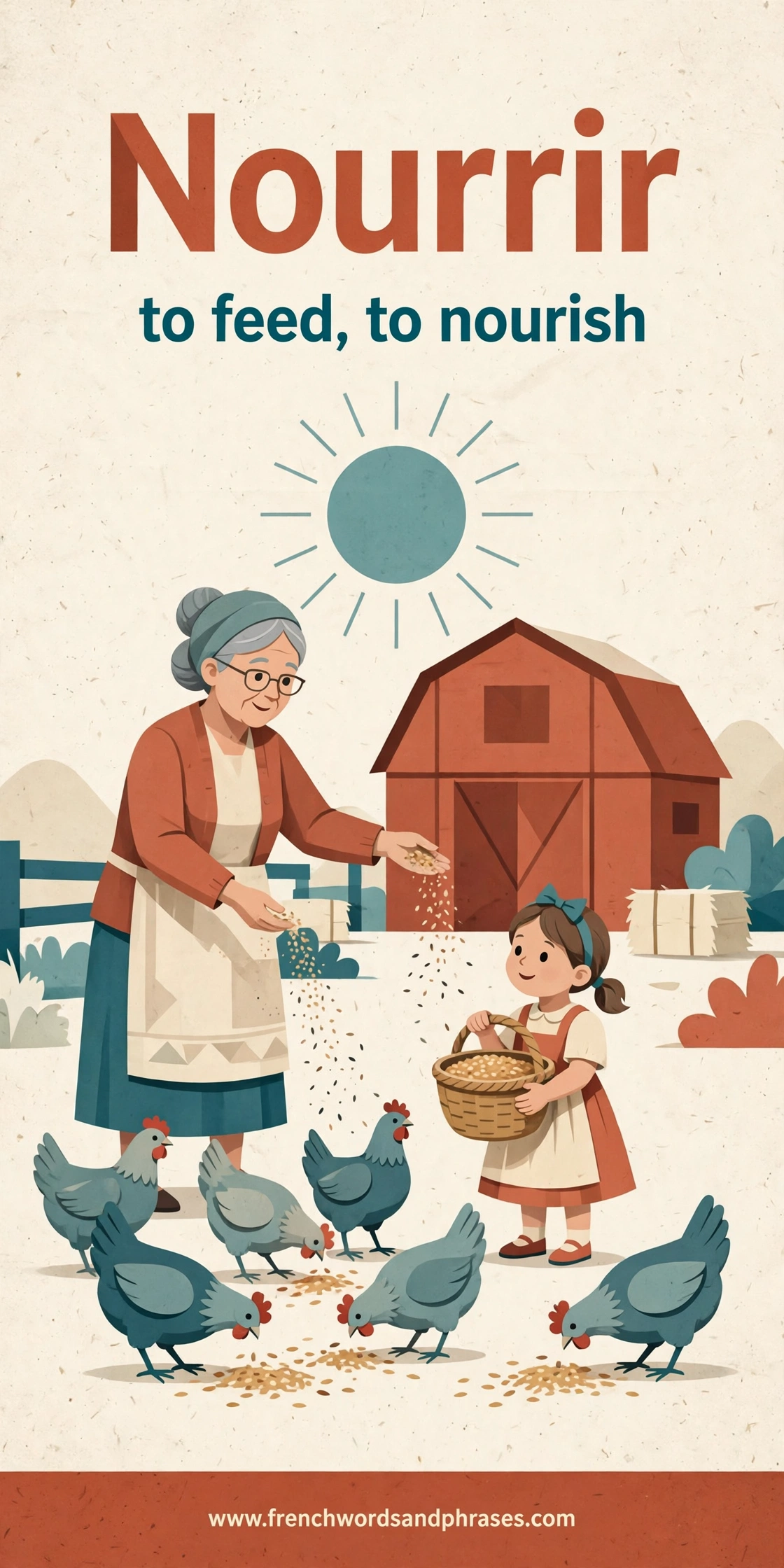
Nourrir means to feed or to nourish.
A mother bird dropping food into open beaks, bread broken and shared at a crowded table, a garden feeding a whole village — nourrir is the verb of giving food, and of everything else that keeps life going.
In this guide, you’ll learn how to conjugate nourrir in all the major French tenses and moods. Explore complete conjugation tables, French examples, English translations, and practice quizzes.
Understanding the French Verb Nourrir
Nourrir is a regular French verb belonging to the second group of verbs, those ending in -ir.
It means to feed, to nourish. It is commonly used for feeding children, animals and guests, for land and gardens feeding people, and figuratively for hopes, plans, friendships and even grudges that someone keeps feeding.
Verb classification: Second group (-ir)
Auxiliary verb: Avoir
Past participle: nourri
Present participle: nourrissant
English equivalents: To feed, to nourish, to keep fed; (figurative) to foster, to cherish (a hope, a plan).
One important detail: nourrir feeds far more than stomachs. You can nourrir un espoir — feed a hope — or nourrir un projet, nurse a plan along. And creatures feed themselves with the reflexive plus de: les vaches se nourrissent d’herbe, the cows feed on grass.
Experience the Word
Nourrir is the verb of care made practical — love you can weigh in loaves, bowls and second helpings.
Imagine a farmhouse kitchen in the Auvergne at midday. The soup pot has been on since dawn, neighbours appear as if by magic, and nobody — nobody — leaves the table hungry.
You have not just cooked. You have nourished people — and that is a different thing.
How to Conjugate Nourrir: Complete French Conjugation Guide
Let’s explore every major conjugation of nourrir, beginning with the indicative mood.
How to Conjugate Nourrir in the Indicative Mood
The indicative mood is used to express facts, observations, actions, and events.
How to Conjugate Nourrir in the Present Tense (Présent)
Used for actions happening now, habitual actions, and general truths.
| Subject | Conjugation |
|---|---|
| je | nourris |
| tu | nourris |
| il / elle | nourrit |
| nous | nourrissons |
| vous | nourrissez |
| ils / elles | nourrissent |
Example
Elle nourrit les chats du quartier chaque matin.
She feeds the neighbourhood cats every morning.
Quick Quiz 1
Complete the sentence:
Nous ______ les oiseaux tout l’hiver.
Reveal the answer
nourrissons
Nous nourrissons les oiseaux tout l’hiver.
We feed the birds all winter.
How to Conjugate Nourrir in the Passé Composé
Used for completed actions in the past. Nourrir takes the auxiliary verb avoir.
| Subject | Conjugation |
|---|---|
| j’ | ai nourri |
| tu | as nourri |
| il / elle | a nourri |
| nous | avons nourri |
| vous | avez nourri |
| ils / elles | ont nourri |
Example
Nous avons nourri les oiseaux tout l’hiver.
We fed the birds all winter.
How to Conjugate Nourrir in the Imparfait (Imperfect Tense)
Used for habitual past actions, descriptions, and ongoing situations in the past.
| Subject | Conjugation |
|---|---|
| je | nourrissais |
| tu | nourrissais |
| il / elle | nourrissait |
| nous | nourrissions |
| vous | nourrissiez |
| ils / elles | nourrissaient |
Example
Ma grand-mère nourrissait tout le village pendant la guerre.
My grandmother used to feed the whole village during the war.
Quick Quiz 2
Choose the correct form:
She fed the baby.
Elle ______ le bébé. (a nourri / est nourrie)
Reveal the answer
a nourri
Elle a nourri le bébé.
Nourrir takes avoir.
How to Conjugate Nourrir in the Plus-que-parfait
Used to describe an action that had already been completed before another past event.
| Subject | Conjugation |
|---|---|
| j’ | avais nourri |
| tu | avais nourri |
| il / elle | avait nourri |
| nous | avions nourri |
| vous | aviez nourri |
| ils / elles | avaient nourri |
Example
Ils avaient nourri de grands espoirs pour ce projet.
They had cherished great hopes for this project.
How to Conjugate Nourrir in the Passé Simple
Primarily used in formal writing, literature, and historical narratives. It is rarely used in everyday conversation.
| Subject | Conjugation |
|---|---|
| je | nourris |
| tu | nourris |
| il / elle | nourrit |
| nous | nourrîmes |
| vous | nourrîtes |
| ils / elles | nourrirent |
Example
Elle nourrit ses enfants de son mieux, sans jamais se plaindre.
She fed her children as best she could, without ever complaining.
How to Conjugate Nourrir in the Passé Antérieur
A literary tense used to express an action completed immediately before another past action, generally in the passé simple.
| Subject | Conjugation |
|---|---|
| j’ | eus nourri |
| tu | eus nourri |
| il / elle | eut nourri |
| nous | eûmes nourri |
| vous | eûtes nourri |
| ils / elles | eurent nourri |
Example
Quand elle eut nourri les bêtes, elle rentra se reposer.
When she had fed the animals, she went back inside to rest.
How to Conjugate Nourrir in the Future Tense (Futur Simple)
Used to describe actions that will take place in the future.
| Subject | Conjugation |
|---|---|
| je | nourrirai |
| tu | nourriras |
| il / elle | nourrira |
| nous | nourrirons |
| vous | nourrirez |
| ils / elles | nourriront |
Example
Ce jardin nourrira toute la famille.
This garden will feed the whole family.
How to Conjugate Nourrir in the Futur Antérieur (Future Perfect)
Used for an action that will have been completed before a particular point in the future.
| Subject | Conjugation |
|---|---|
| j’ | aurai nourri |
| tu | auras nourri |
| il / elle | aura nourri |
| nous | aurons nourri |
| vous | aurez nourri |
| ils / elles | auront nourri |
Example
À midi, tu auras nourri les poules et les lapins.
By noon, you will have fed the hens and the rabbits.
How to Conjugate Nourrir in the Near Future (Futur Proche)
Used to describe something that is going to happen soon. Formed with aller + infinitive.
| Subject | Conjugation |
|---|---|
| je | vais nourrir |
| tu | vas nourrir |
| il / elle | va nourrir |
| nous | allons nourrir |
| vous | allez nourrir |
| ils / elles | vont nourrir |
Example
Je vais nourrir le bébé dans un instant.
I am going to feed the baby in a moment.
How to Conjugate Nourrir in the Conditional Mood
The conditional mood expresses what would happen under certain circumstances. It is also frequently used to make polite requests or express wishes.
How to Conjugate Nourrir in the Present Conditional
| Subject | Conjugation |
|---|---|
| je | nourrirais |
| tu | nourrirais |
| il / elle | nourrirait |
| nous | nourririons |
| vous | nourririez |
| ils / elles | nourriraient |
Example
Un seul champ nourrirait dix familles.
A single field would feed ten families.
How to Conjugate Nourrir in the Past Conditional
| Subject | Conjugation |
|---|---|
| j’ | aurais nourri |
| tu | aurais nourri |
| il / elle | aurait nourri |
| nous | aurions nourri |
| vous | auriez nourri |
| ils / elles | auraient nourri |
Example
Sans le potager, nous n’aurions pas nourri tout le monde.
Without the vegetable garden, we would not have fed everyone.
Nourrir in the Literary Past Conditional Form
This less common literary form uses the imperfect subjunctive of avoir.
| Subject | Conjugation |
|---|---|
| j’ | eusse nourri |
| tu | eusses nourri |
| il / elle | eût nourri |
| nous | eussions nourri |
| vous | eussiez nourri |
| ils / elles | eussent nourri |
Example
Elle eût nourri tout le quartier de sa seule soupe.
She would have fed the whole neighbourhood with her soup alone.
How to Conjugate Nourrir in the Subjunctive Mood
The subjunctive is used to express wishes, emotions, doubts, necessity, and uncertainty. It frequently follows expressions such as il faut que (it is necessary that) or bien que (although).
How to Conjugate Nourrir in the Present Subjunctive
| Subject | Conjugation |
|---|---|
| que je | nourrisse |
| que tu | nourrisses |
| qu’il / qu’elle | nourrisse |
| que nous | nourrissions |
| que vous | nourrissiez |
| qu’ils / qu’elles | nourrissent |
Example
Il faut que tu nourrisses le chat pendant mon absence.
You must feed the cat while I am away.
Quick Quiz 3
Complete the sentence using the subjunctive:
Il faut que vous ______ les poules.
Reveal the answer
nourrissiez
Il faut que vous nourrissiez les poules.
You must feed the hens.
How to Conjugate Nourrir in the Imperfect Subjunctive
A literary tense, rarely encountered in modern spoken French.
| Subject | Conjugation |
|---|---|
| que je | nourrisse |
| que tu | nourrisses |
| qu’il / qu’elle | nourrît |
| que nous | nourrissions |
| que vous | nourrissiez |
| qu’ils / qu’elles | nourrissent |
Example
Je voulais qu’elle nourrît mieux ses enfants.
I wanted her to feed her children better.
How to Conjugate Nourrir in the Pluperfect Subjunctive
A literary construction used to express an action completed before another past action.
| Subject | Conjugation |
|---|---|
| que j’ | eusse nourri |
| que tu | eusses nourri |
| qu’il / qu’elle | eût nourri |
| que nous | eussions nourri |
| que vous | eussiez nourri |
| qu’ils / qu’elles | eussent nourri |
Example
Il regrettait que nous n’eussions pas nourri les voyageurs.
He regretted that we had not fed the travellers.
How to Conjugate Nourrir in the Past Subjunctive
| Subject | Conjugation |
|---|---|
| que j’ | aie nourri |
| que tu | aies nourri |
| qu’il / qu’elle | ait nourri |
| que nous | ayons nourri |
| que vous | ayez nourri |
| qu’ils / qu’elles | aient nourri |
Example
Je suis heureux que tu aies nourri les oiseaux.
I am glad you fed the birds.
How to Conjugate Nourrir in the Imperative
The imperative is used to give commands, instructions, invitations, or suggestions. Subject pronouns are omitted.
How to Conjugate Nourrir in the Present Imperative
| Person | Conjugation |
|---|---|
| (tu) | nourris |
| (nous) | nourrissons |
| (vous) | nourrissez |
Example
Nourris le chien avant de partir !
Feed the dog before you leave!
Quick Quiz 4
How would you say Feed the dog (tu form)?
Reveal the answer
Nourris le chien !
French Participles of Nourrir
Participles are verb forms that can be used in compound tenses and other grammatical constructions.
Present Participle of Nourrir
nourrissant
En nourrissant les abeilles, il protège tout le jardin.
By feeding the bees, he protects the whole garden.
Past Participle of Nourrir
nourri
Nourri de lectures et de voyages, il écrivait sans cesse.
Fed on books and travel, he wrote constantly.
Nourrir in Everyday French: Real-Life Examples
Now that you know the conjugations, let’s see how nourrir appears in everyday French.
Example 1 — Present
Je nourris les chats tous les matins.
I feed the cats every morning.
Example 2 — Passé composé
Elle a nourri le bébé à midi.
She fed the baby at midday.
Example 3 — Imparfait
Autrefois, ce champ nourrissait le village.
In the old days, this field used to feed the village.
Example 4 — Future
Ce potager nourrira toute la famille.
This vegetable garden will feed the whole family.
Example 5 — Conditional
On nourrirait tout le quartier avec cette soupe.
You could feed the whole neighbourhood with this soup.
Example 6 — Imperative
Nourrissez les poules, s’il vous plaît !
Feed the hens, please!
Beyond Translation: The Meaning of Nourrir
English separates feed (practical) from nourish (grand); French lets nourrir do both, from the cat’s bowl to the poet’s hope.
Its family feeds the whole language.
La nourriture is food itself, and un nourrisson is a newborn baby — literally, a little one who is fed. French hears feeding at the very start of life.
How to Remember the French Verb Nourrir
Remember it this way: Nourrir is about feeding — stomachs, gardens and hopes.
- You can feed ideas too — nourrir un espoir, nourrir un projet.
- Creatures feed ON something with the reflexive — se nourrir de.
- Regular -ir: je nourris, nous nourrissons, past participle nourri.
The key idea is feeding — stomachs, gardens and hopes.
Test Your Knowledge of Nourrir
Let’s see how much you’ve learned. Try answering these questions before revealing the answers.
Question 1
How do you say to feed a hope with nourrir?
Reveal the answer
Nourrir un espoir — nourrir feeds hopes and plans as well as people.
Question 2
How do you say She fed the baby at midday in French?
Reveal the answer
Elle a nourri le bébé à midi.
Question 3
Translate: The cows feed on grass.
Reveal the answer
Les vaches se nourrissent d’herbe.
Question 4
What is the past participle of nourrir?
Reveal the answer
Nourri.
Question 5
Complete the sentence:
Il faut que tu ______ le chat pendant mon absence.
Reveal the answer
nourrisses
Il faut que tu nourrisses le chat pendant mon absence.
You must feed the cat while I am away.
Your Final Challenge
Can You Use It?
How would you say this in French?
A good garden feeds the family and the neighbours.
Reveal the answer
Un bon jardin nourrit la famille et les voisins.
A good garden feeds the family and the neighbours.
A little French. A little curiosity. A richer everyday life.
LEARN FRENCH ONE WORD AT A TIME




