A French Word to Live By
Translate Nœud to English
/nø/
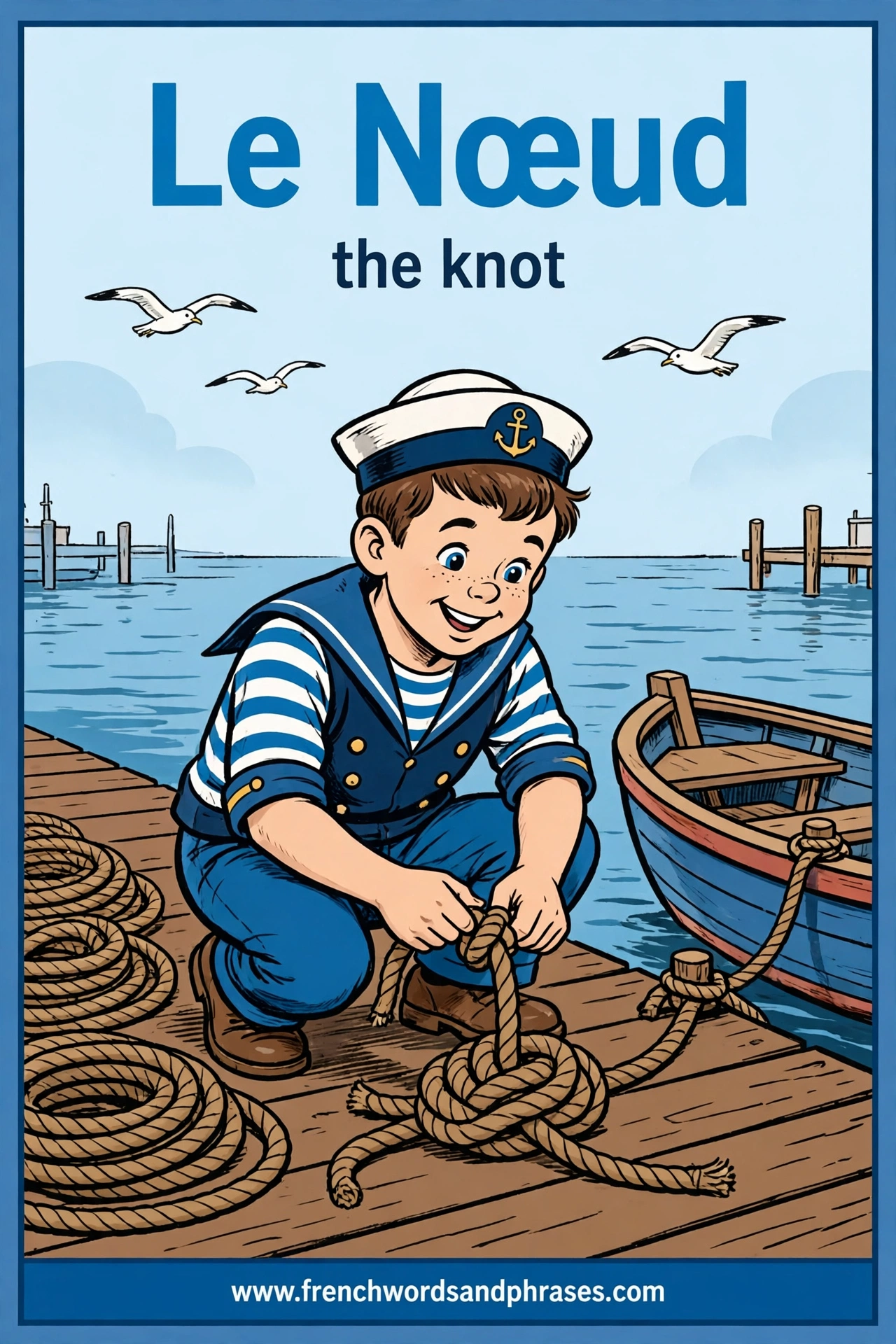
Le Nœud means the knot.
The sailing instructor holds up a rope and ties it in one smooth movement. « Un nœud bien fait ne glisse jamais. » A knot well made never slips. On boats, on shoes, on scarves and on gift parcels, France runs on this one small word: le nœud.
In this guide, you’ll learn what nœud means in English, how to use it with its articles, how to form its plural, and how it appears in everyday French. Explore French examples, English translations, and practice quizzes.
Understanding the French Noun Nœud
Nœud is a masculine French noun, learned with its article: le nœud, un nœud. It means a knot — in a rope, in your laces, in a tree’s wood. It also names the bow of a bow tie (un nœud papillon, literally a butterfly knot) and, at sea, the unit of speed: un nœud is one nautical mile per hour. The final d is silent: say /nø/.
It means the knot — the tangle you tie on purpose or undo by accident. French also uses it figuratively for the crux of a problem: le nœud du problème is the heart of the matter, the tangled point where everything is stuck. And in the theatre, le dénouement — from the same family — is the untying at the end of the plot.
Gender: Masculine — le nœud, un nœud
Definite article: le — le nœud (the knot)
Indefinite article: un — un nœud (a knot)
Plural: les nœuds
At sea: un nœud = one knot of speed (a nautical mile per hour)
English equivalents: The knot; a bow (nœud papillon)
One important usage detail: the d of nœud is never pronounced — the word sounds like « neu », /nø/. The spelling keeps the œ, the pretty ligature, in the singular and the plural: un nœud, des nœuds. And remember that un nœud papillon is not an insect — it is the bow tie you wear with a dinner jacket.
Experience the Word
Nœud is a word you learn with your fingers. Every French child masters the double nœud on school shoes; every scout learns the nœuds marins; every cook has tied un nœud in a tea towel to remember something — the famous nœud au mouchoir, the knot in the handkerchief.
At sea the word becomes a measure: the old sailors counted knots on a rope thrown overboard, and the word stayed — a ferry doing vingt nœuds is flying over the water.
You have not just learned a tangle. You have learned how French ties, remembers and measures — with one silent-d word.
How to Use Nœud in French: Complete Guide
Let’s explore how nœud works in French, beginning with its articles — from shoelaces to bow ties to the speed of ships.
Nœud with the Definite Article (Le, Les)
Masculine: le in the singular, les in the plural.
| Form | French |
|---|---|
| Singular | le nœud |
| Plural | les nœuds |
Example
Le nœud de ta cravate est de travers.
The knot of your tie is crooked.
Nœud with the Indefinite Article (Un, Des)
One knot or several — tying them is faire des nœuds.
| Form | French |
|---|---|
| Singular | un nœud |
| Plural | des nœuds |
Example
Fais un nœud bien serré, sinon ça glisse.
Tie a really tight knot, or it will slip.
Nœuds of Every Kind
Knots have names in French. These are the ones you will actually meet.
| French | In English |
|---|---|
| un nœud coulant | a slip knot, a running knot |
| un nœud papillon | a bow tie |
| un nœud marin | a sailor’s knot |
| faire un nœud | to tie a knot |
| défaire un nœud | to undo a knot |
| un double nœud | a double knot |
Example
Pour les enfants, le double nœud évite les lacets défaits.
For children, the double knot prevents undone laces.
Quick Quiz 1
A gentleman in a dinner jacket wears un nœud papillon. What is it?
Reveal the answer
A bow tie
Papillon means butterfly: the bow tie is the butterfly knot, worn at the neck — not an insect.
The Plural of Nœud
Add -s, keep the œ: des nœuds.
| Number | French |
|---|---|
| Singular | le nœud |
| Plural | les nœuds |
Example
Ses lacets sont pleins de nœuds impossibles.
His laces are full of impossible knots.
Nœud with Possessive Adjectives (Mon, Ton, Son…)
Masculine noun: mon, ton, son — even for a woman’s knot, because the possessive agrees with the thing, not the owner.
| Owner | French |
|---|---|
| my | mon nœud |
| your (tu) | ton nœud |
| his / her | son nœud |
| our | notre nœud |
| your (vous) | votre nœud |
| their | leur nœud |
Example
Elle refait son nœud papillon devant le miroir.
She redoes her bow tie in front of the mirror.
Quick Quiz 2
Complete the sentence:
Le ferry avance à vingt ______. (knots — speed)
Reveal the answer
nœuds
Le ferry avance à vingt nœuds.
At sea, un nœud is a unit of speed: one nautical mile per hour.
Nœud with Demonstrative Adjectives (Ce, Ces)
Ce for the masculine singular, ces for the plural.
| Form | French |
|---|---|
| Masculine singular | ce nœud |
| Plural | ces nœuds |
Example
Ce nœud-là, je n’arrive jamais à le défaire.
That knot there, I can never manage to undo it.
Nœud with Adjectives
Knots are judged by how they hold: serré is the compliment.
| Adjective | With Nœud |
|---|---|
| serré (tight) | un nœud serré |
| double (double) | un double nœud |
| petit (small) | un petit nœud |
| gros (big) | un gros nœud |
Example
Un nœud serré vaut mieux qu’un long discours.
A tight knot is worth more than a long speech.
Quick Quiz 3
How is nœud pronounced — with or without the final d?
Reveal the answer
Without the d — /nø/, like « neu ».
The d is written but silent, in the singular and in the plural: un nœud, des nœuds.
Everyday Expressions with Nœud
Knots for remembering, for worrying, and for getting to the heart of a problem.
| Expression | In English |
|---|---|
| faire un nœud à son mouchoir | to tie a knot in one’s handkerchief (to remember) |
| le nœud du problème | the crux of the problem |
| avoir un nœud à l’estomac | to have a knot in one’s stomach |
| un nœud ferroviaire | a railway junction |
| se faire des nœuds au cerveau | to tie oneself in knots, to overthink |
Example
Avant les téléphones, on faisait un nœud à son mouchoir pour se souvenir.
Before phones, people tied a knot in their handkerchief to remember.
Words from the Same Family as Nœud
Tying and untying — the family even gives French its word for the end of a plot.
| French | In English |
|---|---|
| nouer | to tie, to knot |
| dénouer | to untie, to unravel |
| le dénouement | the outcome, the resolution (of a story) |
| renouer | to renew, to resume (ties, contact) |
| noueux | gnarled (of wood) |
Example
Le dénouement du roman a surpris tous les lecteurs.
The outcome of the novel surprised all the readers.
Quick Quiz 4
What is le dénouement of a novel?
Reveal the answer
Its outcome — the untying of the plot.
From dénouer, to untie: the dénouement is the moment when all the knots of the story come undone.
Nœud in Everyday French: Real-Life Examples
Now that you know the word, let’s see how nœud appears in everyday French.
Example 1 — Shoelaces
Mon fils fait un double nœud pour ne pas perdre ses lacets.
My son ties a double knot so as not to lose his laces.
Example 2 — On the boat
Le marin vérifie chaque nœud avant de partir.
The sailor checks every knot before leaving.
Example 3 — Remembering
Fais un nœud à ton mouchoir, sinon tu vas oublier le pain.
Tie a knot in your handkerchief, or you will forget the bread.
Example 4 — Evening dress
Son nœud papillon noir va très bien avec sa chemise blanche.
His black bow tie goes very well with his white shirt.
Example 5 — A hard problem
Le nœud du problème, c’est le budget.
The crux of the problem is the budget.
Example 6 — Nerves
Avant l’examen, elle a un nœud à l’estomac.
Before the exam, she has a knot in her stomach.
Beyond Translation: The Meaning of Nœud
Nœud is one of French’s prettiest spellings: the œ, two letters married into one, sits in the middle of the word like the knot itself. The word also shows how French thinks in images — a problem has a knot at its centre, a story is untied at its end, and memory itself was once a knot in a handkerchief. Sailors gave the word to the whole world: English « knot » for speed is the same idea, counted on the same ropes.
To learn nœud is to learn that French ties ideas the way sailors tie ropes.
Just remember the silent d — and that a butterfly at a gentleman’s throat is a bow tie.
How to Remember the French Noun Nœud
Remember it this way: Nœud looks like what it is: two letters tied together in the œ, and a silent d at the end like the loose end of the rope.
- You tie your shoes — un nœud, then a double nœud for luck.
- You dress for the gala — un nœud papillon, the butterfly at your throat.
- You cross the Channel — the ferry flies at vingt nœuds.
The key idea is le nœud — the knot with the silent d.
Test Your Knowledge of Nœud
Let’s see how much you’ve learned. Try answering these questions before revealing the answers.
Question 1
What does nœud mean?
Reveal the answer
A knot — and also a bow (tie) and, at sea, a unit of speed.
Question 2
Is nœud masculine or feminine?
Reveal the answer
Masculine — le nœud, un nœud.
Question 3
How do you pronounce the end of nœud?
Reveal the answer
The d is silent — the word sounds like /nø/, « neu ».
Question 4
What is un nœud papillon?
Reveal the answer
A bow tie — literally, a butterfly knot.
Question 5
Translate: Tie a knot in your handkerchief.
Reveal the answer
Fais un nœud à ton mouchoir.
Your Final Challenge
Can You Use It?
How would you say this in French?
“Tie a knot in your handkerchief.”
Reveal the answer
Fais un nœud à ton mouchoir.
Tie a knot in your handkerchief.
A little French. A little curiosity. A richer everyday life.
LEARN FRENCH ONE WORD AT A TIME