A French Word to Live By
Translate Ne pas être sorti de l’auberge to English
/nə pɑ.z‿ɛtʁ sɔʁ.ti də lo.bɛʁʒ/
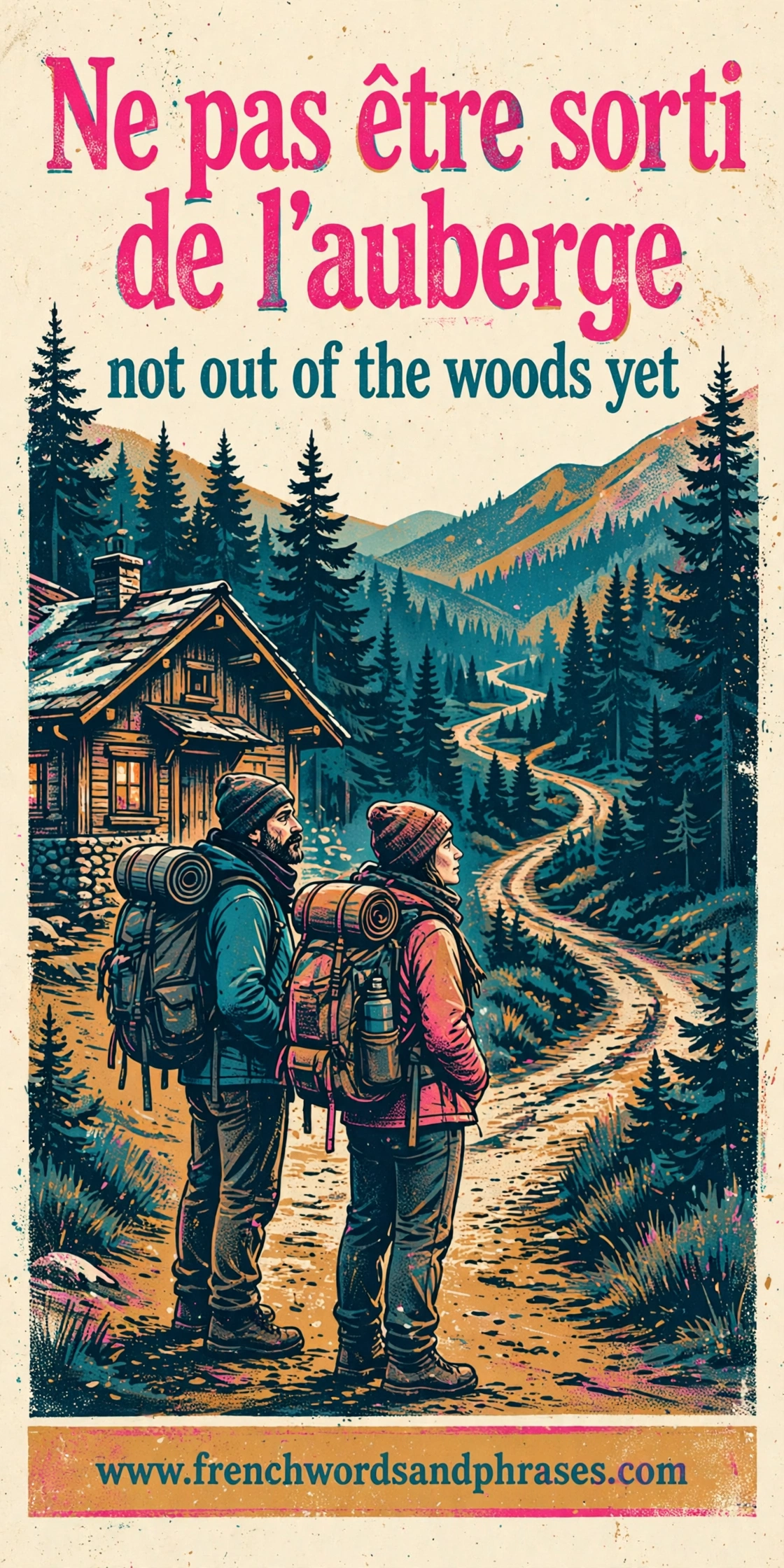
Ne pas être sorti de l’auberge means to not be out of the woods yet.
The builders were supposed to finish in June. It is now September, the kitchen is a building site, and the quote has just doubled. Your neighbour shakes his head over the fence: « Vous n’êtes pas sortis de l’auberge. » You are not out of the inn yet — not by a long way.
Let’s explore how ne pas être sorti de l’auberge works in French, beginning with the whole phrase on one card.
Understanding the French Phrase Ne pas être sorti de l’auberge
Ne pas être sorti de l’auberge is a French idiom built from the negative ne…pas, the verb être sorti (to have gone out, to have left) and the noun l’auberge (the inn). It lives in the negative: it says that someone’s troubles are far from over.
It means to not be out of the woods yet — to still be in the middle of a difficult, complicated situation with no end in sight. The old inn of the picture was a place travellers could be stuck for days: bad weather, no money, debts to the innkeeper. To still be at the inn was to still be in trouble, and the idiom has kept that sigh ever since.
Type: Idiom — negative state phrase (ne pas être sorti de…)
Answers the need: Warning that the trouble is far from over
Register: Informal to neutral — everyday spoken French, rueful tone
Strength: Medium — a warning, often delivered with a sigh or a laugh
Never drop the negative: the whole idiom is the not. The participle sorti agrees with the subject — elle n’est pas sortie de l’auberge, nous ne sommes pas sortis de l’auberge. In relaxed speech the ne often disappears, leaving pas sorti de l’auberge, but the pas always stays.
Experience the Word
Ne pas être sorti de l’auberge is the soundtrack of renovations, tax files, broken cars and long recoveries — anywhere hope meets paperwork.
Imagine a young couple who bought a charming old house. First the roof, then the wiring, then a wall that turns out to be load-bearing in the worst possible way. Each discovery is met with the same family chorus: on n’est pas sortis de l’auberge !
The idiom is a warning, but a companionable one. It says: settle in, order another coffee — this story is not finished, and you are not alone in it.
How to Use Ne pas être sorti de l’auberge in French: Complete Guide
Let’s explore how ne pas être sorti de l’auberge works in French, beginning with the whole phrase on one card.
Ne pas être sorti de l’auberge at a Glance
The Whole Phrase on One Card
Real meaning, literal building blocks, English twin and register — ne pas être sorti de l’auberge in five lines.
| Point | Ne pas être sorti de l’auberge |
|---|---|
| What it really means | to not be out of the woods yet — the troubles are far from over |
| Word for word | to not have left the inn (sorti = gone out, l’auberge = the inn) |
| English equivalent | not out of the woods yet / nowhere near done |
| Register | informal to neutral — rueful, often funny in hindsight |
| Use it for | renovations, paperwork, repairs, recoveries that keep extending |
Example
Avec cette voiture, on n’est pas sortis de l’auberge : après le moteur, les freins !
With this car, we’re not out of the woods: after the engine, the brakes!
Word by Word: Building the Inn
Five building blocks — and the negative pair does the heavy lifting.
| Word | Literal meaning | Its job in the phrase |
|---|---|---|
| ne… pas | not | the negative pair — the heart of the idiom; without it, the meaning flips |
| être | to be | the auxiliary of sortir in the past — and the state verb of the whole phrase |
| sorti | gone out, left | the past participle of sortir — agreed with the subject: sorti, sortie, sortis, sorties |
| de | from, out of | the exit preposition — out of the inn, out of the trouble |
| l’auberge | the inn | the old traveller’s inn: shelter, bills and delays all in one building |
Example
Elle n’est pas sortie de l’auberge avec ce dossier.
She’s not out of the woods with that file.
Quick Quiz 1
What happens to the meaning if you drop the ne… pas?
Reveal the answer
It flips completely — être sorti de l’auberge would mean the trouble is over. The idiom lives in its negative.
On n’est pas sortis de l’auberge, il reste trois formulaires.
We’re not out of the woods, there are three forms left.
When You Say It: The Trouble That Stays
Ne pas être sorti de l’auberge is said mid-crisis — when one problem solves itself and two more walk in.
| Situation | Example |
|---|---|
| A renovation running late | les travaux devaient finir en juin, on n’est pas sortis de l’auberge — the work was due in June; we’re not out of the woods |
| An administrative file | avec toute cette paperasse, tu n’es pas sorti de l’auberge — with all this paperwork, you’re not out of the woods |
| A car that keeps breaking | d’abord la batterie, maintenant l’alternateur : il n’est pas sorti de l’auberge — first the battery, now the alternator: he’s not out of the woods |
| A long recovery | l’opération s’est bien passée, mais elle n’est pas sortie de l’auberge — the operation went well, but she’s not out of the woods yet |
| Warning a friend | si tu signes ce contrat, tu n’es pas sorti de l’auberge — if you sign that contract, you’ll be in it for a long time |
Example
Le plombier a trouvé une deuxième fuite : on n’est pas sortis de l’auberge.
The plumber found a second leak: we’re not out of the woods.
Make It Yours: Every Person, Still at the Inn
The negative never leaves, but the subject and the agreement move — sorti, sortie, sortis, sorties.
| Form | French | In English |
|---|---|---|
| About yourself | je ne suis pas sorti(e) de l’auberge | I’m not out of the woods |
| To a friend (tu) | tu n’es pas sorti de l’auberge | you’re not out of the woods |
| About a woman | elle n’est pas sortie de l’auberge | she’s not out of the woods |
| About a group | nous ne sommes pas sortis de l’auberge | we’re not out of the woods |
| Future warning | on ne sera pas sortis de l’auberge avant Noël | we won’t be out of the woods before Christmas |
| Relaxed speech | pas sortis de l’auberge, les pauvres ! | not out of the woods, poor things! (ne dropped, pas kept) |
Example
Tu crois que c’est fini ? Tu n’es pas sorti de l’auberge, mon ami.
You think it’s over? You’re not out of the woods, my friend.
Quick Quiz 2
How do you say ‘We are not out of the woods’ to your partner, mid-renovation?
Reveal the answer
On n’est pas sortis de l’auberge — or, with nous: nous ne sommes pas sortis de l’auberge.
Encore une fuite ? On n’est pas sortis de l’auberge.
Another leak? We’re not out of the woods.
Everyday Expressions: Frames Built on the Inn
The idiom slots into these everyday frames — each one keeps its negative, as it must.
| Frame | In English |
|---|---|
| on n’est pas sortis de l’auberge ! | we’re not out of the woods! (the classic cry) |
| tu n’es pas sorti de l’auberge avec… | you’re in for a long ride with… |
| si ça continue, on n’est pas sortis de l’auberge | if this goes on, we’ll never be done |
| je ne suis pas sorti de l’auberge avec ce dossier | this file is nowhere near finished |
| ils ne sont pas sortis de l’auberge, les pauvres | they’ve got a long road ahead, poor things |
Example
Si la pluie continue, les maçons ne sont pas sortis de l’auberge.
If the rain keeps up, the builders are in for a long job.
Close Cousins: The Other Long Roads
French has several ways to say the trouble continues — this idiom is the most picturesque; its cousins differ in colour and register.
| Expression | The difference |
|---|---|
| ne pas être sorti de l’auberge | the idiom itself — still at the inn, trouble ongoing, rueful humour |
| ne pas être au bout de ses peines | not to be at the end of your sorrows — the closest cousin, slightly more literary |
| être loin d’en avoir fini | to be far from finished — plain and neutral, no picture |
| être dans le pétrin | to be in a mess, in the kneading trough — informal; the trouble is now, not just long |
| ce n’est pas gagné | it’s not in the bag — informal; the outcome is still uncertain |
Example
Entre la paperasse et les travaux, ils ne sont au bout ni de leurs peines, ni de l’auberge.
Between the paperwork and the building work, they’re at the end of neither their sorrows nor the inn.
Quick Quiz 3
Which cousin literally says you are not at the end of your sorrows?
Reveal the answer
Ne pas être au bout de ses peines — the closest cousin, a touch more literary.
Avec cette maladie, elle n’est pas au bout de ses peines.
With this illness, her troubles are far from over.
Ne pas être sorti de l’auberge and Its Neighbours
The trouble-and-tunnel family around the idiom — including the hopeful exits.
| French | In English |
|---|---|
| voir le bout du tunnel | to see the light at the end of the tunnel — hope, at last |
| être sorti d’affaire | to be out of trouble, in the clear — the happy ending |
| être tiré d’affaire | to be out of the woods, rescued from a fix — the positive twin |
| c’est dans la poche | it’s in the bag — the opposite mood entirely |
| en voir de toutes les couleurs | to go through a lot, to have a rough time of it |
Example
On ne voit pas encore le bout du tunnel, mais on avance.
We can’t see the light at the end of the tunnel yet, but we’re moving.
Watch Out: The Traps Around Ne pas être sorti de l’auberge
The traps: dropping the negative, missing the agreement, and booking a room at the wrong inn.
| Trap | The truth |
|---|---|
| dropping the negative | the idiom only exists as a negative — the positive form means the opposite and is barely used |
| forgetting the agreement | sorti agrees with the subject: sortie for a woman, sortis for a group — elle n’est pas sortie de l’auberge |
| auberge is not just a youth hostel | une auberge is an inn; auberge de jeunesse is the youth hostel — the idiom’s inn is the old traveller’s kind |
| pronouncing the z | pas être links with a z sound: pas-z-être — French ears expect the liaison in careful speech |
Example
Elle n’est pas sortie de l’auberge — sortie prend un e, parce que c’est d’elle qu’on parle.
She’s not out of the woods — sortie takes an e, because she is the one we mean.
Quick Quiz 4
True or false: in relaxed speech, French speakers may drop the pas but keep the ne.
Reveal the answer
False — it is the ne that disappears in relaxed speech; the pas always stays, because the negative carries the idiom.
T’es pas sorti de l’auberge, toi !
You’re not out of the woods, you!
Ne pas être sorti de l’auberge in Everyday French: Real-Life Examples
Now that you know the word, let’s see how ne pas être sorti de l’auberge appears in everyday French.
Example 1 — The endless renovation
Trois mois de retard : on n’est pas sortis de l’auberge.
Three months behind schedule: we’re not out of the woods.
Example 2 — The tax file
Avec ce contrôle fiscal, elle n’est pas sortie de l’auberge.
With this tax audit, she’s not out of the woods.
Example 3 — The old car
Après le moteur, la boîte de vitesses : il n’est pas sorti de l’auberge.
After the engine, the gearbox: he’s not out of the woods.
Example 4 — The thesis
Les corrections n’en finissent pas, je ne suis pas sorti de l’auberge.
The corrections never end, I’m not out of the woods.
Example 5 — The move
Entre les cartons et les démarches, nous ne sommes pas sortis de l’auberge.
Between the boxes and the admin, we’re not out of the woods.
Example 6 — The warning
Si tu commences ce jeu, tu n’es pas sorti de l’auberge !
If you start that game, you’ll be at it forever!
Beyond Translation: The Meaning of Ne pas être sorti de l’auberge
The inn was once the traveller’s whole world: bed, stable, dinner, and a bill that grew with every day of bad weather. To be stuck at the inn was to watch your money and your plans dissolve together, far from home.
Ne pas être sorti de l’auberge measures trouble in nights, not minutes — it is the idiom of the long middle of a problem.
English reaches for the woods, French for the inn: one lost among trees, the other stuck among strangers. Both agree on the essential — the exit is not yet in sight.
How to Remember the French Phrase Ne pas être sorti de l’auberge
Remember it this way: Picture a traveller at a creaky old inn, rain hammering the windows, the innkeeper adding another night to the bill — the road home is not for today.
- You keep the negative welded on — the idiom is the not; lose it and the meaning escapes.
- You agree sorti with the traveller — sortie, sortis, sorties, one per guest.
- You hear the sigh in it — this is said mid-trouble, coffee in hand, not at the victory party.
The key idea is ne pas être sorti de l’auberge means not out of the woods yet — still stuck at the inn of your troubles.
Test Your Knowledge of Ne pas être sorti de l’auberge
Let’s see how much you’ve learned. Try answering these questions before revealing the answers.
Question 1
What does ne pas être sorti de l’auberge mean?
Reveal the answer
To not be out of the woods yet — the troubles are far from over.
Question 2
Translate: We’re not out of the woods with this house.
Reveal the answer
On n’est pas sortis de l’auberge avec cette maison.
Question 3
Which part of the phrase can never be dropped?
Reveal the answer
The negative pas — in relaxed speech the ne may go, but pas carries the idiom.
Question 4
Complete the sentence:
Elle n’est pas ______ de l’auberge. (She is not out of the woods.)
Reveal the answer
sortie
Elle n’est pas sortie de l’auberge.
She is not out of the woods.
Question 5
Which neighbour phrase means the hopeful opposite — the light at the end of the tunnel?
Reveal the answer
voir le bout du tunnel — to see the end of the tunnel.
Your Final Challenge
Can You Use It?
How would you say this in French?
“With all this paperwork, we are not out of the woods yet.”
Reveal the answer
Avec toute cette paperasse, on n’est pas sortis de l’auberge.
With all this paperwork, we are not out of the woods yet.
A little French. A little curiosity. A richer everyday life.
LEARN FRENCH ONE WORD AT A TIME