A French Word to Live By
Translate Ne pas être né de la dernière pluie to English
/nə pa.z‿ɛtʁ ne də la dɛʁ.njɛʁ plɥi/
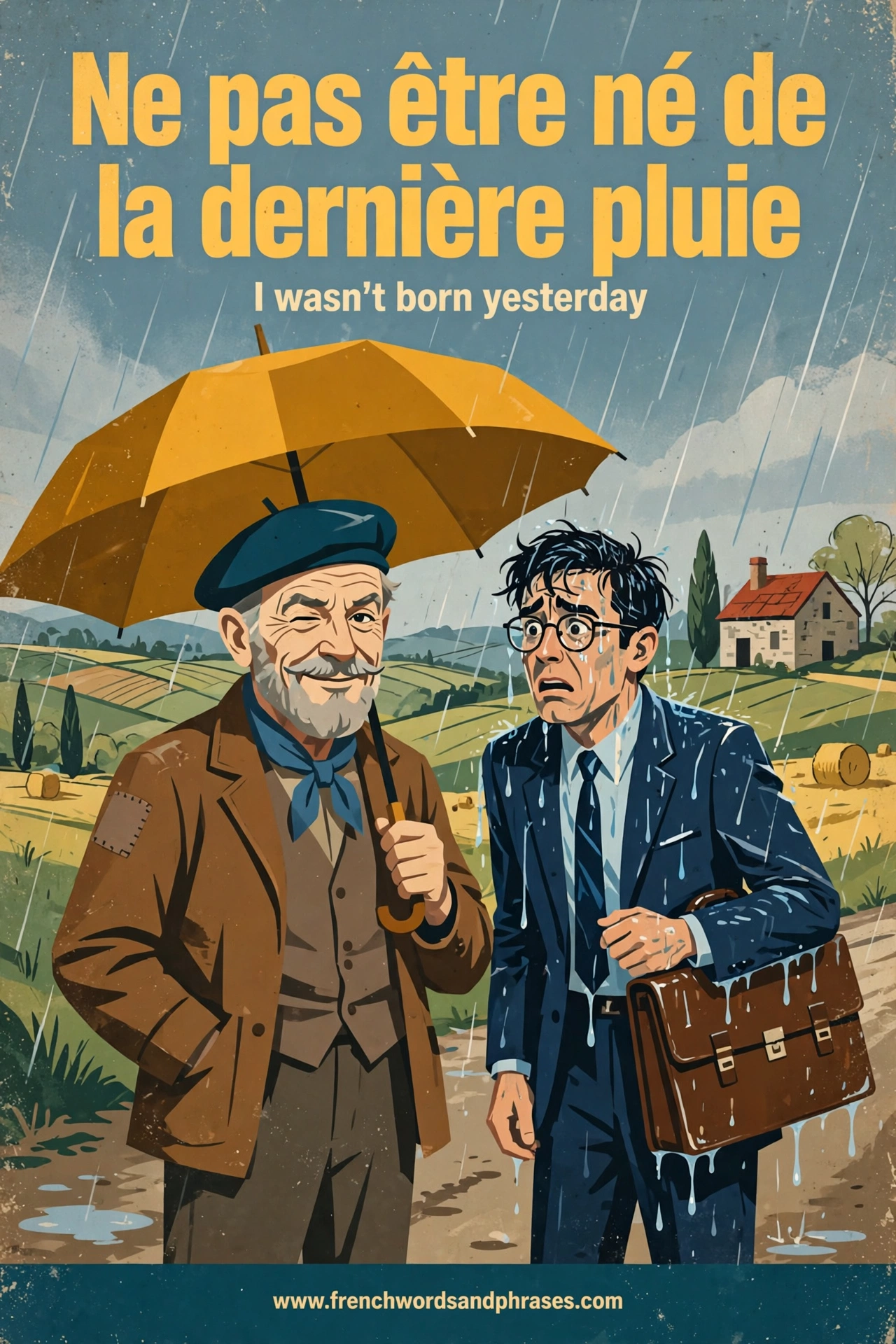
Ne pas être né de la dernière pluie means to not have been born yesterday — to be no fool, not easily fooled.
The market trader quotes you double the price of the melons, smiling like a man doing you a favour. You smile back, tap the melon, name the real price, and add the sentence that ends all such negotiations: « Je ne suis pas né de la dernière pluie. »
Let’s explore how ne pas être né de la dernière pluie works in French, beginning with the whole phrase on one card.
Understanding the French Phrase Ne pas être né de la dernière pluie
Ne pas être né de la dernière pluie is a French idiomatic expression built from ne pas être né (to not have been born) and la dernière pluie (the last, most recent rain). It is the proud French way of saying you are nobody’s fool.
It means to not have been born yesterday — to be experienced, sharp and impossible to fool. The picture is agricultural: the last rain fell recently, so anything born with it is brand new and green. You, the phrase insists, have seen many seasons before this one — and many traders, stories and tricks with them.
Type: Idiomatic expression — shrewdness (negative form of être né)
Answers the need: Saying you are no fool and cannot be taken in
Register: Neutral to familiar — a proud, often humorous claim, at home in speech and lively writing
Strength: Firm and cheerful — a warning wrapped in a joke, not an insult
One important usage detail: the phrase lives almost entirely in the first person — je ne suis pas né de la dernière pluie — said in your own defence when someone tries a trick. Né agrees with the speaker: a woman says je ne suis pas née de la dernière pluie. Without the negative, the phrase collapses — nobody claims to be né de la dernière pluie except as a joke at their own expense.
Experience the Word
Ne pas être né de la dernière pluie is experience wearing its years like medals — every season survived is proof against the next trick.
Imagine the old farmer listening to a salesman describe, at length, a machine that will change his life. The farmer nods, pours the coffee, and lets the silence do the work before he speaks. His whole biography is in the sentence: rains have come and gone over his fields for sixty years, and he was not born with the last one.
The phrase never shouts. It smiles, the way people smile when the trick has already failed.
How to Use Ne pas être né de la dernière pluie in French: Complete Guide
Let’s explore how ne pas être né de la dernière pluie works in French, beginning with the whole phrase on one card.
Ne pas être né de la dernière pluie at a Glance
The Whole Phrase on One Card
Real meaning, literal picture, English twin and register — ne pas être né de la dernière pluie in five lines.
| Point | Ne pas être né de la dernière pluie |
|---|---|
| What it really means | to not have been born yesterday — to be no fool, not easily fooled |
| Word for word | to not have been born from the last rain — not brand new and green |
| English equivalent | I wasn’t born yesterday / you can’t fool me |
| Register | neutral to familiar — proud, humorous, safe in most speech |
| Use it for | refusing a trick, a tall tale or a sales pitch — usually about yourself |
Example
Je ne suis pas né de la dernière pluie, mon ami.
I wasn’t born yesterday, my friend.
Word by Word: Building the Seasons
Five small pieces — take them one by one and the years stack up.
| Word | Literal meaning | Its job in the phrase |
|---|---|---|
| ne pas | not | the negation is part of the idiom — the claim only exists denied |
| être né | to have been born | être is the auxiliary of naître, and né agrees with the speaker |
| de | from, with | the little link that dates the birth |
| la dernière | the last, the most recent | dernière here means latest, not final |
| pluie | rain | the latest shower — whatever arrived most recently |
Example
La dernière pluie a rempli la citerne hier.
The last rain filled the tank yesterday.
Quick Quiz 1
Why the rain? What is la dernière pluie doing in the phrase?
Reveal the answer
It dates the newborn — the last rain fell recently, so to be born with it is to be brand new and green. The speaker was born long before it.
Après tant de saisons, il n’est pas né de la dernière pluie.
After so many seasons, he wasn’t born yesterday.
When You Say It: The Not-Fooled Moments
Ne pas être né de la dernière pluie fires at moments like these — a trick attempted, and politely declined.
| Situation | Example |
|---|---|
| At the market | ce prix ? je ne suis pas né de la dernière pluie — that price? I wasn’t born yesterday |
| Hearing a tall tale | ton histoire est belle, mais je ne suis pas né de la dernière pluie — nice story, but you can’t fool me |
| Refusing a pitch | je ne suis pas née de la dernière pluie, merci — I wasn’t born yesterday, thanks (said by a woman) |
| About a veteran | lui, il n’est pas né de la dernière pluie — him, nobody fools him |
| Warning a friend | attention, elle n’est pas née de la dernière pluie — careful, she’s nobody’s fool |
Example
Elle n’est pas née de la dernière pluie, ne lui raconte pas n’importe quoi.
She wasn’t born yesterday, don’t tell her just anything.
Make It Yours: The Claim for Every Speaker
Être né agrees with the speaker — and the first person is where the phrase lives.
| Form | French | In English |
|---|---|---|
| I (a man) | je ne suis pas né de la dernière pluie | I wasn’t born yesterday |
| I (a woman) | je ne suis pas née de la dernière pluie | I wasn’t born yesterday |
| He | il n’est pas né de la dernière pluie | he wasn’t born yesterday |
| She | elle n’est pas née de la dernière pluie | she wasn’t born yesterday |
| We | nous ne sommes pas nés de la dernière pluie | we weren’t born yesterday |
| You (to a man) | tu n’es pas né de la dernière pluie | you weren’t born yesterday |
Example
Nous ne sommes pas nés de la dernière pluie, nous deux.
The two of us weren’t born yesterday.
Quick Quiz 2
A woman says it of herself: je ne suis pas né or je ne suis pas née de la dernière pluie?
Reveal the answer
Née — né is the past participle of naître and agrees with the speaker: née for a woman.
Je ne suis pas née de la dernière pluie, jeune homme.
I wasn’t born yesterday, young man.
Everyday Expressions: Building on the Seasons
Ne pas être né de la dernière pluie slots into these everyday frames — each one ready to use as it stands.
| Frame | In English |
|---|---|
| je ne suis pas né de la dernière pluie | I wasn’t born yesterday |
| il n’est pas né de la dernière pluie | he’s nobody’s fool |
| on ne me la fait pas | you can’t fool me — the short, sharp cousin |
| je ne suis pas né d’hier | I wasn’t born yesterday — the shorter twin, with ‘yesterday’ said plainly |
| ça ne prend pas avec moi | that won’t work on me |
Example
On ne me la fait pas : je ne suis pas né de la dernière pluie.
You can’t fool me: I wasn’t born yesterday.
Close Cousins: The Other Ways to Be No Fool
French has a whole shelf of shrewdness phrases — the rain is the proud one; its cousins are shorter, sharper or more cautious.
| Expression | The difference |
|---|---|
| ne pas être né de la dernière pluie | to not have been born yesterday — the full, proud, humorous version |
| ne pas être né d’hier | to not have been born yesterday — the shorter twin, same claim, less poetry |
| on ne me la fait pas | you can’t pull that one on me — brisk, defensive, in the moment |
| avoir de l’expérience | to have experience — the plain, flat statement, no picture at all |
| être malin | to be crafty, shrewd — a quality, not a defence |
| ne pas se laisser faire | to not let yourself be pushed around — about standing your ground generally |
Example
Malin et expérimenté, il n’est pas né d’hier, encore moins de la dernière pluie.
Crafty and experienced, he wasn’t born yesterday, still less with the last rain.
Quick Quiz 3
Which cousin is the same claim with the poetry removed — né d’hier or né de la dernière pluie?
Reveal the answer
Né d’hier — ‘born yesterday’ said plainly, exactly like the English. The rain version is the picturesque French original.
Je ne suis pas né d’hier, je connais ce quartier.
I wasn’t born yesterday, I know this neighbourhood.
Ne pas être né de la dernière pluie and Its Neighbours
The shrewdness shelf around the phrase — from the green newcomer to the old hand.
| French | In English |
|---|---|
| un débutant | a beginner — the green one |
| l’expérience | experience |
| malin | crafty, shrewd |
| se méfier | to be wary, to watch out |
| ne pas être né de la dernière pluie | to not have been born yesterday |
| un vieux routier | an old hand — literally an old road-user |
Example
Vieux routier du marché, il n’est pas né de la dernière pluie.
An old hand of the market, he wasn’t born yesterday.
Watch Out: The Traps Around Ne pas être né de la dernière pluie
The traps: a negative that cannot be dropped, an agreement that changes with the speaker, and a dernière that means latest, not last-ever.
| Trap | The truth |
|---|---|
| the negative is the idiom | être né de la dernière pluie, without ne pas, would mean the opposite — brand new and naive; the claim lives in the denial |
| né agrees | je ne suis pas née, elle n’est pas née — the participle follows the speaker, not the grammar book’s default |
| dernière means latest | la dernière pluie is the most recent rain, not the final rain of all time — the same dernière as in la semaine dernière, last week |
| not really about weather | nobody is asking when you were born or what the sky did — the rain is a calendar, not a forecast |
Example
Elle est née bien avant la dernière pluie, cette commerçante.
She was born long before the last rain, that shopkeeper.
Quick Quiz 4
True or false: il est né de la dernière pluie, said straight, is a compliment about his experience.
Reveal the answer
False — without the negative it means he is brand new and naive. The compliment needs the ne pas.
Il n’est pas né de la dernière pluie, ce négociant.
He wasn’t born yesterday, that dealer.
Ne pas être né de la dernière pluie in Everyday French: Real-Life Examples
Now that you know the word, let’s see how ne pas être né de la dernière pluie appears in everyday French.
Example 1 — At the market
Ce prix-là ? Je ne suis pas né de la dernière pluie.
That price? I wasn’t born yesterday.
Example 2 — The tall tale
Belle histoire, mais je ne suis pas né de la dernière pluie.
Nice story, but I wasn’t born yesterday.
Example 3 — Said by a grandmother
Je ne suis pas née de la dernière pluie, mon petit.
I wasn’t born yesterday, my dear.
Example 4 — About the veteran
Lui, il n’est pas né de la dernière pluie.
Him, nobody fools him.
Example 5 — The sales pitch
Votre machine est belle, mais je ne suis pas né de la dernière pluie.
Your machine is lovely, but I wasn’t born yesterday.
Example 6 — Between old friends
Nous ne sommes pas nés de la dernière pluie, nous deux.
The two of us weren’t born yesterday.
Beyond Translation: The Meaning of Ne pas être né de la dernière pluie
English was born yesterday — a calendar insult, neat and dry. French was not born of the last rain: the calendar becomes a climate, and a person’s whole life is measured in seasons of weather survived. The newborn is green because the rain that made him is still drying on the fields.
To not be né de la dernière pluie is to carry your years as evidence — every past season testifies that this trick, too, will fail.
That is why the phrase is said with a smile rather than a snarl: it is less a defence than a harvest report.
How to Remember the French Phrase Ne pas être né de la dernière pluie
Remember it this way: Ne pas être né de la dernière pluie is a harvest report — you have survived too many seasons to be fooled by this one.
- You picture the fields — the last rain fell recently, so anything born with it is green; you were born many rains ago.
- You keep the negative — the idiom lives inside ne pas; drop it and you have called yourself a newborn.
- You agree the participle — née for a woman speaking: je ne suis pas née de la dernière pluie.
The key idea is ne pas être né de la dernière pluie means to not have been born yesterday — no fool, not easily taken in.
Test Your Knowledge of Ne pas être né de la dernière pluie
Let’s see how much you’ve learned. Try answering these questions before revealing the answers.
Question 1
What does ne pas être né de la dernière pluie mean?
Reveal the answer
To not have been born yesterday — to be experienced and impossible to fool.
Question 2
Why does the phrase mention rain?
Reveal the answer
Because the last rain is recent — to be born with it would be to be brand new and green; the speaker predates it by years.
Question 3
How does a woman say ‘I wasn’t born yesterday’?
Reveal the answer
Je ne suis pas née de la dernière pluie — né agrees with the speaker.
Question 4
What is the shorter twin of the phrase?
Reveal the answer
Ne pas être né d’hier — ‘not born yesterday’ said plainly, exactly like the English.
Question 5
Complete the sentence:
Je ne suis pas ______ de la dernière pluie. (I wasn’t born yesterday.)
Reveal the answer
né
Je ne suis pas né de la dernière pluie.
I wasn’t born yesterday.
Your Final Challenge
Can You Use It?
How would you say this in French?
“I wasn’t born yesterday.”
Reveal the answer
Je ne suis pas né de la dernière pluie.
I wasn’t born yesterday.
A little French. A little curiosity. A richer everyday life.
LEARN FRENCH ONE WORD AT A TIME