A French Word to Live By
Translate Ne pas être de la tarte to English
/nə pa ɛtʁ də la taʁt/
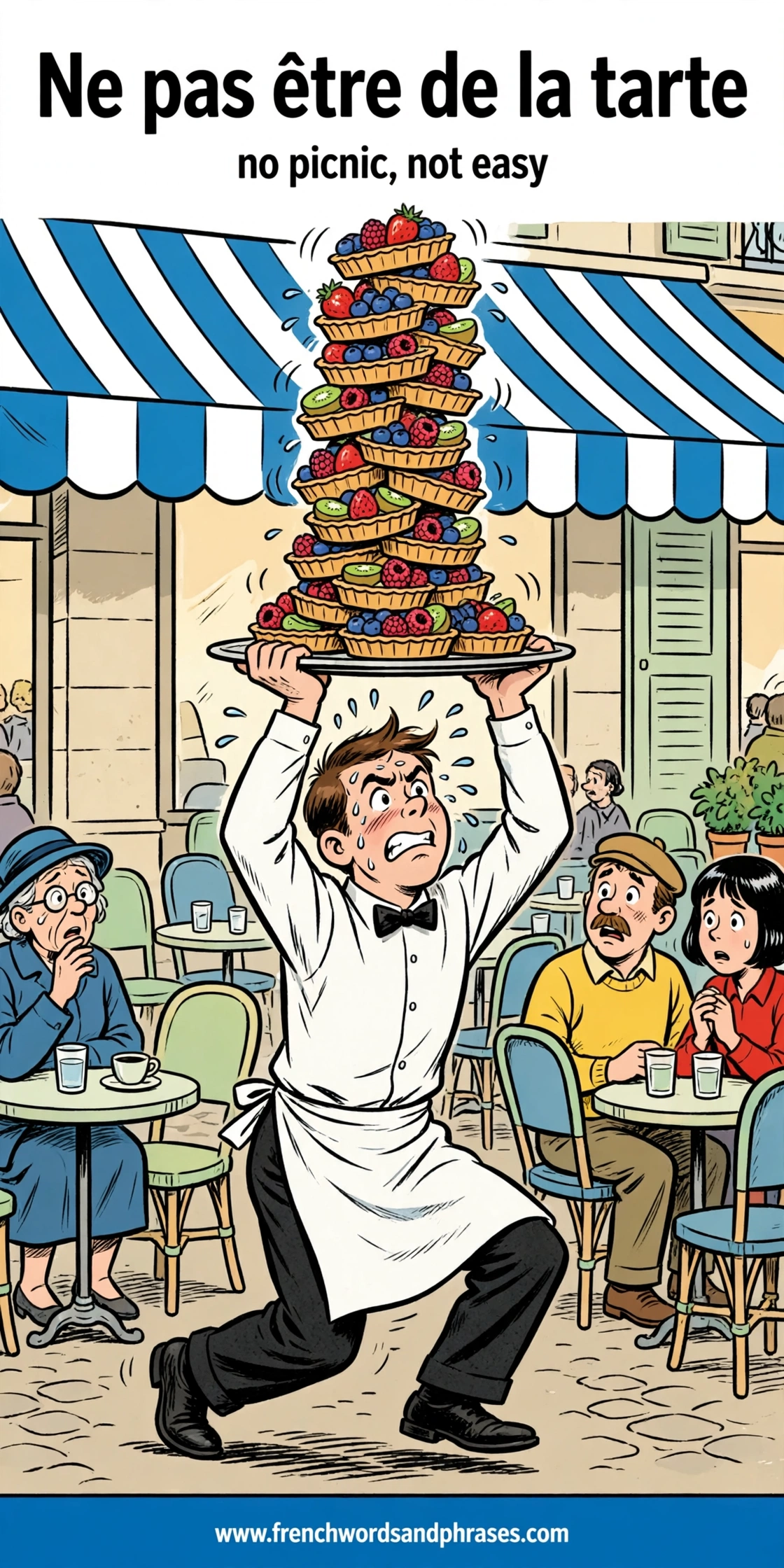
Ne pas être de la tarte means to be no picnic — not easy (ce n’est pas de la tarte).
Your cousin has volunteered to repaint his whole flat in one weekend, alone, including the ceilings. By Sunday evening he is standing on a ladder, spotted with white paint, shaking his head at the last unpainted wall: « Eh bien… ce n’est pas de la tarte ! »
Let’s explore how ne pas être de la tarte works in French, beginning with the whole phrase on one card.
Understanding the French Phrase Ne pas être de la tarte
Ne pas être de la tarte is a French idiom built from the negative ne… pas, the verb être (to be) and de la tarte (some tart, some pie). It lives in one frame: ce n’est pas de la tarte — it is not (a piece of) tart, meaning a task is no picnic, genuinely hard work. It is the exact opposite of its sweet cousin c’est du gâteau, it’s a piece of cake.
It means to be no picnic, to be no easy task. French measures difficulty in pastry and then denies the pastry: the exam, the renovation, the negotiation is not a slice of tart handed to you on a plate — it must be earned. English reaches for the same idea with ‘no picnic’, ‘no walk in the park’ or ‘not exactly a piece of cake’.
Type: Idiom — negative frame: ce n’est pas + de la tarte (some tart/pie)
Answers the need: Saying a task is hard, demanding or tricky — often with a rueful smile
Register: Informal to neutral — everyday speech everywhere; written French prefers moins familier synonyms
Strength: Honest medium — harder than expected, not impossible; a warning, not a complaint of despair
One important usage detail: the subject is almost always ce — ce n’est pas de la tarte. In relaxed speech the ne often drops, as negatives do in conversation: c’est pas de la tarte. And keep the partitive de la: the phrase denies you a serving of tart, which is why it is de la tarte and never la tarte or une tarte.
Experience the Word
Ne pas être de la tarte is the verdict French speakers deliver halfway up the hill — brush in hand, form half-filled, exam half-finished — when the task reveals its true size.
Imagine a young carpenter in Lyon on her first solo job, fitting a kitchen into an old flat where no wall is straight and no corner is square. Every board must be measured three times. She wipes her forehead, looks at the crooked room, and gives the old walls their due.
French respects hard work and names it without self-pity. Ce n’est pas de la tarte is a worker’s compliment to a task: you are not dessert, you are a job.
How to Use Ne pas être de la tarte in French: Complete Guide
Let’s explore how ne pas être de la tarte works in French, beginning with the whole phrase on one card.
Ne pas être de la tarte at a Glance
The Whole Phrase on One Card
Real meaning, literal building blocks, English twin and register — ne pas être de la tarte in five lines.
| Point | Ne pas être de la tarte |
|---|---|
| What it really means | to be no picnic — a task is hard, not easy |
| Word for word | to not be (some) tart/pie |
| English equivalent | no picnic / no walk in the park / not a piece of cake |
| Register | informal to neutral — everyday speech, rueful and honest |
| Use it for | tough tasks: exams, renovations, negotiations, steep climbs |
Example
Cet examen, ce n’est pas de la tarte !
This exam is no picnic!
Word by Word: Building the Denied Dessert
Four pieces — a negation, a verb, and a serving of tart that never arrives.
| Word | Literal meaning | Its job in the phrase |
|---|---|---|
| ce | it, this | the subject of the frame — the task being judged |
| n’est pas | is not (ne… pas) | the negation that snatches the dessert away |
| de la | some (partitive) | a serving of — the phrase denies you a portion, not the whole tart |
| tarte | tart, pie | the sweet, easy thing the task refuses to be |
Example
Réparer ce toit, ce n’est pas de la tarte.
Repairing this roof is no picnic.
Quick Quiz 1
What is the opposite of ce n’est pas de la tarte?
Reveal the answer
C’est du gâteau — it’s a piece of cake. French flips the pastry: cake for easy, denied tart for hard.
Pour lui, cet exercice, c’est du gâteau.
For him, this exercise is a piece of cake.
When You Say It: Tasks That Push Back
Ne pas être de la tarte belongs to honest difficulty — each scene is a job revealing its true size.
| Situation | Example |
|---|---|
| A hard exam | ce concours, ce n’est pas de la tarte — this competitive exam is no picnic |
| Renovation work | refaire la salle de bain, ce n’est pas de la tarte — redoing the bathroom is no easy task |
| A tough negotiation | convaincre le directeur, ce n’est pas de la tarte — convincing the director is no picnic |
| A steep climb | cette montée, ce n’est pas de la tarte — this climb is no walk in the park |
| Learning something hard | apprendre le russe, ce n’est pas de la tarte — learning Russian is not easy |
Example
Traduire ce contrat, ce n’est pas de la tarte.
Translating this contract is no picnic.
Make It Yours: Bending the Frame
The frame flexes — change the tense, drop the ne in speech, or attach the task with pour.
| Form | French | In English |
|---|---|---|
| The classic | ce n’est pas de la tarte | it’s no picnic, it’s not easy |
| Relaxed speech | c’est pas de la tarte | it’s no picnic (ne dropped, as in conversation) |
| In the past | ce n’était pas de la tarte | it was no picnic |
| Judging for someone | pour un débutant, ce n’est pas de la tarte | for a beginner, it’s no easy task |
| With effort admitted | ce n’est pas de la tarte, mais on y arrivera | it’s no picnic, but we’ll get there |
Example
Ce n’était pas de la tarte, mais le résultat est beau.
It was no picnic, but the result is beautiful.
Quick Quiz 2
How does the phrase sound in relaxed conversation?
Reveal the answer
C’est pas de la tarte — spoken French often drops the ne of the negation, keeping only pas.
C’est pas de la tarte, ce déménagement !
This move is no picnic!
Everyday Expressions: Frames Built on the Phrase
Ne pas être de la tarte slots into these everyday frames — each one ready to use as it stands.
| Frame | In English |
|---|---|
| ce n’est pas de la tarte | it’s no picnic, it’s not easy |
| c’est pas de la tarte | it’s no picnic (relaxed speech) |
| ce n’était pas de la tarte | it was no picnic |
| alors ça, ce n’est pas de la tarte | well, that is no easy task |
| ce n’est pas de la tarte, mais… | it’s no picnic, but… |
Example
Alors ça, ce n’est pas de la tarte, je te préviens.
Well, that is no picnic, I’m warning you.
Close Cousins: Other Ways to Say It’s Hard
French grades difficulty carefully — de la tarte denied is the rueful middle; its cousins differ in strength and colour.
| Expression | The difference |
|---|---|
| ne pas être de la tarte | to be no picnic — hard work, said with a rueful smile |
| c’est du gâteau | it’s a piece of cake — the exact opposite: sweet, easy, served on a plate |
| être coton | to be tricky, fiddly — informal; for delicate, awkward tasks (c’est coton) |
| ne pas être une mince affaire | to be no small matter — weightier, for serious undertakings |
| être une autre paire de manches | to be another pair of sleeves — a different, harder challenge altogether |
| être difficile | to be difficult — the plain, neutral word, no pastry involved |
Example
Recoudre ce bouton, c’est coton.
Sewing this button back on is fiddly work.
Quick Quiz 3
Which cousin describes a fiddly, delicate task?
Reveal the answer
Être coton — c’est coton: tricky and awkward rather than heavy, like threading a needle with gloves on.
Réparer cette montre, c’est coton.
Repairing this watch is fiddly work.
Ne pas être de la tarte and Its Neighbours
The difficulty shelf around the phrase — effort on one side, ease on the other.
| French | In English |
|---|---|
| demander des efforts | to require effort |
| un travail de longue haleine | a long-haul job, a marathon task |
| facile comme tout | easy as anything — the sunny opposite |
| les doigts dans le nez | with fingers in your nose — done effortlessly, hands down |
| un jeu d’enfant | child’s play — as easy as it gets |
Example
Pour elle, ce calcul est un jeu d’enfant.
For her, this calculation is child’s play.
Watch Out: The Traps Around Ne pas être de la tarte
The traps: the partitive, the missing ne, and a dessert that changes sides between languages.
| Trap | The truth |
|---|---|
| saying la tarte or une tarte | the phrase denies a serving: de la tarte, with the partitive — ce n’est pas de la tarte |
| hunting for the ne in speech | c’est pas de la tarte is normal conversation; the ne returns in careful speech and writing |
| confusing it with English ‘a piece of cake’ | English cake means easy — and so does French gâteau; the denied tarte means hard. Do not mix the two desserts |
| using it of a person | the phrase judges tasks, not people — for a difficult person, French says il n’est pas facile or il est dur |
Example
Ce n’est pas de la tarte, ce rapport à rendre demain.
It’s no picnic, this report due tomorrow.
Quick Quiz 4
True or false: ce n’est pas de la tarte and c’est du gâteau mean the same thing.
Reveal the answer
False — they are opposites: du gâteau is a piece of cake (easy); pas de la tarte is no picnic (hard).
Le début, c’était du gâteau ; la fin, ce n’était pas de la tarte.
The beginning was a piece of cake; the end was no picnic.
Ne pas être de la tarte in Everyday French: Real-Life Examples
Now that you know the word, let’s see how ne pas être de la tarte appears in everyday French.
Example 1 — Before an exam
Réviser tout le programme en une semaine, ce n’est pas de la tarte.
Revising the whole syllabus in a week is no picnic.
Example 2 — Renovating
Refaire l’électricité de la maison, ce n’est pas de la tarte.
Rewiring the house is no easy task.
Example 3 — At work
Convaincre ce client, ce n’est pas de la tarte, mais je vais essayer.
Convincing this client is no picnic, but I’ll try.
Example 4 — On a hike
La dernière montée, ce n’est pas de la tarte, prenez votre temps.
The last climb is no walk in the park, take your time.
Example 5 — Learning a language
Apprendre le chinois, ce n’est pas de la tarte.
Learning Chinese is not easy.
Example 6 — Looking back
Ce n’était pas de la tarte, ce chantier, mais la maison est superbe.
That building work was no picnic, but the house is superb.
Beyond Translation: The Meaning of Ne pas être de la tarte
French judges life from the dessert trolley. What is sweet, sliced and served — gâteau, tarte — stands for ease; the idiom’s wit is to order the dessert and then refuse it: this job, whatever it is, will not be served to you. Behind the joke sits a work ethic the French admire: difficulty stated plainly, without whining and without boasting.
To say ce n’est pas de la tarte is to roll up your sleeves in a single sentence.
And the pastry scale is complete: du gâteau at the easy end, pas de la tarte at the honest end — a whole philosophy of effort, measured in desserts.
How to Remember the French Phrase Ne pas être de la tarte
Remember it this way: Picture a waiter who will not serve you dessert: no slice of tart is coming to make this easy. What is not tart must be chewed through the hard way.
- You hear tarte and think dessert denied — the task is not a sweet slice on a plate.
- You flip it for easy: c’est du gâteau, it’s a piece of cake — the opposite verdict.
- You keep the partitive: de la tarte, a serving of tart, never la tarte.
The key idea is ce n’est pas de la tarte means it’s no picnic — the dessert is refused, the work is real.
Test Your Knowledge of Ne pas être de la tarte
Let’s see how much you’ve learned. Try answering these questions before revealing the answers.
Question 1
What does ce n’est pas de la tarte mean?
Reveal the answer
It’s no picnic, it’s not easy — a task is hard work, said with a rueful smile.
Question 2
What is its exact opposite?
Reveal the answer
C’est du gâteau — it’s a piece of cake; French flips the pastry to flip the meaning.
Question 3
Why de la tarte and not la tarte?
Reveal the answer
Because the partitive de la means a serving of — the phrase denies you a portion of tart, not the whole dish.
Question 4
Translate: Redoing the bathroom is no picnic.
Reveal the answer
Refaire la salle de bain, ce n’est pas de la tarte.
Question 5
Complete the sentence:
Cet examen, ce n’est pas de la ______. (This exam is no picnic.)
Reveal the answer
tarte
Cet examen, ce n’est pas de la tarte.
This exam is no picnic.
Your Final Challenge
Can You Use It?
How would you say this in French?
“Learning Russian is no picnic, but it’s worth it.”
Reveal the answer
Apprendre le russe, ce n’est pas de la tarte, mais ça vaut le coup.
Learning Russian is no picnic, but it’s worth it.
A little French. A little curiosity. A richer everyday life.
LEARN FRENCH ONE WORD AT A TIME