A French Word to Live By
Translate Navire to English
/na.viʁ/
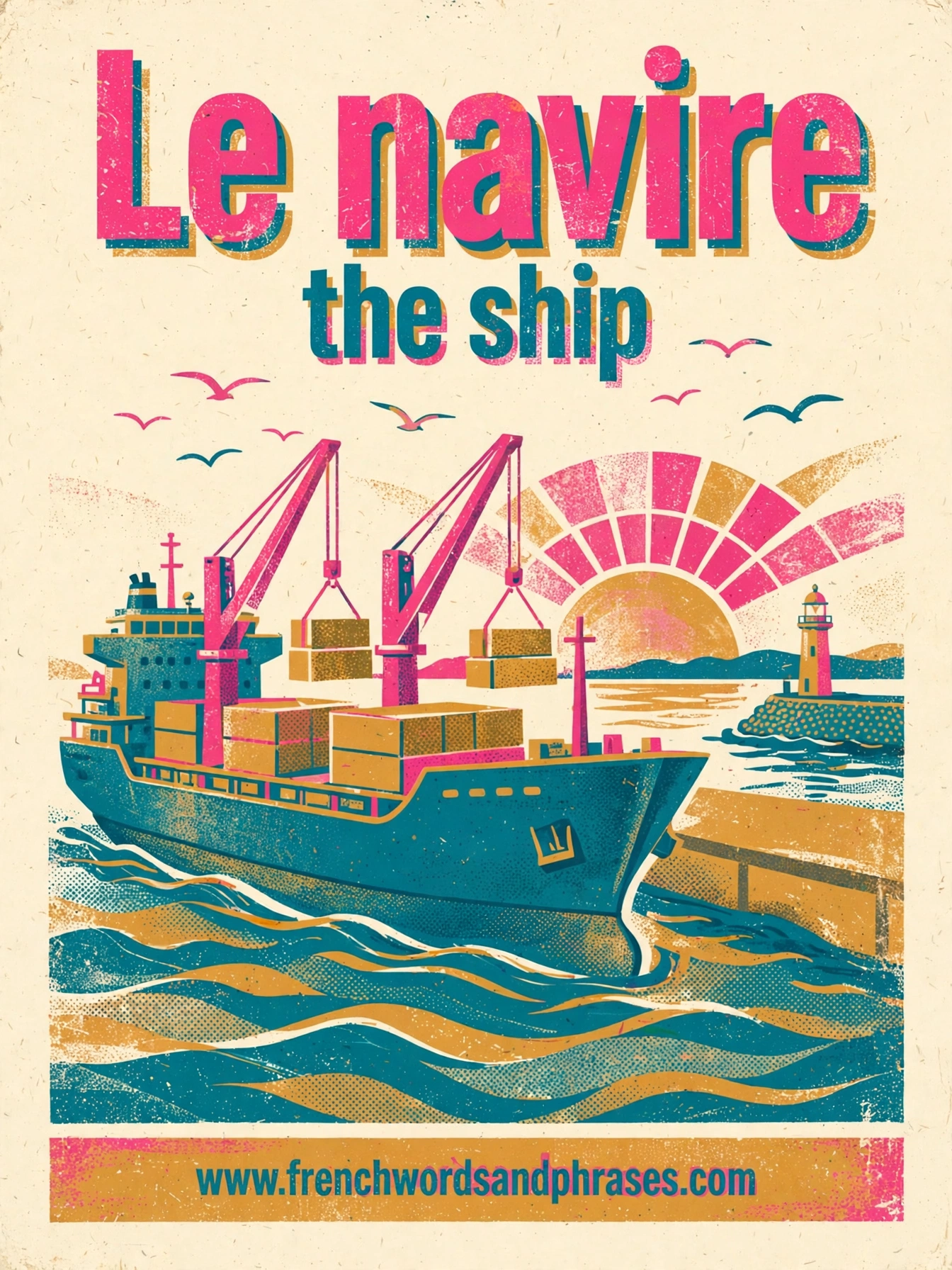
Le navire means the ship.
It slides into the harbour at dawn, three decks high, its horn shaking the windows of the port: le navire, the ship — the formal, full-dress word for the great vessels that carry cargo, passengers and whole navies across the sea.
In this guide, you’ll learn what navire means in English, how to use it with its articles, how to form its plural, and how it appears in everyday French. Explore French examples, English translations, and practice quizzes.
Understanding the French Noun Navire
Navire is a masculine French noun, learned with its article: le navire, un navire. It comes from the Latin navigium, a vessel, from navis, a ship. Keep its register in mind: navire is the word of ports, captains and official documents; the everyday word for a boat of any size is un bateau.
It means a ship — a large seagoing vessel: un navire de guerre, a warship, un navire marchand, a merchant ship, un navire de croisière, a cruise ship. Life aboard has its fixed phrases: à bord du navire, aboard the ship, le capitaine du navire, the ship’s captain, le navire quitte le port, the ship leaves port. When the ship is a metaphor, French keeps it grand: le navire de l’État, the ship of state.
Gender: Masculine — le navire
Definite article: le — le navire (the ship)
Indefinite article: un — un navire (a ship)
Plural: les navires — regular, with a simple -s
Spelling note: from Latin navigium, a vessel — the formal word for a great ship
Close neighbour: un bateau — the everyday word for any boat or ship
English equivalents: The ship, a vessel.
Reach for navire when the vessel is large, official or literary: warships, cargo ships, cruise ships, ships in novels. For the ferry you took on holiday or the boat on the lake, bateau is the natural word. The preposition of ships is à bord de: bienvenue à bord du navire, welcome aboard the ship.
Experience the Word
Navire is the ship with its uniform on — the word smells of harbours, manifests and salutes, never of picnics on the lake.
Imagine the great liner leaving Le Havre at dusk, every window lit, the band playing, the quay shrinking: no one on that quay calls it un bateau. C’est un navire, and the word itself stands a little taller.
You have not just named a big boat. You have named the vessel in full dress — le navire, the ship, pride of the port.
How to Use Navire in French: Complete Guide
Let’s explore how navire works in French, beginning with its articles — le navire, un navire, à bord du navire.
Navire with the Definite Article (Le, Les)
Used for a specific ship — the one entering port, the one in the news.
| Form | French |
|---|---|
| Masculine singular | le navire |
| Plural | les navires |
Example
Le navire entre dans le port à l’aube.
The ship enters the harbour at dawn.
Navire with the Indefinite Article (Un, Des)
Used for a ship in general — any great vessel on the horizon.
| Form | French |
|---|---|
| Masculine singular | un navire |
| Plural | des navires |
Example
Un navire immense passe au large.
An immense ship passes offshore.
Navire by Its Missions (De guerre, Marchand, De croisière…)
Navire is classified by its mission — de plus the mission names the fleet it belongs to.
| Quantity | French |
|---|---|
| a warship | un navire de guerre |
| a merchant ship | un navire marchand |
| a cruise ship | un navire de croisière |
| a cargo ship | un navire de charge |
| aboard the ship | à bord du navire |
Example
Un navire de croisière accueille trois mille passagers.
A cruise ship takes three thousand passengers.
Quick Quiz 1
Complete the sentence:
______ navire quitte le port à marée haute. (the)
Reveal the answer
Le
Le navire quitte le port à marée haute.
The ship leaves the harbour at high tide — navire is masculine, so le.
The Plural of Navire
Navire takes a regular plural in -s — fleets at anchor, convoys at sea.
| Number | French |
|---|---|
| Singular | le navire |
| Plural | les navires |
Example
Les navires attendent l’autorisation d’entrer.
The ships are waiting for permission to enter.
Navire with Possessive Adjectives (Mon, Ton, Son…)
Possessives agree with the noun: navire is masculine, so mon, ton, son in the singular.
| Owner | French |
|---|---|
| my | mon navire |
| your (tu) | ton navire |
| his / her | son navire |
| our | notre navire |
| your (vous) | votre navire |
| their | leur navire |
Example
Le capitaine connaît son navire par cœur.
The captain knows his ship by heart.
Quick Quiz 2
Complete the sentence:
La compagnie présente ______ navire le plus moderne. (its)
Reveal the answer
son
La compagnie présente son navire le plus moderne.
The company presents its most modern ship — son, because navire is masculine.
Navire with Demonstrative Adjectives (Ce, Ces)
Used to point: ce navire, this ship — the giant at the quay.
| Form | French |
|---|---|
| Masculine singular | ce navire |
| Plural | ces navires |
Example
Ce navire transporte des conteneurs.
This ship carries containers.
Navire with Adjectives
Adjectives agree with navire — masculine singular: un navire immense, un navire marchand.
| Adjective | With Navire |
|---|---|
| immense (immense) | un navire immense |
| marchand (merchant) | un navire marchand |
| ancien (old) | un navire ancien |
| moderne (modern) | un navire moderne |
| énorme (enormous) | un navire énorme |
Example
Un navire ancien est devenu un musée.
An old ship has become a museum.
Quick Quiz 3
Complete the sentence:
C’est un navire ______, il dépasse tous les autres. (enormous)
Reveal the answer
énorme
C’est un navire énorme, il dépasse tous les autres.
It’s an enormous ship, it towers over all the others — énorme has the same form for masculine and feminine.
Everyday Expressions with Navire
Harbours, fleets and metaphors — the navire phrases of daily life.
| Expression | In English |
|---|---|
| à bord du navire | aboard the ship |
| un navire de guerre | a warship |
| le capitaine du navire | the ship’s captain |
| le navire quitte le port | the ship leaves port |
| un navire de croisière | a cruise ship |
Example
Bienvenue à bord du navire, passagers !
Welcome aboard the ship, passengers!
Words from the Same Family as Navire
The sea and its vessels — the words that travel with navire.
| French | In English |
|---|---|
| un bateau | a boat, a ship (everyday word) |
| un port | a harbour, a port |
| un capitaine | a captain |
| naviguer | to sail, to navigate (the verb) |
| un marin | a sailor |
Example
Les marins préparent le navire pour la nuit.
The sailors prepare the ship for the night.
Quick Quiz 4
What does à bord du navire mean?
Reveal the answer
Aboard the ship — on board, the only place a passenger wants to be.
Tout l’équipage est à bord du navire.
The whole crew is aboard the ship.
Navire in Everyday French: Real-Life Examples
Now that you know the word, let’s see how navire appears in everyday French.
Example 1 — At the port
Le navire arrive avec deux heures de retard.
The ship arrives two hours late.
Example 2 — A cruise
Notre navire de croisière visite cinq îles.
Our cruise ship visits five islands.
Example 3 — The navy
Un navire de guerre patrouille au large.
A warship is patrolling offshore.
Example 4 — Cargo
Le navire transporte des voitures et des machines.
The ship carries cars and machines.
Example 5 — Boarding
Les passagers montent à bord du navire.
The passengers are boarding the ship.
Example 6 — A metaphor
Le ministre parle du navire de l’État.
The minister speaks of the ship of state.
Beyond Translation: The Meaning of Navire
Navire keeps the Latin navis at full sail: it is the ship of epics, admirals and official prose, where bateau is the ship of holidays and harbourside chats. The register is the meaning — call a liner un navire and you salute it; call it un bateau and you merely use it. French literature never forgot the grandeur: the ship of state, the ghost ship, the ship that carries the hero away all sail under navire.
To say navire is to give the vessel its full honours.
It evokes the dawn arrival, the captain on the bridge, and every window lit as the quay falls behind.
How to Remember the French Noun Navire
Remember it this way: Navire is the ship in full dress — le navire, for warships, liners and literature; the everyday boat is un bateau.
- Always masculine — le navire, un navire, mon navire.
- The register — navire for great, official vessels; bateau for everyday boats.
- The boarding phrase — à bord du navire, aboard the ship.
The key idea is le navire — the ship (formal, large vessel), masculine; everyday = un bateau.
Test Your Knowledge of Navire
Let’s see how much you’ve learned. Try answering these questions before revealing the answers.
Question 1
Is navire masculine or feminine?
Reveal the answer
Masculine — le navire, un navire.
Question 2
How do you say a warship?
Reveal the answer
Un navire de guerre.
Question 3
Translate: The ship enters the harbour at dawn.
Reveal the answer
Le navire entre dans le port à l’aube.
Question 4
What is the everyday French word for a boat?
Reveal the answer
Un bateau — navire is the formal word for a large vessel.
Question 5
Complete the sentence:
______ navires de la flotte sont à quai. (the)
Reveal the answer
Les
Les navires de la flotte sont à quai.
The fleet’s ships are at the quay.
Your Final Challenge
Can You Use It?
How would you say this in French?
“The passengers are boarding the ship.”
Reveal the answer
Les passagers montent à bord du navire.
The passengers are boarding the ship.
A little French. A little curiosity. A richer everyday life.
LEARN FRENCH ONE WORD AT A TIME