
A French Word to Live By
How to Conjugate Méjuger in French
/me.ʒy.ʒe/
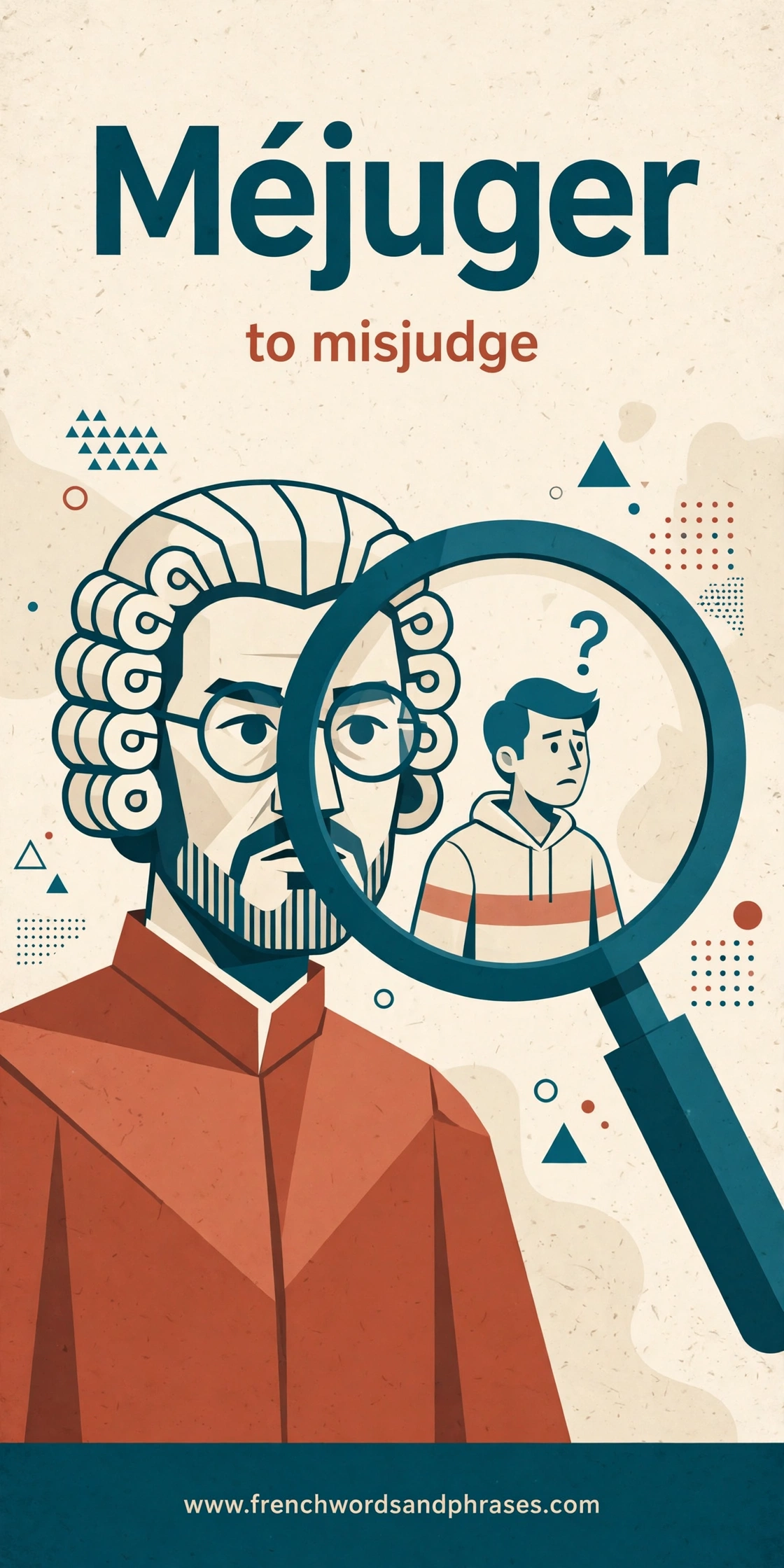
Méjuger means to misjudge.
The quiet colleague who turns out to be brilliant. The short book that changes your life. Méjuger is the verb of the wrong first impression — judging badly, too fast, and having to revise.
In this guide, you’ll learn how to conjugate méjuger in all the major French tenses and moods. Explore complete conjugation tables, French examples, English translations, and practice quizzes.
Understanding the French Verb Méjuger
Méjuger is a regular French verb belonging to the first group of verbs, those ending in -er.
It means to misjudge. It is commonly used for misjudging people at first sight (méjuger un collègue), misjudging situations and distances, in the apology je l’ai méjugé — I misjudged him — and in encouragement: ne te méjuge pas, do not underestimate yourself.
Verb classification: First group (-er)
Auxiliary verb: Avoir
Past participle: méjugé
Present participle: méjugeant
English equivalents: To misjudge, to judge wrongly; méjuger de — to underrate, to have a low opinion of; se méjuger — to underestimate oneself.
One important detail: méjuger is a -ger verb, and it keeps a protective e before a and o so the g stays soft: nous méjugeons, je méjugeais — but before i the e goes home: nous méjugions, vous méjugiez. The verb lives three lives: méjuger quelqu’un, to misjudge someone; méjuger de quelqu’un, to underrate them; and the reflexive se méjuger, to underestimate yourself — the modest person’s classic error.
Experience the Word
Méjuger is the verb of the verdict delivered too early — judgement first, evidence later.
Imagine a new neighbour who never smiles. The street méjuge him for a month — until the night he repairs everyone’s fences after the storm, without a word. The village learns what méjuger costs: a month of warmth, missed.
The man was never cold. He was misjudged — and méjuger is the verb that owns up to it.
How to Conjugate Méjuger: Complete French Conjugation Guide
Let’s explore every major conjugation of méjuger, beginning with the indicative mood.
How to Conjugate Méjuger in the Indicative Mood
The indicative mood is used to express facts, observations, actions, and events.
How to Conjugate Méjuger in the Present Tense (Présent)
Used for actions happening now, habitual actions, and general truths.
| Subject | Conjugation |
|---|---|
| je | méjuge |
| tu | méjuges |
| il / elle | méjuge |
| nous | méjugeons |
| vous | méjugez |
| ils / elles | méjugent |
Example
On méjuge souvent les gens silencieux.
People often misjudge quiet people.
Quick Quiz 1
Complete the sentence:
Nous ______ souvent les gens silencieux.
Reveal the answer
méjugeons
Nous méjugeons souvent les gens silencieux.
We often misjudge quiet people. Note the protective e in méjugeons.
How to Conjugate Méjuger in the Passé Composé
Used for completed actions in the past. Méjuger takes the auxiliary verb avoir.
| Subject | Conjugation |
|---|---|
| j’ | ai méjugé |
| tu | as méjugé |
| il / elle | a méjugé |
| nous | avons méjugé |
| vous | avez méjugé |
| ils / elles | ont méjugé |
Example
Je l’ai méjugé, et je le regrette.
I misjudged him, and I regret it.
How to Conjugate Méjuger in the Imparfait (Imperfect Tense)
Used for habitual past actions, descriptions, and ongoing situations in the past.
| Subject | Conjugation |
|---|---|
| je | méjugeais |
| tu | méjugeais |
| il / elle | méjugeait |
| nous | méjugions |
| vous | méjugiez |
| ils / elles | méjugeaient |
Example
Elle méjugeait ses propres talents, par modestie.
She used to underrate her own talents, out of modesty.
Quick Quiz 2
Choose the correct form:
I misjudged him.
Je l’______ . (ai méjugé / suis méjugé)
Reveal the answer
ai méjugé
Je l’ai méjugé.
Méjuger takes avoir.
How to Conjugate Méjuger in the Plus-que-parfait
Used to describe an action that had already been completed before another past event.
| Subject | Conjugation |
|---|---|
| j’ | avais méjugé |
| tu | avais méjugé |
| il / elle | avait méjugé |
| nous | avions méjugé |
| vous | aviez méjugé |
| ils / elles | avaient méjugé |
Example
Nous avions méjugé la distance et nous sommes arrivés en retard.
We had misjudged the distance and we arrived late.
How to Conjugate Méjuger in the Passé Simple
Primarily used in formal writing, literature, and historical narratives. It is rarely used in everyday conversation.
| Subject | Conjugation |
|---|---|
| je | méjugeai |
| tu | méjugeas |
| il / elle | méjugea |
| nous | méjugeâmes |
| vous | méjugeâtes |
| ils / elles | méjugeèrent |
Example
Le jury méjugea la candidate dès son entrée.
The jury misjudged the candidate the moment she walked in.
How to Conjugate Méjuger in the Passé Antérieur
A literary tense used to express an action completed immediately before another past action, generally in the passé simple.
| Subject | Conjugation |
|---|---|
| j’ | eus méjugé |
| tu | eus méjugé |
| il / elle | eut méjugé |
| nous | eûmes méjugé |
| vous | eûtes méjugé |
| ils / elles | eurent méjugé |
Example
Quand il eut méjugé son ami, il s’en voulut longtemps.
When he had misjudged his friend, he blamed himself for a long time.
How to Conjugate Méjuger in the Future Tense (Futur Simple)
Used to describe actions that will take place in the future.
| Subject | Conjugation |
|---|---|
| je | méjugerai |
| tu | méjugeras |
| il / elle | méjugera |
| nous | méjugerons |
| vous | méjugerez |
| ils / elles | méjugeront |
Example
Tu ne méjugeras plus les gens sur leur silence.
You will no longer misjudge people by their silence.
How to Conjugate Méjuger in the Futur Antérieur (Future Perfect)
Used for an action that will have been completed before a particular point in the future.
| Subject | Conjugation |
|---|---|
| j’ | aurai méjugé |
| tu | auras méjugé |
| il / elle | aura méjugé |
| nous | aurons méjugé |
| vous | aurez méjugé |
| ils / elles | auront méjugé |
Example
À la fin du séjour, ils auront méjugé tout le monde une fois.
By the end of the stay, they will have misjudged everyone once.
How to Conjugate Méjuger in the Near Future (Futur Proche)
Used to describe something that is going to happen soon. Formed with aller + infinitive.
| Subject | Conjugation |
|---|---|
| je | vais méjuger |
| tu | vas méjuger |
| il / elle | va méjuger |
| nous | allons méjuger |
| vous | allez méjuger |
| ils / elles | vont méjuger |
Example
Attention, tu vas méjuger cette situation.
Careful, you are going to misjudge this situation.
How to Conjugate Méjuger in the Conditional Mood
The conditional mood expresses what would happen under certain circumstances. It is also frequently used to make polite requests or express wishes.
How to Conjugate Méjuger in the Present Conditional
| Subject | Conjugation |
|---|---|
| je | méjugerais |
| tu | méjugerais |
| il / elle | méjugerait |
| nous | méjugerions |
| vous | méjugeriez |
| ils / elles | méjugeraient |
Example
Sans le connaître, je le méjugerais peut-être.
Without knowing him, I might misjudge him.
How to Conjugate Méjuger in the Past Conditional
| Subject | Conjugation |
|---|---|
| j’ | aurais méjugé |
| tu | aurais méjugé |
| il / elle | aurait méjugé |
| nous | aurions méjugé |
| vous | auriez méjugé |
| ils / elles | auraient méjugé |
Example
Elle aurait méjugé le risque sans ces chiffres.
She would have misjudged the risk without those figures.
Méjuger in the Literary Past Conditional Form
This less common literary form uses the imperfect subjunctive of avoir.
| Subject | Conjugation |
|---|---|
| j’ | eusse méjugé |
| tu | eusses méjugé |
| il / elle | eût méjugé |
| nous | eussions méjugé |
| vous | eussiez méjugé |
| ils / elles | eussent méjugé |
Example
Il eût méjugé son adversaire, à ses dépens.
He would have misjudged his opponent, to his cost.
How to Conjugate Méjuger in the Subjunctive Mood
The subjunctive is used to express wishes, emotions, doubts, necessity, and uncertainty. It frequently follows expressions such as il faut que (it is necessary that) or bien que (although).
How to Conjugate Méjuger in the Present Subjunctive
| Subject | Conjugation |
|---|---|
| que je | méjuge |
| que tu | méjuges |
| qu’il / qu’elle | méjuge |
| que nous | méjugions |
| que vous | méjugiez |
| qu’ils / qu’elles | méjugent |
Example
Il ne faut pas que tu méjuges ce garçon si vite.
You must not misjudge this boy so quickly.
Quick Quiz 3
Complete the sentence using the subjunctive:
Il ne faut pas que vous ______ vos chances.
Reveal the answer
méjugiez
Il ne faut pas que vous méjugiez vos chances.
You must not underestimate your chances. No protective e before i in méjugiez.
How to Conjugate Méjuger in the Imperfect Subjunctive
A literary tense, rarely encountered in modern spoken French.
| Subject | Conjugation |
|---|---|
| que je | méjugasse |
| que tu | méjugasses |
| qu’il / qu’elle | méjugât |
| que nous | méjugassions |
| que vous | méjugassiez |
| qu’ils / qu’elles | méjugassent |
Example
Je craignais qu’elle méjugeât ses chances.
I feared she might underestimate her chances.
How to Conjugate Méjuger in the Pluperfect Subjunctive
A literary construction used to express an action completed before another past action.
| Subject | Conjugation |
|---|---|
| que j’ | eusse méjugé |
| que tu | eusses méjugé |
| qu’il / qu’elle | eût méjugé |
| que nous | eussions méjugé |
| que vous | eussiez méjugé |
| qu’ils / qu’elles | eussent méjugé |
Example
Il regrettait que nous eussions méjugé cet homme.
He regretted that we had misjudged this man.
How to Conjugate Méjuger in the Past Subjunctive
| Subject | Conjugation |
|---|---|
| que j’ | aie méjugé |
| que tu | aies méjugé |
| qu’il / qu’elle | ait méjugé |
| que nous | ayons méjugé |
| que vous | ayez méjugé |
| qu’ils / qu’elles | aient méjugé |
Example
Je suis étonné que vous ayez méjugé la situation.
I am surprised you misjudged the situation.
How to Conjugate Méjuger in the Imperative
The imperative is used to give commands, instructions, invitations, or suggestions. Subject pronouns are omitted.
How to Conjugate Méjuger in the Present Imperative
| Person | Conjugation |
|---|---|
| (tu) | méjuge |
| (nous) | méjugeons |
| (vous) | méjugez |
Example
Ne méjuge pas les gens avant de les connaître !
Do not misjudge people before you know them!
Quick Quiz 4
How would you say Do not misjudge him (tu form)?
Reveal the answer
Ne le méjuge pas !
French Participles of Méjuger
Participles are verb forms that can be used in compound tenses and other grammatical constructions.
Present Participle of Méjuger
méjugeant
En méjugeant les autres, on se trompe souvent soi-même.
By misjudging others, we often deceive ourselves.
Past Participle of Méjuger
méjugé
Méjugé au début, il a fini premier de la classe.
Misjudged at first, he finished top of the class.
Méjuger in Everyday French: Real-Life Examples
Now that you know the conjugations, let’s see how méjuger appears in everyday French.
Example 1 — Present
Ne te méjuge pas, tu vaux mieux que ça.
Do not underestimate yourself, you are worth more than that.
Example 2 — Passé composé
Je l’ai méjugé, je lui ai demandé pardon.
I misjudged him, I apologised to him.
Example 3 — Imparfait
On méjugeait ce village, il est charmant.
People used to underrate this village, it is charming.
Example 4 — Future
Nous ne méjugerons plus les apparences.
We will no longer misjudge appearances.
Example 5 — Conditional
Je méjugerais ce livre à sa couverture.
I would misjudge this book by its cover.
Example 6 — Imperative
Ne méjugez personne sur un premier regard !
Do not misjudge anyone on a first look!
Beyond Translation: The Meaning of Méjuger
English misjudge and French méjuger are built the same way — judge plus a prefix of error — but French adds the reflexive twist English forgets.
Se méjuger is the humble error.
Most misjudging points outward; se méjuger points inward — underestimating your own talent, your own chances. French gives modesty its own verb form, and its own remedy: ne te méjuge pas.
How to Remember the French Verb Méjuger
Remember it this way: Méjuger is about the verdict too early — méjuger, méjuger de, se méjuger.
- The -ger e protects the soft g — nous méjugeons, but nous méjugions without it.
- Méjuger de quelqu’un — to underrate someone; se méjuger — to underestimate yourself.
- Regular -er: je méjuge, nous méjugeons, past participle méjugé.
The key idea is the verdict too early — méjuger, méjuger de, se méjuger.
Test Your Knowledge of Méjuger
Let’s see how much you’ve learned. Try answering these questions before revealing the answers.
Question 1
Why does nous méjugeons keep an e?
Reveal the answer
To keep the g soft — before o, a plain g would sound hard, so French writes ge: méjugeons.
Question 2
How do you say Do not underestimate yourself in French?
Reveal the answer
Ne te méjuge pas.
Question 3
Translate: I misjudged him, and I regret it.
Reveal the answer
Je l’ai méjugé, et je le regrette.
Question 4
What is the past participle of méjuger?
Reveal the answer
Méjugé.
Question 5
Complete the sentence:
Il ne faut pas que tu ______ ce garçon si vite.
Reveal the answer
méjuges
Il ne faut pas que tu méjuges ce garçon si vite.
You must not misjudge this boy so quickly.
Your Final Challenge
Can You Use It?
How would you say this in French?
Misjudge neither others nor yourself: wait and see.
Reveal the answer
Ne méjuge ni les autres ni toi-même : attends de voir.
Misjudge neither others nor yourself: wait and see.
A little French. A little curiosity. A richer everyday life.
LEARN FRENCH ONE WORD AT A TIME




