
A French Word to Live By
How to Conjugate Matricer in French
/ma.tʁi.se/
Matricer means to stamp out.
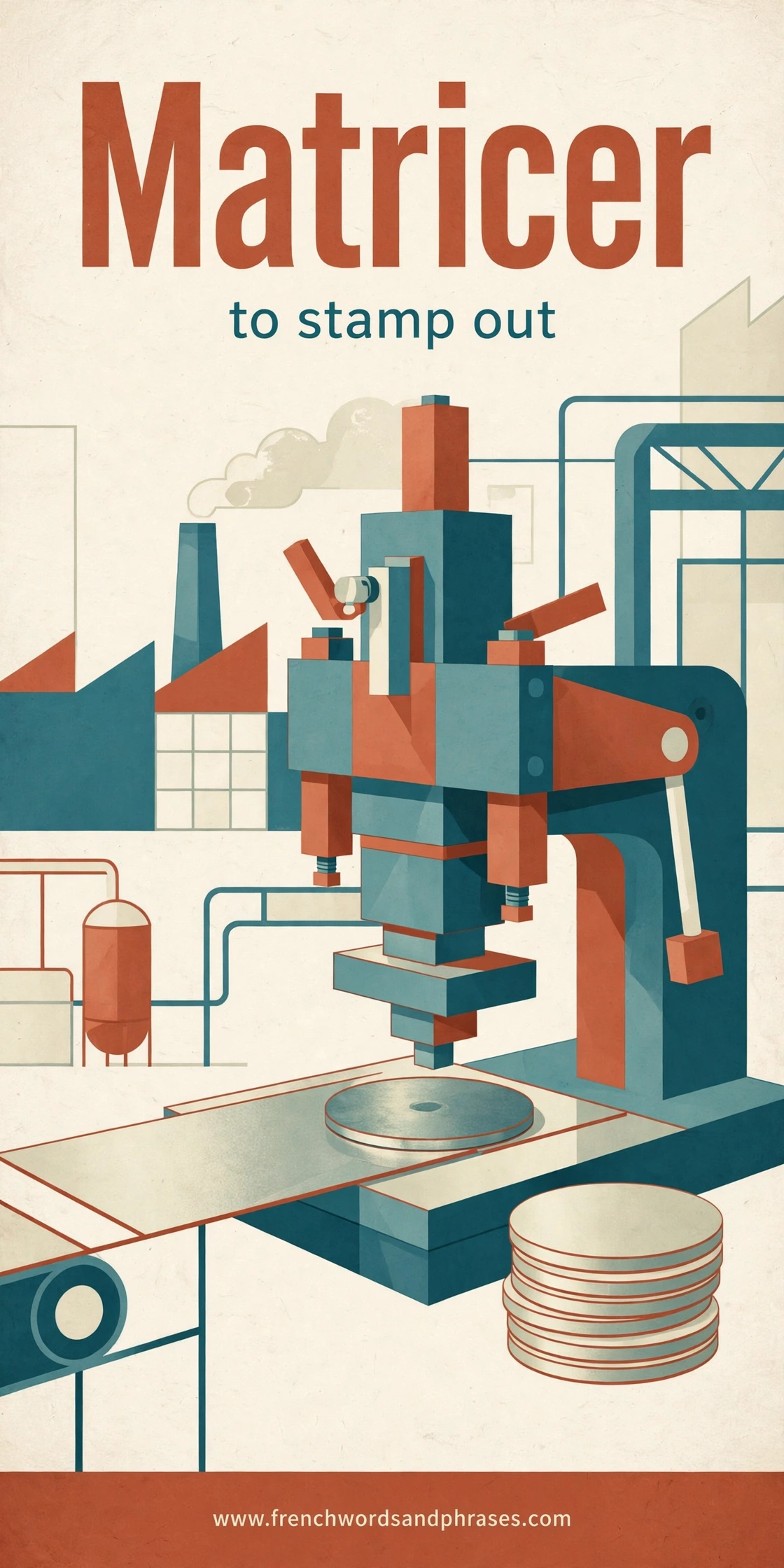
A press crashing down on sheet steel, a thousand identical lids pouring from a machine, washers, caps and car panels born in a single blow — matricer is the metalworker’s verb for shaping metal with a die.
In this guide, you’ll learn how to conjugate matricer in all the major French tenses and moods. Explore complete conjugation tables, French examples, English translations, and practice quizzes.
Understanding the French Verb Matricer
Matricer is a regular French verb belonging to the first group of verbs, those ending in -er.
It means to stamp out. It is commonly used in metalworking and factories for stamping out sheet-metal parts — lids, washers, panels and caps — in a press fitted with a die (une matrice), where speed and perfect repetition matter.
Verb classification: First group (-er)
Auxiliary verb: Avoir
Past participle: matricé
Present participle: matriçant
English equivalents: To stamp out, to die-stamp (metal); to shape sheet metal in a press using a die.
One important detail: matricer works metal with une matrice, a die — the hardened mould that gives each piece its shape. The verb is a -cer verb, so the c becomes ç before a and o to keep its soft s sound: nous matriçons, je matriçais — but before i the plain c returns: nous matricions, vous matriciez. One die, one blow, and every piece that comes out of the press is identical.
Experience the Word
Matricer is the verb of the single decisive blow — the press falls once, and a flat sheet becomes a finished part.
Imagine a workshop at dawn. The press rises and falls like a slow heartbeat, and at every beat a shining lid drops into the bin, identical to the thousand before it.
The metal has not been cut or bent by hand. It has been stamped — shaped in one blow by the die.
How to Conjugate Matricer: Complete French Conjugation Guide
Let’s explore every major conjugation of matricer, beginning with the indicative mood.
How to Conjugate Matricer in the Indicative Mood
The indicative mood is used to express facts, observations, actions, and events.
How to Conjugate Matricer in the Present Tense (Présent)
Used for actions happening now, habitual actions, and general truths.
| Subject | Conjugation |
|---|---|
| je | matrice |
| tu | matrices |
| il / elle | matrice |
| nous | matriçons |
| vous | matricez |
| ils / elles | matricent |
Example
L’ouvrier matrice les plaques d’acier dans la presse.
The worker stamps out the steel sheets in the press.
Quick Quiz 1
Complete the sentence:
Nous ______ les plaques d’acier.
Reveal the answer
matriçons
Nous matriçons les plaques d’acier.
We stamp out the steel sheets. Note the ç in matriçons.
How to Conjugate Matricer in the Passé Composé
Used for completed actions in the past. Matricer takes the auxiliary verb avoir.
| Subject | Conjugation |
|---|---|
| j’ | ai matricé |
| tu | as matricé |
| il / elle | a matricé |
| nous | avons matricé |
| vous | avez matricé |
| ils / elles | ont matricé |
Example
L’usine a matricé mille pièces ce matin.
The factory stamped out a thousand parts this morning.
How to Conjugate Matricer in the Imparfait (Imperfect Tense)
Used for habitual past actions, descriptions, and ongoing situations in the past.
| Subject | Conjugation |
|---|---|
| je | matriçais |
| tu | matriçais |
| il / elle | matriçait |
| nous | matricions |
| vous | matriciez |
| ils / elles | matriçaient |
Example
Autrefois, on matriçait les pièces à la main.
In the old days, parts were stamped out by hand.
Quick Quiz 2
Choose the correct form:
The factory stamped the parts.
L’usine ______ les pièces. (a matricé / est matricée)
Reveal the answer
a matricé
L’usine a matricé les pièces.
Matricer takes avoir.
How to Conjugate Matricer in the Plus-que-parfait
Used to describe an action that had already been completed before another past event.
| Subject | Conjugation |
|---|---|
| j’ | avais matricé |
| tu | avais matricé |
| il / elle | avait matricé |
| nous | avions matricé |
| vous | aviez matricé |
| ils / elles | avaient matricé |
Example
Nous avions matricé toutes les plaques avant la pause.
We had stamped all the sheets before the break.
How to Conjugate Matricer in the Passé Simple
Primarily used in formal writing, literature, and historical narratives. It is rarely used in everyday conversation.
| Subject | Conjugation |
|---|---|
| je | matriçai |
| tu | matriças |
| il / elle | matriça |
| nous | matriçâmes |
| vous | matriçâtes |
| ils / elles | matriçèrent |
Example
La presse matriça la tôle en une seconde.
The press stamped the sheet metal in one second.
How to Conjugate Matricer in the Passé Antérieur
A literary tense used to express an action completed immediately before another past action, generally in the passé simple.
| Subject | Conjugation |
|---|---|
| j’ | eus matricé |
| tu | eus matricé |
| il / elle | eut matricé |
| nous | eûmes matricé |
| vous | eûtes matricé |
| ils / elles | eurent matricé |
Example
Quand il eut matricé la dernière pièce, il arrêta la machine.
When he had stamped the last part, he stopped the machine.
How to Conjugate Matricer in the Future Tense (Futur Simple)
Used to describe actions that will take place in the future.
| Subject | Conjugation |
|---|---|
| je | matricerai |
| tu | matriceras |
| il / elle | matricera |
| nous | matricerons |
| vous | matricerez |
| ils / elles | matriceront |
Example
Demain, nous matricerons les couvercles en série.
Tomorrow, we will stamp out the lids in series.
How to Conjugate Matricer in the Futur Antérieur (Future Perfect)
Used for an action that will have been completed before a particular point in the future.
| Subject | Conjugation |
|---|---|
| j’ | aurai matricé |
| tu | auras matricé |
| il / elle | aura matricé |
| nous | aurons matricé |
| vous | aurez matricé |
| ils / elles | auront matricé |
Example
À midi, l’atelier aura matricé cinq cents pièces.
By noon, the workshop will have stamped five hundred parts.
How to Conjugate Matricer in the Near Future (Futur Proche)
Used to describe something that is going to happen soon. Formed with aller + infinitive.
| Subject | Conjugation |
|---|---|
| je | vais matricer |
| tu | vas matricer |
| il / elle | va matricer |
| nous | allons matricer |
| vous | allez matricer |
| ils / elles | vont matricer |
Example
Je vais matricer cette plaque d’aluminium.
I am going to stamp out this aluminium sheet.
How to Conjugate Matricer in the Conditional Mood
The conditional mood expresses what would happen under certain circumstances. It is also frequently used to make polite requests or express wishes.
How to Conjugate Matricer in the Present Conditional
| Subject | Conjugation |
|---|---|
| je | matricerais |
| tu | matricerais |
| il / elle | matricerait |
| nous | matricerions |
| vous | matriceriez |
| ils / elles | matriceraient |
Example
Avec une matrice neuve, on matricerait les pièces plus proprement.
With a new die, we would stamp the parts more cleanly.
How to Conjugate Matricer in the Past Conditional
| Subject | Conjugation |
|---|---|
| j’ | aurais matricé |
| tu | aurais matricé |
| il / elle | aurait matricé |
| nous | aurions matricé |
| vous | auriez matricé |
| ils / elles | auraient matricé |
Example
Elle aurait matricé les plaques si la presse avait marché.
She would have stamped the sheets if the press had worked.
Matricer in the Literary Past Conditional Form
This less common literary form uses the imperfect subjunctive of avoir.
| Subject | Conjugation |
|---|---|
| j’ | eusse matricé |
| tu | eusses matricé |
| il / elle | eût matricé |
| nous | eussions matricé |
| vous | eussiez matricé |
| ils / elles | eussent matricé |
Example
Il eût matricé la tôle lui-même.
He would have stamped the sheet metal himself.
How to Conjugate Matricer in the Subjunctive Mood
The subjunctive is used to express wishes, emotions, doubts, necessity, and uncertainty. It frequently follows expressions such as il faut que (it is necessary that) or bien que (although).
How to Conjugate Matricer in the Present Subjunctive
| Subject | Conjugation |
|---|---|
| que je | matrice |
| que tu | matrices |
| qu’il / qu’elle | matrice |
| que nous | matricions |
| que vous | matriciez |
| qu’ils / qu’elles | matricent |
Example
Il faut que tu matrices les pièces avant le contrôle.
You must stamp out the parts before inspection.
Quick Quiz 3
Complete the sentence using the subjunctive:
Il faut que vous ______ les couvercles.
Reveal the answer
matriciez
Il faut que vous matriciez les couvercles.
You must stamp out the lids. No ç before i in matriciez.
How to Conjugate Matricer in the Imperfect Subjunctive
A literary tense, rarely encountered in modern spoken French.
| Subject | Conjugation |
|---|---|
| que je | matricasse |
| que tu | matricasses |
| qu’il / qu’elle | matricât |
| que nous | matricassions |
| que vous | matricassiez |
| qu’ils / qu’elles | matricassent |
Example
Je voulais qu’il matriçât les couvercles un par un.
I wanted him to stamp the lids one by one.
How to Conjugate Matricer in the Pluperfect Subjunctive
A literary construction used to express an action completed before another past action.
| Subject | Conjugation |
|---|---|
| que j’ | eusse matricé |
| que tu | eusses matricé |
| qu’il / qu’elle | eût matricé |
| que nous | eussions matricé |
| que vous | eussiez matricé |
| qu’ils / qu’elles | eussent matricé |
Example
Il regrettait que nous eussions matricé les plaques trop vite.
He regretted that we had stamped the sheets too quickly.
How to Conjugate Matricer in the Past Subjunctive
| Subject | Conjugation |
|---|---|
| que j’ | aie matricé |
| que tu | aies matricé |
| qu’il / qu’elle | ait matricé |
| que nous | ayons matricé |
| que vous | ayez matricé |
| qu’ils / qu’elles | aient matricé |
Example
Je suis content que vous ayez matricé les pièces à temps.
I am glad you stamped out the parts in time.
How to Conjugate Matricer in the Imperative
The imperative is used to give commands, instructions, invitations, or suggestions. Subject pronouns are omitted.
How to Conjugate Matricer in the Present Imperative
| Person | Conjugation |
|---|---|
| (tu) | matrice |
| (nous) | matriçons |
| (vous) | matricez |
Example
Matrice les plaques, la presse est chaude !
Stamp out the sheets, the press is hot!
Quick Quiz 4
How would you say Stamp out the sheets (tu form)?
Reveal the answer
Matrice les plaques !
French Participles of Matricer
Participles are verb forms that can be used in compound tenses and other grammatical constructions.
Present Participle of Matricer
matriçant
En matriçant la tôle, l’ouvrier obtient des pièces identiques.
By stamping the sheet metal, the worker obtains identical parts.
Past Participle of Matricer
matricé
Matricée avec précision, la pièce s’emboîte parfaitement.
Stamped with precision, the part fits perfectly.
Matricer in Everyday French: Real-Life Examples
Now that you know the conjugations, let’s see how matricer appears in everyday French.
Example 1 — Present
On matrice les couvercles dans cet atelier.
The lids are stamped out in this workshop.
Example 2 — Passé composé
L’usine a matricé dix mille pièces cette semaine.
The factory stamped out ten thousand parts this week.
Example 3 — Imparfait
Le vieil ouvrier matriçait la tôle sans jamais se tromper.
The old worker used to stamp the sheet metal without ever making a mistake.
Example 4 — Future
Nous matricerons les rondelles demain matin.
We will stamp out the washers tomorrow morning.
Example 5 — Conditional
Tu matricerais les plaques plus vite avec cette machine.
You would stamp the sheets faster with this machine.
Example 6 — Imperative
Matricez les pièces avant le contrôle !
Stamp out the parts before inspection!
Beyond Translation: The Meaning of Matricer
English needs stamp out or die-cut and a picture of the machine; French matricer names the tool inside the verb — la matrice, the die, does the work.
It is the opposite of the craftsman’s hand.
Where the smith hammers each piece into its own shape, matricer promises repetition: one die, one blow, ten thousand twins.
How to Remember the French Verb Matricer
Remember it this way: Matricer is about the die and the press — one blow, ten thousand identical parts.
- Une matrice is the die — matricer is shaping metal with it, in one blow of the press.
- The ç keeps the s soft: nous matriçons — but vous matriciez without it.
- Regular -cer: je matrice, il matrice, past participle matricé.
The key idea is the die and the press — one blow, ten thousand identical parts.
Test Your Knowledge of Matricer
Let’s see how much you’ve learned. Try answering these questions before revealing the answers.
Question 1
What is une matrice in a metal workshop?
Reveal the answer
A die — the hardened mould that shapes each stamped part.
Question 2
Why does nous matriçons have a ç?
Reveal the answer
To keep the c soft — before o, a plain c would sound like a k, so French writes ç.
Question 3
Translate: The factory stamped out a thousand parts this morning.
Reveal the answer
L’usine a matricé mille pièces ce matin.
Question 4
What is the past participle of matricer?
Reveal the answer
Matricé.
Question 5
Complete the sentence:
Il faut que tu ______ les pièces avant le contrôle.
Reveal the answer
matrices
Il faut que tu matrices les pièces avant le contrôle.
You must stamp out the parts before inspection.
Your Final Challenge
Can You Use It?
How would you say this in French?
The press falls, and the sheet metal becomes a perfect part.
Reveal the answer
La presse tombe, et la tôle devient une pièce parfaite.
The press falls, and the sheet metal becomes a perfect part.
A little French. A little curiosity. A richer everyday life.
LEARN FRENCH ONE WORD AT A TIME




