A French Word to Live By
Translate Marié to English
/maʁje/
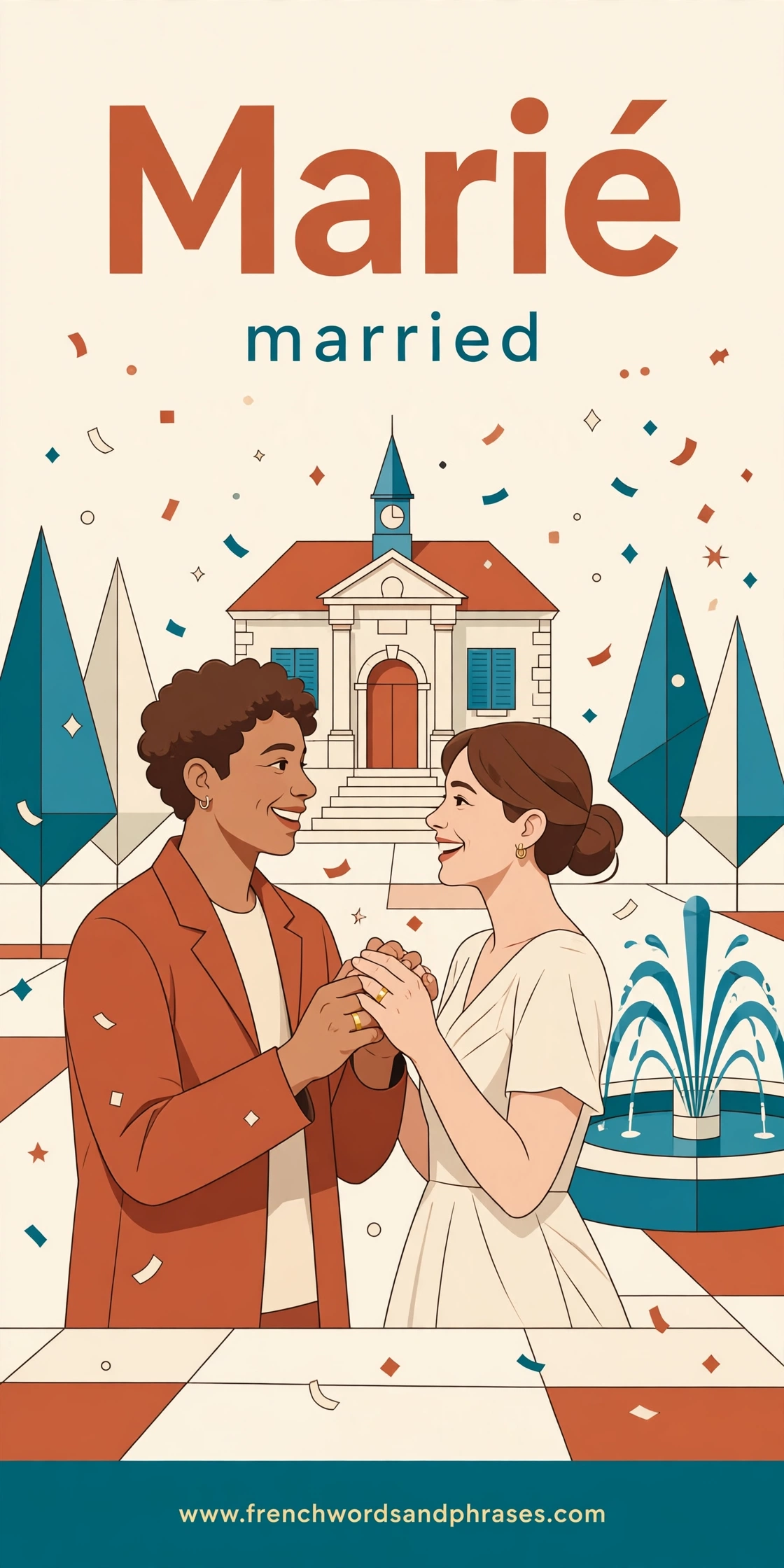
Marié means married.
A small town hall on a Saturday morning, rice still in the air, and two signatures drying side by side in a big leather register. The mayor closes the book, smiles at the couple, and the whole room applauds. From this moment, French has a new word for both of them: mariés.
In this guide, you’ll learn what marié means in English, how its regular feminine is formed, where it stands in the sentence, and how it pairs with its opposite, célibataire. Explore French examples, English translations, and practice quizzes.
Understanding the French Adjective Marié
Marié is a French adjective of state — the adjective of the wedding ring. It comes from the verb se marier, to get married, and it agrees in the regular -é way: marié, mariée, mariés, mariées. It also works as a noun: les mariés are the newlyweds themselves.
It means married — joined in marriage to someone. It describes husbands and wives (un homme marié, a married man; une femme mariée, a married woman), and with depuis it tells you for how long: mariés depuis dix ans, married for ten years. It is the word on forms, in announcements and in every introduction that ends with « et sa femme ».
Type: Adjective of state — marital status
Answers the question: What is his or her situation? — married
Changes form: Yes — marié, mariée, mariés, mariées
English equivalents: Married.
One important usage detail: marié stands AFTER the noun — un homme marié — and after être: ils sont mariés. To say who someone is married to, French uses à: elle est mariée à un médecin, she is married to a doctor — never avec in careful French.
Experience the Word
Marié is the adjective of the two signatures — the state that begins with a ceremony and continues in a thousand ordinary mornings of coffee made for two.
Imagine a couple celebrating sixty years together, cutting a cake in the village hall where they danced at their wedding. Around them: children, grandchildren, and a photograph in a silver frame of two very young people who had just become mariés.
You have not just described a legal state. You have named a shared life.
How to Use Marié in French: Complete Guide
Let’s explore how Marié works in French, beginning with the whole word on one card.
Marié at a Glance
Before the details, here is the whole word on one card.
The Whole Word on One Card
Meaning, type, position and forms — marié in four lines.
| Point | Marié |
|---|---|
| Meaning | married |
| Type | Adjective of state — marital status |
| Usual position | after the noun — un homme marié |
| Form | marié / mariée / mariés / mariées |
Example
C’est un homme marié.
He is a married man.
The Four Forms of Marié
Marié agrees with the person it describes, following the regular pattern of adjectives in -é: the feminine adds an e, the plurals add an s.
| Form | Marié | Example |
|---|---|---|
| Masculine singular | marié | un homme marié — a married man |
| Feminine singular | mariée | une femme mariée — a married woman |
| Masculine plural | mariés | des hommes mariés — married men |
| Feminine plural | mariées | des femmes mariées — married women |
Example
Ils sont mariés depuis vingt ans.
They have been married for twenty years.
Quick Quiz 1
Which form of marié goes with femme (feminine)?
Reveal the answer
mariée
Une femme mariée.
A married woman.
Mariée: The Regular Feminine in -ée
The feminine of marié is formed by adding a single e. The spelling changes, the sound does not — marié and mariée are pronounced exactly alike.
| Situation | Example |
|---|---|
| The rule | just add -e — marié → mariée |
| The sound | marié and mariée sound exactly the same: /maʁje/ |
| Masculine plural | mariés — des frères mariés |
| Feminine plural | mariées — des sœurs mariées |
Example
Ma sœur est mariée et heureuse.
My sister is married and happy.
Where Marié Goes: After the Noun
Marié follows the noun it describes, like most French adjectives, and it is perfectly at home after être.
| Pattern | Example |
|---|---|
| After the noun | une femme mariée — a married woman |
| After être | ils sont mariés — they are married |
| Married to | mariée à un médecin — married to a doctor |
| Before the noun | une mariée femme — not in everyday French |
Example
Elle est mariée à un professeur.
She is married to a teacher.
Quick Quiz 2
How do you say ‘married to a doctor’ — marié avec un médecin or marié à un médecin?
Reveal the answer
marié à un médecin
French joins the couple with à, not avec.
Married to a doctor.
More Marié: Comparing with Marié
Marié compares the regular way, with plus, moins and aussi.
| Degree | Example |
|---|---|
| As married as | aussi marié que — as married as |
| More married | plus marié — more married |
| Less married | moins marié — less married |
Example
Ils sont aussi heureux que de jeunes mariés.
They are as happy as newlyweds.
Everyday Expressions with Marié
The phrases French actually reaches for when marié comes up in conversation.
| Expression | In English |
|---|---|
| les jeunes mariés | the newlyweds |
| mariés depuis dix ans | married for ten years |
| un homme marié | a married man |
| marié, deux enfants | married, two children — the language of forms and announcements |
| être marié à quelqu’un | to be married to someone |
| à peine mariés | barely married, just married |
Example
Les jeunes mariés partent en voyage de noces.
The newlyweds are leaving on their honeymoon.
Quick Quiz 3
What does les jeunes mariés mean?
Reveal the answer
The newlyweds
Les jeunes mariés sourient sur la photo.
The newlyweds are smiling in the photo.
Marié and Its Neighbours
The words that live closest to marié — near-synonyms, partners and opposites.
| French | In English |
|---|---|
| célibataire | single — the opposite state |
| fiancé | engaged — the step just before marié |
| divorcé | divorced — married once, no longer |
| séparé | separated — apart, but not yet divorced |
| veuf | widowed — a marriage ended by death |
| époux / épouse | spouse — the nouns for husband and wife |
Example
Il a été fiancé, puis marié, et il est veuf aujourd’hui.
He was engaged, then married, and he is widowed today.
Watch Out: The Traps Around Marié
The mistakes learners make with marié — each one easy to avoid once seen.
| Trap | The truth |
|---|---|
| avec or à | say marié à quelqu’un — French marries people with à, not avec |
| se marier | the verb is se marier — ils se marient en juin, they are getting married in June |
| les mariés | as a noun, les mariés means the bride and groom, the newlyweds |
| Agreement | the couple together is masculine plural: ils sont mariés |
Example
Ils se marient en juin et seront mariés en juillet.
They are getting married in June and will be married in July.
Quick Quiz 4
How do you say ‘they are married’ (a couple)?
Reveal the answer
Ils sont mariés
A couple together takes the masculine plural.
They are married.
Marié in Everyday French: Real-Life Examples
Now that you know the word, let’s see how marié appears in everyday French.
Example 1 — Family
Ma sœur est mariée et elle a deux enfants.
My sister is married and she has two children.
Example 2 — On a form
Il a coché la case « marié » sur le formulaire.
He ticked the ‘married’ box on the form.
Example 3 — An introduction
Voici Paul, il est marié à une amie de ma sœur.
This is Paul, he is married to a friend of my sister’s.
Example 4 — An anniversary
Ils sont mariés depuis cinquante ans cette année.
They will have been married for fifty years this year.
Example 5 — The newlyweds
Les jeunes mariés ont dansé toute la nuit.
The newlyweds danced all night.
Example 6 — A question
Tu es marié ou célibataire ?
Are you married or single?
Beyond Translation: The Meaning of Marié
English says married for the meaning of marié — but French lets the word live a double life: adjective for the state, noun for the people. Les mariés, with the article, are not a description but two people walking out of the town hall into the rice and the applause.
To say ils sont mariés is to tell the end of a love story — and the beginning of a life story.
And the word keeps its memory of the verb: se marier is something two people do together, and marié is what they remain, together, ever after.
How to Remember the French Adjective Marié
Remember it this way: Marié is the wedding adjective — a regular -é agreement, the partner joined with à, and a secret second life as the noun for the newlyweds.
- You add an e for her — mariée, and an s for the plural — mariés.
- You marry someone with à — marié à un médecin, never avec.
- You remember the noun — les jeunes mariés, the newlyweds.
The key idea is marié agrees like a regular -é adjective, takes à for the partner, and les mariés means the newlyweds.
Test Your Knowledge of Marié
Let’s see how much you’ve learned. Try answering these questions before revealing the answers.
Question 1
What does marié mean?
Reveal the answer
Married — joined in marriage to someone.
Question 2
What is the feminine of marié?
Reveal the answer
mariée — just add an e; it sounds exactly the same.
Question 3
Translate: a married woman.
Reveal the answer
Une femme mariée.
Question 4
Complete the sentence:
Elle est mariée ______ un médecin.
Reveal the answer
à
Elle est mariée à un médecin.
She is married to a doctor.
Question 5
What does les jeunes mariés mean?
Reveal the answer
The newlyweds — marié as a noun names the couple themselves.
Your Final Challenge
Can You Use It?
How would you say this in French?
“They have been married for ten years and they have two children.”
Reveal the answer
Ils sont mariés depuis dix ans et ils ont deux enfants.
They have been married for ten years and they have two children.
A little French. A little curiosity. A richer everyday life.
LEARN FRENCH ONE WORD AT A TIME