A French Word to Live By
How to Conjugate Marger in French
/maʁ.ʒe/
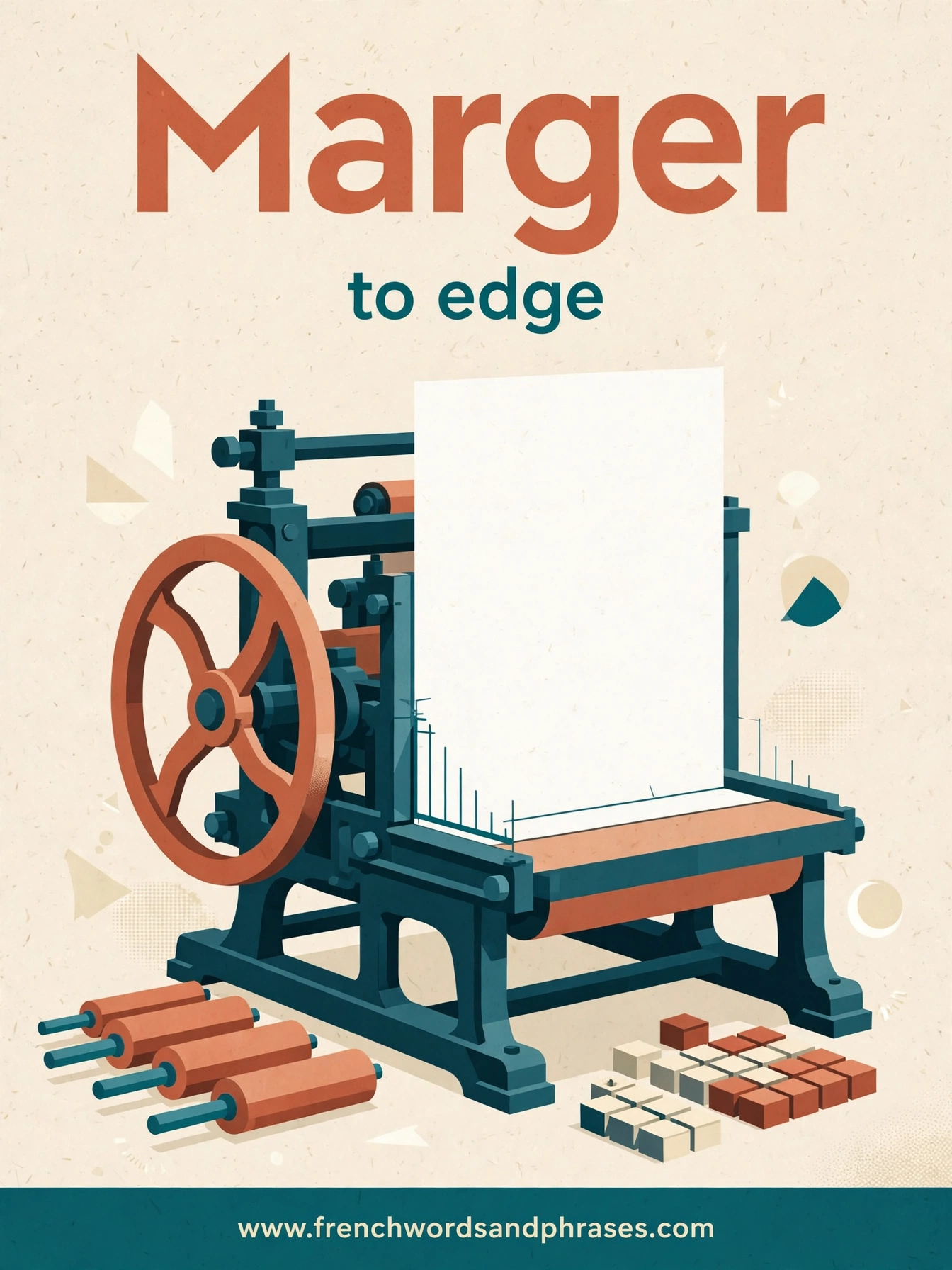
Marger means to edge — to set and keep the margin of a printed page.
A proof coming off the press with a crooked margin, a letter typed too close to the edge of the sheet — marger is the printer’s verb: to give the page its frame of white before a single word is read.
In this guide, you’ll learn how to conjugate marger in all the major French tenses and moods. Explore complete conjugation tables, French examples, English translations, and practice quizzes.
Understanding the French Verb Marger
Marger is a regular French verb belonging to the first group of verbs, those ending in -er.
It means to edge. It is commonly used in printing and typography for setting the margins of a page, for feeding sheets into a press against the margin stop, and on typewriters and word processors for fixing where each line begins — the quiet geometry that makes a page look professional.
Verb classification: First group (-er)
Auxiliary verb: Avoir
Past participle: margé
Present participle: margeant
English equivalents: To margin, to set the margins of; to feed (paper) against the margin guide; la marge — the margin.
One important detail: marger is a -ger verb, and it keeps a silent e after the g before a and o so the g stays soft: nous margeons, je margeais — but the e disappears before i: nous margions, vous margiez. The verb belongs to the print shop and the typewriter: marger une feuille is to set the sheet against its guide so the text block sits squarely inside la marge, the margin — the white border that frames every printed page.
Experience the Word
Marger is the verb of the invisible frame — nobody praises a good margin, but everybody notices a missing one.
Imagine an old print shop smelling of ink and paper. The apprentice lays each sheet against the guide, checks the white border with a practised thumb, and only then lets the press come down.
No ink has touched the page yet. It has been margined — given the frame its words will live in.
How to Conjugate Marger: Complete French Conjugation Guide
Let’s explore every major conjugation of marger, beginning with the indicative mood.
How to Conjugate Marger in the Indicative Mood
The indicative mood is used to express facts, observations, actions, and events.
How to Conjugate Marger in the Present Tense (Présent)
Used for actions happening now, habitual actions, and general truths.
| Subject | Conjugation |
|---|---|
| je | marge |
| tu | marges |
| il / elle | marge |
| nous | margeons |
| vous | margez |
| ils / elles | margent |
Example
Elle marge chaque feuille avant de lancer l’impression.
She margins every sheet before starting the print run.
Quick Quiz 1
Complete the sentence:
Nous ______ les feuilles avant l’impression.
Reveal the answer
margeons
Nous margeons les feuilles avant l’impression.
We margin the sheets before printing. Note the e that keeps the g soft.
How to Conjugate Marger in the Passé Composé
Used for completed actions in the past. Marger takes the auxiliary verb avoir.
| Subject | Conjugation |
|---|---|
| j’ | ai margé |
| tu | as margé |
| il / elle | a margé |
| nous | avons margé |
| vous | avez margé |
| ils / elles | ont margé |
Example
Il a margé le document à deux centimètres de chaque côté.
He set the document’s margins at two centimetres on each side.
How to Conjugate Marger in the Imparfait (Imperfect Tense)
Used for habitual past actions, descriptions, and ongoing situations in the past.
| Subject | Conjugation |
|---|---|
| je | margeais |
| tu | margeais |
| il / elle | margeait |
| nous | margions |
| vous | margiez |
| ils / elles | margeaient |
Example
L’apprenti margeait les feuilles à la main, une par une.
The apprentice used to margin the sheets by hand, one by one.
Quick Quiz 2
Choose the correct form:
She set the margins of the document.
Elle ______ le document. (a margé / est margée)
Reveal the answer
a margé
Elle a margé le document.
Marger takes avoir.
How to Conjugate Marger in the Plus-que-parfait
Used to describe an action that had already been completed before another past event.
| Subject | Conjugation |
|---|---|
| j’ | avais margé |
| tu | avais margé |
| il / elle | avait margé |
| nous | avions margé |
| vous | aviez margé |
| ils / elles | avaient margé |
Example
Nous avions margé la page avant de composer le titre.
We had set the page margins before typesetting the title.
How to Conjugate Marger in the Passé Simple
Primarily used in formal writing, literature, and historical narratives. It is rarely used in everyday conversation.
| Subject | Conjugation |
|---|---|
| je | margeai |
| tu | margeas |
| il / elle | margea |
| nous | margeâmes |
| vous | margeâtes |
| ils / elles | margeèrent |
Example
Elle marga la feuille et abaissa le levier de la presse.
She margined the sheet and lowered the press lever.
How to Conjugate Marger in the Passé Antérieur
A literary tense used to express an action completed immediately before another past action, generally in the passé simple.
| Subject | Conjugation |
|---|---|
| j’ | eus margé |
| tu | eus margé |
| il / elle | eut margé |
| nous | eûmes margé |
| vous | eûtes margé |
| ils / elles | eurent margé |
Example
Quand il eut margé le papier, il commença l’impression des affiches.
When he had margined the paper, he began printing the posters.
How to Conjugate Marger in the Future Tense (Futur Simple)
Used to describe actions that will take place in the future.
| Subject | Conjugation |
|---|---|
| je | margerai |
| tu | margeras |
| il / elle | margera |
| nous | margerons |
| vous | margerez |
| ils / elles | margeront |
Example
Demain, nous margerons le registre avant de le relier.
Tomorrow, we will set the register’s margins before binding it.
How to Conjugate Marger in the Futur Antérieur (Future Perfect)
Used for an action that will have been completed before a particular point in the future.
| Subject | Conjugation |
|---|---|
| j’ | aurai margé |
| tu | auras margé |
| il / elle | aura margé |
| nous | aurons margé |
| vous | aurez margé |
| ils / elles | auront margé |
Example
À midi, elle aura margé toutes les pages du catalogue.
By noon, she will have margined all the pages of the catalogue.
How to Conjugate Marger in the Near Future (Futur Proche)
Used to describe something that is going to happen soon. Formed with aller + infinitive.
| Subject | Conjugation |
|---|---|
| je | vais marger |
| tu | vas marger |
| il / elle | va marger |
| nous | allons marger |
| vous | allez marger |
| ils / elles | vont marger |
Example
Je vais marger ce document avant de l’envoyer à l’imprimerie.
I am going to set the margins of this document before sending it to the printers.
How to Conjugate Marger in the Conditional Mood
The conditional mood expresses what would happen under certain circumstances. It is also frequently used to make polite requests or express wishes.
How to Conjugate Marger in the Present Conditional
| Subject | Conjugation |
|---|---|
| je | margerais |
| tu | margerais |
| il / elle | margerait |
| nous | margerions |
| vous | margeriez |
| ils / elles | margeraient |
Example
Avec une marge plus large, je margerais le texte plus au centre.
With a wider margin, I would set the text closer to the centre.
How to Conjugate Marger in the Past Conditional
| Subject | Conjugation |
|---|---|
| j’ | aurais margé |
| tu | aurais margé |
| il / elle | aurait margé |
| nous | aurions margé |
| vous | auriez margé |
| ils / elles | auraient margé |
Example
Elle aurait margé la page autrement pour la reliure.
She would have margined the page differently for the binding.
Marger in the Literary Past Conditional Form
This less common literary form uses the imperfect subjunctive of avoir.
| Subject | Conjugation |
|---|---|
| j’ | eusse margé |
| tu | eusses margé |
| il / elle | eût margé |
| nous | eussions margé |
| vous | eussiez margé |
| ils / elles | eussent margé |
Example
Il eût margé chaque feuille avec la précision d’un compagnon imprimeur.
He would have margined each sheet with the precision of a master printer.
How to Conjugate Marger in the Subjunctive Mood
The subjunctive is used to express wishes, emotions, doubts, necessity, and uncertainty. It frequently follows expressions such as il faut que (it is necessary that) or bien que (although).
How to Conjugate Marger in the Present Subjunctive
| Subject | Conjugation |
|---|---|
| que je | marge |
| que tu | marges |
| qu’il / qu’elle | marge |
| que nous | margions |
| que vous | margiez |
| qu’ils / qu’elles | margent |
Example
Il faut que tu marges la feuille bien droite.
You must margin the sheet nice and straight.
Quick Quiz 3
Complete the sentence using the subjunctive:
Il faut que vous ______ la page.
Reveal the answer
margiez
Il faut que vous margiez la page.
You must set the page margins. No extra e before i in margiez.
How to Conjugate Marger in the Imperfect Subjunctive
A literary tense, rarely encountered in modern spoken French.
| Subject | Conjugation |
|---|---|
| que je | margasse |
| que tu | margasses |
| qu’il / qu’elle | margât |
| que nous | margassions |
| que vous | margassiez |
| qu’ils / qu’elles | margassent |
Example
Je voulais qu’elle margeât le document avant la composition.
I wanted her to set the document’s margins before typesetting.
How to Conjugate Marger in the Pluperfect Subjunctive
A literary construction used to express an action completed before another past action.
| Subject | Conjugation |
|---|---|
| que j’ | eusse margé |
| que tu | eusses margé |
| qu’il / qu’elle | eût margé |
| que nous | eussions margé |
| que vous | eussiez margé |
| qu’ils / qu’elles | eussent margé |
Example
Il regrettait que nous eussions margé si près du bord.
He regretted that we had margined so close to the edge.
How to Conjugate Marger in the Past Subjunctive
| Subject | Conjugation |
|---|---|
| que j’ | aie margé |
| que tu | aies margé |
| qu’il / qu’elle | ait margé |
| que nous | ayons margé |
| que vous | ayez margé |
| qu’ils / qu’elles | aient margé |
Example
Je suis content que tu aies margé le texte correctement.
I am glad you set the text’s margins correctly.
How to Conjugate Marger in the Imperative
The imperative is used to give commands, instructions, invitations, or suggestions. Subject pronouns are omitted.
How to Conjugate Marger in the Present Imperative
| Person | Conjugation |
|---|---|
| (tu) | marge |
| (nous) | margeons |
| (vous) | margez |
Example
Marge la feuille contre le guide, puis imprime !
Margin the sheet against the guide, then print!
Quick Quiz 4
How would you say Margin the sheet (tu form)?
Reveal the answer
Marge la feuille !
French Participles of Marger
Participles are verb forms that can be used in compound tenses and other grammatical constructions.
Present Participle of Marger
margeant
En margeant les feuilles, il vérifiait chaque bord du regard.
While margining the sheets, he checked each edge with his eye.
Past Participle of Marger
margé
Margée trop étroit, la page semble étouffer son texte.
Margined too narrowly, the page seems to suffocate its text.
Marger in Everyday French: Real-Life Examples
Now that you know the conjugations, let’s see how marger appears in everyday French.
Example 1 — Present
Je marge toujours mes documents avant de les imprimer.
I always set the margins of my documents before printing them.
Example 2 — Passé composé
Elle a margé la lettre à l’ancienne, sur sa machine à écrire.
She margined the letter the old way, on her typewriter.
Example 3 — Imparfait
À l’imprimerie, on margeait le papier à la main.
At the print shop, the paper was margined by hand.
Example 4 — Future
Nous margerons les affiches avant l’impression.
We will margin the posters before printing.
Example 5 — Conditional
Tu margerais la page un peu plus large, toi ?
Would you set the page margins a bit wider?
Example 6 — Imperative
Margez les feuilles bien droites !
Margin the sheets nice and straight!
Beyond Translation: The Meaning of Marger
English borrows the noun margin and mostly leaves it there; French marger turns the margin into an action, something a craftsman does with his hands.
La marge is where French thinks.
Students write in it, readers argue in it, printers protect it — and the same word gives en marge de, on the sidelines of, for everything that happens just outside the official text.
How to Remember the French Verb Marger
Remember it this way: Marger is about the printer’s frame — white borders set before the words arrive.
- Nous margeons — the e after g keeps the sound soft before o; nous margions drops it before i.
- La marge is the margin; marger is the act of setting it.
- Regular -ger: je marge, nous margeons, past participle margé.
The key idea is the printer’s frame — white borders set before the words arrive.
Test Your Knowledge of Marger
Let’s see how much you’ve learned. Try answering these questions before revealing the answers.
Question 1
Why is nous margeons written with an e after the g?
Reveal the answer
To keep the g soft — before o, a bare g would sound hard, so French keeps a silent e: margeons, but margions before i.
Question 2
How do you say You must margin the sheet in French?
Reveal the answer
Il faut que tu marges la feuille.
Question 3
Translate: He set the document’s margins at two centimetres.
Reveal the answer
Il a margé le document à deux centimètres.
Question 4
What is the past participle of marger?
Reveal the answer
Margé.
Question 5
Complete the sentence:
Il faut que vous ______ la page avant l’impression.
Reveal the answer
margiez
Il faut que vous margiez la page avant l’impression.
You must set the page margins before printing.
Your Final Challenge
Can You Use It?
How would you say this in French?
He margins each sheet with care, and the book is born already well framed.
Reveal the answer
Il marge chaque feuille avec soin, et le livre naît déjà bien cadré.
He margins each sheet with care, and the book is born already well framed.
A little French. A little curiosity. A richer everyday life.
LEARN FRENCH ONE WORD AT A TIME