A French Word to Live By
Translate Maréchal to English
/ma.ʁe.ʃal/
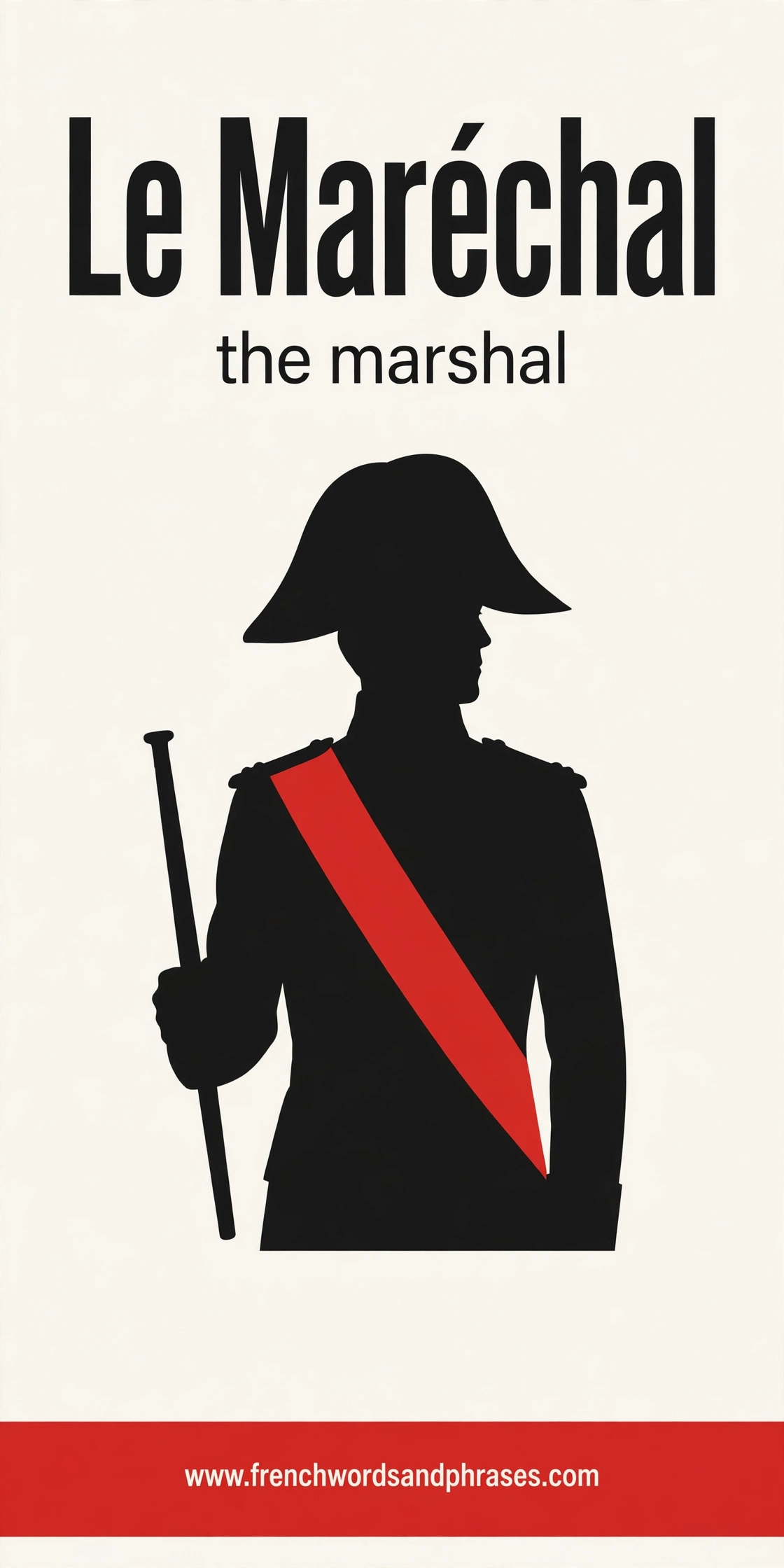
Le maréchal means the marshal.
On the parade ground, the troops stand silent as an old officer walks slowly down the line, a short decorated baton under his arm. No one outranks him here: he is le maréchal, a Marshal of France.
In this guide, you’ll learn what maréchal means in English, how to use it with its articles, how to form its plural, and how it appears in everyday French. Explore French examples, English translations, and practice quizzes.
Understanding the French Noun Maréchal
Maréchal is a masculine French noun, learned with its article: le maréchal, un maréchal. It names the highest rank in the French army — and its plural follows the famous -al pattern: les maréchaux, like cheval, chevaux.
It means the marshal — a Marshal of France, the summit of a military career, a dignity rather than an everyday rank. Watch the plural: nouns ending in -al usually change to -aux, so des maréchaux. The word also survives in le maréchal-ferrant, the farrier who shoes horses — a reminder that the marshal began as the man in charge of the horses.
Gender: Masculine
Definite article: le — le maréchal (the marshal)
Indefinite article: un — un maréchal (a marshal)
Plural: les maréchaux — the -al ending becomes -aux
Highest honour: Maréchal de France — a dignity, above every rank
Other trade: le maréchal-ferrant — the farrier, the horse-shoer
One important usage detail: the plural. Like cheval → chevaux and journal → journaux, maréchal becomes maréchaux — never ‘maréchals’. And capitalise with care: le Maréchal with a capital often points to one famous holder of the title in history books.
Experience the Word
Maréchal is a word heavy with ceremony. France has named only a few hundred marshals in eight centuries; the title was carried by Turenne, by Napoleon’s marshals, and by the victors of the First World War — Foch, Joffre, Pétain, Leclerc after the Second.
The symbol of the dignity is the famous baton — le bâton de maréchal, blue with golden stars — which is why the word maréchal travels so often with the word bâton. The baton says what the title means: command, recognised at the highest level.
Yet the word began at the stable door: in old Germanic, a ‘marshal’ was a horse-servant. The man who cared for the horses rose, century by century, until he commanded the armies — and the village maréchal-ferrant still keeps the original trade alive.
How to Use Maréchal in French: Complete Guide
Let’s explore how maréchal works in French, beginning with its articles — and master that plural in -aux.
Maréchal with the Definite Article (Le, Les)
The article changes; in the plural the noun itself changes too.
| Form | French |
|---|---|
| Singular | le maréchal |
| Plural | les maréchaux |
Example
Le maréchal inspecte les troupes une dernière fois.
The marshal inspects the troops one last time.
Maréchal with the Indefinite Article (Un, Des)
Use un for one marshal, des for marshals in general.
| Form | French |
|---|---|
| Singular | un maréchal |
| Plural | des maréchaux |
Example
Napoléon a nommé un maréchal après la victoire.
Napoleon appointed a marshal after the victory.
Maréchal in Quantities and Negatives
After quantities and in negatives, des becomes de — but -aux stays.
| Expression | French |
|---|---|
| several marshals | plusieurs maréchaux |
| two marshals | deux maréchaux |
| many marshals | beaucoup de maréchaux |
| no marshal | pas de maréchal |
Example
Plusieurs maréchaux assistaient à la cérémonie.
Several marshals attended the ceremony.
Quick Quiz 1
Complete the sentence:
______ maréchal Foch a signé l’armistice en 1918. (the)
Reveal the answer
Le
Le maréchal Foch a signé l’armistice en 1918.
Marshal Foch signed the armistice in 1918 — le, because maréchal is masculine.
The Plural of Maréchal
Nouns ending in -al form their plural in -aux.
| Number | French |
|---|---|
| Singular | le maréchal |
| Plural | les maréchaux |
Example
Les maréchaux de Napoléon sont restés célèbres.
Napoleon’s marshals have remained famous.
Maréchal with Possessive Adjectives (Mon, Ton, Son…)
Maréchal is masculine, so the singular possessives are mon, ton, son.
| Owner | French |
|---|---|
| my | mon maréchal |
| your (tu) | ton maréchal |
| his / her | son maréchal |
| our | notre maréchal |
| your (vous) | votre maréchal |
| their | leur maréchal |
Example
Leur maréchal a gagné la bataille décisive.
Their marshal won the decisive battle.
Quick Quiz 2
Complete the sentence:
Les ______ de France portent un bâton bleu et or. (marshals)
Reveal the answer
maréchaux
Les maréchaux de France portent un bâton bleu et or.
The Marshals of France carry a blue and gold baton — the plural of -al is -aux.
Maréchal with Demonstrative Adjectives (Ce, Ces)
Ce points to one marshal, ces to several.
| Form | French |
|---|---|
| Singular | ce maréchal |
| Plural | ces maréchaux |
Example
Ce maréchal était aimé de ses soldats.
This marshal was loved by his soldiers.
Maréchal with Adjectives
Adjectives agree: masculine singular with maréchal, masculine plural with maréchaux.
| Adjective | With Maréchal |
|---|---|
| célèbre (famous) | un maréchal célèbre |
| français (French) | un maréchal français |
| vieux (old) | un vieux maréchal |
| grand (great) | un grand maréchal |
Example
Un vieux maréchal racontait ses batailles aux enfants.
An old marshal told the children about his battles.
Quick Quiz 3
True or false?
The plural of maréchal is « les maréchals ».
Reveal the answer
False
The plural is les maréchaux — like cheval, chevaux, the -al ending becomes -aux.
Everyday Expressions with Maréchal
Maréchal appears in titles and one famous saying.
| Expression | In English |
|---|---|
| le Maréchal de France | the Marshal of France, the highest dignity |
| le bâton de maréchal | the marshal’s baton, symbol of supreme command |
| le maréchal-ferrant | the farrier, the craftsman who shoes horses |
| chaque soldat porte dans sa giberne le bâton de maréchal | every soldier carries a marshal’s baton in his knapsack — anyone can rise to the top |
Example
Le maréchal-ferrant du village ferre encore les chevaux.
The village farrier still shoes the horses.
Words from the Same Family as Maréchal
Words from the marshal’s world of horses and armies.
| French | In English |
|---|---|
| le cheval | the horse — plural chevaux, like maréchaux |
| le général | the general — plural généraux |
| la giberne | the cartridge pouch, the knapsack of the saying |
Example
Le général attend les ordres du maréchal.
The general awaits the marshal’s orders.
Quick Quiz 4
Complete the sentence:
Le ______ -ferrant change les fers du cheval. (marshal)
Reveal the answer
maréchal
Le maréchal-ferrant change les fers du cheval.
The farrier changes the horse’s shoes — the marshal’s original trade.
Maréchal in Everyday French: Real-Life Examples
Now that you know the word, let’s see how maréchal appears in everyday French.
Example 1 — In a history lesson
Le maréchal Joffre a gagné la bataille de la Marne.
Marshal Joffre won the Battle of the Marne.
Example 2 — At a ceremony
Les maréchaux sont placés au premier rang.
The marshals are seated in the front row.
Example 3 — Reading a novel
Le vieux maréchal se souvient de ses campagnes.
The old marshal remembers his campaigns.
Example 4 — At the farm
Le maréchal-ferrant arrive demain pour les chevaux.
The farrier is coming tomorrow for the horses.
Example 5 — Talking ambition
Il rêve, lui aussi, de son bâton de maréchal.
He too dreams of his marshal’s baton.
Example 6 — At the museum
Ce bâton a appartenu à un maréchal de Napoléon.
This baton belonged to one of Napoleon’s marshals.
Beyond Translation: The Meaning of Maréchal
The marshal’s story is the story of a word climbing a ladder. It begins with a servant who looks after horses, rises through the royal stables to the command of armies, and ends as the highest dignity France can give a soldier. Napoleon — himself risen from nowhere — loved the idea so much that his saying about the baton in every soldier’s knapsack became the motto of ambition itself. And the old trade never disappeared: in French villages, le maréchal-ferrant still shoes horses, keeping the word’s first job alive beside its glorious second one.
How to Remember the French Noun Maréchal
Remember it this way: Maréchal is the marshal — remember the plural: like cheval becomes chevaux, maréchal becomes maréchaux.
- You see the rank — le maréchal, above every general.
- You form the plural — les maréchaux, -al turning into -aux.
- You remember the stable — le maréchal-ferrant, still shoeing horses.
The key idea is le maréchal, les maréchaux — from the stable to the summit.
Test Your Knowledge of Maréchal
Let’s see how much you’ve learned. Try answering these questions before revealing the answers.
Question 1
Is maréchal masculine or feminine?
Reveal the answer
Masculine — le maréchal, un maréchal.
Question 2
What is the plural of maréchal?
Reveal the answer
Les maréchaux — the -al ending becomes -aux, like cheval, chevaux.
Question 3
What is « le maréchal-ferrant »?
Reveal the answer
The farrier — the craftsman who shoes horses.
Question 4
What does the marshal carry as the symbol of his dignity?
Reveal the answer
Le bâton de maréchal — the blue and gold marshal’s baton.
Question 5
How do you say ‘several marshals’?
Reveal the answer
Plusieurs maréchaux — with the -aux plural.
Your Final Challenge
Can You Use It?
How would you say this in French?
“The marshal inspects the troops.”
Reveal the answer
Le maréchal inspecte les troupes.
The marshal inspects the troops.
A little French. A little curiosity. A richer everyday life.
LEARN FRENCH ONE WORD AT A TIME