A French Word to Live By
Translate Maître to English
/mɛtʁ/
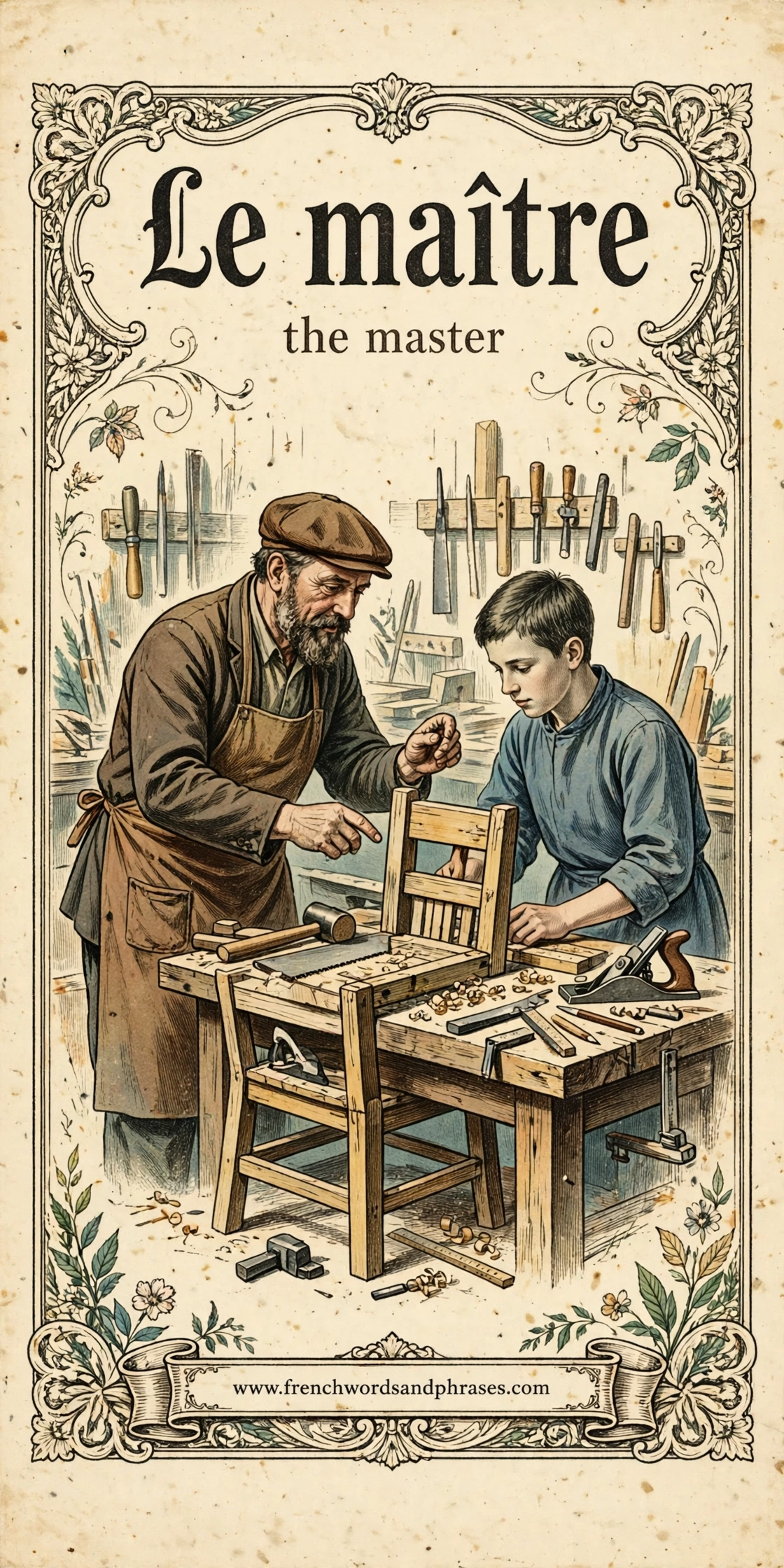
Le maître means the master.
He corrects the class with one raised eyebrow, she has painted for fifty years and students cross oceans for her criticism, and the dog at the gate watches one person only: le maître, the master — the teacher, the expert, the owner, the one in charge.
In this guide, you’ll learn what maître means in English, how to use it with its articles, how to form its plural, and how it appears in everyday French. Explore French examples, English translations, and practice quizzes.
Understanding the French Noun Maître
Maître is a masculine French noun, learned with its article: le maître, un maître. It comes from the Latin magister — the same root as English master and magistrate. Its feminine is la maîtresse, which serves as the schoolmistress and, in another life, a lover — handle with care. Maître fans out across French life: the primary-school teacher (le maître d’école), the master craftsman, the lawyer’s title (Maître Dupont), the dog’s owner, and the master of the house (le maître de maison).
It means a master — first the teacher of young children: le maître de mon fils, my son’s teacher, le maître d’école, the schoolmaster. Then the supreme expert: un maître de la peinture, a master of painting, un coup de maître, a masterstroke. Then authority and ownership: le maître de maison, the master of the house, le maître du chien, the dog’s owner, être maître de soi, to be master of oneself. As a title, lawyers are addressed as Maître — Maître Martin, never Monsieur Martin, in court.
Gender: Masculine — le maître
Definite article: le — le maître (the master)
Indefinite article: un — un maître (a master)
Plural: les maîtres — regular, with a simple -s
Spelling note: the î keeps the memory of a lost s — Latin magister; the feminine is la maîtresse
Key lives: schoolmaster, master craftsman, lawyer’s title, dog’s owner, master of the house
English equivalents: The master; a teacher (primary school).
At primary school, children call their teacher simply maître — « Maître, je peux sortir ? » — where secondary school switches to monsieur and professeur. The feminine maîtresse is the schoolmistress in the classroom and a lover outside it; context and tone decide, and learners should know both. For mastery of a subject, the verb is maîtriser: maîtriser une langue, to master a language.
Experience the Word
Maître is authority earned and recognised: the class falls silent, the atelier watches his hands, the dog sits — all for the same word.
Imagine the village school in 1960, ink pens scratching, the stove ticking in the corner. One cough from le maître and forty backs straighten. He taught their parents before them; his authority needs no raising of the voice.
You have not just named a boss. You have named mastery itself — le maître, the master, teacher, expert and owner in one.
How to Use Maître in French: Complete Guide
Let’s explore how maître works in French, beginning with its articles — le maître, un maître, le maître d’école.
Maître with the Definite Article (Le, Les)
Used for a specific master — the teacher, the owner, the expert in question.
| Form | French |
|---|---|
| Masculine singular | le maître |
| Plural | les maîtres |
Example
Le maître explique la leçon au tableau.
The teacher explains the lesson on the board.
Maître with the Indefinite Article (Un, Des)
Used for a master in general — of painting, of dogs, of ceremonies.
| Form | French |
|---|---|
| Masculine singular | un maître |
| Plural | des maîtres |
Example
Rembrandt était un maître de la lumière.
Rembrandt was a master of light.
Maître and His Kingdoms (D’école, De maison, De soi…)
Each kingdom names its master — the phrases that sort them out.
| Quantity | French |
|---|---|
| the schoolmaster | le maître d’école |
| the master of the house | le maître de maison |
| a master of painting | un maître de la peinture |
| to be master of oneself | être maître de soi |
| a masterstroke | un coup de maître |
Example
Un coup de maître a décidé du match.
A masterstroke decided the match.
Quick Quiz 1
Complete the sentence:
______ maître distribue les cahiers. (the)
Reveal the answer
Le
Le maître distribue les cahiers.
The teacher hands out the notebooks — maître is masculine, so le.
The Plural of Maître
Maître takes a regular plural in -s — old masters in the museum, schoolmasters at the fête.
| Number | French |
|---|---|
| Singular | le maître |
| Plural | les maîtres |
Example
Les maîtres anciens sont exposés au Louvre.
The old masters are exhibited at the Louvre.
Maître with Possessive Adjectives (Mon, Ton, Son…)
Possessives agree with the noun: maître is masculine, so mon, ton, son in the singular.
| Owner | French |
|---|---|
| my | mon maître |
| your (tu) | ton maître |
| his / her | son maître |
| our | notre maître |
| your (vous) | votre maître |
| their | leur maître |
Example
Le chien attend son maître devant la boulangerie.
The dog waits for its master outside the bakery.
Quick Quiz 2
Complete the sentence:
Les élèves écoutent ______ maître en silence. (their)
Reveal the answer
leur
Les élèves écoutent leur maître en silence.
The pupils listen to their teacher in silence — leur, because maître is singular.
Maître with Demonstrative Adjectives (Ce, Ces)
Used to point: ce maître, this master — this teacher, this expert.
| Form | French |
|---|---|
| Masculine singular | ce maître |
| Plural | ces maîtres |
Example
Ce maître a formé trois générations d’artisans.
This master has trained three generations of craftsmen.
Maître with Adjectives
Adjectives agree with maître — masculine singular: un maître exigeant, un grand maître.
| Adjective | With Maître |
|---|---|
| exigeant (demanding) | un maître exigeant |
| grand (great) | un grand maître |
| ancien (old, former) | un maître ancien |
| sévère (strict) | un maître sévère |
| respecté (respected) | un maître respecté |
Example
Un maître sévère mais juste dirigeait l’école.
A strict but fair master ran the school.
Quick Quiz 3
Complete the sentence:
C’est un ______ maître de la cuisine française. (great)
Reveal the answer
grand
C’est un grand maître de la cuisine française.
He is a great master of French cooking — grand, masculine, before the noun.
Everyday Expressions with Maître
Classrooms, courts and chessboards — the maître phrases of daily life.
| Expression | In English |
|---|---|
| le maître d’école | the primary-school teacher |
| être maître de soi | to be master of oneself, self-controlled |
| un coup de maître | a masterstroke |
| Maître + name | the title of a lawyer: Maître Dupont |
| le maître de maison | the master of the house, the host |
Example
Maître Dupont plaide cet après-midi au tribunal.
Maître Dupont is pleading at the court this afternoon.
Words from the Same Family as Maître
Mastery and mistresses — the words that travel with maître.
| French | In English |
|---|---|
| la maîtresse | the schoolmistress; also a lover — context decides |
| maîtriser | to master, to control (the verb) |
| la maîtrise | mastery; a master’s degree |
| un professeur | a teacher (secondary and university) |
| un élève | a pupil — the maître’s counterpart |
Example
Elle maîtrise parfaitement trois langues.
She has a perfect mastery of three languages.
Quick Quiz 4
How is a lawyer addressed in a French court?
Reveal the answer
Maître — Maître followed by the surname, never Monsieur in the courtroom.
Maître Martin, vous avez la parole.
Maître Martin, you may speak.
Maître in Everyday French: Real-Life Examples
Now that you know the word, let’s see how maître appears in everyday French.
Example 1 — At school
Maître, je n’ai pas compris l’exercice.
Sir, I didn’t understand the exercise.
Example 2 — Dogs
Le chien court vers son maître dès qu’il rentre.
The dog runs to its master as soon as he comes home.
Example 3 — Art
Ce peintre est un maître de la couleur.
This painter is a master of colour.
Example 4 — Self-control
Il reste maître de soi même sous la pression.
He stays master of himself even under pressure.
Example 5 — Law
Maître Leroy représente la famille au procès.
Maître Leroy represents the family at the trial.
Example 6 — Chess
Elle joue contre un grand maître d’échecs.
She is playing against a chess grandmaster.
Beyond Translation: The Meaning of Maître
Maître is Latin magister wearing French dress, and it never retired: the same word salutes the village schoolmaster, the grand maître of chess, the maître d’hôtel who runs the dining room, and the maître de maison who carves at his own table. Its feminine, maîtresse, split into two lives — the respected schoolmistress of the classroom and the lover of the novel — a doubling every French speaker navigates without thinking. Mastery, in this word, is always personal: there is no maître without someone who recognises him.
To say maître is to name the person the room looks to.
It evokes the raised eyebrow in the classroom, the lawyer rising in court, and the dog’s whole heart at the gate.
How to Remember the French Noun Maître
Remember it this way: Maître is the master — masculine: le maître, from the schoolmaster to the lawyer’s title to the dog’s owner.
- Always masculine — le maître, un maître, mon maître.
- The kingdoms — maître d’école (teacher), maître de maison (host), Maître Dupont (lawyer).
- The feminine trap — la maîtresse is the schoolmistress… and also a lover; context decides.
The key idea is le maître — the master, the teacher, masculine; feminine la maîtresse.
Test Your Knowledge of Maître
Let’s see how much you’ve learned. Try answering these questions before revealing the answers.
Question 1
Is maître masculine or feminine?
Reveal the answer
Masculine — le maître, un maître.
Question 2
How do primary-school children address their teacher?
Reveal the answer
Maître — « Maître, je peux sortir ? »
Question 3
Translate: The dog waits for its master.
Reveal the answer
Le chien attend son maître.
Question 4
What does être maître de soi mean?
Reveal the answer
To be master of oneself — to stay self-controlled.
Question 5
Complete the sentence:
______ maîtres anciens sont au Louvre. (the)
Reveal the answer
Les
Les maîtres anciens sont au Louvre.
The old masters are at the Louvre.
Your Final Challenge
Can You Use It?
How would you say this in French?
“The teacher explains the lesson on the board.”
Reveal the answer
Le maître explique la leçon au tableau.
The teacher explains the lesson on the board.
A little French. A little curiosity. A richer everyday life.
LEARN FRENCH ONE WORD AT A TIME