
A French Word to Live By
How to Conjugate Luire in French
/lɥiʁ/
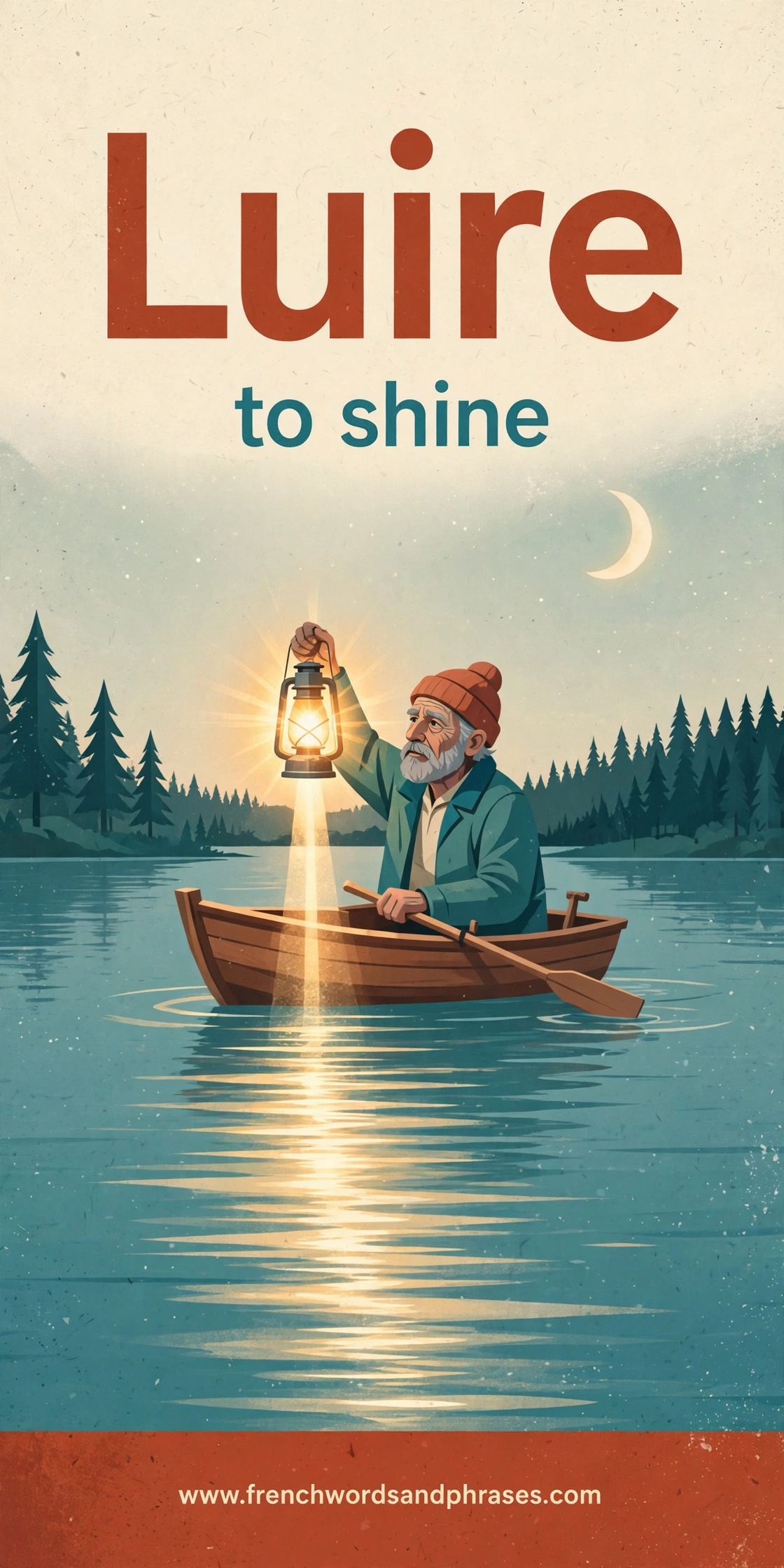
Luire means to shine or to gleam.
The sun breaking through after rain, a cat’s eyes in the dark, a lighthouse across the bay — luire is the quieter shine of French, the gleam of things that give light without noise.
In this guide, you’ll learn how to conjugate luire in all the major French tenses and moods. Explore complete conjugation tables, French examples, English translations, and practice quizzes.
Understanding the French Verb Luire
Luire is a French verb belonging to the third group of verbs, those ending in -ire.
It means to shine, to gleam. It is commonly used for the sun and moon shining, eyes gleaming (les yeux lui luisent de joie), wet streets and roofs glistening, and figuratively for hope appearing — une lueur d’espoir luit, a glimmer of hope shines.
Verb classification: Third group (-ire)
Auxiliary verb: Avoir
Past participle: lui
Present participle: luisant
English equivalents: To shine, to gleam, to glow softly (sun, moon, eyes, hope).
One important detail: the past participle of luire is lui — and it never changes: le soleil a lui, la lune a lui, les étoiles ont lui. No agreement, ever. The present keeps the family shape: je luis, il luit, nous luisons, ils luisent, and the passé simple grows an extra syllable: il luisit.
Experience the Word
Luire is the verb of the soft gleam — not the blaze of fire, but the steady light of sun, moon and eyes.
Imagine a harbour at dawn in Brittany. The water is grey silk, the boats are shadows — then the sun lifts, and every wet rope and railing begins to luire at once.
Nothing has caught fire. Everything is simply shining.
How to Conjugate Luire: Complete French Conjugation Guide
Let’s explore every major conjugation of luire, beginning with the indicative mood.
How to Conjugate Luire in the Indicative Mood
The indicative mood is used to express facts, observations, actions, and events.
How to Conjugate Luire in the Present Tense (Présent)
Used for actions happening now, habitual actions, and general truths.
| Subject | Conjugation |
|---|---|
| je | luis |
| tu | luis |
| il / elle | luit |
| nous | luisons |
| vous | luisez |
| ils / elles | luisent |
Example
Le soleil luit après la pluie.
The sun is shining after the rain.
Quick Quiz 1
Complete the sentence:
Les yeux de l’enfant ______ de joie.
Reveal the answer
luisent
Les yeux de l’enfant luisent de joie.
The child’s eyes gleam with joy.
How to Conjugate Luire in the Passé Composé
Used for completed actions in the past. Luire takes the auxiliary verb avoir.
| Subject | Conjugation |
|---|---|
| j’ | ai lui |
| tu | as lui |
| il / elle | a lui |
| nous | avons lui |
| vous | avez lui |
| ils / elles | ont lui |
Example
Ses yeux ont lui d’espoir.
Her eyes gleamed with hope.
How to Conjugate Luire in the Imparfait (Imperfect Tense)
Used for habitual past actions, descriptions, and ongoing situations in the past.
| Subject | Conjugation |
|---|---|
| je | luisais |
| tu | luisais |
| il / elle | luisait |
| nous | luisions |
| vous | luisiez |
| ils / elles | luisaient |
Example
La lune luisait sur le lac calme.
The moon used to shine on the calm lake.
Quick Quiz 2
Choose the correct form:
The stars shone.
Les étoiles ______ . (ont lui / ont luies)
Reveal the answer
ont lui
Les étoiles ont lui.
The participle lui never changes.
How to Conjugate Luire in the Plus-que-parfait
Used to describe an action that had already been completed before another past event.
| Subject | Conjugation |
|---|---|
| j’ | avais lui |
| tu | avais lui |
| il / elle | avait lui |
| nous | avions lui |
| vous | aviez lui |
| ils / elles | avaient lui |
Example
Une lumière avait lui toute la nuit dans la tour.
A light had shone all night in the tower.
How to Conjugate Luire in the Passé Simple
Primarily used in formal writing, literature, and historical narratives. It is rarely used in everyday conversation.
| Subject | Conjugation |
|---|---|
| je | luisis |
| tu | luisis |
| il / elle | luisit |
| nous | luisîmes |
| vous | luisîtes |
| ils / elles | luisirent |
Example
Un éclair luisit dans le ciel noir.
A flash of lightning gleamed in the black sky.
How to Conjugate Luire in the Passé Antérieur
A literary tense used to express an action completed immediately before another past action, generally in the passé simple.
| Subject | Conjugation |
|---|---|
| j’ | eus lui |
| tu | eus lui |
| il / elle | eut lui |
| nous | eûmes lui |
| vous | eûtes lui |
| ils / elles | eurent lui |
Example
Quand le soleil eut lui un instant, les nuages revinrent.
When the sun had shone for a moment, the clouds returned.
How to Conjugate Luire in the Future Tense (Futur Simple)
Used to describe actions that will take place in the future.
| Subject | Conjugation |
|---|---|
| je | luirai |
| tu | luiras |
| il / elle | luira |
| nous | luirons |
| vous | luirez |
| ils / elles | luiront |
Example
Demain, le soleil luira dès l’aube.
Tomorrow, the sun will shine from dawn.
How to Conjugate Luire in the Futur Antérieur (Future Perfect)
Used for an action that will have been completed before a particular point in the future.
| Subject | Conjugation |
|---|---|
| j’ | aurai lui |
| tu | auras lui |
| il / elle | aura lui |
| nous | aurons lui |
| vous | aurez lui |
| ils / elles | auront lui |
Example
À midi, le soleil aura lui sur toute la vallée.
By noon, the sun will have shone over the whole valley.
How to Conjugate Luire in the Near Future (Futur Proche)
Used to describe something that is going to happen soon. Formed with aller + infinitive.
| Subject | Conjugation |
|---|---|
| je | vais luire |
| tu | vas luire |
| il / elle | va luire |
| nous | allons luire |
| vous | allez luire |
| ils / elles | vont luire |
Example
Regarde, le soleil va luire entre les nuages.
Look, the sun is going to shine between the clouds.
How to Conjugate Luire in the Conditional Mood
The conditional mood expresses what would happen under certain circumstances. It is also frequently used to make polite requests or express wishes.
How to Conjugate Luire in the Present Conditional
| Subject | Conjugation |
|---|---|
| je | luirais |
| tu | luirais |
| il / elle | luirait |
| nous | luirions |
| vous | luiriez |
| ils / elles | luiraient |
Example
Sans les nuages, la lune luirait sur la mer.
Without the clouds, the moon would shine on the sea.
How to Conjugate Luire in the Past Conditional
| Subject | Conjugation |
|---|---|
| j’ | aurais lui |
| tu | aurais lui |
| il / elle | aurait lui |
| nous | aurions lui |
| vous | auriez lui |
| ils / elles | auraient lui |
Example
Le phare aurait lui toute la nuit sans la panne.
The lighthouse would have shone all night without the breakdown.
Luire in the Literary Past Conditional Form
This less common literary form uses the imperfect subjunctive of avoir.
| Subject | Conjugation |
|---|---|
| j’ | eusse lui |
| tu | eusses lui |
| il / elle | eût lui |
| nous | eussions lui |
| vous | eussiez lui |
| ils / elles | eussent lui |
Example
Le soleil eût lui sur la plaine gelée.
The sun would have shone over the frozen plain.
How to Conjugate Luire in the Subjunctive Mood
The subjunctive is used to express wishes, emotions, doubts, necessity, and uncertainty. It frequently follows expressions such as il faut que (it is necessary that) or bien que (although).
How to Conjugate Luire in the Present Subjunctive
| Subject | Conjugation |
|---|---|
| que je | luise |
| que tu | luises |
| qu’il / qu’elle | luise |
| que nous | luisions |
| que vous | luisiez |
| qu’ils / qu’elles | luisent |
Example
Il faut que le soleil luise pour la fête.
The sun must shine for the festival.
Quick Quiz 3
Complete the sentence using the subjunctive:
Il faut que la lune ______ ce soir.
Reveal the answer
luise
Il faut que la lune luise ce soir.
The moon must shine tonight.
How to Conjugate Luire in the Imperfect Subjunctive
A literary tense, rarely encountered in modern spoken French.
| Subject | Conjugation |
|---|---|
| que je | luisse |
| que tu | luisses |
| qu’il / qu’elle | luisît |
| que nous | luissions |
| que vous | luissiez |
| qu’ils / qu’elles | luissent |
Example
Je doutais que la lune luisît cette nuit-là.
I doubted the moon would shine that night.
How to Conjugate Luire in the Pluperfect Subjunctive
A literary construction used to express an action completed before another past action.
| Subject | Conjugation |
|---|---|
| que j’ | eusse lui |
| que tu | eusses lui |
| qu’il / qu’elle | eût lui |
| que nous | eussions lui |
| que vous | eussiez lui |
| qu’ils / qu’elles | eussent lui |
Example
Il semblait que le soleil eût lui toute la journée.
It seemed the sun had shone all day.
How to Conjugate Luire in the Past Subjunctive
| Subject | Conjugation |
|---|---|
| que j’ | aie lui |
| que tu | aies lui |
| qu’il / qu’elle | ait lui |
| que nous | ayons lui |
| que vous | ayez lui |
| qu’ils / qu’elles | aient lui |
Example
Je suis heureux que le soleil ait lui pour notre mariage.
I am glad the sun shone for our wedding.
How to Conjugate Luire in the Imperative
The imperative is used to give commands, instructions, invitations, or suggestions. Subject pronouns are omitted.
How to Conjugate Luire in the Present Imperative
| Person | Conjugation |
|---|---|
| (tu) | luis |
| (nous) | luisons |
| (vous) | luisez |
Example
Luis, petit soleil d’hiver !
Shine, little winter sun!
Quick Quiz 4
How would you say Shine (tu form)?
Reveal the answer
Luis !
French Participles of Luire
Participles are verb forms that can be used in compound tenses and other grammatical constructions.
Present Participle of Luire
luisant
En luisant, les étoiles guidaient les marins.
By shining, the stars guided the sailors.
Past Participle of Luire
lui
Le soleil a lui toute la matinée sur les toits.
The sun shone all morning on the rooftops.
Luire in Everyday French: Real-Life Examples
Now that you know the conjugations, let’s see how luire appears in everyday French.
Example 1 — Present
Le soleil luit, sortons !
The sun is shining, let’s go out!
Example 2 — Passé composé
La lune a lui sur la neige.
The moon shone on the snow.
Example 3 — Imparfait
Ses yeux luisaient de joie.
Her eyes were gleaming with joy.
Example 4 — Future
Le soleil luira demain.
The sun will shine tomorrow.
Example 5 — Conditional
La lune luirait sans les nuages.
The moon would shine without the clouds.
Example 6 — Imperative
Luis pour nous, soleil !
Shine for us, sun!
Beyond Translation: The Meaning of Luire
English shine covers everything from shoes to stars; French splits the work — briller for sparkle and glitter, luire for the calm gleam of lights and eyes.
Its noun is a word of hope.
Une lueur is a glimmer — and une lueur d’espoir, a glimmer of hope, is one of the most loved phrases in French. Where there is luire, there is lueur.
How to Remember the French Verb Luire
Remember it this way: Luire is about the soft gleam — sun, moon, eyes; participle lui.
- Past participle lui never agrees — le soleil a lui, les étoiles ont lui.
- Les yeux luisent — eyes gleam: the classic luire picture.
- Present: je luis, il luit, nous luisons — the conduire family shape.
The key idea is the soft gleam — sun, moon, eyes; participle lui.
Test Your Knowledge of Luire
Let’s see how much you’ve learned. Try answering these questions before revealing the answers.
Question 1
True or false: in les étoiles ont lui, the participle agrees with étoiles.
Reveal the answer
False — lui is invariable: les étoiles ont lui, never luies.
Question 2
How do you say The sun is shining after the rain in French?
Reveal the answer
Le soleil luit après la pluie.
Question 3
Translate: Her eyes were gleaming with joy.
Reveal the answer
Ses yeux luisaient de joie.
Question 4
What is the past participle of luire?
Reveal the answer
Lui — and it never changes.
Question 5
Complete the sentence:
Il faut que le soleil ______ pour la fête.
Reveal the answer
luise
Il faut que le soleil luise pour la fête.
The sun must shine for the festival.
Your Final Challenge
Can You Use It?
How would you say this in French?
After the rain, the sun shines and the rooftops glisten.
Reveal the answer
Après la pluie, le soleil luit et les toits brillent.
After the rain, the sun shines and the rooftops glisten.
A little French. A little curiosity. A richer everyday life.
LEARN FRENCH ONE WORD AT A TIME




