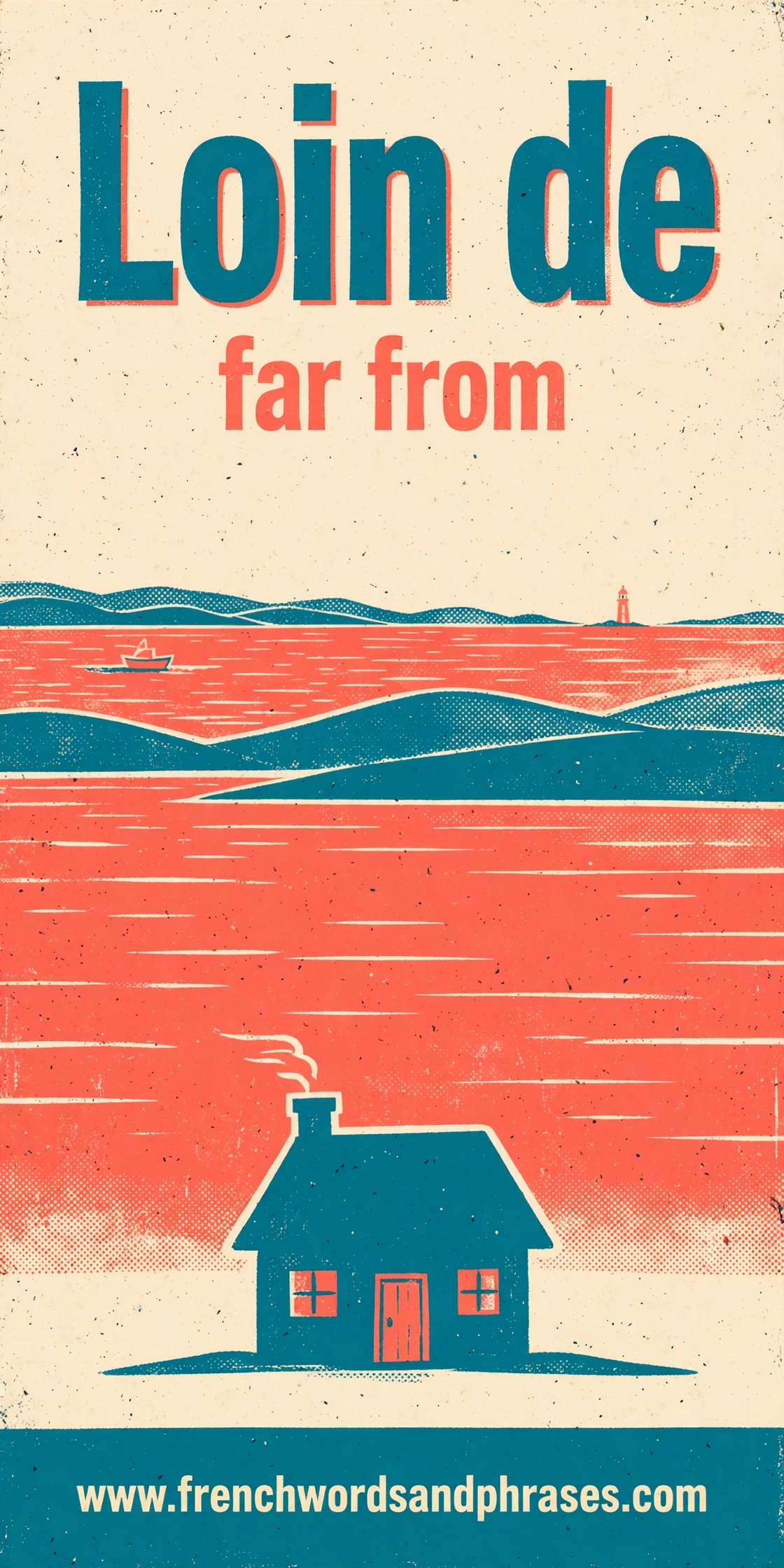
A French Word to Live By
Translate Loin de to English
/lwɛ̃ də/
Loin de means far from.
From the lighthouse gallery, the keeper watches the coastline shrink to a ribbon of lights. The village, the harbour, his own house — all of it tiny and quiet below. « La maison est loin de la mer. » The house is far from the sea. Loin de is the French way of measuring distance: it names a place and stretches the space between you and it.
Let’s explore how loin de works in French, beginning with the whole phrase on one card.
Understanding the French Preposition Loin de
Loin de is a French compound preposition of place, built from loin (far) + de. It places something at a distance from a landmark, and in a second life it teams up with an infinitive to mean ‘far from doing something’ — a graceful way of saying the opposite is true.
It means far from. The picture is a map with a long line on it: loin de Paris, far from Paris; loin des yeux, far from the eyes. Its exact mirror is près de, near — the two phrases share the same shape and divide the world between them.
Type: Compound preposition — place (distance)
Answers the question: À quelle distance ? — How far? (Answer: a long way off)
What follows it: A noun, a pronoun, or an infinitive: loin de moi, loin de rire
Watch the pair: loin de (far from) vs près de (near) — same shape, opposite ends
One important usage detail: loin de + infinitive is a soft, elegant denial — loin de moi l’idée de partir, far from me the idea of leaving; il est loin d’avoir fini, he is far from having finished. And loin de là means ‘far from it — quite the opposite’.
Experience the Word
Loin de is the preposition of horizons — it always points at something you can barely see.
Imagine a mountain refuge at dusk: loin de la vallée, loin des routes, loin du bruit — far from the valley, far from the roads, far from the noise — with nothing but stars getting closer.
You have not just said where something is. You have measured the emptiness between here and there.
How to Use Loin de in French: Complete Guide
Let’s explore how loin de works in French, beginning with the whole phrase on one card.
Loin de at a Glance
The Whole Phrase on One Card
Meaning, job, pattern and pair — loin de in four lines.
| Point | Loin de |
|---|---|
| Meaning | far from |
| Job | places something at a distance from a landmark |
| What follows | a noun, a pronoun, or an infinitive |
| Its opposite | près de — near, close to |
Example
Le chalet est loin de la ville.
The chalet is far from the town.
The Pattern in Action: A Landmark and a Long Line
Loin de stretches between the thing and its landmark — the longer the line, the better it fits.
| Pattern | Example |
|---|---|
| place + loin de + place | l’aéroport est loin du centre — the airport is far from the centre |
| loin de + pronoun | ne reste pas si loin de moi — do not stay so far from me |
| loin des + plural | un village loin des grandes routes — a village far from the main roads |
| loin de + infinitive | elle est loin de se plaindre — she is far from complaining |
Example
Ils habitent loin de la gare.
They live far from the station.
Quick Quiz 1
What is the exact opposite of loin de?
Reveal the answer
près de — near, close to. Same shape, opposite end of the line.
Il habite près de la gare, pas loin d’elle.
He lives near the station, not far from it.
The Tricky Bit: Loin de + Infinitive Means ‘Not At All’
With a verb after it, loin de stops measuring metres and starts denying — elegantly.
| Pattern | The difference |
|---|---|
| loin de + noun | distance in space: loin de Paris — far from Paris |
| loin de + infinitive | the opposite is true: il est loin de comprendre — he is far from understanding (he does not understand at all) |
| loin de moi l’idée de… | far be it from me to…: loin de moi l’idée de vous déranger — far from me the idea of disturbing you |
| loin de là | far from it — quite the opposite: il n’est pas riche, loin de là |
Example
Le travail est loin d’être terminé.
The work is far from being finished.
Where It Goes: After the Thing, Before the Landmark
Loin de sits between the thing measured and the landmark it is measured from — with the usual de contractions.
| Position / pattern | Example |
|---|---|
| thing + loin de + landmark | la ferme est loin de la rivière — the farm is far from the river |
| de + le = du | loin du bruit — far from the noise (never ‘de le’) |
| de + les = des | loin des villes — far from the towns |
| elision: loin d’ | loin d’ici — far from here; loin d’être fini — far from being finished |
Example
Ne va pas trop loin de la maison.
Do not go too far from the house.
Quick Quiz 2
“He is far from having finished” — which pattern: loin de + noun or loin de + infinitive?
Reveal the answer
loin de + infinitive — the denial pattern.
Il est loin d’avoir fini.
He is far from having finished.
Everyday Expressions with Loin de
Loin de lives in these everyday phrases — distance, denial and one famous proverb.
| Expression | In English |
|---|---|
| loin des yeux, loin du coeur | out of sight, out of mind |
| loin de là | far from it — quite the opposite |
| loin de moi l’idée de… | far be it from me to… |
| pas loin de | not far from — nearly: pas loin de cent personnes, nearly a hundred people |
| de loin | by far / from a distance: le meilleur de loin — by far the best |
Example
Ce n’est pas un échec, loin de là.
It is not a failure — far from it.
Close Cousins: The Distance Family
Four ways to measure a gap — French picks by size and by shape.
| Word | The difference |
|---|---|
| loin de | far from — a long stretch of space |
| près de | near — the short end of the same line |
| à distance de | at a (measured) distance from: à cent mètres de la porte |
| éloigné de | the adjective form: un village éloigné de tout — a village far from everything |
Example
Près de la gare mais loin du centre, l’hôtel est calme.
Near the station but far from the centre, the hotel is quiet.
Quick Quiz 3
Which cousin is an adjective, not a preposition — éloigné de or près de?
Reveal the answer
éloigné de — it agrees with its noun like an adjective.
Une maison éloignée du village.
A house far from the village.
Loin de and Its Neighbours
The distance shelf, from touching distance to the horizon.
| French | In English |
|---|---|
| à côté de | right next to |
| près de | near |
| à quelques minutes de | a few minutes from |
| loin de | far from |
| à l’autre bout de | at the other end of |
Example
À côté de l’école mais loin de chez moi, le parc est magnifique.
Next to the school but far from my house, the park is magnificent.
Watch Out: The Traps Around Loin de
The traps: the missing de, the contraction, and reading the denial literally.
| Trap | The truth |
|---|---|
| dropping the de | it is loin de la mer, never ‘loin la mer’ — the de belongs to the phrase |
| writing ‘loin de le’ | de + le contracts to du: loin du village |
| missing the denial | il est loin de rire does not measure distance — it means he is far from laughing, he does not feel like laughing at all |
| confusing loin and long | loin = far (distance), long = long (length or time): un long chemin loin d’ici |
Example
Elle est loin de s’ennuyer dans ce village loin de tout.
She is far from bored in this village far from everything.
Quick Quiz 4
Complete: Le chalet est loin ______ bruit de la ville. (far from the noise)
Reveal the answer
du — de + le contracts to du.
Le chalet est loin du bruit de la ville.
The chalet is far from the noise of the town.
Loin de in Everyday French: Real-Life Examples
Now that you know the word, let’s see how loin de appears in everyday French.
Example Example 1 — Travel
L’aéroport est loin de la ville.
The airport is far from the city.
Example Example 2 — Home
Nous habitons loin de la mer.
We live far from the sea.
Example Example 3 — Proverb
Loin des yeux, loin du coeur.
Out of sight, out of mind.
Example Example 4 — Denial
Il est loin d’être prêt.
He is far from being ready.
Example Example 5 — Distance
Le village est loin de la grande route.
The village is far from the main road.
Example Example 6 — Opposite
Elle n’est pas fatiguée, loin de là !
She is not tired — far from it!
Beyond Translation: The Meaning of Loin de
English “far from” does double duty too — “far from finished” — but French loin de makes the trick feel natural: a distance in space becomes a distance in truth. If understanding is a place, il est loin de comprendre — he is nowhere near it.
To say loin de is to hold two points apart and make the listener feel the stretch between them.
And its mirror, près de, keeps the pair honest: every far in French quietly promises a near.
How to Remember the French Preposition Loin de
Remember it this way: Remember it this way: Loin de stretches a line to a landmark — and with an infinitive, it politely says ‘not at all’.
- You keep the pair together — loin de (far from) against près de (near), same shape, opposite ends.
- You contract on contact — de + le = du: loin du bruit.
- You listen for the denial — loin d’avoir fini means nowhere near finished.
The key idea is loin de means far from, mirrors près de (near), contracts to du/des, and loin de + infinitive means not at all.
Test Your Knowledge of Loin de
Let’s see how much you’ve learned. Try answering these questions before revealing the answers.
Question 1
What does loin de mean?
Reveal the answer
Far from — a long distance between the thing and its landmark.
Question 2
What is the opposite of loin de?
Reveal the answer
Près de — near, close to.
Question 3
Translate: The farm is far from the river.
Reveal the answer
La ferme est loin de la rivière.
Question 4
What does ‘il est loin d’avoir fini’ really mean?
Reveal the answer
He is far from having finished — loin de + infinitive is a denial: he has not finished at all.
Question 5
Complete the sentence:
Le village est ______ ______ la grande ville. (far from the big city)
Reveal the answer
loin de
Le village est loin de la grande ville.
The village is far from the big city.
Your Final Challenge
Can You Use It?
How would you say this in French?
“How would you say this in French?”
Reveal the answer
La maison est loin de la mer.
The house is far from the sea.
A little French. A little curiosity. A richer everyday life.
LEARN FRENCH ONE WORD AT A TIME