A French Word to Live By
Translate Je suis partant to English
/ʒə sɥi paʁ.tɑ̃/
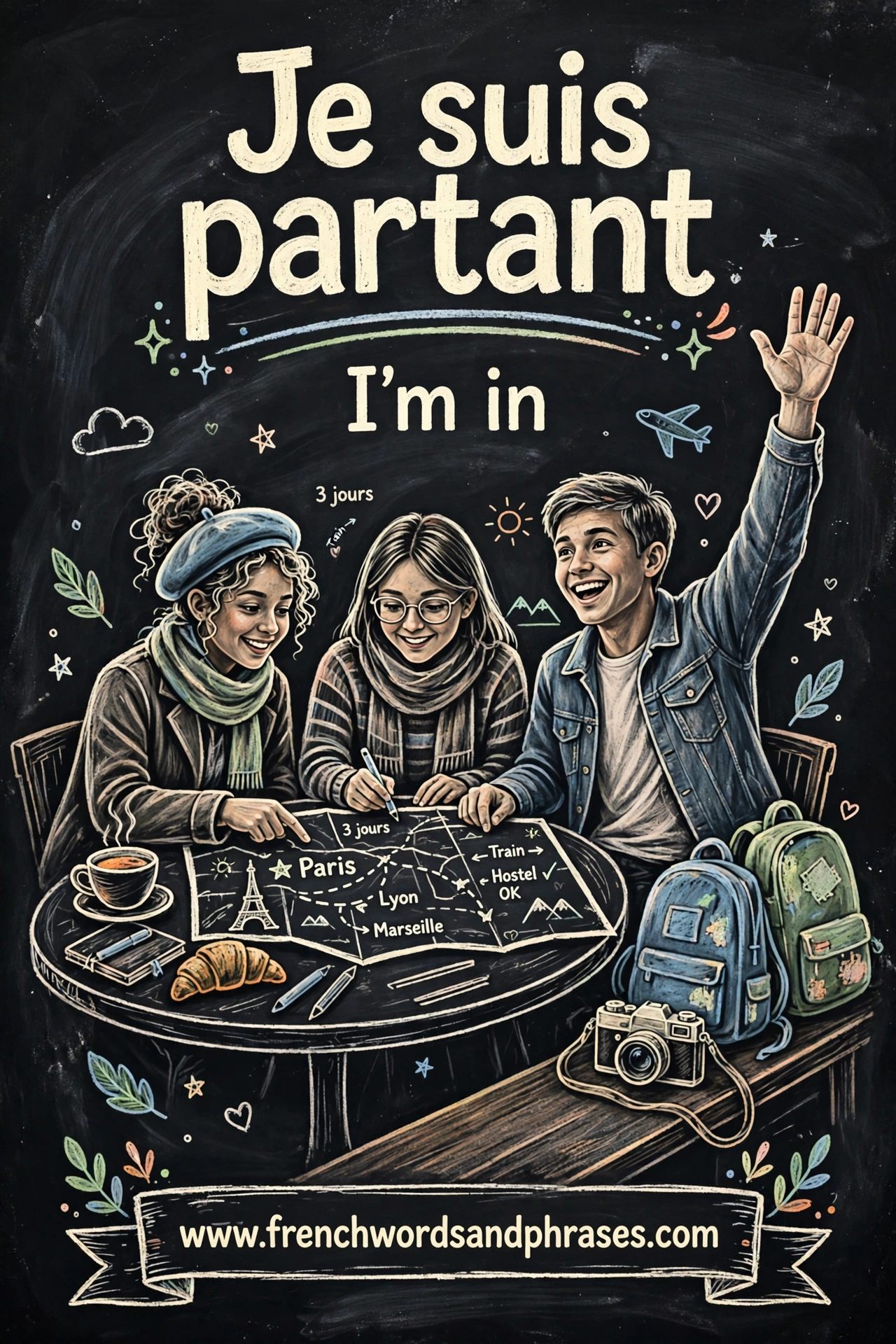
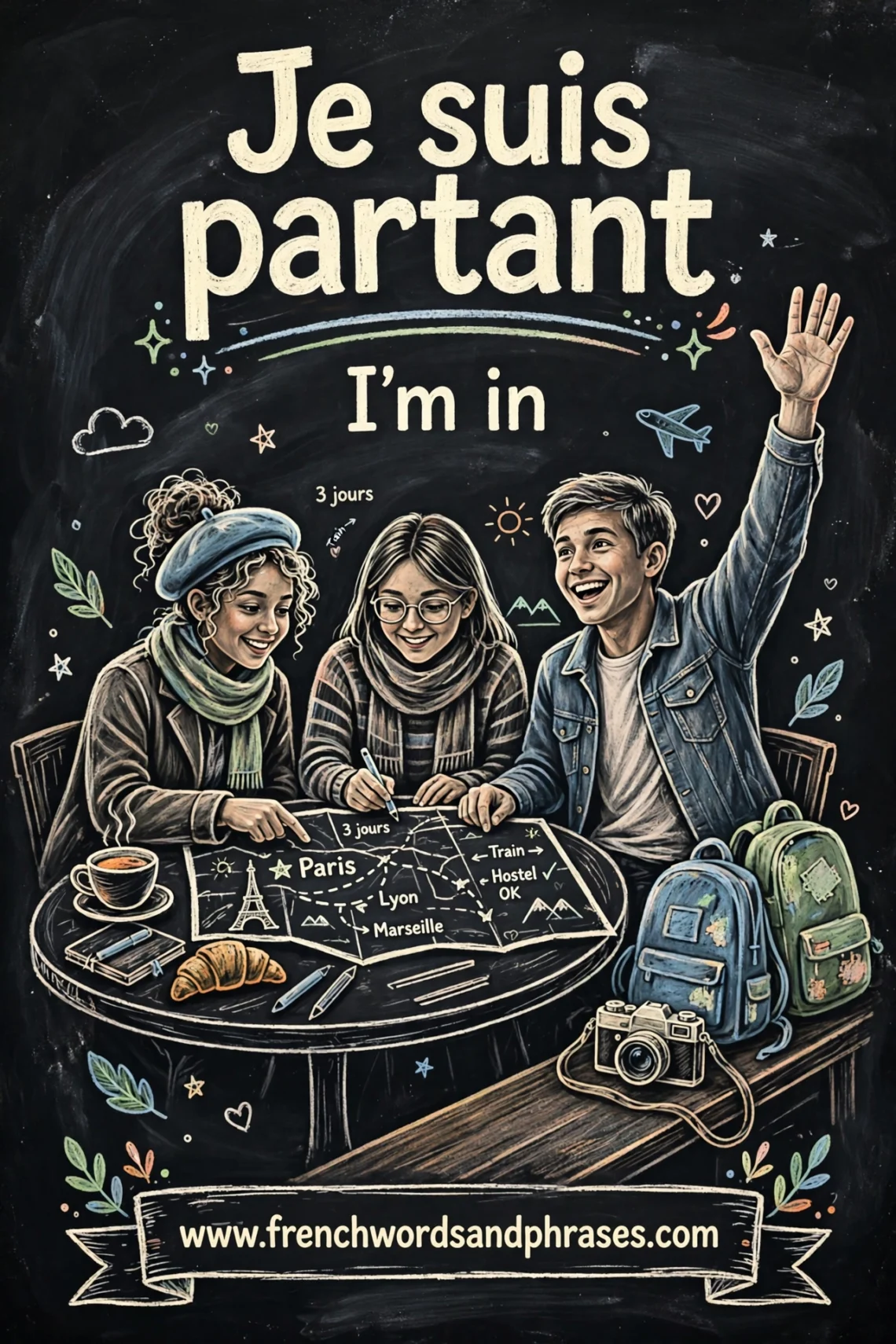
Je suis partant means I’m in — count me in.
Friday, 6 p.m. Someone in the group chat types: ‘Spontaneous trip to the coast tomorrow — who’s in?’ The answers drift in: maybes, emojis, silence. Yours lands in two seconds flat: « Je suis partant ! »
Let’s explore how je suis partant works in French, beginning with the whole phrase on one card.
Understanding the French Phrase Je suis partant
Je suis partant is a French sign-me-up phrase — the adjective partant (literally ‘leaving, going’) used to mean up for it, game, in. It is the present participle of partir turned into a badge of enthusiasm, and it agrees like any adjective: partant, partante, partants, partantes.
It means I’m in — count me in. Where a plain oui accepts, je suis partant volunteers: it says not just ‘yes’ but ‘yes, and I’m already halfway out of the door’. The agreement matters: a man says je suis partant, a woman says je suis partante — one small e that French ears always hear.
Type: Enthusiastic yes — adjective partant (from partir, to leave) with être
Answers the need: Joining a plan with energy — a trip, a meal, a game, a project
Register: Informal and friendly — the language of friends and good colleagues
Strength: Strong yes — warmer and more committed than a simple d’accord
One important usage detail: partant agrees with the speaker. A woman says je suis partante; a mixed or male group says nous sommes partants; two women, nous sommes partantes. Saying je suis partant as a woman is one of the most common agreement slips — and one of the easiest to fix.
Experience the Word
Je suis partant is the fastest yes in French — the sound of someone who was already hoping you’d ask.
Imagine four students around a café table, dreaming out loud about cycling to the sea in July. Budgets are counted, doubts are listed — until Léa slaps the table: « Je suis partante ! » and suddenly the trip is real.
Plans are fragile things; they live or die on the first enthusiastic answer. Je suis partant is the answer that makes a plan real.
How to Use Je suis partant in French: Complete Guide
Let’s explore how je suis partant works in French, beginning with the whole phrase on one card.
Je suis partant at a Glance
The Whole Phrase on One Card
Real meaning, literal picture, English twin and register — je suis partant in five lines.
| Point | Je suis partant |
|---|---|
| What it really means | I’m in — count me in, I’m up for it |
| Word for word | I am leaving / going (the one who is off) |
| English equivalent | I’m in / count me in / I’m game |
| Register | informal, friendly — friends, family, relaxed workplaces |
| Use it for | accepting a plan with enthusiasm, not just politeness |
Example
Un pique-nique dimanche ? Je suis partant !
A picnic on Sunday? I’m in!
Word by Word: Building the Phrase
Three pieces — and a participle that turned into a badge of enthusiasm.
| Word | Literal meaning | Its job in the phrase |
|---|---|---|
| je | I | the volunteer |
| suis | am | être — the badge is worn, not performed |
| partant | leaving / going → up for it | partir’s participle as an adjective: ready to go, therefore game |
Example
Je suis partant pour tout, ce week-end.
I’m up for anything this weekend.
Quick Quiz 1
A woman wants to say “I’m in!” Give her exact words.
Reveal the answer
Je suis partante — partant is an adjective and agrees: partante for a woman, with an e that is pronounced.
Elle est partante pour le voyage.
She’s in for the trip.
When You Say It: The Sign-Me-Up Moments
Je suis partant fires at moments like these — a plan is proposed, and you are the first yes.
| Situation | Example |
|---|---|
| Friends propose a trip | je suis partant, je réserve la voiture ! — I’m in, I’ll book the car! |
| A colleague suggests lunch | je suis partant, on va où ? — I’m in, where are we going? |
| A team needs a volunteer | je suis partant, je commence quand ? — count me in, when do I start? |
| A game needs one more player | je suis partant, je prends les cartes — I’m in, I’ll deal the cards |
| An after-work drink | je suis partant pour un verre — I’m up for a drink |
Example
Je suis partant, dis-moi l’heure et l’adresse.
I’m in, tell me the time and the address.
Make It Yours: Agreement Is Everything
The phrase dresses itself for whoever speaks — partant, partante, partants, partantes.
| Form | French | In English |
|---|---|---|
| A woman speaking | je suis partante | I’m in (female speaker) |
| Asking a man | tu es partant ? | are you in? |
| Asking a woman | tu es partante ? | are you in? |
| A group, mixed or male | on est partants | we’re in |
| With the plan named | je suis partant pour un cinéma | I’m in for a film |
| Saying no, gently | je ne suis pas partant | I’m not really up for it |
Example
Vous êtes partants pour samedi ?
Are you all in for Saturday?
Quick Quiz 2
How do you ask a group of friends, “are you in?”
Reveal the answer
Vous êtes partants ? — or tu es partant(e) to one person. The adjective follows the people: partants for a group.
Alors, vous êtes partants pour la randonnée ?
So, are you in for the hike?
Everyday Expressions: Building on the Phrase
Je suis partant slots into these everyday frames — each one ready to use as it stands.
| Frame | In English |
|---|---|
| je suis partant pour… | I’m in for… (name the plan) |
| je suis partant, à quelle heure ? | I’m in — what time? |
| compte sur moi, je suis partant | count on me, I’m in |
| je suis partant si on part tôt | I’m in if we leave early |
| alors là, je suis partant ! | now that, I’m definitely in for! |
Example
Je suis partant pour le marché de Noël.
I’m in for the Christmas market.
Close Cousins: The Other Ways to Say Yes
French yeses come in temperatures — je suis partant is the hot one; its cousins range from polite to lukewarm.
| Expression | The difference |
|---|---|
| je suis partant(e) | I’m in — enthusiastic, ready to go |
| ça me dit | I fancy it — literally ‘it says to me’; about desire, cooler than partant |
| avec plaisir | with pleasure — polite acceptance, any register |
| je suis d’accord | I agree — about opinions, not plans; much flatter |
| pourquoi pas | why not — a shrug of a yes, half-hearted |
| je marche ! | I’m in — very informal, literally ‘I walk’; among close friends |
Example
Ça me dit bien, ce concert — je suis partante !
I really fancy that concert — I’m in!
Quick Quiz 3
Which cousin is only a half-hearted yes — avec plaisir or pourquoi pas?
Reveal the answer
Pourquoi pas — why not: a shrug, not enthusiasm. Avec plaisir is a warm, full yes.
Pourquoi pas, si je n’ai rien d’autre.
Why not, if I’ve got nothing else on.
Je suis partant and Its Neighbours
The yes shelf around the phrase — from the echo yes to the flat refusal.
| French | In English |
|---|---|
| moi aussi | me too (the echo yes) |
| on y va ! | let’s go! (the plan starts moving) |
| je suis partant | I’m in |
| qui d’autre ? | who else? (recruiting the rest) |
| je passe mon tour | I’ll sit this one out |
| sans moi | count me out (the flat opposite) |
Example
Moi aussi je suis partant — on y va !
I’m in too — let’s go!
Watch Out: The Traps Around Je suis partant
The traps: agreement, a dangerous twin, and rooms where the phrase is too casual.
| Trap | The truth |
|---|---|
| forgetting agreement | a woman is partante, not partant — the extra e is heard, and French ears notice |
| confusing partant with parti | je suis parti means I have left / I’m gone — the party is over, not starting |
| hearing it as literal leaving | je suis partant rarely means you are physically departing — in plans, it means you’re game |
| using it in formal settings | with a boss or in writing, prefer je serai des vôtres or je participerai avec plaisir |
| naming the plan wrongly | the plan follows pour: partant pour un resto, partant pour sortir |
Example
Elle est partante, mais lui n’est pas partant.
She’s in, but he isn’t up for it.
Quick Quiz 4
Spot the mistake: “Marie est partant pour la sortie.“
Reveal the answer
Partant must agree with Marie — partante, with an e. Elle est partante.
Marie est partante pour la sortie.
Marie is in for the outing.
Je suis partant in Everyday French: Real-Life Examples
Now that you know the word, let’s see how je suis partant appears in everyday French.
Example Example 1 — In the group chat
Je suis partant pour demain, à 100 % !
I’m in for tomorrow, 100%!
Example Example 2 — At work
Un déjeuner d’équipe vendredi ? Je suis partant.
A team lunch on Friday? I’m in.
Example Example 3 — A woman answers
Je suis partante, je prépare le dessert.
I’m in, I’ll make the dessert.
Example Example 4 — Sport
Je suis partant pour un match de foot dimanche.
I’m up for a football match on Sunday.
Example Example 5 — Travel plans
Elle est partante pour le Portugal en mai.
She’s in for Portugal in May.
Example Example 6 — Saying no kindly
Ce soir, je ne suis pas partant, je suis épuisé.
Tonight I’m not up for it, I’m exhausted.
Beyond Translation: The Meaning of Je suis partant
The picture inside partant is movement: you are already leaving, already going. English ‘I’m in’ imagines a circle you step into; French imagines a road you step onto.
To say je suis partant is to answer a plan with your feet, not just your voice.
No wonder it is the reply every organiser hopes for. It does not weigh the plan — it launches it.
How to Remember the French Phrase Je suis partant
Remember it this way: Remember it this way: Je suis partant means your feet are already on the road — and the word dresses like the speaker: partant, partante, partants.
- You picture partir — to leave; the partant is the one who is off, so the one who is game.
- You agree the ending — partante for a woman, partants for a group.
- You save it for plans, not opinions — agreeing with an idea is je suis d’accord.
The key idea is je suis partant means I’m in — and it agrees: partante for a woman.
Test Your Knowledge of Je suis partant
Let’s see how much you’ve learned. Try answering these questions before revealing the answers.
Question 1
What does je suis partant mean?
Reveal the answer
I’m in — count me in, I’m up for it. An enthusiastic yes to a plan.
Question 2
How does a woman say it?
Reveal the answer
Je suis partante — partant is an adjective and takes an e for a woman.
Question 3
What is the difference between je suis partant and je suis parti?
Reveal the answer
Partant = I’m in, game. Parti = I have left, I’m gone. One starts the plan; the other has already left it.
Question 4
How do you say ‘we’re in’ for a mixed group?
Reveal the answer
On est partants — or nous sommes partants; a group takes partants with an s.
Question 5
Complete the sentence:
Elle est ______ pour le voyage. (She’s in for the trip.)
Reveal the answer
partante
Elle est partante pour le voyage.
She’s in for the trip.
Your Final Challenge
Can You Use It?
How would you say this in French?
“How would you say this in French?”
Reveal the answer
Compte sur moi, je suis partant !
Count me in, I’m in!
A little French. A little curiosity. A richer everyday life.
LEARN FRENCH ONE WORD AT A TIME