A French Word to Live By
Translate J’ai la banane to English
/ʒɛ la ba.nan/
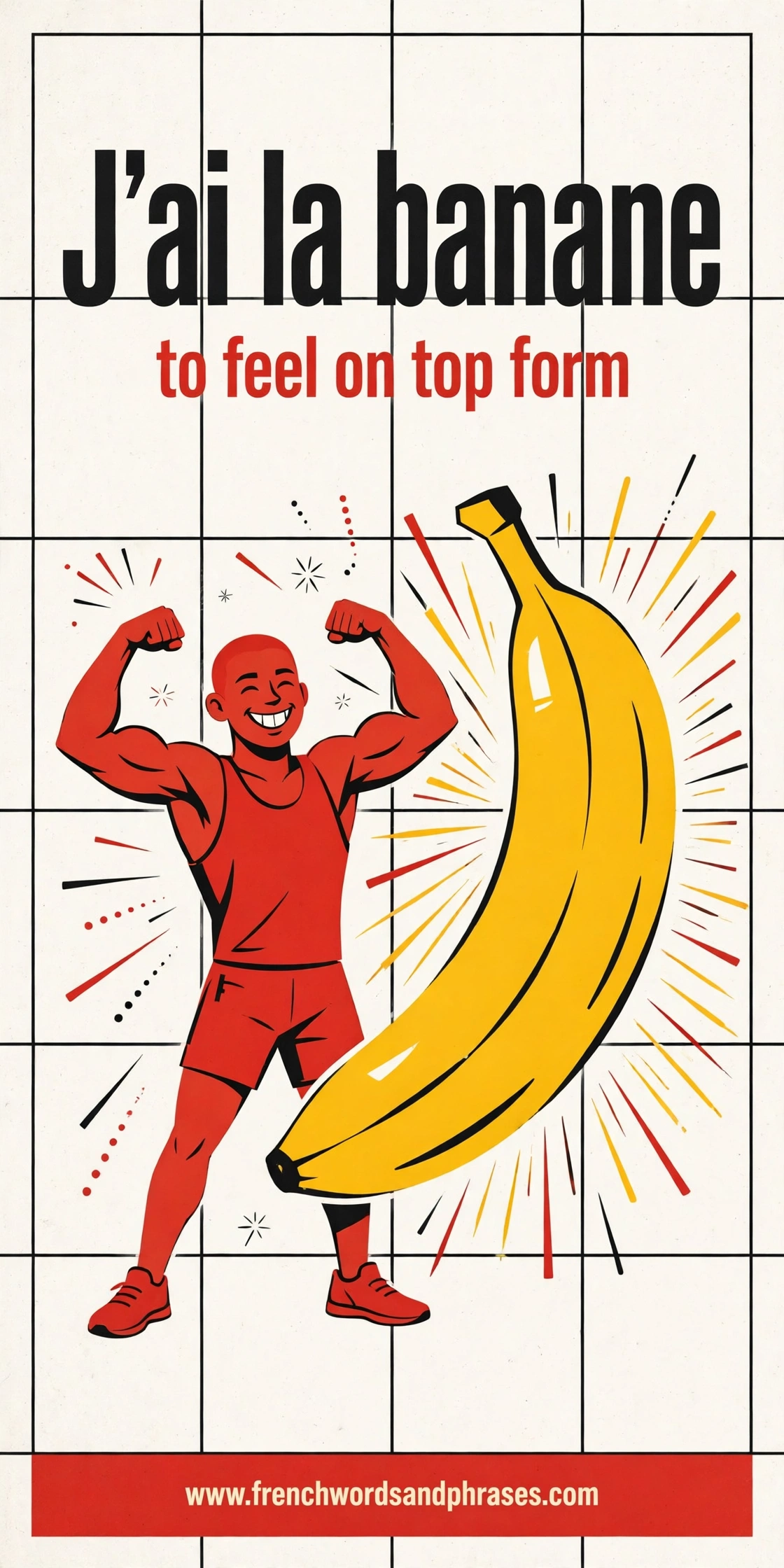
J’ai la banane means I’m in great form — full of energy, cheerful, with a grin you can see across the room.
Monday morning, rain on the windows, and your colleague arrives whistling, coffees balanced, jokes ready, somehow sunnier than the sky. Someone at the next desk mutters the diagnosis with envy: « Elle a la banane, ce matin. »
Let’s explore how avoir la banane works in French, beginning with the whole phrase on one card.
Understanding the French Phrase J’ai la banane
J’ai la banane is a French idiomatic expression built from avoir (to have) and la banane (the banana). The banana here is first of all a shape: the wide, curved grin of someone in sparkling form — a smile bent like a banana — and by extension the energy and good mood that go with it.
It means to be in great form — full of energy, cheerful, visibly delighted with the day. Nobody is carrying fruit: the banana is your grin and your spark at once. French says it of the colleague who lights up the office, the player who is flying, the grandfather who has slept well — anyone whose good mood is practically a facial expression.
Type: Idiomatic expression — energy and mood (avoir + la banane)
Answers the need: Saying someone is in sparkling form, grinning and full of beans
Register: Informal — friendly slang of offices, sports and families
Strength: Radiant — more than fine: visibly, contagiously on form
One important usage detail: the phrase lives in the present of a good day — avoir la banane ce matin, aujourd’hui — and the grin comes first: you can say it of someone simply because their smile is enormous. The citation form is avoir la banane; j’ai la banane is its most common outfit, said of oneself with pride.
Experience the Word
Avoir la banane is good mood you can see from across the street — French gives cheerfulness a shape, and the shape is curved.
Imagine the village baker at five in the morning, flour on his sleeves, singing at the ovens while the village still sleeps. The first customer of the day takes one look and laughs: il a la banane. Nothing has happened yet. Everything, somehow, is already going well.
The phrase is a small piece of national optimism. A language that names the grin will keep finding reasons to wear it.
How to Use J’ai la banane in French: Complete Guide
Let’s explore how avoir la banane works in French, beginning with the whole phrase on one card.
J’ai la banane at a Glance
The Whole Phrase on One Card
Real meaning, literal picture, English twin and register — avoir la banane in five lines.
| Point | Avoir la banane |
|---|---|
| What it really means | to be in great form — full of energy, cheerful, grinning |
| Word for word | to have the banana — the banana being the wide curved grin itself |
| English equivalent | to be in top form / to be full of beans / to be beaming |
| Register | informal — warm slang, offices and sports pages |
| Use it for | great mornings, players on form, anyone radiating good mood |
Example
Ce matin, j’ai la banane, rien ne peut m’arrêter.
This morning I’m in great form, nothing can stop me.
Word by Word: Building the Grin
Three small pieces — take them one by one and the smile appears.
| Word | Literal meaning | Its job in the phrase |
|---|---|---|
| avoir | to have | the verb of possession — in French, states of body and mood are things you have |
| la | the | THE banana: the one grin, the visible one |
| banane | banana | the fruit whose curve draws the grin — and whose energy fills it |
Example
Avec une banane comme ça, il pourrait vendre des parapluies au soleil.
With a grin like that, he could sell umbrellas in the sunshine.
Quick Quiz 1
Why a banana? What does the fruit draw?
Reveal the answer
The grin — a wide smile curves like a banana; the fruit’s shape names the expression, and the energy follows.
Elle est entrée avec la banane, et le bureau entier a souri.
She came in beaming, and the whole office smiled.
When You Say It: The Top-Form Moments
Avoir la banane fires at moments like these — someone’s form is so visible it needs naming.
| Situation | Example |
|---|---|
| A great morning | j’ai la banane ce matin, je ne sais pas pourquoi — I’m in great form this morning, I don’t know why |
| A player flying | l’attaquant a la banane depuis le premier but — the striker has been flying since the first goal |
| After good news | depuis l’annonce, elle a la banane — since the announcement, she’s been beaming |
| Teasing a grump, gently | toi, tu n’as pas la banane aujourd’hui — you are not exactly beaming today |
| At work | le lundi, il a toujours la banane, c’est suspect — on Mondays he’s always in top form, it’s suspicious |
Example
Depuis sa promotion, il a la banane tous les jours.
Since his promotion, he’s been in great form every day.
Make It Yours: The Banana for Every Person
The phrase rides on avoir — conjugate avoir and hand the banana to anyone.
| Form | French | In English |
|---|---|---|
| I have it | j’ai la banane | I’m in great form |
| You have it | tu as la banane | you’re beaming |
| She has it | elle a la banane | she’s in top form |
| We have it | on a la banane | we’re full of beans |
| They lost it | ils n’ont plus la banane | they’ve lost their spark |
| Question | tu as la banane, toi, ce matin ? | are you in form this morning? |
Example
On a la banane, l’équipe a gagné et le soleil brille.
We’re full of beans, the team won and the sun is shining.
Quick Quiz 2
Which verb carries the banana — avoir or être?
Reveal the answer
Avoir — French has its moods: j’ai la banane, like j’ai la pêche and j’ai le cafard.
Aujourd’hui, j’ai la banane ; hier, j’avais le cafard.
Today I’m in great form; yesterday I was down in the dumps.
Everyday Expressions: Building on the Banana
Avoir la banane slots into these everyday frames — each one ready to use as it stands.
| Frame | In English |
|---|---|
| avoir la banane | to be in great form, beaming |
| avoir la banane jusqu’aux oreilles | to grin from ear to ear — the banana at full stretch |
| garder la banane | to keep the grin, to stay on form |
| perdre la banane | to lose the grin, to go flat |
| donner la banane à quelqu’un | to put a grin on someone’s face |
Example
Sa bonne nouvelle m’a donné la banane pour la journée.
Her good news put a grin on my face for the day.
Close Cousins: The Other Good Moods
French stocks a fruit bowl of good moods — the banane is the grin; its cousins stress energy, luck or lightness.
| Expression | The difference |
|---|---|
| avoir la banane | to be in great form — the grin first, energy with it |
| avoir la pêche | to be full of energy — the peach of pure vitality, grin optional |
| avoir la frite | to be on form — the Belgian-flavoured twin, energy in chip shape |
| être aux anges | to be in seventh heaven — joy at its peak, a moment of bliss |
| avoir le cafard | to be down in the dumps — the exact opposite, the cockroach for the banana |
Example
Hier le cafard, aujourd’hui la banane : quel changement !
Yesterday the dumps, today top form: what a change!
Quick Quiz 3
Which cousin is the pure energy one, grin optional — la pêche or la banane?
Reveal the answer
La pêche — the peach is vitality itself; the banana adds the visible grin to the energy.
Elle a la pêche au travail et la banane en sortant.
She has the energy at work and the grin when she leaves.
J’ai la banane and Its Neighbours
The good-mood shelf around the phrase — from the fruit bowl to the opposite insect.
| French | In English |
|---|---|
| une banane | a banana |
| un sourire | a smile |
| avoir la pêche | to be full of energy |
| la forme | form, good shape |
| être de bonne humeur | to be in a good mood — the plain version |
| avoir le cafard | to be down in the dumps |
Example
De bonne humeur dès l’aube, elle a la banane avant même le café.
In a good mood from dawn, she’s beaming before even having coffee.
Watch Out: The Traps Around Avoir la banane
The traps: a haircut with the same name, a verb that must be avoir, and a grin that can be teased but not insulted.
| Trap | The truth |
|---|---|
| the haircut trap | une banane is also a quiff — the rocker’s swept-up fringe; context decides whether the banana is worn or felt |
| avoir, not être | je suis la banane would make you the fruit — French has its good moods, it is not them |
| it can be envied, not mocked | tu as la banane said flatly can tease, but the phrase itself is a compliment to the day |
| not for formal writing | in a report, write en pleine forme or de très bonne humeur — the banana stays in conversation |
Example
En réunion, on dit « en pleine forme » ; entre amis, on dit « la banane ».
In a meeting you say ‘in top form’; among friends, you say ‘the banana’.
Quick Quiz 4
True or false: avoir la banane can describe a hairstyle.
Reveal the answer
False — the phrase is the grin and the form. The hairstyle is une banane, worn, not avoir la banane, felt.
Il a une banane sur la tête et la banane au cœur.
He has a quiff on his head and the grin in his heart.
J’ai la banane in Everyday French: Real-Life Examples
Now that you know the word, let’s see how j’ai la banane appears in everyday French.
Example 1 — Monday morning
J’ai la banane ce matin, ne me demandez pas pourquoi.
I’m in great form this morning, don’t ask me why.
Example 2 — The striker
Depuis son doublé, l’attaquant a la banane.
Since his brace of goals, the striker has been flying.
Example 3 — The compliment
Tu as la banane aujourd’hui, ça te va bien.
You’re beaming today, it suits you.
Example 4 — After the news
Elle a appris la nouvelle, et elle a la banane depuis.
She heard the news, and she’s been grinning ever since.
Example 5 — The baker
Le boulanger chante à cinq heures du matin : il a la banane.
The baker sings at five in the morning: he’s in top form.
Example 6 — Losing it
À midi, sous la pluie, je n’avais plus la banane.
By noon, in the rain, I’d lost the grin.
Beyond Translation: The Meaning of J’ai la banane
English is full of beans — energy as fuel, invisible inside. French draws the smile itself: la banane is the grin made fruit, mood you can see from the street. The English phrase asks how you feel; the French one already knows, because your face announced it.
Avoir la banane means your good mood has become public property.
That is why it is said to people, about people, in their hearing — it is the compliment a whole office can join in with.
How to Remember the French Phrase J’ai la banane
Remember it this way: Avoir la banane is the grin you can draw — a smile curved like the fruit, on a day when everything is going well.
- You picture the curve — the banana is the shape of the grin first, and the energy comes with it.
- You keep the verb avoir — French has its moods: la banane up, le cafard down.
- You know the fruit bowl — la pêche is pure energy, la banane is energy with the grin showing.
The key idea is avoir la banane means to be in great form — the banana-shaped grin of a sparkling day.
Test Your Knowledge of J’ai la banane
Let’s see how much you’ve learned. Try answering these questions before revealing the answers.
Question 1
What does avoir la banane mean?
Reveal the answer
To be in great form — full of energy and cheerful, with a grin to prove it.
Question 2
Why a banana?
Reveal the answer
The grin — a wide smile curves like a banana; the fruit’s shape names the expression.
Question 3
How do you say ‘this morning I’m in great form’?
Reveal the answer
Ce matin, j’ai la banane — the verb is avoir, as with all French mood-fruit.
Question 4
What is the opposite of avoir la banane?
Reveal the answer
Avoir le cafard — to be down in the dumps; the cockroach answers the banana.
Question 5
Complete the sentence:
Depuis la bonne nouvelle, elle a la ______ jusqu’aux oreilles. (Since the good news, she has been grinning from ear to ear.)
Reveal the answer
banane
Depuis la bonne nouvelle, elle a la banane jusqu’aux oreilles.
Since the good news, she has been grinning from ear to ear.
Your Final Challenge
Can You Use It?
How would you say this in French?
“This morning I’m in great form, and nothing can wipe the grin off my face.”
Reveal the answer
Ce matin, j’ai la banane, et rien ne peut effacer mon sourire.
This morning I’m in great form, and nothing can wipe the grin off my face.
A little French. A little curiosity. A richer everyday life.
LEARN FRENCH ONE WORD AT A TIME