
A French Word to Live By
How to Conjugate Infliger in French
/ɛ̃.fli.ʒe/
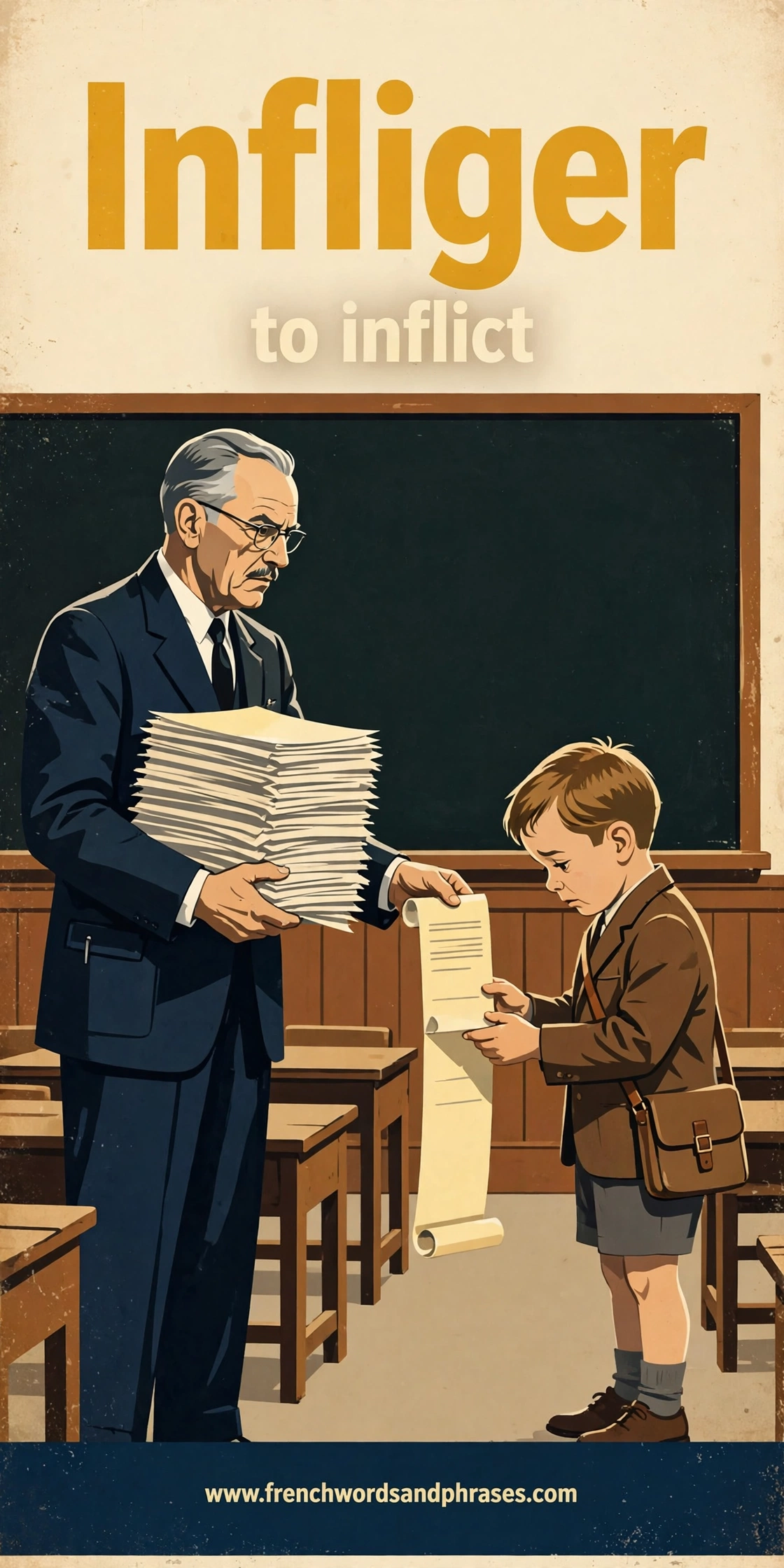
Infliger means to inflict — to impose something painful or unwelcome on someone: a fine, a defeat, a punishment, suffering they did not choose.
A referee’s red card, a tax notice in the letterbox, an army’s crushing defeat — infliger is the verb of unwelcome things delivered officially: someone with power hands down something that hurts.
In this guide, you’ll learn how to conjugate infliger in all the major French tenses and moods. Explore complete conjugation tables, French examples, English translations, and practice quizzes.
Understanding the French Verb Infliger
Infliger is a regular French verb belonging to the first group of verbs, those ending in-er.
It means to inflict. It is used of fines, penalties, defeats, losses and suffering handed down by judges, referees, armies, fate and tax offices: infliger une amende de cent euros, infliger une lourde défaite, infliger des souffrances. The tone is always serious or ironical — one does not infliger a gift. In everyday speech, mettre une amende covers the fine; infliger is the formal, weightier word.
Verb classification: First group (-er)
Auxiliary verb: Avoir
Past participle: infligé
Present participle: infligeant
English equivalents: To inflict, to impose; infliger une amende — to impose a fine; infliger une défaite à l’ennemi — to inflict a defeat on the enemy; infliger une punition — to inflict a punishment; s’infliger quelque chose — to inflict something on oneself.
One important detail: infliger is a -ger verb, so it keeps a protective e before the endings in a and o: nous infligeons, j’infligeais, infligeant — that e keeps the g soft, like a j. The construction is two-sided: infliger quelque chose à quelqu’un — le juge inflige une amende au conducteur, the judge imposes a fine on the driver. And French happily turns it on oneself: s’infliger un régime, s’infliger ce film — to put oneself through a diet, or through that film.
Experience the Word
Infliger is the verb of the sentence handed down — the moment someone in authority makes the pain official.
Imagine a village football final. In the last minute, the visiting striker scores, and the home crowd falls silent as if struck: l’équipe visiteuse vient d’infliger une défaite cruelle aux nôtres — a defeat not just suffered, but inflicted, delivered like a verdict.
The winners did not merely win. They inflicted — infligé — a defeat the village will talk about all winter.
How to Conjugate Infliger: Complete French Conjugation Guide
Let’s explore every major conjugation of infliger, beginning with the indicative mood.
How to Conjugate Infliger in the Indicative Mood
The indicative mood is used to express facts, observations, actions, and events.
How to Conjugate Infliger in the Present Tense (Présent)
Used for actions happening now, habitual actions, and general truths.
| Subject | Conjugation |
|---|---|
| je | inflige |
| tu | infliges |
| il / elle | inflige |
| nous | infligeons |
| vous | infligez |
| ils / elles | infligent |
Example
Le juge inflige une amende au conducteur imprudent.
The judge is imposing a fine on the careless driver.
Quick Quiz 1
Complete the sentence:
Nous ______ une amende aux contrevenants, dit le maire.
Reveal the answer
infligeons
Nous infligeons une amende aux contrevenants, dit le maire.
We are imposing a fine on offenders, says the mayor.
How to Conjugate Infliger in the Passé Composé
Used for completed actions in the past. Infliger takes the auxiliary verb avoir.
| Subject | Conjugation |
|---|---|
| j’ | ai infligé |
| tu | as infligé |
| il / elle | a infligé |
| nous | avons infligé |
| vous | avez infligé |
| ils / elles | ont infligé |
Example
L’armée a infligé une lourde défaite à l’ennemi.
The army inflicted a heavy defeat on the enemy.
How to Conjugate Infliger in the Imparfait (Imperfect Tense)
Used for habitual past actions, descriptions, and ongoing situations in the past.
| Subject | Conjugation |
|---|---|
| je | infligeais |
| tu | infligeais |
| il / elle | infligeait |
| nous | infligions |
| vous | infligiez |
| ils / elles | infligeaient |
Example
Le tyran infligeait des punitions terribles à ses sujets.
The tyrant used to inflict terrible punishments on his subjects.
Quick Quiz 2
Choose the correct form:
They inflicted a defeat on the enemy.
Ils ______ une défaite à l’ennemi. (ont infligé / sont infligés)
Reveal the answer
ont infligé
Ils ont infligé une défaite à l’ennemi.
Infliger takes avoir.
How to Conjugate Infliger in the Plus-que-parfait
Used to describe an action that had already been completed before another past event.
| Subject | Conjugation |
|---|---|
| j’ | avais infligé |
| tu | avais infligé |
| il / elle | avait infligé |
| nous | avions infligé |
| vous | aviez infligé |
| ils / elles | avaient infligé |
Example
La sécheresse avait infligé de grandes pertes aux paysans.
The drought had inflicted great losses on the farmers.
How to Conjugate Infliger in the Passé Simple
Primarily used in formal writing, literature, and historical narratives. It is rarely used in everyday conversation.
| Subject | Conjugation |
|---|---|
| je | infligeai |
| tu | infligeas |
| il / elle | infligea |
| nous | infligeâmes |
| vous | infligeâtes |
| ils / elles | infligeèrent |
Example
Le général infligea une défaite complète à l’armée ennemie.
The general inflicted a complete defeat on the enemy army.
How to Conjugate Infliger in the Passé Antérieur
A literary tense used to express an action completed immediately before another past action, generally in the passé simple.
| Subject | Conjugation |
|---|---|
| j’ | eus infligé |
| tu | eus infligé |
| il / elle | eut infligé |
| nous | eûmes infligé |
| vous | eûtes infligé |
| ils / elles | eurent infligé |
Example
Quand le juge eut infligé l’amende, l’homme paya sans un mot.
When the judge had imposed the fine, the man paid without a word.
How to Conjugate Infliger in the Future Tense (Futur Simple)
Used to describe actions that will take place in the future.
| Subject | Conjugation |
|---|---|
| je | infligerai |
| tu | infligeras |
| il / elle | infligera |
| nous | infligerons |
| vous | infligerez |
| ils / elles | infligeront |
Example
Ce rapport infligera un démenti cruel aux rumeurs.
This report will inflict a cruel denial on the rumours.
How to Conjugate Infliger in the Futur Antérieur (Future Perfect)
Used for an action that will have been completed before a particular point in the future.
| Subject | Conjugation |
|---|---|
| j’ | aurai infligé |
| tu | auras infligé |
| il / elle | aura infligé |
| nous | aurons infligé |
| vous | aurez infligé |
| ils / elles | auront infligé |
Example
À la fin du match, ils auront infligé trois buts à leurs adversaires.
By the end of the match, they will have inflicted three goals on their opponents.
How to Conjugate Infliger in the Near Future (Futur Proche)
Used to describe something that is going to happen soon. Formed with aller + infinitive.
| Subject | Conjugation |
|---|---|
| je | vais infliger |
| tu | vas infliger |
| il / elle | va infliger |
| nous | allons infliger |
| vous | allez infliger |
| ils / elles | vont infliger |
Example
L’arbitre va infliger un carton rouge au défenseur.
The referee is going to inflict a red card on the defender.
How to Conjugate Infliger in the Conditional Mood
The conditional mood expresses what would happen under certain circumstances. It is also frequently used to make polite requests or express wishes.
How to Conjugate Infliger in the Present Conditional
| Subject | Conjugation |
|---|---|
| je | infligerais |
| tu | infligerais |
| il / elle | infligerait |
| nous | infligerions |
| vous | infligeriez |
| ils / elles | infligeraient |
Example
Un tel scandale infligerait un coup terrible au gouvernement.
Such a scandal would inflict a terrible blow on the government.
How to Conjugate Infliger in the Past Conditional
| Subject | Conjugation |
|---|---|
| j’ | aurais infligé |
| tu | aurais infligé |
| il / elle | aurait infligé |
| nous | aurions infligé |
| vous | auriez infligé |
| ils / elles | auraient infligé |
Example
Le juge aurait infligé une peine plus lourde sans les aveux.
The judge would have imposed a heavier sentence without the confession.
Infliger in the Literary Past Conditional Form
This less common literary form uses the imperfect subjunctive of avoir.
| Subject | Conjugation |
|---|---|
| j’ | eusse infligé |
| tu | eusses infligé |
| il / elle | eût infligé |
| nous | eussions infligé |
| vous | eussiez infligé |
| ils / elles | eussent infligé |
Example
Le destin eût infligé moins de malheurs à cette famille.
Fate would have inflicted fewer misfortunes on this family.
How to Conjugate Infliger in the Subjunctive Mood
The subjunctive is used to express wishes, emotions, doubts, necessity, and uncertainty. It frequently follows expressions such as il faut que (it is necessary that) or bien que (although).
How to Conjugate Infliger in the Present Subjunctive
| Subject | Conjugation |
|---|---|
| que je | inflige |
| que tu | infliges |
| qu’il / qu’elle | inflige |
| que nous | infligions |
| que vous | infligiez |
| qu’ils / qu’elles | infligent |
Example
Il faut que le tribunal inflige une sanction juste.
The court must impose a fair sanction.
Quick Quiz 3
Complete the sentence using the subjunctive:
Il faut que vous ______ une sanction proportionnée.
Reveal the answer
infligiez
Il faut que vous infligiez une sanction proportionnée.
You must impose a proportionate sanction.
How to Conjugate Infliger in the Imperfect Subjunctive
A literary tense, rarely encountered in modern spoken French.
| Subject | Conjugation |
|---|---|
| que je | infligasse |
| que tu | infligasses |
| qu’il / qu’elle | infligât |
| que nous | infligassions |
| que vous | infligassiez |
| qu’ils / qu’elles | infligassent |
Example
On craignait que la guerre infligeât de nouvelles souffrances.
People feared the war might inflict new suffering.
How to Conjugate Infliger in the Pluperfect Subjunctive
A literary construction used to express an action completed before another past action.
| Subject | Conjugation |
|---|---|
| que j’ | eusse infligé |
| que tu | eusses infligé |
| qu’il / qu’elle | eût infligé |
| que nous | eussions infligé |
| que vous | eussiez infligé |
| qu’ils / qu’elles | eussent infligé |
Example
On racontait que le roi eût infligé des impôts écrasants.
People said the king had inflicted crushing taxes.
How to Conjugate Infliger in the Past Subjunctive
| Subject | Conjugation |
|---|---|
| que j’ | aie infligé |
| que tu | aies infligé |
| qu’il / qu’elle | ait infligé |
| que nous | ayons infligé |
| que vous | ayez infligé |
| qu’ils / qu’elles | aient infligé |
Example
Je regrette que ce retard ait infligé tant de soucis à l’équipe.
I regret that this delay has inflicted so many worries on the team.
How to Conjugate Infliger in the Imperative
The imperative is used to give commands, instructions, invitations, or suggestions. Subject pronouns are omitted.
How to Conjugate Infliger in the Present Imperative
| Person | Conjugation |
|---|---|
| (tu) | inflige |
| (nous) | infligeons |
| (vous) | infligez |
Example
N’inflige pas cette punition aux enfants, elle est trop dure !
Do not inflict this punishment on the children, it is too harsh!
Quick Quiz 4
How would you say Do not inflict this punishment (tu form)?
Reveal the answer
N’inflige pas cette punition !
French Participles of Infliger
Participles are verb forms that can be used in compound tenses and other grammatical constructions.
Present Participle of Infliger
infligeant
En infligeant une amende record, le juge a voulu faire un exemple.
By imposing a record fine, the judge wanted to make an example.
Past Participle of Infliger
infligé
Infligée par le tribunal, l’amende a été payée le jour même.
Imposed by the court, the fine was paid the same day.
Infliger in Everyday French: Real-Life Examples
Now that you know the conjugations, let’s see how infliger appears in everyday French.
Example 1 — Present
Le juge inflige une amende.
The judge is imposing a fine.
Example 2 — Passé composé
Ils ont infligé une défaite à l’ennemi.
They inflicted a defeat on the enemy.
Example 3 — Imparfait
Le tyran infligeait des punitions terribles.
The tyrant used to inflict terrible punishments.
Example 4 — Future
L’arbitre infligera un carton rouge.
The referee will inflict a red card.
Example 5 — Conditional
Ce scandale infligerait un coup au gouvernement.
This scandal would inflict a blow on the government.
Example 6 — Imperative
N’inflige pas cette punition aux enfants !
Do not inflict this punishment on the children!
Beyond Translation: The Meaning of Infliger
English inflict is the same Latin blow — infligere, to strike against — but French infliger has kept the full ceremonial range: fines, defeats, taxes, suffering, even three goals in a match.
Nothing pleasant is ever infligé.
That one-sidedness is the word’s flavour: it always travels from the powerful to the receiving end — which is why the reflexive s’infliger is so comic: je me suis infligé ce film, I put myself through that film, judge and victim in one.
How to Remember the French Verb Infliger
Remember it this way: Infliger is about the judge’s fine and the army’s defeat — pain delivered officially.
- The frame is infliger quelque chose à quelqu’un: infliger une amende au conducteur, une défaite à l’ennemi.
- -ger spelling: nous infligeons, j’infligeais — the e keeps the g soft before a and o.
- Nothing pleasant is infligé: fines, defeats, punishments, suffering — and s’infliger for what you put yourself through.
The key idea is the judge’s fine and the army’s defeat — pain delivered officially.
Test Your Knowledge of Infliger
Let’s see how much you’ve learned. Try answering these questions before revealing the answers.
Question 1
What construction does infliger use?
Reveal the answer
Infliger quelque chose à quelqu’un — le juge inflige une amende au conducteur.
Question 2
How do you say The judge is imposing a fine in French?
Reveal the answer
Le juge inflige une amende.
Question 3
Translate: The army inflicted a heavy defeat on the enemy.
Reveal the answer
L’armée a infligé une lourde défaite à l’ennemi.
Question 4
What is the past participle of infliger?
Reveal the answer
Infligé.
Question 5
Complete the sentence:
Il faut que le tribunal ______ une sanction juste.
Reveal the answer
inflige
Il faut que le tribunal inflige une sanction juste.
The court must impose a fair sanction.
Your Final Challenge
Can You Use It?
How would you say this in French?
The judge imposed a fine on the reckless driver, and the whole village approved in silence.
Reveal the answer
Le juge a infligé une amende au chauffard, et tout le village a approuvé en silence.
The judge imposed a fine on the reckless driver, and the whole village approved in silence.
A little French. A little curiosity. A richer everyday life.
LEARN FRENCH ONE WORD AT A TIME




