
A French Word to Live By
How to Conjugate Incurver in French
/ɛ̃.kyʁ.ve/
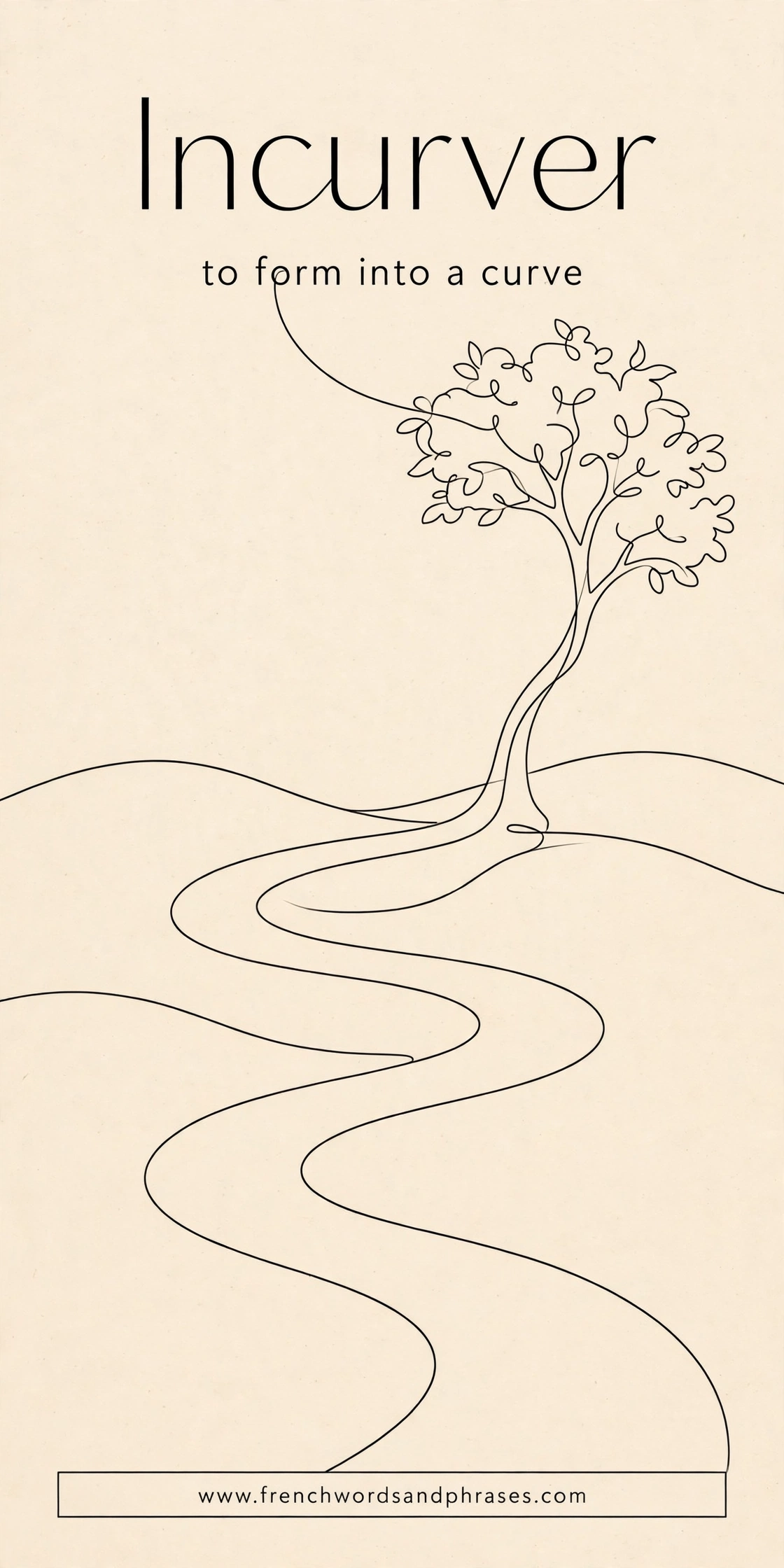
Incurver means to form into a curve, to bend — to give a straight thing a gentle bow, or to watch it bow slowly under weight, heat or years.
A shelf sagging under books, a beam bowing under a roof, an old man’s back rounding with age — incurver is the verb of the slow curve: nothing breaks, everything bends.
In this guide, you’ll learn how to conjugate incurver in all the major French tenses and moods. Explore complete conjugation tables, French examples, English translations, and practice quizzes.
Understanding the French Verb Incurver
Incurver is a regular French verb belonging to the first group of verbs, those ending in-er.
It means to form into a curve, to bend. It is used of wood, metal, shelves, beams and backs — anything long that yields gradually into an arc under a load or with time. It is gentler than plier and slower than courber: incurver suggests the curve that comes by degrees and stays.
Verb classification: First group (-er)
Auxiliary verb: Avoir
Past participle: incurvé
Present participle: incurvant
English equivalents: To curve, to bend into a curve; incurver une étagère — to make a shelf sag; incurver une tige — to bend a stem into a curve; s’incurver — to curve, to bow, to sag; un dos qui s’incurve — a back that is rounding.
One important detail: incurver lives two lives. Transitive, it bends something: le poids incurve l’étagère. Reflexive, s’incurver, the thing bends itself, slowly and by itself: la poutre s’incurve, son dos s’est incurvé avec les années — and the reflexive takes être, with the participle agreeing: elle s’est incurvée. The verb itself is perfectly regular: j’incurve, nous incurvons, past participle incurvé.
Experience the Word
Incurver is the verb of patience applied to matter — the curve that no single day produces and every day increases.
Imagine a library shelf fitted twenty years ago, dead straight, now holding three rows of atlases. Look along its edge today: il s’est incurvé, a shallow smile of wood, two centimetres lower in the middle than at the ends — twenty years of quiet weight, written as a curve.
Nothing has snapped. The shelf has simply curved — incurvée, slowly, under the honourable weight of books.
How to Conjugate Incurver: Complete French Conjugation Guide
Let’s explore every major conjugation of incurver, beginning with the indicative mood.
How to Conjugate Incurver in the Indicative Mood
The indicative mood is used to express facts, observations, actions, and events.
How to Conjugate Incurver in the Present Tense (Présent)
Used for actions happening now, habitual actions, and general truths.
| Subject | Conjugation |
|---|---|
| je | incurve |
| tu | incurves |
| il / elle | incurve |
| nous | incurvons |
| vous | incurvez |
| ils / elles | incurvent |
Example
Le poids des livres incurve l’étagère du haut.
The weight of the books is curving the top shelf.
Quick Quiz 1
Complete the sentence:
Nous ______ la tige pour former un arc.
Reveal the answer
incurvons
Nous incurvons la tige pour former un arc.
We are bending the stem to form an arch.
How to Conjugate Incurver in the Passé Composé
Used for completed actions in the past. Incurver takes the auxiliary verb avoir.
| Subject | Conjugation |
|---|---|
| j’ | ai incurvé |
| tu | as incurvé |
| il / elle | a incurvé |
| nous | avons incurvé |
| vous | avez incurvé |
| ils / elles | ont incurvé |
Example
Le vent a incurvé les branches du vieux pommier.
The wind has bent the branches of the old apple tree into a curve.
How to Conjugate Incurver in the Imparfait (Imperfect Tense)
Used for habitual past actions, descriptions, and ongoing situations in the past.
| Subject | Conjugation |
|---|---|
| je | incurvais |
| tu | incurvais |
| il / elle | incurvait |
| nous | incurvions |
| vous | incurviez |
| ils / elles | incurvaient |
Example
La chaleur incurvait les planches de la terrasse.
The heat was warping the terrace boards into curves.
Quick Quiz 2
Choose the correct form:
His back has rounded with the years.
Son dos ______ avec les années. (s’est incurvé / a incurvé)
Reveal the answer
s’est incurvé
Son dos s’est incurvé avec les années.
The reflexive s’incurver takes être.
How to Conjugate Incurver in the Plus-que-parfait
Used to describe an action that had already been completed before another past event.
| Subject | Conjugation |
|---|---|
| j’ | avais incurvé |
| tu | avais incurvé |
| il / elle | avait incurvé |
| nous | avions incurvé |
| vous | aviez incurvé |
| ils / elles | avaient incurvé |
Example
Les années avaient incurvé son dos petit à petit.
The years had gradually rounded his back.
How to Conjugate Incurver in the Passé Simple
Primarily used in formal writing, literature, and historical narratives. It is rarely used in everyday conversation.
| Subject | Conjugation |
|---|---|
| je | incurvai |
| tu | incurvas |
| il / elle | incurva |
| nous | incurvâmes |
| vous | incurvâtes |
| ils / elles | incurvèrent |
Example
La tempête incurva les mâts des bateaux dans le port.
The storm bent the masts of the boats in the harbour into curves.
How to Conjugate Incurver in the Passé Antérieur
A literary tense used to express an action completed immediately before another past action, generally in the passé simple.
| Subject | Conjugation |
|---|---|
| j’ | eus incurvé |
| tu | eus incurvé |
| il / elle | eut incurvé |
| nous | eûmes incurvé |
| vous | eûtes incurvé |
| ils / elles | eurent incurvé |
Example
Quand le soleil eut incurvé les planches, on dut les remplacer.
When the sun had warped the boards, they had to be replaced.
How to Conjugate Incurver in the Future Tense (Futur Simple)
Used to describe actions that will take place in the future.
| Subject | Conjugation |
|---|---|
| je | incurverai |
| tu | incurveras |
| il / elle | incurvera |
| nous | incurverons |
| vous | incurverez |
| ils / elles | incurveront |
Example
Cette poutre incurvera sous le poids du toit.
This beam will bow under the weight of the roof.
How to Conjugate Incurver in the Futur Antérieur (Future Perfect)
Used for an action that will have been completed before a particular point in the future.
| Subject | Conjugation |
|---|---|
| j’ | aurai incurvé |
| tu | auras incurvé |
| il / elle | aura incurvé |
| nous | aurons incurvé |
| vous | aurez incurvé |
| ils / elles | auront incurvé |
Example
À la fin de l’été, la chaleur aura incurvé toutes les planches.
By the end of the summer, the heat will have warped all the boards.
How to Conjugate Incurver in the Near Future (Futur Proche)
Used to describe something that is going to happen soon. Formed with aller + infinitive.
| Subject | Conjugation |
|---|---|
| je | vais incurver |
| tu | vas incurver |
| il / elle | va incurver |
| nous | allons incurver |
| vous | allez incurver |
| ils / elles | vont incurver |
Example
Attention, cette étagère va incurver si tu la charges trop.
Careful, this shelf is going to sag if you load it too much.
How to Conjugate Incurver in the Conditional Mood
The conditional mood expresses what would happen under certain circumstances. It is also frequently used to make polite requests or express wishes.
How to Conjugate Incurver in the Present Conditional
| Subject | Conjugation |
|---|---|
| je | incurverais |
| tu | incurverais |
| il / elle | incurverait |
| nous | incurverions |
| vous | incurveriez |
| ils / elles | incurveraient |
Example
Un bois plus sec incurverait moins au soleil.
A drier wood would curve less in the sun.
How to Conjugate Incurver in the Past Conditional
| Subject | Conjugation |
|---|---|
| j’ | aurais incurvé |
| tu | aurais incurvé |
| il / elle | aurait incurvé |
| nous | aurions incurvé |
| vous | auriez incurvé |
| ils / elles | auraient incurvé |
Example
La poutre aurait incurvé sans le renfort central.
The beam would have bowed without the central support.
Incurver in the Literary Past Conditional Form
This less common literary form uses the imperfect subjunctive of avoir.
| Subject | Conjugation |
|---|---|
| j’ | eusse incurvé |
| tu | eusses incurvé |
| il / elle | eût incurvé |
| nous | eussions incurvé |
| vous | eussiez incurvé |
| ils / elles | eussent incurvé |
Example
La branche eût incurvé sous le poids des fruits.
The branch would have bent under the weight of the fruit.
How to Conjugate Incurver in the Subjunctive Mood
The subjunctive is used to express wishes, emotions, doubts, necessity, and uncertainty. It frequently follows expressions such as il faut que (it is necessary that) or bien que (although).
How to Conjugate Incurver in the Present Subjunctive
| Subject | Conjugation |
|---|---|
| que je | incurve |
| que tu | incurves |
| qu’il / qu’elle | incurve |
| que nous | incurvions |
| que vous | incurviez |
| qu’ils / qu’elles | incurvent |
Example
Il faut que le menuisier incurve légèrement cette pièce.
The joiner must curve this piece slightly.
Quick Quiz 3
Complete the sentence using the subjunctive:
Il faut que le menuisier ______ légèrement cette pièce.
Reveal the answer
incurve
Il faut que le menuisier incurve légèrement cette pièce.
The joiner must curve this piece slightly.
How to Conjugate Incurver in the Imperfect Subjunctive
A literary tense, rarely encountered in modern spoken French.
| Subject | Conjugation |
|---|---|
| que je | incurvasse |
| que tu | incurvasses |
| qu’il / qu’elle | incurvât |
| que nous | incurvassions |
| que vous | incurvassiez |
| qu’ils / qu’elles | incurvassent |
Example
On craignait que la poutre incurvât davantage.
People feared the beam might bow further.
How to Conjugate Incurver in the Pluperfect Subjunctive
A literary construction used to express an action completed before another past action.
| Subject | Conjugation |
|---|---|
| que j’ | eusse incurvé |
| que tu | eusses incurvé |
| qu’il / qu’elle | eût incurvé |
| que nous | eussions incurvé |
| que vous | eussiez incurvé |
| qu’ils / qu’elles | eussent incurvé |
Example
On racontait que le vent eût incurvé le vieux panneau.
People said the wind had bent the old sign into a curve.
How to Conjugate Incurver in the Past Subjunctive
| Subject | Conjugation |
|---|---|
| que j’ | aie incurvé |
| que tu | aies incurvé |
| qu’il / qu’elle | ait incurvé |
| que nous | ayons incurvé |
| que vous | ayez incurvé |
| qu’ils / qu’elles | aient incurvé |
Example
Je suis surpris que l’étagère ait tant incurvé.
I am surprised the shelf has sagged so much.
How to Conjugate Incurver in the Imperative
The imperative is used to give commands, instructions, invitations, or suggestions. Subject pronouns are omitted.
How to Conjugate Incurver in the Present Imperative
| Person | Conjugation |
|---|---|
| (tu) | incurve |
| (nous) | incurvons |
| (vous) | incurvez |
Example
Incurve doucement la tige pour former un arc !
Gently bend the stem to form an arch!
Quick Quiz 4
How would you say Gently bend the stem (tu form)?
Reveal the answer
Incurve doucement la tige !
French Participles of Incurver
Participles are verb forms that can be used in compound tenses and other grammatical constructions.
Present Participle of Incurver
incurvant
En incurvant la branche, il a formé une belle arche.
By bending the branch, he formed a beautiful arch.
Past Participle of Incurver
incurvé
Incurvée par le poids des ans, la poutre menace de céder.
Bowed by the weight of the years, the beam threatens to give way.
Incurver in Everyday French: Real-Life Examples
Now that you know the conjugations, let’s see how incurver appears in everyday French.
Example 1 — Present
Le poids des livres incurve l’étagère.
The weight of the books is curving the shelf.
Example 2 — Passé composé
Son dos s’est incurvé avec les années.
His back has rounded with the years.
Example 3 — Imparfait
La chaleur incurvait les planches.
The heat was warping the boards.
Example 4 — Future
Cette poutre incurvera sous le toit.
This beam will bow under the roof.
Example 5 — Conditional
Un bois sec incurverait moins.
Dry wood would curve less.
Example 6 — Imperative
Incurve doucement la tige !
Gently bend the stem!
Beyond Translation: The Meaning of Incurver
English curve is the plain twin, and French incurver is built straight from it — curvus, bent, with the prefix of gradual inward change.
It is the verb of the arc that arrives uninvited.
Shelves, beams and backs do not decide to curve; the curve is the autobiography of everything they have carried — which is why s’incurver, said of an old person’s back, sounds tender rather than technical.
How to Remember the French Verb Incurver
Remember it this way: Incurver is about the shelf’s slow smile — twenty years of weight as a curve.
- Two lives: incurver quelque chose (to bend it) and s’incurver (to sag, to round by itself).
- The reflexive takes être: son dos s’est incurvé avec les années.
- Regular -er: j’incurve, nous incurvons, past participle incurvé.
The key idea is the shelf’s slow smile — twenty years of weight as a curve.
Test Your Knowledge of Incurver
Let’s see how much you’ve learned. Try answering these questions before revealing the answers.
Question 1
How do you say His back has rounded with the years, using the reflexive?
Reveal the answer
Son dos s’est incurvé avec les années.
Question 2
Translate: The weight of the books is curving the shelf.
Reveal the answer
Le poids des livres incurve l’étagère.
Question 3
Which auxiliary does s’incurver use?
Reveal the answer
Être — it is reflexive in that use: elle s’est incurvée sous le poids.
Question 4
What is the past participle of incurver?
Reveal the answer
Incurvé.
Question 5
Complete the sentence:
On craignait que la poutre ______ davantage.
Reveal the answer
incurvât
On craignait que la poutre incurvât davantage.
People feared the beam might bow further.
Your Final Challenge
Can You Use It?
How would you say this in French?
Under the weight of the books, the old shelf curves like a tired smile.
Reveal the answer
Sous le poids des livres, la vieille étagère s’incurve comme un sourire fatigué.
Under the weight of the books, the old shelf curves like a tired smile.
A little French. A little curiosity. A richer everyday life.
LEARN FRENCH ONE WORD AT A TIME




