
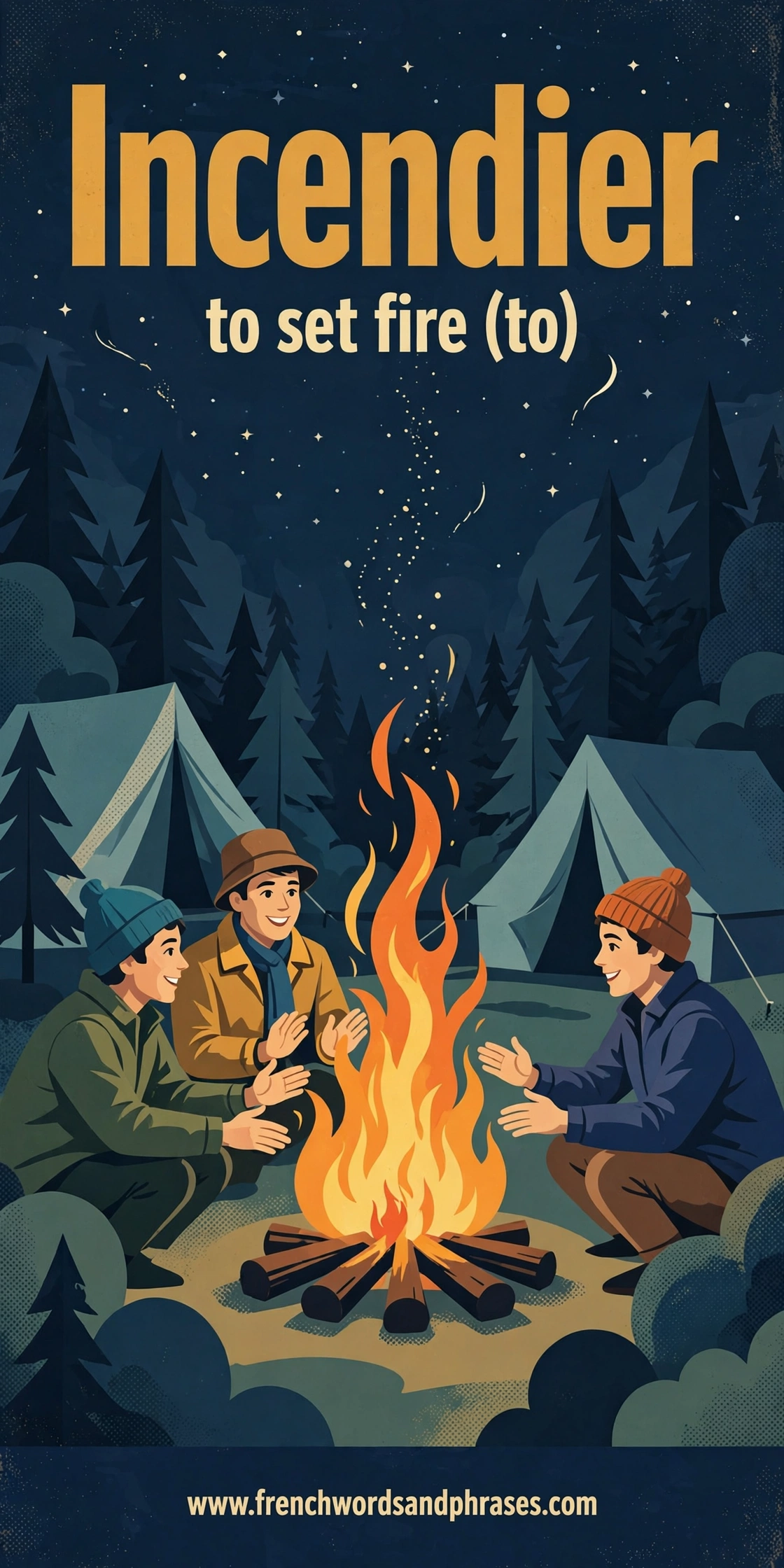
A French Word to Live By
How to Conjugate Incendier in French
/ɛ̃.sɑ̃.dje/
Incendier means to set fire (to) — to deliberately burn something: a building, a car, a forest, until the flames do the rest.
Firefighters reading the blackened map of a forest in August, investigators photographing a burnt-out car at dawn — incendier is the verb of the deliberate fire: the blaze that somebody chose to start.
In this guide, you’ll learn how to conjugate incendier in all the major French tenses and moods. Explore complete conjugation tables, French examples, English translations, and practice quizzes.
Understanding the French Verb Incendier
Incendier is a regular French verb belonging to the first group of verbs, those ending in-er.
It means to set fire (to). Incendier is the verb of arson in news and law: des inconnus ont incendié des voitures, un pyromane incendie les granges de la région. Where English says the fire broke out, French uses se déclarer or prendre — incendier always implies a hand behind the flame. The familiar figurative use — se faire incendier par son père — is heard constantly and burns nothing but ears.
Verb classification: First group (-er)
Auxiliary verb: Avoir
Past participle: incendié
Present participle: incendiant
English equivalents: To set fire to, to torch, to burn down; incendier une voiture — to torch a car; incendier un bâtiment — to set fire to a building; un entrepôt incendié — a burnt-out warehouse; incendier quelqu’un (familiar) — to tear into someone verbally.
One important detail: incendier is an -ier verb, and -ier verbs double the i wherever two i’s meet: imperfect nous incendiions, vous incendiiez, subjunctive que nous incendiions — never simplify them to a single i. Present: j’incendie, nous incendions, ils incendient; past participle incendié. Its noun is un incendie, a fire (the event, accidental or not), and in familiar French the verb takes a second, bloodless life: incendier quelqu’un is to give someone a furious dressing-down — le chef l’a incendié, the boss tore into him.
Experience the Word
Incendier is the verb of the chosen flame — behind every incendie it names, there is a match and a decision.
Imagine a pine forest on a windless August night. A single point of orange appears between the trees, hesitates, then takes hold of a bush, a branch, a whole hillside. By dawn the firefighters will say what the investigators already suspect: quelqu’un a incendié la forêt — nobody’s cigarette explains a fire started in four places at once.
Accidents happen, but this fire was a sentence someone wrote in flame. It was set — incendié — and the verb itself is the accusation.
How to Conjugate Incendier: Complete French Conjugation Guide
Let’s explore every major conjugation of incendier, beginning with the indicative mood.
How to Conjugate Incendier in the Indicative Mood
The indicative mood is used to express facts, observations, actions, and events.
How to Conjugate Incendier in the Present Tense (Présent)
Used for actions happening now, habitual actions, and general truths.
| Subject | Conjugation |
|---|---|
| je | incendie |
| tu | incendies |
| il / elle | incendie |
| nous | incendions |
| vous | incendiez |
| ils / elles | incendient |
Example
Un pyromane incendie les granges de la région.
An arsonist is setting fire to the barns of the region.
Quick Quiz 1
Complete the sentence:
Nous ______ les vieux papiers dans la cour.
Reveal the answer
incendions
Nous incendions les vieux papiers dans la cour.
We are burning the old papers in the yard.
How to Conjugate Incendier in the Passé Composé
Used for completed actions in the past. Incendier takes the auxiliary verb avoir.
| Subject | Conjugation |
|---|---|
| j’ | ai incendié |
| tu | as incendié |
| il / elle | a incendié |
| nous | avons incendié |
| vous | avez incendié |
| ils / elles | ont incendié |
Example
Des inconnus ont incendié trois voitures cette nuit.
Unknown persons torched three cars last night.
How to Conjugate Incendier in the Imparfait (Imperfect Tense)
Used for habitual past actions, descriptions, and ongoing situations in the past.
| Subject | Conjugation |
|---|---|
| je | incendiais |
| tu | incendiais |
| il / elle | incendiait |
| nous | incendiions |
| vous | incendiiez |
| ils / elles | incendiaient |
Example
Autrefois, les armées incendiaient les villages ennemis.
In the old days, armies would burn enemy villages.
Quick Quiz 2
Choose the correct form:
Unknown persons torched three cars.
Des inconnus ______ trois voitures. (ont incendié / sont incendiés)
Reveal the answer
ont incendié
Des inconnus ont incendié trois voitures.
Incendier takes avoir.
How to Conjugate Incendier in the Plus-que-parfait
Used to describe an action that had already been completed before another past event.
| Subject | Conjugation |
|---|---|
| j’ | avais incendié |
| tu | avais incendié |
| il / elle | avait incendié |
| nous | avions incendié |
| vous | aviez incendié |
| ils / elles | avaient incendié |
Example
Il avait incendié l’entrepôt avant de disparaître.
He had set fire to the warehouse before disappearing.
How to Conjugate Incendier in the Passé Simple
Primarily used in formal writing, literature, and historical narratives. It is rarely used in everyday conversation.
| Subject | Conjugation |
|---|---|
| je | incendiai |
| tu | incendias |
| il / elle | incendia |
| nous | incendiâmes |
| vous | incendiâtes |
| ils / elles | incendièrent |
Example
Les soldats incendièrent la ferme avant de partir.
The soldiers set fire to the farm before leaving.
How to Conjugate Incendier in the Passé Antérieur
A literary tense used to express an action completed immediately before another past action, generally in the passé simple.
| Subject | Conjugation |
|---|---|
| j’ | eus incendié |
| tu | eus incendié |
| il / elle | eut incendié |
| nous | eûmes incendié |
| vous | eûtes incendié |
| ils / elles | eurent incendié |
Example
Quand le gardien eut incendié les vieux papiers, il ferma la cour.
When the caretaker had burnt the old papers, he closed the yard.
How to Conjugate Incendier in the Future Tense (Futur Simple)
Used to describe actions that will take place in the future.
| Subject | Conjugation |
|---|---|
| je | incendierai |
| tu | incendieras |
| il / elle | incendiera |
| nous | incendierons |
| vous | incendierez |
| ils / elles | incendieront |
Example
Si le vent se lève, personne n’incendiera les broussailles aujourd’hui.
If the wind rises, nobody will burn the brushwood today.
How to Conjugate Incendier in the Futur Antérieur (Future Perfect)
Used for an action that will have been completed before a particular point in the future.
| Subject | Conjugation |
|---|---|
| j’ | aurai incendié |
| tu | auras incendié |
| il / elle | aura incendié |
| nous | aurons incendié |
| vous | aurez incendié |
| ils / elles | auront incendié |
Example
À l’aube, les flammes auront incendié toute la colline.
By dawn, the flames will have set the whole hillside ablaze.
How to Conjugate Incendier in the Near Future (Futur Proche)
Used to describe something that is going to happen soon. Formed with aller + infinitive.
| Subject | Conjugation |
|---|---|
| je | vais incendier |
| tu | vas incendier |
| il / elle | va incendier |
| nous | allons incendier |
| vous | allez incendier |
| ils / elles | vont incendier |
Example
Attention, ce fou va incendier la poubelle !
Watch out, that madman is going to set fire to the bin!
How to Conjugate Incendier in the Conditional Mood
The conditional mood expresses what would happen under certain circumstances. It is also frequently used to make polite requests or express wishes.
How to Conjugate Incendier in the Present Conditional
| Subject | Conjugation |
|---|---|
| je | incendierais |
| tu | incendierais |
| il / elle | incendierait |
| nous | incendierions |
| vous | incendieriez |
| ils / elles | incendieraient |
Example
Seul un criminel incendierait une école.
Only a criminal would set fire to a school.
How to Conjugate Incendier in the Past Conditional
| Subject | Conjugation |
|---|---|
| j’ | aurais incendié |
| tu | aurais incendié |
| il / elle | aurait incendié |
| nous | aurions incendié |
| vous | auriez incendié |
| ils / elles | auraient incendié |
Example
Il aurait incendié la grange si on ne l’avait pas arrêté.
He would have set fire to the barn if he had not been stopped.
Incendier in the Literary Past Conditional Form
This less common literary form uses the imperfect subjunctive of avoir.
| Subject | Conjugation |
|---|---|
| j’ | eusse incendié |
| tu | eusses incendié |
| il / elle | eût incendié |
| nous | eussions incendié |
| vous | eussiez incendié |
| ils / elles | eussent incendié |
Example
L’armée eût incendié le village sans l’ordre contraire.
The army would have burnt the village without the counter-order.
How to Conjugate Incendier in the Subjunctive Mood
The subjunctive is used to express wishes, emotions, doubts, necessity, and uncertainty. It frequently follows expressions such as il faut que (it is necessary that) or bien que (although).
How to Conjugate Incendier in the Present Subjunctive
| Subject | Conjugation |
|---|---|
| que je | incendie |
| que tu | incendies |
| qu’il / qu’elle | incendie |
| que nous | incendiions |
| que vous | incendiiez |
| qu’ils / qu’elles | incendient |
Example
Je crains que le pyromane incendie une autre grange.
I fear the arsonist may set fire to another barn.
Quick Quiz 3
Complete the sentence using the subjunctive:
Il faut que vous ______ les broussailles avant l’été.
Reveal the answer
incendiiez
Il faut que vous incendiiez les broussailles avant l’été.
You must burn the brushwood before the summer.
How to Conjugate Incendier in the Imperfect Subjunctive
A literary tense, rarely encountered in modern spoken French.
| Subject | Conjugation |
|---|---|
| que je | incendiasse |
| que tu | incendiasses |
| qu’il / qu’elle | incendiât |
| que nous | incendiassions |
| que vous | incendiassiez |
| qu’ils / qu’elles | incendiassent |
Example
Il fallait empêcher qu’il incendiât le dépôt.
It was necessary to stop him setting fire to the depot.
How to Conjugate Incendier in the Pluperfect Subjunctive
A literary construction used to express an action completed before another past action.
| Subject | Conjugation |
|---|---|
| que j’ | eusse incendié |
| que tu | eusses incendié |
| qu’il / qu’elle | eût incendié |
| que nous | eussions incendié |
| que vous | eussiez incendié |
| qu’ils / qu’elles | eussent incendié |
Example
On racontait que les soldats eussent incendié la ferme eux-mêmes.
People said the soldiers had set fire to the farm themselves.
How to Conjugate Incendier in the Past Subjunctive
| Subject | Conjugation |
|---|---|
| que j’ | aie incendié |
| que tu | aies incendié |
| qu’il / qu’elle | ait incendié |
| que nous | ayons incendié |
| que vous | ayez incendié |
| qu’ils / qu’elles | aient incendié |
Example
Je suis soulagé que personne n’ait incendié la forêt cet été.
I am relieved nobody set fire to the forest this summer.
How to Conjugate Incendier in the Imperative
The imperative is used to give commands, instructions, invitations, or suggestions. Subject pronouns are omitted.
How to Conjugate Incendier in the Present Imperative
| Person | Conjugation |
|---|---|
| (tu) | incendie |
| (nous) | incendions |
| (vous) | incendiez |
Example
N’incendie jamais les broussailles par grand vent !
Never burn brushwood in a strong wind!
Quick Quiz 4
How would you say Never burn brushwood in a strong wind (tu form)?
Reveal the answer
N’incendie jamais les broussailles par grand vent !
French Participles of Incendier
Participles are verb forms that can be used in compound tenses and other grammatical constructions.
Present Participle of Incendier
incendiant
En incendiant l’entrepôt, il a détruit toutes les preuves.
By setting fire to the warehouse, he destroyed all the evidence.
Past Participle of Incendier
incendié
Incendiée pendant la nuit, la grange n’est plus qu’une carcasse noire.
Burnt during the night, the barn is nothing but a black shell.
Incendier in Everyday French: Real-Life Examples
Now that you know the conjugations, let’s see how incendier appears in everyday French.
Example 1 — Present
Un pyromane incendie les granges.
An arsonist is setting fire to the barns.
Example 2 — Passé composé
Des inconnus ont incendié trois voitures.
Unknown persons torched three cars.
Example 3 — Imparfait
Les armées incendiaient les villages ennemis.
Armies would burn enemy villages.
Example 4 — Future
Personne n’incendiera les broussailles par ce vent.
Nobody will burn brushwood in this wind.
Example 5 — Conditional
Seul un criminel incendierait une école.
Only a criminal would set fire to a school.
Example 6 — Imperative
N’incendie jamais les broussailles par grand vent !
Never burn brushwood in a strong wind!
Beyond Translation: The Meaning of Incendier
English incendiary is the adjective hiding in plain sight — an incendiary bomb, an incendiary speech — and French incendier is the verb of the same fire.
It always accuses: a fire that was a decision.
That is why its slang twin works so well: se faire incendier by an angry father or a furious boss is to be verbally torched — no flames, the same heat, and everybody in the room can smell the smoke.
How to Remember the French Verb Incendier
Remember it this way: Incendier is about four fires at once in the pines — a flame that was a decision.
- -Ier verb: double i where two i’s meet — nous incendiions, que nous incendiions; never simplify.
- Incendier always implies a deliberate hand: the fire as accident is un incendie that se déclare.
- Familiar bonus: incendier quelqu’un = to tear into someone verbally; past participle incendié.
The key idea is four fires at once in the pines — a flame that was a decision.
Test Your Knowledge of Incendier
Let’s see how much you’ve learned. Try answering these questions before revealing the answers.
Question 1
How do you say Unknown persons torched three cars in French?
Reveal the answer
Des inconnus ont incendié trois voitures.
Question 2
Why does nous incendiions have two i’s?
Reveal the answer
Because incendier is an -ier verb — the stem’s i meets the ending’s i in the nous/vous imperfect and subjunctive forms, and both are written.
Question 3
Translate: An arsonist is setting fire to the barns of the region.
Reveal the answer
Un pyromane incendie les granges de la région.
Question 4
What is the past participle of incendier?
Reveal the answer
Incendié.
Question 5
Complete the sentence:
Je crains que le pyromane ______ une autre grange.
Reveal the answer
incendie
Je crains que le pyromane incendie une autre grange.
I fear the arsonist may set fire to another barn.
Your Final Challenge
Can You Use It?
How would you say this in French?
The arsonist sets fire to the barn at midnight, but the rain knows neither plan nor malice.
Reveal the answer
Le pyromane incendie la grange à minuit, mais la pluie, elle, ne connaît ni plan ni méchanceté.
The arsonist sets fire to the barn at midnight, but the rain knows neither plan nor malice.
A little French. A little curiosity. A richer everyday life.
LEARN FRENCH ONE WORD AT A TIME




